XRP Ledger Activates Token Escrow: Here’s What XLS-85 Unlocks

bitcoinistPublicado em 2026-02-13Última atualização em 2026-02-13

Resumo

The XRP Ledger has activated the Token Escrow (XLS-85) amendment on its mainnet, extending its native escrow functionality beyond XRP to include Trustline-based tokens (IOUs) and Multi-Purpose Tokens (MPTs). This enables secure, conditional, on-chain settlements for assets like stablecoins and real-world assets. The feature requires specific issuer flags for tokens to be escrowed and includes authorization rules for secure transactions. It supports time-based, conditional, and combination escrows, though it involves transaction fees and requires an expiration time for token escrows. Use cases include vesting, conditional payments, treasury workflows, and tokenized rights, providing a native "lock until X" mechanism without relying on third-party custodians.

The XRP Ledger has activated Token Escrow (XLS-85) on mainnet on Feb.12, extending the network’s native escrow mechanics beyond XRP to Trustline-based tokens (IOUs) and Multi-Purpose Tokens (MPTs). The amendment was enabled today with 88% consensus (30/34 validators) and was introduced in rippled v2.5.0 under the XLS-85 specification.

Escrow, But For Every Asset On XRP Ledger

RippleX framed the change as a broadening of XRPL’s settlement primitives from one native asset to the wider token stack via X:

“Token Escrow (XLS-85) is now live on XRPL Mainnet! This feature extends native escrow functionality beyond XRP to all Trustline-based tokens (IOUs) and Multi-Purpose Tokens (MPTs). From stablecoins like RLUSD to Real World Assets, the XRPL now supports secure, conditional, onchain settlement for all assets.” It added: “The toolbox for Institutional DeFi just got bigger.”

XRPL.org describes escrow in familiar terms, then emphasizes what the ledger automates: “Traditionally, an escrow is a contract between two parties to facilitate financial transactions... The XRP Ledger takes escrow a step further, replacing the third party with an automated system built into the ledger.” With the TokenEscrow amendment, that same approach now applies to fungible tokens, not just XRP.

For Trust Line Tokens, the issuing account must enable the Allow Trust Line Locking flag so the issued token can be escrowed. For MPTs, the issuer must set Can Escrow and Can Transfer flags at issuance so those tokens can both be held in escrow and transferred when released. One notable constraint: issuers cannot create escrows using their own issued tokens, though they can receive escrowed tokens as recipients.

Authorization gating also matters. If a token requires authorization, the sender must be pre-authorized by the issuer before creating an escrow, and must be authorized to receive the tokens back if an expired escrow is canceled—regardless of who submits the cancellation. Separately, the recipient must be pre-authorized before an escrow can be finished.

XRPL supports time-based, conditional, and combination escrows. The flow is anchored around EscrowCreate to lock funds, EscrowFinish to release them when conditions are met, and EscrowCancel to return funds once an escrow expires. For token escrows specifically, an expiration time is mandatory.

The feature is not free. XRPL.org flags that escrow “requires two transactions” and that Crypto-Conditions increase fees. While the ledger supports Crypto-Conditions, it currently only supports PREIMAGE-SHA-256, and fulfillment verification raises EscrowFinish costs. The documentation gives a concrete minimum: an EscrowFinish with a fulfillment requires at least 330 drops of XRP plus an additional amount based on fulfillment size, with the formula scaling if fee settings change.

RippleX highlighted use cases spanning vesting and grants, conditional payments and OTC-style swaps, treasury workflows like legal holds and collateral, and tokenized rights and RWA-style unlocks. The common thread is a native, on-ledger “lock until X” mechanism now available to the token layer, useful for structured settlement, compliance-shaped flows, and predictable release conditions without relying on a third-party custodian or purely off-chain coordination.

At press time, XRP traded at $1.35.
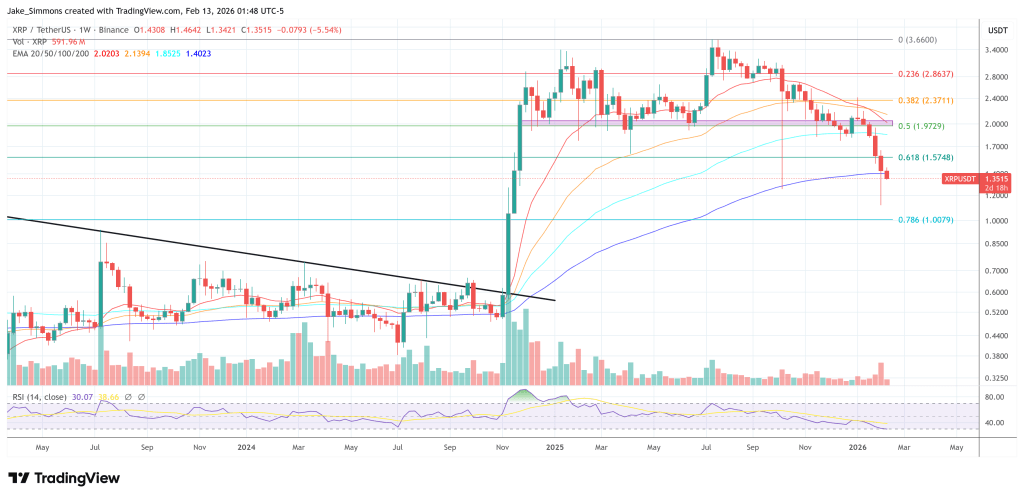
XRP drops below the 200-week EMA, 1-week chart | Source: XRPUSDT on TradingView.com

Perguntas relacionadas

QWhat is the main feature activated on the XRP Ledger mainnet on February 12, as described in the article?

AThe main feature activated is Token Escrow (XLS-85), which extends the network's native escrow functionality beyond XRP to include Trustline-based tokens (IOUs) and Multi-Purpose Tokens (MPTs).

QAccording to the article, what are the two types of tokens that the new Token Escrow feature now supports?

AThe Token Escrow feature now supports Trustline-based tokens (IOUs) and Multi-Purpose Tokens (MPTs).

QWhat specific flags must an issuer set for a Multi-Purpose Token (MPT) to be eligible for escrow?

AFor an MPT to be eligible for escrow, the issuer must set the Can Escrow and Can Transfer flags at the time of issuance.

QWhat are the three primary transaction types involved in the XRPL escrow flow?

AThe three primary transaction types are EscrowCreate (to lock funds), EscrowFinish (to release funds when conditions are met), and EscrowCancel (to return funds once an escrow expires).

QBesides time-based escrows, what other types of escrow does the XRPL support, as mentioned in the article?

ABesides time-based escrows, the XRPL also supports conditional escrows and combination escrows.

Leituras Relacionadas

The Compounding Crisis in an Era of High Valuations: Is the US Stock Market Facing a New 'Lost Decade'?

This article analyzes the long-term structural risks in US equity markets, challenging the assumption that "time in the market" always ensures positive returns. Drawing on 155 years of historical data, it identifies three prolonged periods—1929-1954, 1966-1982, and 2000-2013—where real buy-and-hold returns were near zero or negative. Collectively, these "lost decades" represent roughly 35% of market history since 1871 and cause not just delayed wealth accumulation but permanent damage to compound growth paths due to the mathematics of recovering from significant drawdowns. Crucially, the authors argue that current conditions mirror historical precursors to such phases. Multiple valuation indicators, including the CAPE ratio (near its 99th percentile), the Buffett Indicator, and Tobin's Q, signal extreme overvaluation, historically associated with lower future 10-year real returns (averaging 3.6%). The paper debunks the common objection to tactical management—fear of missing the "best days" in the market—by showing that the vast majority of these top-performing days occur during bear markets and crises, often adjacent to the worst days. Therefore, avoiding major drawdowns inherently means missing these volatile surges. A key framework proposed involves monitoring market breadth (advance/decline data), which tends to deteriorate before major indices peak, providing an early warning signal. Combined with high valuations, breadth analysis offers a more robust risk-assessment tool. The conclusion for investors and advisors is not a forecast of an inevitable downturn, but a call to move from complacency to preparedness. The empirical evidence suggests that the conditions preceding lost decades are identifiable. A disciplined, adaptive strategy focused on valuation and breadth signals, rather than precise timing, can help protect long-term compounding from permanent impairment.

marsbitHá 3m

The Compounding Crisis in an Era of High Valuations: Is the US Stock Market Facing a New 'Lost Decade'?

marsbitHá 3m

Farewell to Traditional Bull and Bear Markets, Deciphering the Logic of Today's Bubble Rotation

"Farewell to Traditional Bulls and Bears: Understanding Today's Market Logic of Bubble Rotation" The article draws a parallel between modern financial markets and a meteorological chain of thunderstorms, contrasting it with the past's slower-moving, more predictable 'layered cloud' systems of long bull/bear cycles and gradual sector rotations. The author argues that today's market has undergone a permanent structural shift, creating an environment where discrete, intense thematic bubbles (e.g., AI, GLP-1 drugs, crypto, robotics, quantum tech) sequentially form, swell, and burst. These 'storm cells' are triggered when capital fleeing a dying bubble acts like a meteorological 'cold air wedge,' forcing the warm, moist capital of latent interest in a new sector to rapidly rise and condense into the next speculative frenzy. This new 'convective' market regime is driven by eight fundamental changes: 1. Democratization of speculation via zero-commission trading, gamified apps, and heavy retail participation in instruments like 0DTE options. 2. Permanent, price-insensitive buying pressure from defined-contribution retirement plans (e.g., 401(k)s). 3. Passive investing creating inelastic market participants that amplify momentum, especially into mega-cap stocks. 4. The dominance of multi-strategy funds and high-frequency trading (HFT), weakening price discovery and creating fragile microstructure prone to synchronized sell-offs. 5. Artificially suppressed volatility that eventually erupts in violent spikes. 6. A transformed market index heavily weighted toward long-duration, narrative-driven tech companies instead of stable, cyclical industrials. 7. The total elimination of information delay, accelerating fear-of-missing-out (FOMO) and herd behavior. 8. A persistently loose fiscal and monetary policy environment. These structural shifts are deemed irreversible. The article outlines the common lifecycle of these thematic bubbles: latency, catalyzing event, narrative formation, peak divergence, and rupture—with outflowing capital seeding the next bubble. In this environment, two investor archetypes can thrive: deep domain experts who understand underlying technologies and business models, and disciplined trend-followers. The author concludes that while emotionally challenging, recognizing this new "climate" is crucial. The key is to elevate one's perspective above the immediate storm to see the cyclical chain of bubbles, avoiding being swept away by the emotions of any single thematic frenzy.

Foresight NewsHá 22m

Farewell to Traditional Bull and Bear Markets, Deciphering the Logic of Today's Bubble Rotation

Foresight NewsHá 22m

Michael Saylor's Latest Article: Bitcoin Must Find Balance Between Uniqueness and Universal Value

Michael Saylor outlines four key Bitcoin ideologies shaping its future: * **Bitcoin Maximalists** see Bitcoin as the dominant digital monetary network and a breakthrough in economic empowerment, emphasizing its superior property rights and role as a sound money solution. * **Bitcoin Capitalists** focus on integration, believing Bitcoin must embed into the global economy—through institutions, capital markets, and financial products—to reach its full potential as digital capital. * **Bitcoin Technologists** advocate for continuous protocol improvements in scalability, privacy, and security to adapt to evolving needs and threats, while acknowledging the high bar for change. * **Bitcoin Fundamentalists** guard Bitcoin's core principles of self-custody, decentralization, and censorship resistance, warning against dilution from institutions or risky modifications. Saylor argues that a healthy Bitcoin ecosystem requires a balance of these perspectives. Bitcoin's path forward involves disciplined expansion: preserving its immutable core (Fundamentalist insight), recognizing its dominant status (Maximalist view), integrating with the global economy (Capitalist drive), and enabling careful innovation, primarily in higher layers (Technologist role). The challenge is to maintain Bitcoin's unique properties while making it useful for the world, ensuring it remains Bitcoin as it grows.

Foresight NewsHá 54m

Michael Saylor's Latest Article: Bitcoin Must Find Balance Between Uniqueness and Universal Value

Foresight NewsHá 54m

Trading

Spot
Futuros

Artigos em Destaque

O que é XRP 2.0

XRP 2.0: Uma Nova Fronteira no Landscape das Criptomoedas Introdução ao XRP 2.0 No reino em constante evolução das criptomoedas, novos projetos surgem continuamente, lutando por atenção e adoção. Uma dessas iniciativas promissoras é o XRP 2.0, um novo projeto de criptomoeda concebido para aproveitar a tecnologia de blockchain avançada e as metodologias de criptografia robustas. Embora o nome tenha paralelos com o XRP da Ripple, é crucial notar que o XRP 2.0 opera de forma independente, focando em melhorar a segurança das transações, a privacidade e a escalabilidade. À medida que o panorama financeiro digital abraça cada vez mais soluções descentralizadas, o XRP 2.0 visa contribuir de forma significativa para a web3 e a expansão global dos projetos de criptomoedas. O que é o XRP 2.0? No seu núcleo, o XRP 2.0 é um projeto de criptomoeda que visa criar um ecossistema de moeda digital seguro e descentralizado. Sua tecnologia fundamental integra princípios de blockchain sofisticados com técnicas de criptografia de ponta. O objetivo abrangente do XRP 2.0 é estabelecer-se como uma plataforma confiável e eficiente que possibilita a execução rápida de transações, priorizando a proteção de privacidade aprimorada para os seus usuários. O projeto é promovido como uma solução para muitas limitações enfrentadas pelas criptomoedas existentes, propondo um sistema que pode lidar com um volume maior de transações com velocidade e privacidade melhoradas. Esta versatilidade posiciona o XRP 2.0 como um concorrente significativo em um mercado repleto de várias moedas digitais. Quem é o Criador do XRP 2.0? A identidade do criador por trás do XRP 2.0 foi identificada como 'Wilbur.' No entanto, detalhes abrangentes sobre Wilbur ou a sua entidade associada permanecem elusivos. O anonimato de muitos criadores de criptomoedas não é um fenômeno incomum na indústria, muitas vezes concebido para manter um grau de privacidade e segurança. Quem são os Investidores do XRP 2.0? Até agora, informações específicas relacionadas às fundações ou organizações de investimento que apoiam o XRP 2.0 não estão disponíveis publicamente. No setor das criptomoedas, o apoio de investidores reputados pode influenciar significativamente a credibilidade e o sucesso de um projeto, no entanto, a transparência em relação aos apoiantes financeiros do XRP 2.0 não foi estabelecida. Como Funciona o XRP 2.0? O XRP 2.0 destaca-se por empregar uma combinação de tecnologia blockchain e algoritmos de criptografia avançados que asseguram transações seguras e descentralizadas. Sua estrutura inovadora inclui características únicas projetadas para fomentar o envolvimento dos usuários e ampliar as funcionalidades além das transações convencionais de criptomoedas. Entre essas características, o XRP 2.0 incorpora capacidades potenciadas por IA, como funcionalidades de texto-para-imagem e texto-para-fala. Estas adições são projetadas para melhorar a experiência interativa dos usuários, promovendo uma maior aplicabilidade em vários setores. Ao unir avanços tecnológicos com um design centrado no utilizador, o XRP 2.0 pretende captar a atenção de uma diversa gama de indivíduos e empresas que procuram integrar soluções de criptomoedas em suas estruturas operacionais. Cronologia do XRP 2.0 Compreender o XRP 2.0 requer examinar os marcos que definiram sua jornada até agora: 23 de Julho de 2023: O XRP 2.0 é apresentado como um novo projeto de criptomoeda, visando revolucionar as capacidades de transação seguras e descentralizadas no domínio do blockchain. 8 de Setembro de 2023: O lançamento de outro projeto, XRP20, ocorre, marcando o surgimento de um token ERC-20 na blockchain Ethereum que permanece não relacionado ao XRP 2.0. 13 de Novembro de 2023: O XRP Ledger passa por uma atualização significativa com o lançamento da versão 2.0.0 do software do servidor rippled. É importante notar que este desenvolvimento está desconectado do projeto de criptomoeda XRP 2.0. Pontos-chave sobre o XRP 2.0 Para destilar a essência do XRP 2.0, vários fatores críticos emergem: Características Únicas: A inclusão de características como texto-para-imagem e texto-para-fala potenciadas por IA diversifica ainda mais as aplicações potenciais do XRP 2.0. Tecnologia Blockchain: A estrutura utiliza mecanismos de blockchain avançados e protocolos de criptografia, assegurando um ambiente seguro e descentralizado para transações. Escalabilidade e Privacidade: O XRP 2.0 prioriza proteção de privacidade aprimorada nos processos de transação e a escalabilidade necessária para acomodar uma base de utilizadores crescente. Sem Afiliação com a Ripple: Importante, apesar do seu nome, o XRP 2.0 não tem qualquer lealdade ou colaboração com o XRP da Ripple, distinguindo sua estrutura operacional e objetivos dentro do ecossistema das criptomoedas. Conclusão O XRP 2.0 representa uma empreitada ambiciosa no domínio das criptomoedas, visando oferecer uma combinação de segurança, privacidade e eficiência em transações digitais. Ao integrar tecnologias sofisticadas e características amigáveis ao utilizador, o projeto propõe-se a ampliar os horizontes do que as criptomoedas podem alcançar na economia digital atual. Embora o anonimato do seu criador e a falta de investidores divulgados possam levantar questões para alguns, o foco do XRP 2.0 em funcionalidades avançadas e descentralização aumenta seu apelo num mercado de criptomoedas cada vez mais congestionado. À medida que o panorama das criptomoedas continua a evoluir, o XRP 2.0 pode ainda emergir como um jogador crucial na expansão de soluções de blockchain seguras e escaláveis.

99 Visualizações TotaisPublicado em {updateTime}Atualizado em 2024.12.03

O que é XRP 2.0

Como comprar XRP

Bem-vindo à HTX.com!Tornámos a compra de XRP (XRP) simples e conveniente.Segue o nosso guia passo a passo para iniciar a tua jornada no mundo das criptos.Passo 1: cria a tua conta HTXUtiliza o teu e-mail ou número de telefone para te inscreveres numa conta gratuita na HTX.Desfruta de um processo de inscrição sem complicações e desbloqueia todas as funcionalidades.Obter a minha contaPasso 2: vai para Comprar Cripto e escolhe o teu método de pagamentoCartão de crédito/débito: usa o teu visa ou mastercard para comprar XRP (XRP) instantaneamente.Saldo: usa os fundos da tua conta HTX para transacionar sem problemas.Terceiros: adicionamos métodos de pagamento populares, como Google Pay e Apple Pay, para aumentar a conveniência.P2P: transaciona diretamente com outros utilizadores na HTX.Mercado de balcão (OTC): oferecemos serviços personalizados e taxas de câmbio competitivas para os traders.Passo 3: armazena teu XRP (XRP)Depois de comprar o teu XRP (XRP), armazena-o na tua conta HTX.Alternativamente, podes enviá-lo para outro lugar através de transferência blockchain ou usá-lo para transacionar outras criptomoedas.Passo 4: transaciona XRP (XRP)Transaciona facilmente XRP (XRP) no mercado à vista da HTX.Acede simplesmente à tua conta, seleciona o teu par de trading, executa as tuas transações e monitoriza em tempo real.Oferecemos uma experiência de fácil utilização tanto para principiantes como para traders experientes.

1.6k Visualizações TotaisPublicado em {updateTime}Atualizado em 2026.06.02

Como comprar XRP

Discussões

Bem-vindo à Comunidade HTX. Aqui, pode manter-se informado sobre os mais recentes desenvolvimentos da plataforma e obter acesso a análises profissionais de mercado. As opiniões dos utilizadores sobre o preço de XRP (XRP) são apresentadas abaixo.

活动图片