XDC launches real-world USDC spending as stablecoins cross $307B

ambcryptoPublicado em 2026-02-18Última atualização em 2026-02-18

Resumo

Stablecoins, with a total market capitalization exceeding $307 billion, are primarily used for behind-the-scenes financial transactions. However, a new partnership between XDC Network and OrbitX Pay aims to bridge the gap between on-chain assets and real-world commerce. This integration will allow users to spend USD Coin (USDC) held on the XDC network directly at any merchant that accepts Visa, functioning like a regular card payment. The goal is to reduce reliance on costly and time-consuming fiat currency conversions and third-party off-ramps. Ritesh Kakkad, co-founder of XDC Network, sees this as a move towards everyday blockchain utility. Similarly, OrbitX CEO Ankitt Guar stated the initiative aims to reduce friction by keeping users in control of their assets while connecting to global payment networks. This development occurs as stablecoin adoption grows. A BVNK research report found that 56% of stablecoin users plan to acquire more in the next year, and over half increased their holdings in the past year. Notably, about 35% of income for freelancers and sellers is received in stablecoins on average. The move underscores the evolution of digital assets from speculative instruments into practical tools for daily spending, though meaningful adoption of such integrations remains an open question.

Stablecoins move trillions of dollars each year, but most of that activity still happens behind the scenes.

A new partnership between XDC Network and OrbitX Pay will test whether that can change by allowing USD Coin [USDC] held on XDC to be spent at merchants that accept Visa.

The idea is that users will keep funds on-chain until the moment they pay; the transaction itself works like a regular card payment.

This could reduce the need for fiat conversions and third-party off-ramps, which often add cost and delays.

Ritesh Kakkaad, co-founder of XDC Network, argued that this is part of a change to everyday use.

“The real opportunity is when blockchain moves beyond powering finance behind the scenes…”

 OrbitX CEO Ankitt Guar also said in an official statement,

By keeping users in control of their assets while connecting to global payment networks, we aim to reduce the friction between on-chain value and real-world spending.”

Whether such integrations see meaningful adoption remains an open question.

Stablecoin engine on full power

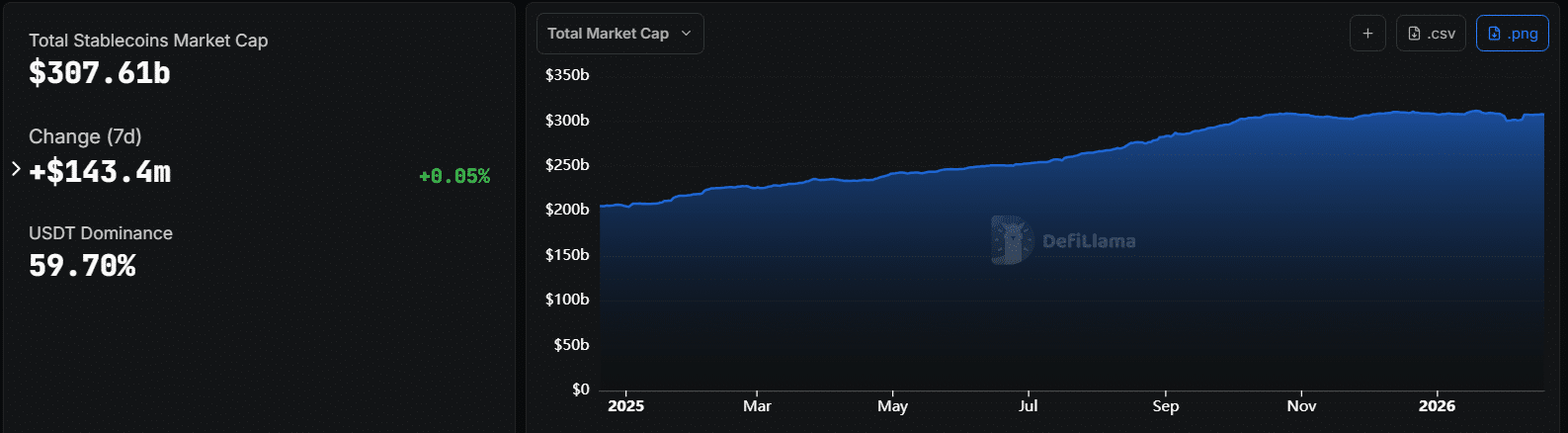
Stablecoin total market capitalization is holding above $307 billion, with steady growth over the past year.

This matters because payment use cases tend to grow faster when there’s already liquidity and user familiarity in place.

Source: DeFiLlama

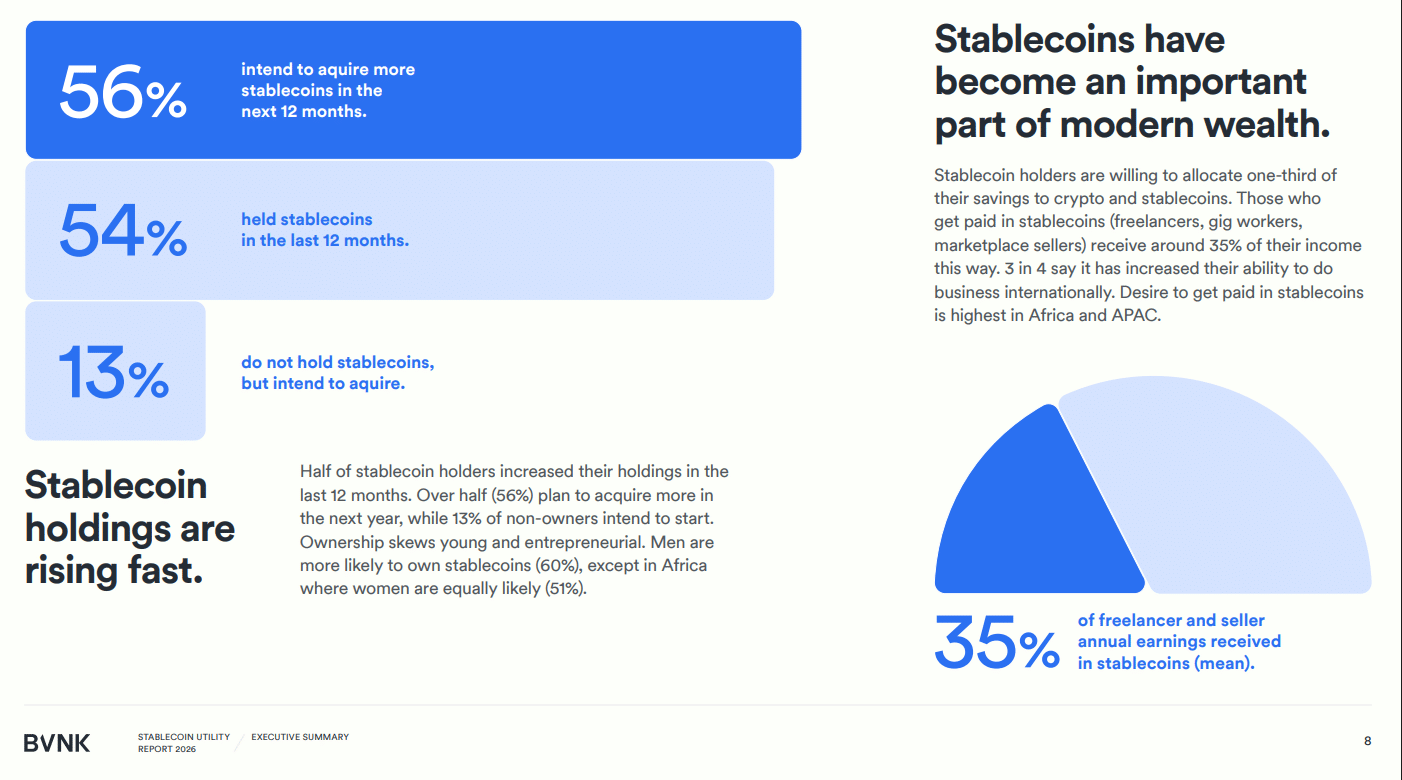
User behavior trends also look strong. A recent BVNK research report found that 56% of stablecoin users plan to acquire more over the next 12 months, while more than half increased their holdings over the past year.

Source: BVNK

Among freelancers and sellers who receive payments in stablecoins, about 35% of their income comes through these assets on average!

By eliminating fiat conversions and enabling direct stablecoin spending, the move underscores how digital assets are evolving from speculative instruments into practical payment tools.


Final Summary

  • Stablecoin adoption is accelerating, and real-world USDC spending only speeds it up.
  • The foundation for everyday crypto payments is already forming.
Next: Jito jumps 11% as new Solana market layer fuels demand: Is $0.50 next?
Share
  • Share
  • Tweet

Criptomoedas em alta

Perguntas relacionadas

QWhat is the new partnership between XDC Network and OrbitX Pay designed to achieve?

AThe partnership is designed to allow users to spend USD Coin (USDC) held on the XDC Network directly at merchants that accept Visa, testing the potential for on-chain assets to be used in everyday transactions.

QAccording to the article, what is a key benefit of spending stablecoins directly instead of converting to fiat?

AA key benefit is the reduction of the need for fiat conversions and third-party off-ramps, which often add cost and delays to transactions.

QWhat does the data from BVNK's research report reveal about stablecoin user behavior?

AThe report found that 56% of stablecoin users plan to acquire more stablecoins over the next 12 months, and more than half increased their holdings over the past year.

QWhat is the current total market capitalization of stablecoins mentioned in the article?

AThe total market capitalization of stablecoins is holding above $307 billion.

QWhat does the move to enable direct stablecoin spending signify about the evolution of digital assets?

AIt underscores how digital assets are evolving from speculative instruments into practical payment tools for real-world use.

Leituras Relacionadas

Gate Research Institute: The 'Wall Street-ization' Wave of Crypto Financial Products – Competition or Integration?

The article titled "Gate Research Institute: Are Crypto Financial Products Sparking a 'Wall Street' Wave—Competition or Convergence?" explores the evolving relationship between the crypto ecosystem and traditional finance (TradFi). The piece begins by reflecting on Bitcoin's original 2009 vision of decentralization, disintermediation, and moving away from banks. It then contrasts this with the 2024 landscape, where key crypto assets like Bitcoin are increasingly held through Wall Street products like ETFs issued by giants like BlackRock. The article questions whether this signifies that TradFi is systematically taking over the rights to issue, price, custody, and distribute crypto financial assets. The core argument is that this is not a zero-sum takeover but rather a bidirectional convergence where each side addresses the other's weaknesses. Crypto offers 24/7 global markets, programmable settlement, and open access but lacks compliant channels, institutional-grade custody, deep fiat liquidity, and mainstream distribution. TradFi possesses these but is constrained by legacy systems, limited operating hours, and slow settlement. Two primary convergence paths are highlighted: * **Path A (CEX to TradFi):** Exemplified by Gate, which has progressed from offering tokenized stocks and CFDs to providing direct, real stock trading (US, Hong Kong, South Korea) within its platform, using USDT. * **Path B (TradFi to Crypto):** Exemplified by Robinhood, which has integrated crypto trading, acquired exchanges like Bitstamp, and is moving traditional assets like stocks onto the blockchain via tokenization and its own Layer 2. Both paths are ultimately competing to become the next-generation, unified financial account—a "super account" where users can seamlessly trade cryptocurrencies, stocks, ETFs, RWA (Real World Assets), and tokenized treasury products in one interface. The growth of RWA and tokenized treasuries (e.g., BlackRock's BUIDL) is presented as the asset-layer fusion, providing stable, yield-bearing assets on-chain and acting as a bridge between the two worlds. In conclusion, the "Wall Street-ization" of crypto is framed as a mutual transformation. Decentralized ideals persist in the protocol layer, while at the application layer, a more efficient, global, and accessible unified capital market is emerging from this convergence. The future competition lies not between crypto exchanges and stockbrokers, but between platforms vying to offer the most comprehensive asset coverage, liquidity, and user experience within a single account.

marsbitHá 4m

Gate Research Institute: The 'Wall Street-ization' Wave of Crypto Financial Products – Competition or Integration?

marsbitHá 4m

Claude's Major New Feature: Screen Recording + Voice, Distilling Your Skills into AI Tasks in One Click

Claude has introduced a major new feature called "Record a Skill," available for Pro, Max, and Team users. This function, found in the Claude desktop app's CoWork menu, allows users to create reusable AI skills simply by recording their screen and providing voice narration while performing a task. Claude then automatically analyzes the recording and generates a functional Skill. A hands-on test confirmed the feature works seamlessly. Users start recording via the Skills manager, perform their workflow while verbally explaining the steps and logic, and avoid including sensitive information. After recording, Claude processes the content and creates the Skill, which can be saved and later invoked with a slash command (/). This eliminates the need for manual adjustments or writing complex instruction files. The innovation goes beyond mere efficiency. Previously, creating a Skill required writing a detailed SKILL.md file in Markdown—a significant barrier for non-technical users. "Record a Skill" bypasses this by directly capturing both actions and the implicit reasoning shared in the narration. This lowers the barrier to knowledge transfer and automation, addressing a core challenge in corporate knowledge management: the difficulty of getting experts to write and maintain documentation. However, the feature also highlights a shift in the nature of work. A case study from March 2026 showed a freelancer whose five-year client relationship was effectively replaced by a hand-coded Claude Skill automating their content workflow. With the even lower barrier of screen recording, the ability to distill personal expertise into automatable skills accelerates this trend. The "moat" for work is moving from simply knowing how to do a task to mastering tasks that are difficult or impossible to automate.

marsbitHá 8m

Claude's Major New Feature: Screen Recording + Voice, Distilling Your Skills into AI Tasks in One Click

marsbitHá 8m

Feeding AI "Noise" Can Also Boost Scores, This Work Enables Positive Transfer with Noise

Feeding "Noise" to AI Can Improve Performance: A Method Enables Positive Transfer from Noise This work, Semi-Supervised Noise Adaptation (SSNA), introduces a Noise Adaptation Framework (NAF) that challenges traditional transfer learning. Instead of requiring a labeled source domain of real data (e.g., images, text), NAF uses randomly generated Gaussian noise as the source. For a target task with C classes, it constructs C noise clusters by sampling from Gaussian distributions. Although this synthetic noise contains no semantic meaning, NAF trains it to form a discriminative class structure in a shared representation space—clustering same-class noise and separating different classes. The key is aligning this learned structure from the noise domain to the real, sparsely labeled target domain. A small number of target labels are still essential to establish the correspondence between noise clusters and actual classes. The training objective combines: 1) supervised loss on the few labeled target samples, 2) classification loss for the noise to build its structure, and 3) a distribution alignment loss (using Negative Domain Similarity) to minimize the gap between the noise and target domains in the shared space. Experiments show significant gains in few-label settings. With just 4 labels per class, NAF with a ResNet-18 backbone improves accuracy over a standard supervised baseline (ERM) by +12.35% on CIFAR-10, +7.61% on CIFAR-100, +4.38% on DTD-47, and +2.74% on Caltech-101. It also benefits fine-grained datasets and scales to ImageNet-1K (with 100 labels/class) and text classification (AG News). NAF can be integrated into existing semi-supervised methods like FixMatch for further gains. Ablation studies confirm the transferred benefit comes from the discriminative structure of the noise, not randomness itself. Collapsing all noise into a single point causes negative transfer, while increasing separation between noise cluster centers improves performance. The amount of noise per class is less critical once a basic structure forms. In conclusion, this work demonstrates that for positive transfer, the semantic content of source data may not be necessary. What can be effectively transferred is the *organizational structure* of categories within a representation space. This offers a promising alternative for scenarios where real source data is unavailable due to privacy, copyright, or procurement constraints.

marsbitHá 10m

Feeding AI "Noise" Can Also Boost Scores, This Work Enables Positive Transfer with Noise

marsbitHá 10m

Trading

Spot

Artigos em Destaque

Como comprar XDC

Bem-vindo à HTX.com!Tornámos a compra de XDC Network (XDC) simples e conveniente.Segue o nosso guia passo a passo para iniciar a tua jornada no mundo das criptos.Passo 1: cria a tua conta HTXUtiliza o teu e-mail ou número de telefone para te inscreveres numa conta gratuita na HTX.Desfruta de um processo de inscrição sem complicações e desbloqueia todas as funcionalidades.Obter a minha contaPasso 2: vai para Comprar Cripto e escolhe o teu método de pagamentoCartão de crédito/débito: usa o teu visa ou mastercard para comprar XDC Network (XDC) instantaneamente.Saldo: usa os fundos da tua conta HTX para transacionar sem problemas.Terceiros: adicionamos métodos de pagamento populares, como Google Pay e Apple Pay, para aumentar a conveniência.P2P: transaciona diretamente com outros utilizadores na HTX.Mercado de balcão (OTC): oferecemos serviços personalizados e taxas de câmbio competitivas para os traders.Passo 3: armazena teu XDC Network (XDC)Depois de comprar o teu XDC Network (XDC), armazena-o na tua conta HTX.Alternativamente, podes enviá-lo para outro lugar através de transferência blockchain ou usá-lo para transacionar outras criptomoedas.Passo 4: transaciona XDC Network (XDC)Transaciona facilmente XDC Network (XDC) no mercado à vista da HTX.Acede simplesmente à tua conta, seleciona o teu par de trading, executa as tuas transações e monitoriza em tempo real.Oferecemos uma experiência de fácil utilização tanto para principiantes como para traders experientes.

498 Visualizações TotaisPublicado em {updateTime}Atualizado em 2026.06.02

Como comprar XDC

Discussões

Bem-vindo à Comunidade HTX. Aqui, pode manter-se informado sobre os mais recentes desenvolvimentos da plataforma e obter acesso a análises profissionais de mercado. As opiniões dos utilizadores sobre o preço de XDC (XDC) são apresentadas abaixo.

活动图片