World Unveils Full-Stack World ID Upgrade to Power Proof of Human

TheNewsCryptoPublicado em 2026-04-18Última atualização em 2026-04-18

Resumo

World has launched World ID 4.0, a major upgrade to its identity protocol designed to serve as a universal proof of human in digital environments. The system verifies that users are real, unique humans without collecting or exposing personal data, relying instead on cryptographic methods and one-time nullifiers to ensure privacy and prevent tracking. Already used by 18 million people across 160 countries, World ID enables seamless, anonymous authentication across platforms. It introduces a dedicated app for credential management and an open-source SDK for developers. Applications include reducing bots on social media, ensuring fair access in ticketing systems, improving security in enterprise settings through "human continuity," and enabling accountability for AI agents via "human-backed AI" tools. The protocol aims to make proof of humanity a foundational, privacy-preserving layer of the internet—establishing trust through cryptographic verification rather than personal data disclosure.

In an internet increasingly shaped by automation, bots, and AI-driven interactions, one fundamental question is becoming harder to answer: is there a real person on the other side? World is attempting to solve this problem at scale with the latest upgrade World ID 4.0 to its identity protocol, introducing a new version of World ID designed to act as a universal proof of human across digital environments.

This upgrade marks a significant shift in how identity is handled online. Rather than relying on usernames, passwords, or even devices, World ID focuses on verifying the individual behind the screen without exposing personal data. It is not about who someone is, but about confirming that they are real, unique, and human.

The timing of this release reflects the rapid expansion of what World calls the “real human network.” With participation spanning more than 160 countries and nearly 18 million individuals already verified, expectations around security, usability, and scalability have evolved. Both enterprises and everyday users now demand systems that are not only secure, but also private, portable, and resilient.

A New Architecture for Digital Identity

At the core of the upgraded World ID is a redesigned architecture that prioritizes privacy and self-custody. Users can manage their credentials, recover access if needed, and interact seamlessly across platforms, all while maintaining anonymity. The system ensures that no personal information is stored or shared, relying instead on advanced cryptographic methods to confirm authenticity.

One of the key technical features enabling this is the use of one-time nullifiers, which prevent different interactions from being linked together. This design choice ensures that while a person can repeatedly prove they are human, their activity cannot be tracked across platforms.

The protocol is also moving toward greater openness. By releasing an open-source software development kit, World allows developers to integrate proof of human into their own applications. This creates a flexible ecosystem where multiple apps can act as authenticators, rather than relying on a single centralized system.

Complementing this is the introduction of the World ID app, a dedicated interface where users can manage their identity, store credentials, and verify themselves across services. Over time, this app is expected to become a central hub for interacting with digital platforms that require human verification.

Building Trust in Consumer Platforms

The implications of proof of human extend far beyond technical infrastructure. In consumer-facing platforms, the ability to confirm that users are real people can fundamentally change the quality of online interactions.

Social platforms, gaming environments, and ticketing systems are all grappling with the impact of bots. Fake accounts distort conversations, automated scripts dominate competitive environments, and ticket scalping bots prevent genuine fans from accessing live events.

World ID is positioning itself as a solution to these challenges by acting as a trust layer beneath these platforms. Once verified, users can demonstrate their authenticity without revealing personal details, creating a safer and more reliable environment for interaction.

In online dating, for example, verified profiles can help reduce concerns about fake accounts and impersonation. In gaming, proof of human ensures fair competition by limiting automated participation. In ticketing, it opens the door to systems where access is reserved for real individuals rather than automated buyers.

A notable example of this application is the introduction of Concert Kit, a tool designed to give artists greater control over ticket distribution. By reserving tickets for verified humans, it aims to reduce the influence of bots and ensure that real fans have fair access to live events.

Enterprise Adoption and Human Continuity

For businesses, the new World ID introduces a concept that goes beyond traditional security models: human continuity. Current systems are effective at verifying devices and credentials, but they often fail to confirm whether the actual user is present.

This gap has become increasingly problematic as cyber threats evolve. Phishing attacks, credential theft, and session hijacking all exploit the assumption that possession of a device or password equals identity.

World ID addresses this by verifying the human directly. It enables systems to confirm that the same real individual is present across multiple interactions, without exposing any personal data. This approach adds a new layer of assurance to existing security frameworks.

The protocol now includes features such as multi-key support, key rotation, recovery mechanisms, and session management, making it suitable for enterprise deployment at scale. Integration tools like IDKit allow developers to incorporate these capabilities into existing systems with relative ease.

Several early use cases highlight the potential of this approach. In video conferencing, proof of human can help protect against deepfake impersonation by confirming that participants are real individuals. In digital agreements, it ensures that actions are authorized by a human rather than automated processes. Even in email communication, it can provide assurance that messages originate from verified individuals.

Powering the Next Generation of AI Interaction

As AI agents become more capable and widely used, the need for accountability grows. These agents can perform tasks, make decisions, and interact with systems on behalf of users, but existing infrastructure lacks a reliable way to confirm that a human is behind those actions.

World ID extends its functionality into this emerging space by enabling what it describes as “human-backed AI.” Through tools like AgentKit, developers can build systems where agents carry proof of the human they represent, request approval for sensitive actions, and operate within defined boundaries.

This introduces a new level of trust into automated workflows. Services can verify that actions taken by agents are ultimately tied to real individuals, reducing the risk of abuse while maintaining user privacy.

Toward a More Human Internet

The broader vision behind World ID is to establish proof of human as a foundational layer of the internet. Just as protocols for communication and data transfer underpin today’s digital world, identity verification may become a core component of future systems.

What sets this approach apart is its emphasis on privacy. Unlike traditional identity systems that rely on collecting and storing personal data, World ID uses cryptographic proofs to confirm authenticity without revealing any additional information. There is no central database, no personal profiles, and no tracking of user activity.

As digital interactions continue to evolve, the distinction between humans and automated systems will become increasingly important. Whether in social platforms, enterprise environments, or AI-driven ecosystems, the ability to verify that a real person is present may shape the next generation of online experiences.

With its latest upgrade, World ID is positioning itself at the center of this transformation, offering a system where trust is built not on identity disclosure, but on proof of humanity itself.


TagsAltcoinBlockchain

Perguntas relacionadas

QWhat is the primary goal of the World ID 4.0 upgrade?

AThe primary goal of World ID 4.0 is to provide a universal proof of human across digital environments, verifying that users are real, unique individuals without exposing personal data.

QHow does World ID ensure user privacy and prevent tracking across platforms?

AWorld ID uses one-time nullifiers and advanced cryptographic methods to prevent different interactions from being linked, ensuring activity cannot be tracked while allowing repeated proof of humanity.

QWhat are some consumer-facing applications where World ID can improve trust and reliability?

AWorld ID can enhance trust in social platforms by reducing fake accounts, ensure fair competition in gaming by limiting bots, and prevent ticket scalping in events through tools like Concert Kit.

QHow does World ID address enterprise security challenges like phishing or session hijacking?

AWorld ID verifies the human directly rather than relying on devices or credentials, enabling systems to confirm the same real individual is present across interactions without exposing personal data.

QHow does World ID integrate with AI systems to ensure accountability?

AThrough tools like AgentKit, World ID enables 'human-backed AI' where agents carry proof of the human they represent, request approval for sensitive actions, and operate within defined boundaries to reduce abuse risks.

Leituras Relacionadas

Breaking the DeFi Cascading Liquidation Curse: Vitalik Proposes a New Solution

Vitalik Buterin has proposed a new DeFi design to eliminate the automatic liquidation mechanism that causes market instability during sharp downturns. The current system, used by protocols like Aave, triggers forced sales when collateral value falls below a threshold, often exacerbating price drops and creating systemic selling pressure. Buterin's alternative model is based on splitting an asset like ETH into two synthetic option-like tokens, P and N, pegged to a price index. Their combined value always equals one ETH. Instead of sudden liquidation, a position's value gradually drifts from its target peg if the market moves. Users must proactively rebalance their holdings to maintain their desired exposure, transferring the management burden from the protocol to the user or automated tools. A key advantage is the reduced reliance on real-time oracles. Pricing decisions are deferred until contract expiry, allowing for more robust, fault-tolerant oracle designs. This removes a clear liquidation threshold that speculators can target for manipulation or MEV extraction. However, significant challenges remain. Frequent rebalancing could incur high slippage and transaction costs, necessitating new liquidity provider models. The design is better suited for hedging instruments than for stablecoins requiring a rigid 1:1 peg. While not an immediate replacement for existing systems, the proposal challenges the foundational assumption that instantaneous forced liquidation is an unavoidable necessity in DeFi, opening the door for fundamentally different risk management architectures.

marsbitHá 1m

Breaking the DeFi Cascading Liquidation Curse: Vitalik Proposes a New Solution

marsbitHá 1m

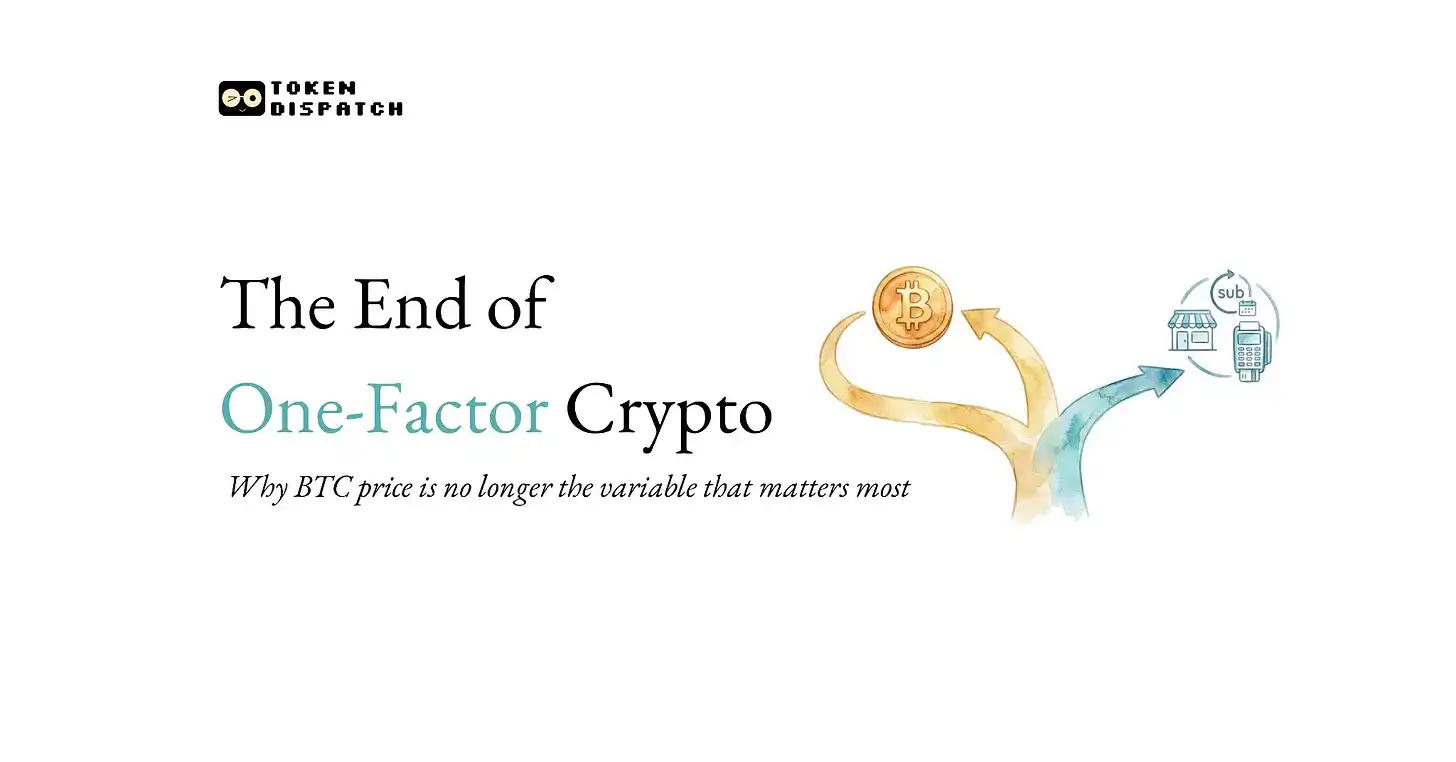
The End of Single-Factor Cryptography

The article "The End of Single-Factor Crypto" posits a fundamental shift in the cryptocurrency ecosystem. It argues the era where crypto asset valuations were predominantly driven by, and correlated with, Bitcoin's price is ending. The space is bifurcating into two distinct economies: endogenous and exogenous. The endogenous economy represents traditional crypto, where token and project values are directly tied to crypto market prices. The emerging exogenous economy comprises projects and businesses that may utilize blockchain technology or tokens but derive their fundamental value from external, non-crypto factors like consumer demand, subscription revenue, or real-world utility. Examples include AI inference platforms like Venice, fintech lenders using blockchain for efficiency, and stablecoin/payment infrastructure companies acquired by giants like Mastercard and Stripe. This shift means investment analysis must change. For exogenous assets, evaluating traditional business fundamentals—such as revenue streams, unit economics, and competitive moats—becomes more critical than tracking Bitcoin charts. While endogenous assets like Bitcoin remain relevant, the growth of the exogenous category is driven by measurable demand independent of crypto price cycles, paving the way for a new, more diversified market phase. Consequently, crypto is evolving from a single-factor, reflexive asset class into a multifaceted ecosystem with varied drivers and investment theses.

marsbitHá 1m

The End of Single-Factor Cryptography

marsbitHá 1m

Morning Post | Bitmine Plans to Raise $300 Million Through Preferred Stock Issuance; Polymarket Accuses Kalshi of Commercial Espionage

ChainCatcher's Daily Crypto Brief: Key developments from the past 24 hours include significant funding moves, regulatory actions, and market predictions. Bitmine announced a $300 million preferred stock fundraising. Polymarket accused rival prediction platform Kalshi of corporate espionage, citing numerous suspicious coincidences in product launches, a claim Kalshi strongly denied. The U.S. Department of Justice, in a joint "Disruption Week" anti-fraud operation with companies like Coinbase and Meta, froze over $3.8 million in cryptocurrency linked to scams. In infrastructure news, Macau completed its integration with the multi-central bank digital currency bridge, mBridge, aiming to build efficient cross-border payment channels. Cosmos Labs acquired the block explorer Mintscan. Market-wise, Geoffrey Kendrick, Standard Chartered's Head of Digital Assets Research, stated Bitcoin is nearing a bottom around $63,000, maintaining a year-end target of $100,000. He noted stability in U.S. spot Bitcoin ETF holdings. Ahead of SpaceX's anticipated IPO, internal insiders at Rocket Lab (RKLB) sold over $18.41 million in stock. In tokenization, Goldman Sachs partnered with Apex and Archax to launch a tokenized real estate fund. The meme token tracker GMGN reported the top trending tokens: on Ethereum, HEX, SHIB, LINK, PEPE, mUSD; on Solana, TROLL, swarms, WORLDCUP, neet, Buttcoin; and on Base, PEPE, toby, ODDS, ELSA, SKI.

链捕手Há 16m

Morning Post | Bitmine Plans to Raise $300 Million Through Preferred Stock Issuance; Polymarket Accuses Kalshi of Commercial Espionage

链捕手Há 16m

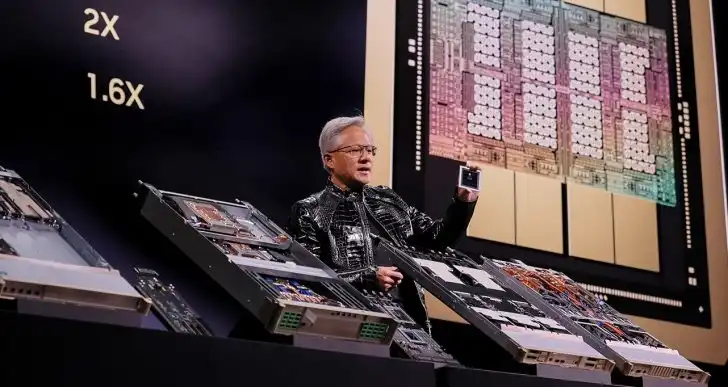
55TB to 28TB? The Rumor and Panic Behind Rubin's Memory Being Halved

Title: 55TB to 28TB? The Rumor and Panic Behind the Potential Halving of Rubin's Memory. On June 4th, a report from SemiAnalysis suggested NVIDIA's next-gen Vera Rubin NVL72 AI rack may ship with roughly 28TB of SOCAMM DRAM per rack instead of the anticipated 55TB, primarily using 96GB modules. This sparked a market panic, causing Micron's stock to drop over 10% on fears of halved memory demand. However, the article argues this panic is misguided for several key reasons. First, SOCAMM modules are socketed and upgradeable, not soldered. Lower initial configuration doesn't mean permanent demand loss. Second, the primary driver is a severe 2026 LPDDR5X supply shortage, not diminished need. NVIDIA is likely prioritizing rack shipments with available components. Third, with fixed total LPDDR5X supply, using less per rack could allow NVIDIA to ship *more* racks, not necessarily reducing overall memory orders. Micron's sharp drop was also attributed to a broader semiconductor sell-off triggered by Broadcom's earnings, with the SemiAnalysis report providing a convenient narrative for profit-taking after Micron's massive rally. In summary: the report on lower default configurations is likely accurate, but interpreting it as a demand collapse is wrong. The real risk for Micron lies in its reportedly minimal HBM4 share for Rubin, not in potentially flexible SOCAMM demand. The sell-off appears more like a correction amplified by coinciding negative catalysts.

marsbitHá 33m

55TB to 28TB? The Rumor and Panic Behind Rubin's Memory Being Halved

marsbitHá 33m

Exclusive from Yingke | Tang Wenbin's 'Yuanli Lingji' Merges with Logistics Robotics Company, and Secures Investment from Zhipu, SenseTime, Jieyue, and Others

Exclusive report: Embodied AI company "Yuanli Lingji" recently completed a new round of financing from major AI model firms including Zhipu AI, Stepfun, and SenseTime, alongside continued investments from industrial backers like Huaqin and SAIC Hengxu. Founded in March 2025 by Tang Wenbin, former co-founder and CTO of Megvii, Yuanli Lingji is a general-purpose embodied AI model company. In a notable move, the company has merged with logistics robotics firm "Atomix" (formerly known as Yuanli Juhe) through a share acquisition. Atomix, which originated from Megvii's logistics robotics business led by Tang in 2016 and was spun off in July 2024, has grown to become the world's second-largest supplier of pallet shuttle robots, with annual revenue nearing 1 billion RMB and over 500 projects globally for clients like Uniqlo and CATL. This merger aims to break the industry's "data deadlock" by combining Atomix's extensive real-world operational data from more than 20 countries with Yuanli Lingji's model training capabilities. The company's embodied AI model "DM0" utilizes a cross-domain training approach, integrating internet semantics, autonomous driving rules, and robotics data to achieve hardware-agnostic, precise manipulation even with a compact 2.4B parameter size. The collective investment from key AI players and the strategic merger signal a shift in the competitive landscape, as major model companies pivot from language tokens to physical actions ("from Token to Action"). The industry is entering a consolidation phase where hardware, AI models, data, and application scenarios converge to scale embodied intelligence, a trend mirrored by recent moves from giants like ByteDance and Skild AI.

marsbitHá 40m

Exclusive from Yingke | Tang Wenbin's 'Yuanli Lingji' Merges with Logistics Robotics Company, and Secures Investment from Zhipu, SenseTime, Jieyue, and Others

marsbitHá 40m

Trading

Spot
Futuros

Artigos em Destaque

Como comprar ID

Bem-vindo à HTX.com!Tornámos a compra de SPACE ID (ID) simples e conveniente.Segue o nosso guia passo a passo para iniciar a tua jornada no mundo das criptos.Passo 1: cria a tua conta HTXUtiliza o teu e-mail ou número de telefone para te inscreveres numa conta gratuita na HTX.Desfruta de um processo de inscrição sem complicações e desbloqueia todas as funcionalidades.Obter a minha contaPasso 2: vai para Comprar Cripto e escolhe o teu método de pagamentoCartão de crédito/débito: usa o teu visa ou mastercard para comprar SPACE ID (ID) instantaneamente.Saldo: usa os fundos da tua conta HTX para transacionar sem problemas.Terceiros: adicionamos métodos de pagamento populares, como Google Pay e Apple Pay, para aumentar a conveniência.P2P: transaciona diretamente com outros utilizadores na HTX.Mercado de balcão (OTC): oferecemos serviços personalizados e taxas de câmbio competitivas para os traders.Passo 3: armazena teu SPACE ID (ID)Depois de comprar o teu SPACE ID (ID), armazena-o na tua conta HTX.Alternativamente, podes enviá-lo para outro lugar através de transferência blockchain ou usá-lo para transacionar outras criptomoedas.Passo 4: transaciona SPACE ID (ID)Transaciona facilmente SPACE ID (ID) no mercado à vista da HTX.Acede simplesmente à tua conta, seleciona o teu par de trading, executa as tuas transações e monitoriza em tempo real.Oferecemos uma experiência de fácil utilização tanto para principiantes como para traders experientes.

202 Visualizações TotaisPublicado em {updateTime}Atualizado em 2026.06.02

Como comprar ID

Discussões

Bem-vindo à Comunidade HTX. Aqui, pode manter-se informado sobre os mais recentes desenvolvimentos da plataforma e obter acesso a análises profissionais de mercado. As opiniões dos utilizadores sobre o preço de ID (ID) são apresentadas abaixo.

活动图片