With $0.16 defended, can Terra [LUNA] extend its rally by another 50%?

ambcryptoPublicado em 2025-12-11Última atualização em 2025-12-11

Resumo

Terra (LUNA) has experienced a significant rally, gaining 226% over 9 days and 45.8% in the past 24 hours, driven by the recent v2.18 network upgrade. The bullish momentum is supported by strong trading volume and a weekly close above $0.168, which confirms a structural shift. Key resistance levels are identified at $0.28, $0.51, and $0.72. The $0.16 area, overlapping with a demand zone and the 61.8% Fibonacci retracement, presents a buying opportunity. While a bearish divergence on the 4-hour RSI could signal a pullback, the overall outlook remains optimistic. Traders are advised to consider long positions in the $0.16-$0.18 range, targeting $0.283 or $0.34. A short-term rally of 30%-50% is possible, potentially after a dip toward $0.18.

Terra has gained 226% over the past 9 days, and 45.8% over the past 24 hours alone. It also witnessed high trading volume in recent days.

The rally was likely a result of the Terra Chain upgrade v2.18.

Multi-timeframe analysis highlights bullish Terra potential

The weekly chart indicated that the structure had been bullish, for now. A weekly session close above $0.168 would confirm this shift. This swing high was important because it precipitated the previous move down.

The strong trading volume over the past two weeks was reflected in the OBV, which has surpassed the December 2024 highs. This was encouraging for the bulls.

The RSI also signaled that bullish momentum was established with a reading of over 50.

The next horizontal resistances to watch out for are $0.28, $0.51, and $0.72.

The bullish outlook was reinforced on the 4-hour chart. The demand zone (cyan box) from $0.148-$0.163 overlapped with the 61.8% Fibonacci retracement level at $0.155.

Additionally, the imbalance (white box) was likely to see a bullish reaction upon a retest.

The confluence of demand zones around $0.16 meant any Terra [LUNA] price dip to this region would present a buying opportunity.

Examining the bearish case

The H4 RSI could form a bearish divergence over the next few days. This would be an early warning of a potential pullback.

If this pullback, combined with high selling volume, pushes prices below the $0.15 area, it would be troublesome for the bulls.

Traders’ call to action: Is it feasible to long LUNA?

The bearish scenario was less likely to play out, due to the bullish weekly and 4-hour timeframe outlooks.

The $0.16 area is also a solid support that bulls should be able to defend. The OBV reflects sustained buying pressure over the past week.

Hence, traders can look to go long in the $0.16-$0.18 area. The Fibonacci extension levels at $0.283 and $0.34 would be the bullish price targets.


Final Thoughts

  • The Terra upgrade would bolster the network security and reliability, and has boosted sentiment.
  • In the short term, another 30%-50% rally is possible, but it might be preceded by a price dip toward $0.18.

Disclaimer: The information presented does not constitute financial, investment, trading, or other types of advice and is solely the writer’s opinion

Leituras Relacionadas

From Airdrop Myth to King of Derivatives: A Look Back at Hyperliquid's 2025 Conquest

Reviewing crypto's growth in 2025, Hyperliquid stands out. It began the year with an epic airdrop and strong price performance, capturing attention. By year's end, it transformed into a top-four revenue-generating platform in crypto, earning over $650M and at one point capturing 70% of all perp trading volume. Its success was no accident. In Q1, it solidified its reputation by being first to list new assets like the TRUMP perp and launched HyperEVM, a smart contract layer. Q2 saw explosive growth: HYPE token surged 4x from April lows, and HyperEVM's TVL grew from $350M to $1.8B. The platform gained mainstream media coverage. In Q3, major wallets like Phantom and MetaMask integrated via Hyperliquid's builder codes, routing $158B in volume and earning partners nearly $50M. A high-profile stablecoin bid war was won by Native Markets, aligning with Hyperliquid's bootstrapped ethos. However, new competitors like Aster and Lighter emerged with aggressive airdrops. Q4 brought permissionless listings via HIP-3, enabling new markets like stock perps and yield-bearing collateral. Yet, HYPE fell nearly 50% from its September peak due to market conditions, a rare ADL event during a crash, and the start of team token unlocks. As perps go mainstream in 2026, Hyperliquid's true test begins. Its success came from building a superior product and ecosystem without shortcuts. Maintaining leadership will require doing it all over again in a crowded field.

marsbitHá 14m

From Airdrop Myth to King of Derivatives: A Look Back at Hyperliquid's 2025 Conquest

marsbitHá 14m

ETC Olympia Development Part 1: Implementing ECIP-1111 and ECIP-1112

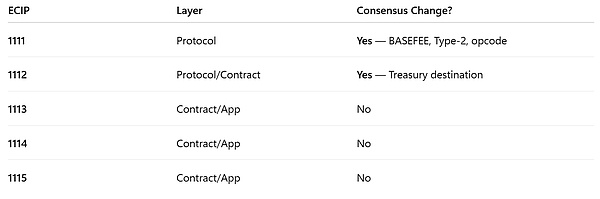
ETC Olympia Development Series Part 1: Implementing ECIP-1111 and ECIP-1112 This article introduces the first part of the Ethereum Classic Olympia development series, focusing on the implementation of ECIP-1111 and ECIP-1112. These two proposals are the only components within the broader Olympia framework that modify consensus behavior. ECIP-1111 modernizes the fee market by introducing an EIP-1559-style mechanism with a base fee and optional priority tip (miner tip). A key difference from Ethereum is that the base fee is not burned but is instead redirected to a treasury address defined by ECIP-1112. It also adds support for Type-2 transactions and the BASEFEE opcode (0x48), ensuring compatibility with modern EVM tooling and wallets. Crucially, it does not change miner rewards, monetary policy, or existing transaction types. ECIP-1112 defines an immutable, deterministic treasury smart contract that will receive the redirected base fees. This vault is designed to be receive-only upon activation, meaning it can accumulate value but cannot distribute funds until a separate, subsequent governance layer (defined in other ECIPs) is deployed and activated on the contract layer. The article emphasizes the modular architecture of Olympia. While the suite includes five ECIPs (1111-1115), only these two affect consensus. This separation ensures that the core protocol remains minimal and auditable, while future governance and funding mechanisms can evolve independently at the contract level without requiring further hard forks. The implementation is currently in the draft stage per the ECIP-1000 process. Any decision to move forward with mainnet activation will require extensive testing on the Mordor testnet and full community review.

金色财经Há 18m

ETC Olympia Development Part 1: Implementing ECIP-1111 and ECIP-1112

金色财经Há 18m

Trading

Spot
Futuros
活动图片