Wintermute: The Four-Year Cycle is Dead, How Will Crypto Break Through in 2026?

marsbitPublicado em 2026-01-20Última atualização em 2026-01-20

Resumo

The traditional four-year crypto cycle, once considered a market "iron law," is now obsolete, according to a 2025 annual report from market maker Wintermute. The market logic has shifted from "seasonal rotation" to "liquidity lock-up." 2025 did not bring the anticipated broad rally but instead showed extreme polarization: BTC and ETH gained institutional legitimacy through ETFs, while altcoins saw significantly reduced momentum and shorter lifespans. OTC data indicates that the historical wealth flow—from Bitcoin to Ethereum, then to blue chips, and finally to altcoins—has weakened substantially. ETFs and Digital Asset Trusts (DATs) act as "walled gardens," providing sustained demand for large-cap assets but failing to naturally circulate liquidity to the broader market. Altcoin rallies in 2025 lasted an average of just 20 days, down from 60 days in 2024, reflecting a highly concentrated market. Wintermute outlines three potential catalysts to break this stagnation in 2026: 1. **Expanding Institutional Mandates**: Broader institutional adoption beyond current large-cap assets, as seen with early ETF filings for Solana (SOL) and XRP. 2. **The Wealth Effect**: A strong rally in BTC or ETH could generate spillover demand for altcoins, similar to 2024. 3. **Rotation from Equities**: Retail attention shifting back from equity markets (e.g., AI, rare earths, quantum computing) to crypto, though this is the least likely scenario. The future of the market depends on...

The once-considered "iron law" of the four-year halving cycle in the crypto market is facing unprecedented challenges. Top market maker Wintermute pointed out in its latest 2025 annual report that the traditional cycle narrative has become obsolete, and market logic has shifted from "seasonal rotation" to "liquidity lock-up."

2025 did not bring the widespread euphoria as expected; instead, it exhibited extreme emotional polarization: on one hand, BTC and ETH entered the institutional hall of fame with the support of ETFs, while on the other hand, the explosive power of altcoins significantly diminished, and their lifecycles shortened.

Facing 2026, can the crypto market break the current存量困局 (stock dilemma)? Wintermute has outlined three core variables to打破现状 (break the status quo).

Main Text:

2025 did not bring the anticipated broad-based rally, but this may be regarded by future generations as the beginning of cryptocurrency's transition from a speculative tool to a mature asset class.

The traditional four-year cycle is becoming outdated. Market performance is no longer dominated by self-fulfilling timed narratives but depends on the flow of liquidity and the concentration of investor attention.

What Changed in 2025?

Historically, crypto-native wealth manifested as a fungible pool of capital. Profits from Bitcoin would spill over into Ethereum (ETH), then flow to blue-chip assets, and finally reach altcoins.

Wintermute's over-the-counter (OTC) flow data indicates that this传导机制 (transmission mechanism) significantly weakened in 2025.

Spot exchange-traded funds (ETFs) and digital asset trusts (DATs) evolved into "walled gardens." They provided sustained demand for large-cap assets but did not naturally rotate funds into the broader market.

With retail interest being drawn to the stock market, 2025 became a year of extreme polarization.
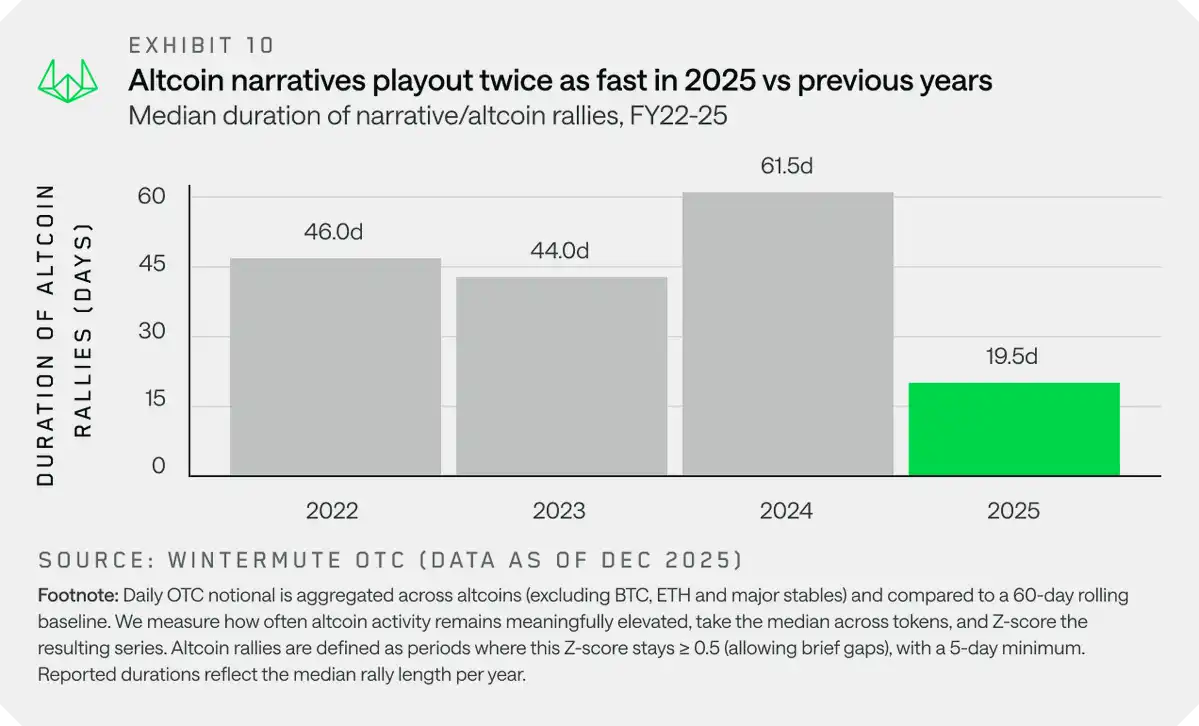
The average duration of altcoin rallies in 2025 was 20 days, far below the 60 days seen in 2024.

A handful of mainstream assets absorbed the vast majority of new funds, while the broader market struggled.

Three Paths for 2026

For market participation to extend beyond mainstream assets and expand further, at least one of the following three things needs to happen:

1. Expanding Institutional Mandates

Currently, most of the new liquidity remains confined to institutional channels. A full market recovery requires institutional investors to broaden the range of assets they can invest in.

Early signs have already emerged through ETF applications for Solana (SOL) and XRP.

2. The Wealth Effect from Mainstream Assets

A strong rebound in Bitcoin or Ethereum could generate a wealth effect, spilling over into the broader market, similar to what happened in 2024.

However, there remains uncertainty about how much capital will ultimately flow back into digital assets.

3. Rotation from Equities

Retail investor attention could rotate back from the stock market (such as AI, rare earths, quantum computing, etc.) to cryptocurrencies, bringing fresh capital inflows and stablecoin minting.

Although this is the least likely scenario, it would significantly expand market participation.

The future outcome will depend on whether the aforementioned catalysts can effectively diffuse liquidity beyond a few large-cap assets or whether this concentration trend will persist.

Understanding where capital flows and what structural changes are needed will determine which strategies will work in 2026.


Perguntas relacionadas

QAccording to Wintermute's 2025 report, what is replacing the traditional four-year cycle narrative in the crypto market?

AThe market logic has shifted from 'seasonal rotation' to 'liquidity lock-up', where performance is now dictated by the flow of liquidity and the concentration of investor attention rather than self-fulfilling, timed narratives.

QWhat does Wintermute identify as a key factor causing the extreme polarization in the crypto market in 2025?

AThe introduction of spot ETFs and Digital Asset Trusts (DATs) acted as 'walled gardens', providing sustained demand for large-cap assets like BTC and ETH but not naturally rotating capital into the broader market, while retail interest was drawn to the stock market.

QWhat was the average duration of an altcoin rally in 2025, as cited by Wintermute?

AThe average duration of an altcoin rally in 2025 was 20 days, which is significantly lower than the 60-day average seen in 2024.

QWhat are the three potential catalysts Wintermute outlines for breaking the current market stagnation and expanding participation beyond large-cap assets in 2026?

AThe three catalysts are: 1. Expanding Institutional Mandates, where institutions invest in a wider range of assets. 2. The Wealth Effect from a strong Bitcoin or Ethereum rally spilling over. 3. A Rotation from Equities, where retail attention shifts back from the stock market to crypto.

QWhat early sign does Wintermute point to regarding the potential expansion of institutional investment mandates?

AWintermute points to the ETF applications for Solana (SOL) and XRP as early signs that institutional investors might be expanding the range of assets they are willing to invest in.

Leituras Relacionadas

The Verdict in Choi Tae-won's Divorce Case: Revealing the Inheritance Undercurrent Behind SK Hynix's Trillion-Won Empire

SK Group Chairman Chey Tae-won's high-profile divorce case, involving a record 1.38 trillion won settlement, has drawn attention to the succession plans for Korea's second-largest conglomerate, especially its crown jewel, SK hynix. Unlike traditional chaebol scripts centered on the eldest son, Chey's three children from his marriage to former President Roh Tae-woo's daughter, Roh Soh-yeong, are carving distinct, non-traditional paths. Eldest daughter Chey Yun-jung (b. 1989) is seen as the most evident successor. With a scientific and consulting background, she holds executive roles at SK bioscience and SK Inc.'s growth support department, focusing on future strategy and biopharma. Her marriage is to an AI infrastructure entrepreneur, not a traditional business alliance. Second daughter Chey Min-jung (b. 1991) took a unique route, voluntarily serving as a South Korean naval officer, including an anti-piracy deployment. She later worked on policy and strategy for SK hynix in Washington D.C. before co-founding an AI-driven healthcare startup. She married a former U.S. Marine Corps officer, connecting her to U.S. defense and policy circles—networks crucial for a global semiconductor giant. The only son, Chey In-geun (b. 1995), who studied physics like his father, worked briefly at SK E&S before joining McKinsey. Despite fitting the traditional "heir" profile as the eldest son, he remains silent and holds no public position or shares in SK, suggesting the old succession playbook is obsolete. As SK hynix's valuation soars, becoming a geopolitical asset in the AI era, the heirs' legitimacy is no longer automatic. They must prove themselves in fields like AI biotech, global policy, and strategic consulting. Their marriages also reflect new elite networks in tech and defense, not old political alliances. Their inheritance is the complex challenge of navigating a globalized, tech-driven world, not just a corporate throne.

marsbitHá 10h

The Verdict in Choi Tae-won's Divorce Case: Revealing the Inheritance Undercurrent Behind SK Hynix's Trillion-Won Empire

marsbitHá 10h

From OpenSea to OpenRouter: Is Alex Atallah Repeating His 'Exit at the Peak' Playbook?

From OpenSea to OpenRouter: Is Alex Atallah Repeating His "Exit at the Peak" Playbook? According to the Wall Street Journal, payments giant Stripe is in talks to acquire the AI model aggregation platform OpenRouter in a potential deal valuing the company near $100 billion. This would mark founder Alex Atallah's second creation of a company reaching a $100 billion valuation, following his co-founding of NFT marketplace OpenSea. OpenRouter, founded just over three years ago, has grown rapidly by acting as a unified gateway for developers to access over 400 AI models. It currently has about 10 million users and processes over 200 trillion tokens monthly. While the platform's annualized revenue is around $50 million, its valuation has skyrocketed from $1.3 billion in March 2026. The potential acquisition by Stripe, a company OpenRouter's founder once likened it to, represents a major expansion into AI infrastructure for the payments leader. This move echoes Atallah's previous timing with OpenSea, where he departed before the NFT market's significant downturn. For OpenRouter, selling now may be strategic. Despite its scale, its business model—charging a 5-5.5% fee on AI inference calls—faces pressure from competition, open-source models, and potential price wars among model providers, limiting its profitability narrative for an IPO. A key asset for potential acquirers like Stripe is OpenRouter's vast repository of real-world AI usage data, which offers unique insights into model performance and developer preferences that are difficult to replicate. Whether this potential deal signifies a new valuation benchmark for AI infrastructure or another market peak signal remains to be seen.

链捕手Há 10h

From OpenSea to OpenRouter: Is Alex Atallah Repeating His 'Exit at the Peak' Playbook?

链捕手Há 10h

Trading

Spot
活动图片




