Will Warsh Compromise with Trump? A Look at the 70-Year Power Struggle Between the President and the Fed

marsbitPublicado em 2026-05-22Última atualização em 2026-05-22

Resumo

Will the Fed's new chair, Kevin Warsh, yield to pressure from President Trump? A White House-administered oath ceremony for Warsh breaks recent precedent, spotlighting a seven-decade power struggle between the presidency and the Federal Reserve. Historically, each Fed chair has balanced political pressure with policy independence. Warsh's situation, however, is uniquely complex, inheriting a divided Federal Open Market Committee (FOMC) with some members opposing even hints of rate cuts, while Trump expects easing. The report from Caitong Securities reviews this history: from William Martin establishing independence, to Arthur Burns compromising under Nixon, Paul Volcker building institutional credibility, Alan Greenspan navigating political waters, and Jerome Powell facing severe pressure from Trump, ultimately hardening the Fed's defensive stance. Warsh, a former Fed governor known for questioning quantitative easing, is not a traditional dove. His recent statements emphasize a nuanced view of Fed independence, skepticism of forward guidance, serious concern over inflation (contradicting Trump's "fake inflation" claims), and the potential for AI-driven productivity gains to allow rate cuts. The analysis concludes Warsh's policy will likely feature a clear direction but cautious pace. Rate cuts are probable but constrained by persistent inflation above target; if Trump pressures heavily, Warsh may delay cuts to defend Fed independence. Balance sheet reduction is seen as nec...

Author: Zhao Ying

Source: Wall Street News

Trump will personally preside over the swearing-in ceremony of the new Fed Chairman, Kevin Warsh. This arrangement, which breaks recent conventions, once again thrusts the decades-long power game between the White House and the Federal Reserve into the spotlight. History shows that every Fed Chair has had to seek a balance between political pressure and policy independence, and Warsh is no exception—but the situation he faces is far more complex than outsiders imagine.

According to the Wall Street Journal, citing White House officials, Trump will preside over Warsh's swearing-in ceremony at the White House this Friday. This move breaks with recent practice—inauguration ceremonies are typically held internally at the Fed, with the president rarely attending in person. The last time a Fed Chair's swearing-in ceremony was held at the White House dates back nearly forty years to Alan Greenspan's inauguration in 1987.

The Fixed Income team at Caitong Securities (Sun Binbin, Sui Xiuping, Lu Xingchen) pointed out in their latest research report that although Warsh is not a "dovish chair," it cannot be ruled out that there will be no rate cuts this year—the relationship between the Fed Chair and the U.S. President is not static but evolves over time.

However, Warsh is not inheriting a unified and ready Federal Reserve. At the late April FOMC meeting, Governors Hammack (Cleveland), Kashkari (Minneapolis), and Logan (Dallas) cast the most unusual dissenting votes since October 1992—they did not oppose the idea of rate cuts themselves but argued against even hinting at them. This means Warsh inherits a central bank already showing internal fractures, precisely as Trump expects him to deliver rate cuts.

White House Inauguration: An Arrangement Full of Political Signals

The arrangement of the inauguration ceremony itself sends a strong signal. When Jerome Powell was inaugurated in 2018, the ceremony was held internally at the Fed, and Trump did not attend. The most recent sitting president to attend an inauguration was George W. Bush, who attended Ben Bernanke's swearing-in in 2006. Trump's personal hosting this time directly underscores his close attention to this Fed appointment.

At the procedural level, this transition process has also been unusually lengthy. Warsh was confirmed by the Senate last week, receiving a four-year term. Powell's term as Chair ended last weekend, but he stated he would remain on the Fed Board as a Governor, a term that lasts until January 2028. Warsh also agreed to divest some personal investments before formally taking office, which delayed the transition to some extent. During the interim, Fed Vice Chair Philip Jefferson represented the central bank at the G7 finance ministers and central bank governors meeting in Paris this Monday.

70 Years of Rivalry: From Martin to Powell

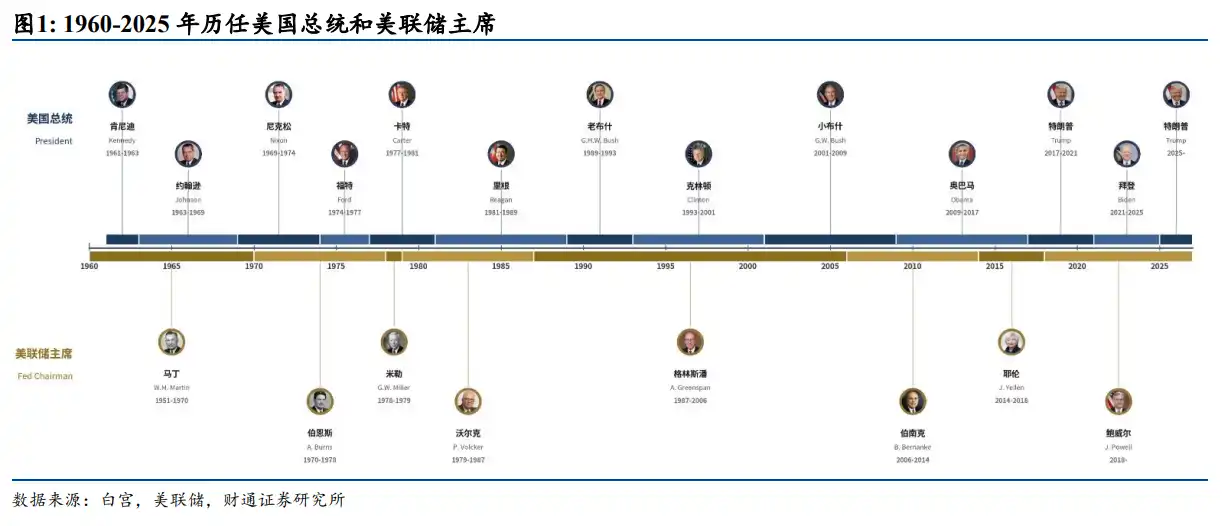
Caitong Securities' report systematically reviews the history of the relationships between each Fed Chair and the President since 1960, outlining a clear evolutionary path.

William Martin, facing a lack of institutional moats, could only rely on personal credibility to guard independence. After taking office, he refused to act as the Treasury's agent, shifted the Fed's decision-making center from New York to Washington, and expanded decision-making authority to the entire FOMC. When Truman saw him on a New York street, he just threw out the word "Traitor" and walked away.

Arthur Burns's failure stemmed from his own disbelief that monetary policy could end inflation, which opened the door to Nixon's political pressure. Nixon applied pressure through private letters, intervened in Board personnel composition, and even sent senior advisors to directly lecture Fed staff. Burns preserved institutional independence in form but made significant compromises on substantive policy direction, ultimately destroying the Fed's credibility.

William Miller represents the most direct political coordination model—deliberately chosen to align with Carter's political goals, but backfired in the face of external crises. By the summer of 1979, inflation had become Carter's biggest political crisis. Miller was moved to Treasury Secretary, making way for appointing a true inflation hawk.

Paul Volcker elevated independence from "personal credibility defense" to a triple moat of "personal credibility + institutional framework + market credibility." Carter, knowing appointing Volcker would come at a political cost, still made the choice—as his policy advisor Eizenstat said, it "ultimately squeezed him out of a second term, at the cost of high unemployment, while squeezing out inflation." Though Reagan "ordered" Volcker not to raise rates before the 1984 election and launched an "FOMC ambush" through appointed governors in 1986, he ultimately failed to substantively change policy direction.

Alan Greenspan used technocratic rhetoric to push the struggle below the surface, clashing fiercely with George H. W. Bush, reaching a "Washington-style peace" with Clinton, but overstepping to support tax cuts under George W. Bush, becoming the first Fed Chair in history to actively "invade" the realm of fiscal policy.

Ben Bernanke embodied a model of natural convergence between the White House and the Fed under crisis conditions, with his main pressures coming from Congress and within the Fed, not the White House. Janet Yellen countered Trump's attacks with "non-political language + strict self-restraint," becoming the first Fed Chair to be replaced by an incoming president since Carter did not reappoint Burns.

Jerome Powell faced presidential pressure more severe than any Chair since Burns. During Trump's first term, under combined external political pressure and internal economic judgment, Powell cut rates three times consecutively in 2019 and stopped balance sheet reduction. In Trump's second term, facing investigations launched by Trump over cost overruns in the Fed's Washington headquarters renovation and hints of dismissal, Powell's response significantly hardened, elevating the defense of Fed independence to a historically new level of legalization, documentation, and publicity. In his final meeting as Chair, the FOMC held rates steady with an unusually split 8-4 vote.
Warsh's Dilemma: A New Chair Caught in Internal and External Troubles

The situation Warsh inherits is quite rare in history—he simultaneously faces rate cut pressure from the White House and hawkish resistance from within the FOMC.

Warsh is not a traditional dove. Appointed as a Fed Governor by George W. Bush in 2006 at age 35, he was one of the youngest governors in Fed history. After QE2 was formally launched in 2010, he became the only Governor in the FOMC to publicly question its expansionary direction and resigned early in 2011, widely interpreted by the market as a silent protest against the Fed's excessive easing. His background as a Morgan Stanley investment banker, Executive Secretary of the White House NEC, and close ties to Republican core circles suggest his policy independence expectations are no lower than those of historically similar chairs.

Caitong Securities' report outlines four key points from Warsh's recent speeches and Q&A sessions:

  • First, his definition of Fed independence is more nuanced than his predecessors'. He believes politicians' comments on monetary policy do not affect Fed independence. This is both a desensitization tactic towards Trump's pressure and leaves room to maintain policy independence in the future without open conflict.
  • Second, he holds a negative view of forward guidance. Markets may need to adapt to a more "silent" Fed.
  • Third, he takes inflation very seriously, directly refuting Trump's view that rising oil prices represent "fake inflation."
  • Fourth, he believes productivity gains from artificial intelligence will make rate cuts possible, sharing a similar logical structure to Greenspan's insights during the late 1990s productivity boom.

Rate Cuts and Balance Sheet Reduction: Direction Certain, Pace Cautious

Caitong Securities believes that monetary policy under Warsh will likely feature "certain direction but cautious pace."

Regarding the pace of rate cuts, with inflation exceeding the target for five consecutive years, the priority of stabilizing inflation expectations is higher. Warsh's serious attitude towards inflation, especially his denial of "fake inflation," indicates he will not easily cut rates before inflation clearly returns to the target range. In the short term, demand growth driven by data center investment may further offset room for rate cuts, causing the pace of cuts to be constrained by data and slow down. The report notes that if Trump shows Warsh more respect, rate cuts may come earlier; if Trump continues high-intensity pressure, to defend Fed independence, Warsh would instead lean towards cutting later.

Regarding the pace of balance sheet reduction, Warsh believes the expanded balance sheet has effectively extended the Fed's monetary policy boundary into the fiscal domain, making reduction logically necessary. But he also acknowledges that it took the Fed 18 years to accumulate the balance sheet to this extent, and reducing it is not an overnight task; it's expected to proceed slowly and methodically. Furthermore, starting balance sheet reduction without having cut rates could almost be seen as proactively picking a fight with the White House—this also dictates that reduction will proceed at a pace that avoids a direct confrontation before the rate-cutting cycle begins.

Caitong Securities' core conclusion is: Recreating Greenspan-style management and returning to a scarce reserve model first require winning support within the Fed itself; moving too hastily will only backfire. Judging Warsh's future policy path should not rely solely on his personal stance or his current relationship with the White House but should return to macro trends—the position of inflation, growth elasticity, oil price direction, financial condition tightness—to deduce his most likely choices under different scenarios.


Perguntas relacionadas

QWhat is the significance of Trump personally presiding over the swearing-in ceremony of the new Federal Reserve Chair, Kevin Warsh?

ATrump's personal presiding of Kevin Warsh's swearing-in ceremony at the White House, a departure from recent convention, sends a strong political signal of the administration's close attention to this Fed appointment. It underscores the ongoing power dynamics between the White House and the Federal Reserve, reminiscent of ceremonies from decades ago, such as Alan Greenspan's in 1987, and highlights the exceptional nature of this leadership transition under political scrutiny.

QAccording to the Caitong Securities report, what are the key characteristics of the relationship between the Fed Chair and the President?

AAccording to the Caitong Securities report, the relationship between the Federal Reserve Chair and the President is not static but evolves and changes with time. Each Fed Chair has had to navigate the delicate balance between political pressure and policy independence differently, shaped by their personal beliefs, the institutional framework of their time, and the specific economic and political circumstances they faced.

QWhat historical case illustrates a Fed Chair's failure to maintain policy independence due to personal belief, and what was the consequence?

AThe historical case of Arthur Burns illustrates this failure. Burns himself did not believe monetary policy could end inflation, which opened the door to political pressure from President Nixon. While he formally preserved the Fed's institutional independence, he made substantial compromises on the direction of policy, ultimately destroying the Fed's credibility.

QHow does the situation faced by Kevin Warsh differ from that of his predecessors?

AKevin Warsh faces a historically rare and complex situation. He is caught between opposing pressures: on one side, he faces explicit interest rate cut demands from the White House (President Trump), and on the other side, he encounters resistance from hawkish dissenting votes within his own Federal Open Market Committee (FOMC). This puts him in a position where he must navigate external political pressure while managing internal policy disagreements.

QWhat is Caitong Securities' prediction for the likely monetary policy approach under Kevin Warsh?

ACaitong Securities predicts that monetary policy under Kevin Warsh will likely be characterized by 'a clear direction but a cautious pace.' Regarding interest rates, while a rate-cutting cycle is the probable direction, the pace will be data-dependent and cautious due to high inflation priority. Regarding balance sheet reduction (QT), it is considered logically necessary but will proceed slowly and methodically to avoid direct conflict with the White House, especially before rate cuts begin. The report concludes that the policy path will ultimately be shaped by macro trends like inflation, growth, and financial conditions.

Leituras Relacionadas

SpaceX, OpenAI, Anthropic: The Three AI Giants Racing for IPO, Which One Is Worth Betting On?

SpaceX, OpenAI, and Anthropic are poised for historic IPOs within weeks, potentially raising a combined $180 billion—a sum exceeding the entire internet bubble's fundraising. The hosts of the Limitless Podcast argue this isn't just individual company financing but an unprecedented capital concentration for AI infrastructure, driven by an insatiable need for compute, data centers, power, and chips. SpaceX's IPO is notable for reportedly changing market index rules to allow faster inclusion, potentially funneling trillions in passive retirement funds into its stock, despite its unproven space-based data center business model. In contrast, Anthropic demonstrates explosive growth, with ARR reportedly hitting $45 billion and approaching profitability, fueled by strong enterprise adoption of products like Claude Code. Google's separate $80 billion raise highlights the immense capital pressure, even for giants. The discussion acknowledges bubble risks but leans optimistic. The hosts contend the massive spending is building essential physical infrastructure for the next technological era. A key bottleneck isn't capital but the real-world limits of chip manufacturing and construction speed. As long as demand for AI compute outstrips supply, this investment cycle represents a foundational build-out rather than a purely financial bubble. All three companies are seen as foundational bets on the future, with Anthropic often cited as the most immediately compelling due to its proven revenue trajectory.

marsbitMesmo agora

SpaceX, OpenAI, Anthropic: The Three AI Giants Racing for IPO, Which One Is Worth Betting On?

marsbitMesmo agora

From 'Old Guys' to 'New Favorites': How AI Is Revaluing Old Infrastructure from Dell to Nokia?

From "Vintage Tech" to "New AI Darlings": How AI Revalues Old Infrastructure One year ago, tech giants like Dell, Nokia, Cisco, and Western Data were seen as slow-growth, low-valuation stories, far from the AI spotlight dominated by players like Nvidia. Now, these legacy tech stocks are gaining market attention, sparking debate on whether this is genuine industry revaluation or a temporary narrative. As AI moves from model parameters to real-world data centers, the market is recognizing companies with proven delivery and infrastructure capabilities. This shift marks a change in the AI investment thesis: from pure model and GPU focus to the complex systems engineering required for deployment. Companies like Dell, HPE, and Corning are being revalued not for being "sexy" AI innovators, but for their decades of accumulated expertise in supply chains, enterprise delivery, and infrastructure—assets that have become critical in the AI buildout phase. The revaluation is unfolding across three key infrastructure lines: 1. **Servers & System Integration:** Dell and HPE are emerging as crucial system integrators or "general contractors" for AI data centers, translating GPU orders into complete, deployable server racks integrated with power, cooling, and networking. 2. **Networking & Connectivity:** AI's scale demands robust high-speed connections. Corning (fiber optics), Nokia (AI-RAN, 6G), and Cisco (data center switches) are gaining importance for enabling efficient data transfer within and between AI clusters. 3. **Storage:** Beyond high-speed memory (HBM/DRAM), the AI data explosion is driving demand for high-capacity hard drives (HDDs) from companies like Western Digital and Seagate to handle training data, logs, and cold storage cost-effectively. For this revaluation to be substantive and not just a narrative, three criteria are key: 1) Concrete AI-related order and revenue growth (e.g., Dell's AI server sales), 2) Upward revisions to company financial guidance, and 3) Sustainable improvements in profit quality, not just top-line revenue spikes. In essence, AI's transition to a real construction phase is re-pricing "old assets" against "new demand." The opportunity, however, is selective. Only those legacy firms that are demonstrably integrated into the capital expenditure chains of data center and enterprise AI deployment are likely to experience a true "logic re-rating" rather than just a temporary valuation bounce.

marsbitHá 7m

From 'Old Guys' to 'New Favorites': How AI Is Revaluing Old Infrastructure from Dell to Nokia?

marsbitHá 7m

The Merger of Codex and ChatGPT Marks the Beginning of a Major Reshuffle in Programming Tools

OpenAI is shifting its strategic focus from ChatGPT to Codex, merging them along with the browser tool Atlas into a unified desktop super-app. This move signals an internal belief that Codex, originally a programming tool, represents the next evolution of AI more than conversational models like ChatGPT. Over the past year, Codex's weekly active users have surged past 5 million. The key distinction is that while ChatGPT answers questions, Codex executes tasks. Enterprises increasingly value this ability to get work done over simply receiving advice. Consequently, Codex is attracting professionals beyond developers, including analysts, bankers, marketers, and product managers. OpenAI's reorganization and increased investment in Codex stem from recognizing that the future of AI competition lies in execution capabilities, not just conversation. The company is launching role-specific plugins (e.g., for data analysis, sales, design) to transform Codex into a broad knowledge work platform that automates and redefines white-collar workflows. Beyond being a tool, Codex reflects OpenAI's ambition to redefine software. New features like "Sites"—which generates interactive websites from documents—and collaborative "Annotations" aim to create a paradigm where the AI understands the goal and handles the tools and steps, functioning more like a digital colleague than traditional software. The ultimate goal is a unified experience where the user cares only about the completed task.

marsbitHá 16m

The Merger of Codex and ChatGPT Marks the Beginning of a Major Reshuffle in Programming Tools

marsbitHá 16m

Interpreting Investment Opportunities in the Age of Great Navigation, Invesco Great Wall Fund Releases '2026 Report on Chinese Enterprises Going Global'

Invesco Great Wall Fund has released its "2026 China Corporate Globalization Report," titled "The 'Great Navigation Era' of Chinese Enterprises." The report analyzes the new trends and investment opportunities as Chinese companies expand globally, moving from simple product exports to comprehensive overseas operations involving services, branding, and local production. Driven by factors like trade friction, the pursuit of higher profit margins abroad, and policy support, globalization is becoming essential for Chinese companies. The report outlines an evolution: from early product export ("Globalization 1.0") to the current "Globalization 2.0," characterized by overseas capacity, capital goods investment, consumer brand expansion, and service exports. Chinese firms' competitive advantages are highlighted, including a vast engineer talent pool, low-cost and robust infrastructure, and complete industrial clusters. Specific sectors with significant出海 potential are identified: * **Capital Goods** (e.g., engineering machinery, power equipment): Benefiting from global demand, especially in Belt & Road markets and the AI-driven power grid upgrade cycle. * **Consumer Brands**: Transitioning from cost to brand advantage, leveraging供应链 efficiency. * **Technology & Innovation**: Including AI applications, optical modules within global tech supply chains, and new energy vehicles focusing on local production. * **Pharmaceuticals**: Chinese biotech firms are becoming preferred partners for global pharma, with potential for breakthrough drugs in areas like oncology and weight loss. The report concludes that corporate globalization represents a sustained, core theme for China's capital markets, though companies must navigate challenges like geopolitics and localization.

marsbitHá 28m

Interpreting Investment Opportunities in the Age of Great Navigation, Invesco Great Wall Fund Releases '2026 Report on Chinese Enterprises Going Global'

marsbitHá 28m

Trading

Spot
Futuros
活动图片