Will the CLARITY Act miss out on approval? ‘The window continues to narrow each day’

ambcryptoPublicado em 2026-06-28Última atualização em 2026-06-28

Resumo

Galaxy Research has downgraded the odds of the CLARITY Act passing to 50/50 (neutral), citing a narrowing legislative window. The bill passed a Senate committee vote in May but faces a crowded Senate calendar, intensified by President Trump's demand to prioritize another bill. Key obstacles remain, including the need to reconcile different Senate committee versions into a final text and resolve contentious issues like stablecoin yields and developer protections (Section 604). With the Senate scheduled for a two-week July recess and an August break starting in early August, there are roughly four weeks for progress. No final bill text or floor vote date has been set, increasing urgency. Advocates warn the opportunity is shrinking daily.

Galaxy Research has reviewed its CLARITY Act outlook downwards from 60% to 50/50 (neutral).

According to Alex Thorn, head of research at Galaxy, the tight Senate calendar following recent President Donald Trump’s stance on a separate, unrelated bill was the main reason for the downgrade.

President Trump said Wednesday he won’t sign a housing bill unless Congress passes the SAVE Act, intensifying competition for scarce Senate floor time, and thereby hurting the CLARITY Act’s odds.

AD

After passing the Senate Banking Committee vote last May, the bill cleared a key hurdle to proceed to the Senate floor vote.

However, before that, both the bill’s versions from the Senate Banking and Agriculture committees must be reconciled into a single piece of legislation.

On a positive note, Galaxy noted there was some ‘constructive’ progress on the reconciliation efforts.

Reconciliation of the Banking and Agriculture committee texts continues at the staff level, and there are some indications that constructive negotiations continue.

However, Thorn cautioned that,

But there has been no public announcement that Banking and Agriculture have agreed on a combined bill, no release of unified legislative text, and no signal on timing for floor consideration.

He added that the sticky issues, such as stablecoin yield, ethics provision, and Section 604 (developer protections), remained largely unaddressed.

Less than four weeks to pass the CLARITY Act

That said, the Senate will take a two-week break after the 4th of July. They’ll resume on the 13th of July.

Notably, the August recess will begin on the second week of the 10th, leaving about four weeks of Senate calendar for active sessions.
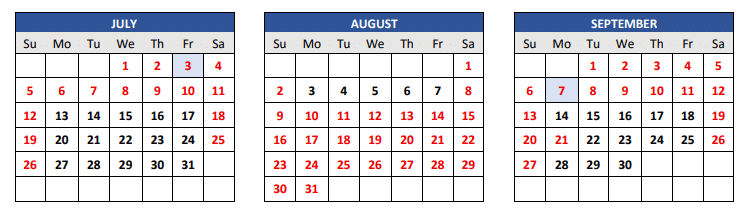
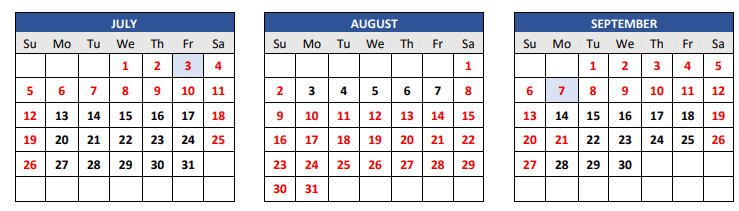
Source: Senate Calendar 2026 (red dates mean the Senate is not in session)

So, what exactly is the issue and path forward for the bill?

The main problem is that no scheduled floor vote date has been issued. Besides, the final text of the bill has not been made public. The final text of the bill is speculated to be released in early July.

In fact, Stand With Crypto, a lobby group affiliated with Coinbase, also echoed the urgency and reinforced Thorn’s concerns.

The Senate going on recess without voting means the Clarity Act doesn’t disappear, but it slips. The Senate has a crowded calendar, and the window for Clarity continues to narrow each day.

That said, on the contentious Section 604, Ark Invest’s Cathie Wood backed a “thoughtful, nuanced” approach that does not push the market overseas again.
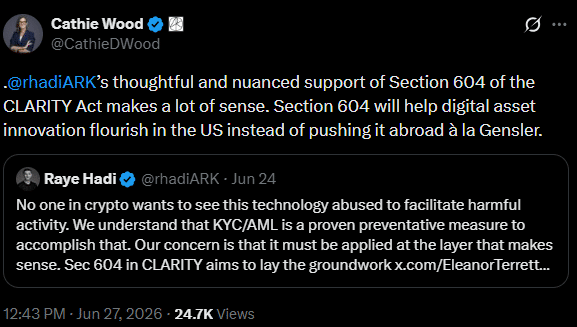
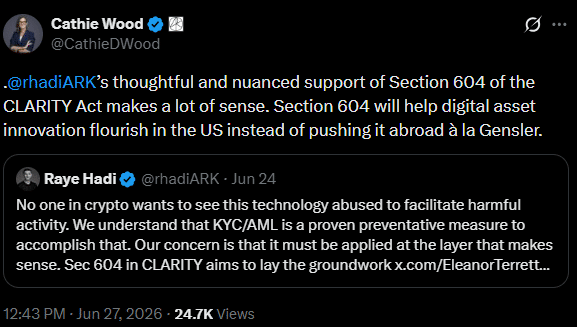
Source: X

Overall, the bill may hit a wall if the next four weeks don’t present material progress on key issues and the Senate floor vote date.


Final Summary

  • Galaxy reduced its CLARITY Act passage chance from 60% to 50%.
  • Cathie Wood backed the contentious Section 604 but asked for a ‘thoughtful, nuanced’ application.


Perguntas relacionadas

QWhy did Galaxy Research lower the CLARITY Act passage probability from 60% to 50%?

AGalaxy Research lowered the probability primarily due to the tight Senate calendar following President Donald Trump's stance on a separate, unrelated bill (the SAVE Act), which intensifies competition for scarce Senate floor time.

QWhat key issues remain unaddressed in the CLARITY Act, according to the article?

AThe key issues that remain largely unaddressed are stablecoin yield, ethics provisions, and the contentious Section 604 regarding developer protections.

QHow many weeks of active Senate sessions are left before the August recess to pass the CLARITY Act?

AThere are about four weeks of active Senate sessions left before the August recess begins on the second week of the 10th.

QWhat two things must happen before the CLARITY Act can proceed to a Senate floor vote?

ABefore a Senate floor vote, the bill's versions from the Senate Banking and Agriculture committees must be reconciled into a single piece of legislation, and then a scheduled floor vote date must be issued.

QWhat is Stand With Crypto's main concern regarding the CLARITY Act's timeline?

AStand With Crypto is concerned that the Senate's crowded calendar means the window of opportunity for the CLARITY Act to pass continues to narrow each day.

Leituras Relacionadas

In Jinjiang, Fujian, a Storage Super Unicorn Lies Quiet

In Fujian's Jinjiang, a city known for sportswear, lies a quiet semiconductor giant: Fujian Jinhua Integrated Circuit Co. (JHICC). Once a promising domestic DRAM manufacturer alongside Yangtze Memory and ChangXin Memory Technologies (CXMT), its journey was derailed in 2018 when the U.S. placed it on an Entity List and filed criminal charges for alleged trade secret theft. This halted production for years. A turning point came in February 2024 when a U.S. federal court found JHICC not guilty. However, it had lost crucial time. While CXMT soared to become a top-valued A-share company in 2024, JHICC, with an estimated valuation of 80 billion RMB, was just restarting. Its current output is primarily customized DDR4 chips, not the advanced DDR5/HBM demanded for AI, but it still benefits from the broader memory chip upcycle. JHICC's story is tied to Chen Zhengkun, a veteran engineer who left Micron to lead the venture. Founded in 2016 with state-backed funding, JHICC partnered with Taiwan's UMC to develop DRAM technology. Rapid progress was cut short by the U.S. actions, which Micron initiated, partly due to its heavy reliance on the Chinese market. Post-sanctions, Chen's team worked to rebuild the production line with reduced reliance on U.S. technology. According to its records, JHICC achieved small-scale production and revenue growth under immense pressure. It now focuses on the stable "niche" DRAM market (e.g., TVs, routers) with a monthly capacity of ~40,000 wafers, aiming for 60,000 by 2026. It holds over 1,000 patents but remains on the Entity List. For Jinjiang, investing in JHICC was a bold industrial leap. The local government provided unwavering financial and logistical support during the crisis, helping the company survive. JHICC has become the anchor for a growing local semiconductor cluster. Though its scale lags behind domestic peers, JHICC's persistence symbolizes a hard-won foothold in a global market long dominated by Samsung, SK Hynix, and Micron. Having missed one boom, it seeks a place in the new AI-driven memory supercycle.

marsbitHá 46m

In Jinjiang, Fujian, a Storage Super Unicorn Lies Quiet

marsbitHá 46m

Trading

Spot
活动图片




