Will Maple Finance [SYRUP] extend rally as TVL hits $2.2B? THESE metrics say…

ambcryptoPublicado em 2026-07-11Última atualização em 2026-07-11

Resumo

Maple Finance's SYRUP token rallied 14%, driven by strong fundamental growth. The protocol's assets under management hit $4.6 billion in H1 2026, an 81% year-on-year increase, while total value locked (TVL) surged past $2.2 billion. A key driver is the recent launch of syrupUSDG on Robinhood, which saw over $200 million in inflows. On-chain data shows about 18% of SYRUP's supply is staked, tightening market availability. Additionally, the protocol reported strong yields, outperforming industry benchmarks. A proposed revenue-linked buyback program could further support the token's value, with buybacks scaling up to 30% of monthly revenue if it exceeds $2 million.

Maple Finance [SYRUP] has climbed over the past day, and much of that move traces back to the protocol’s strengthening fundamentals.

The altcoin rallied 14% as fresh partnerships and capital rotation flowed into the ecosystem, and that underlying performance could sustain the rally across the next several trading sessions.

Capital inflows power SYRUP’s fundamentals

Capital moving into Maple Finance has driven much of the token’s recent performance.

Assets under management reached $4.6 billion in the first half of 2026, up 81% year-on-year, while loans outstanding hit an all-time high of $1.9 billion, a 123% jump over the same period.

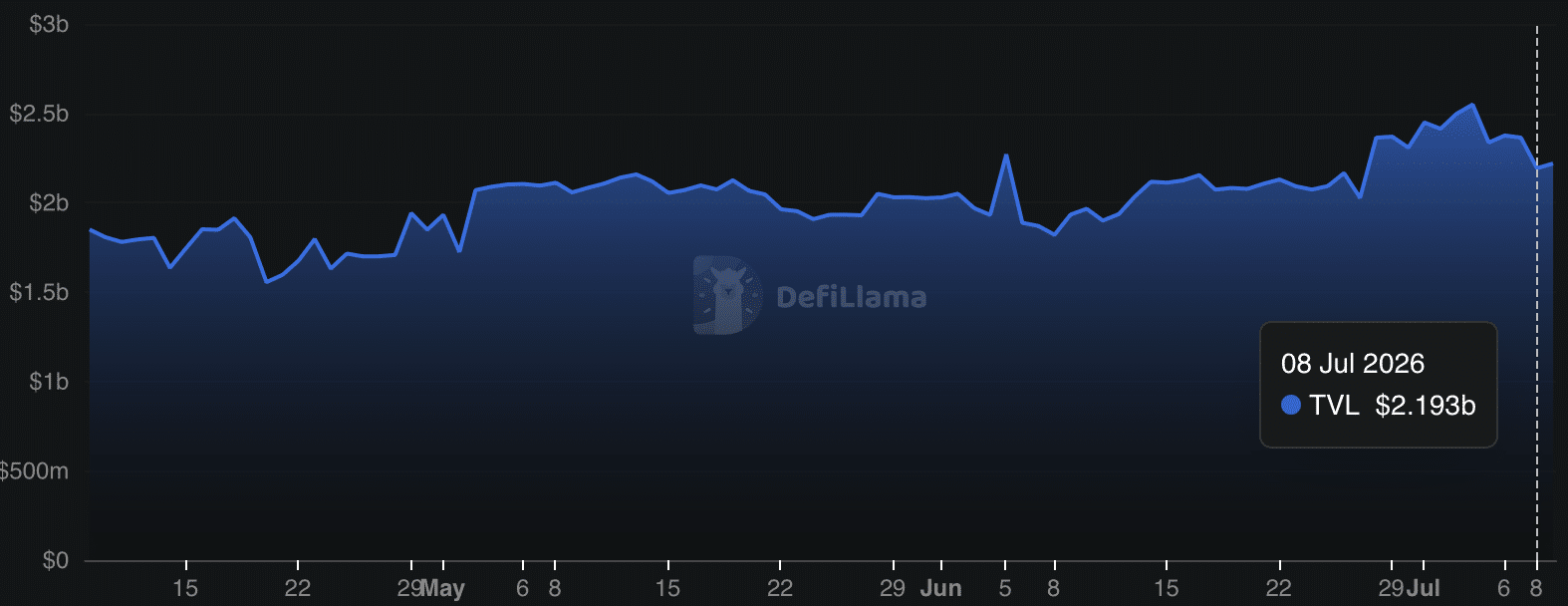
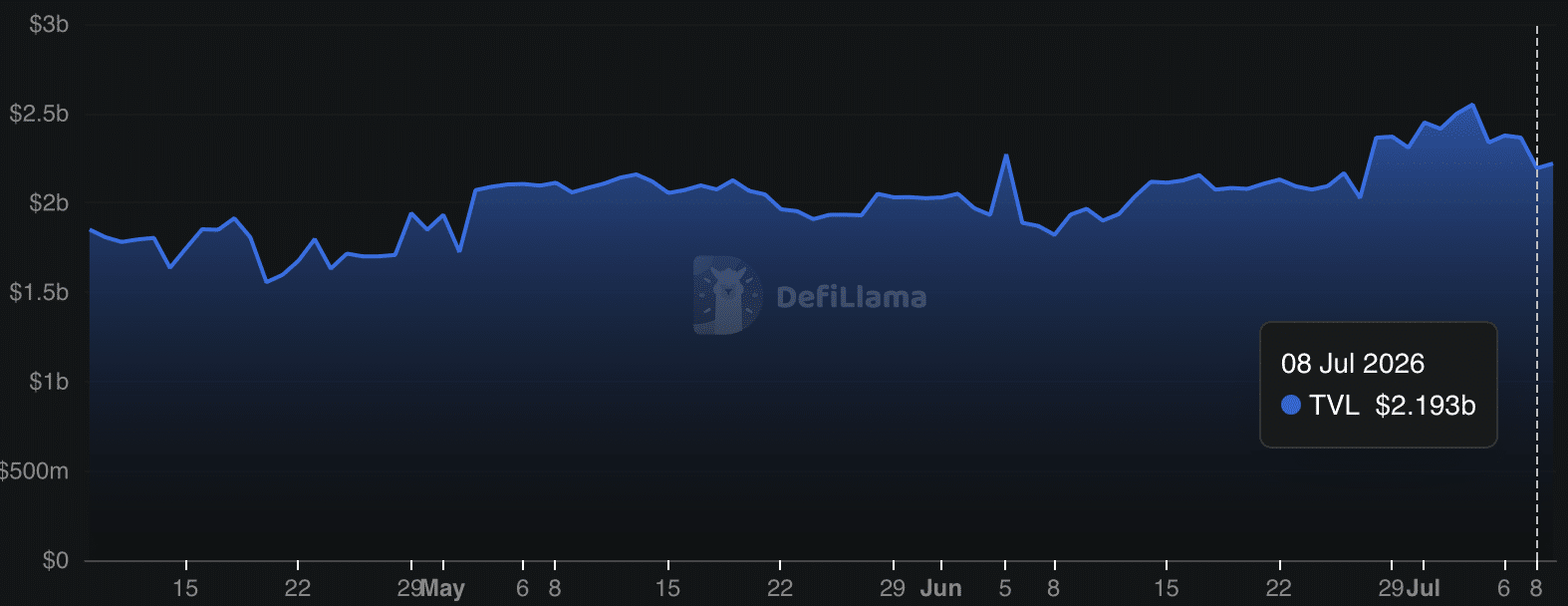
The flow reflects in the protocol’s total value locked (TVL), which measures the assets deposited and locked on the platform mostly by investors holding a long-term outlook, and which surged by more than $220 million over the past day to reach a high of $2.265 billion.
Source: TradingView

Much of the inflow points to syrupUSDG, which recently launched on Robinhood and has seen its assets under management climb by more than $200 million according to Maple’s own data.

Sid Powell, co-founder and CEO of Maple Finance, tied much of the growth to demand from fintech and neobank users, noting that the comparable SyrupUSDT product took more than 18 months to reach $100 million in AUM.

How syrupUSDG demand translates to SYRUP growth

SyrupUSDG is an interest-bearing token issued by the decentralized credit protocol Maple Finance, and holders who deposit the Global Dollar (USDG) stablecoin earn returns generated through institutional lending.

Rising adoption of SyrupUSDG feeds activity back into Maple, and that in turn lifts demand for the native token.

The link shows up on-chain, with DeFiLlama data reporting roughly 18% of the token’s market capitalization already staked, worth $36.93 million at the time of reporting, tightening the supply available to the market.

Maple’s yields has played a major role too. The company’s recent report shows the protocol outperformed the industry benchmark by more than 117 basis points at an APY of 4.765% against a benchmark of roughly 3.590%.

SYRUP market outlook and buyback proposal

SYRUP carries a longer-term case beyond the current move, anchored by a proposal to introduce revenue-linked buybacks that scale with earnings.

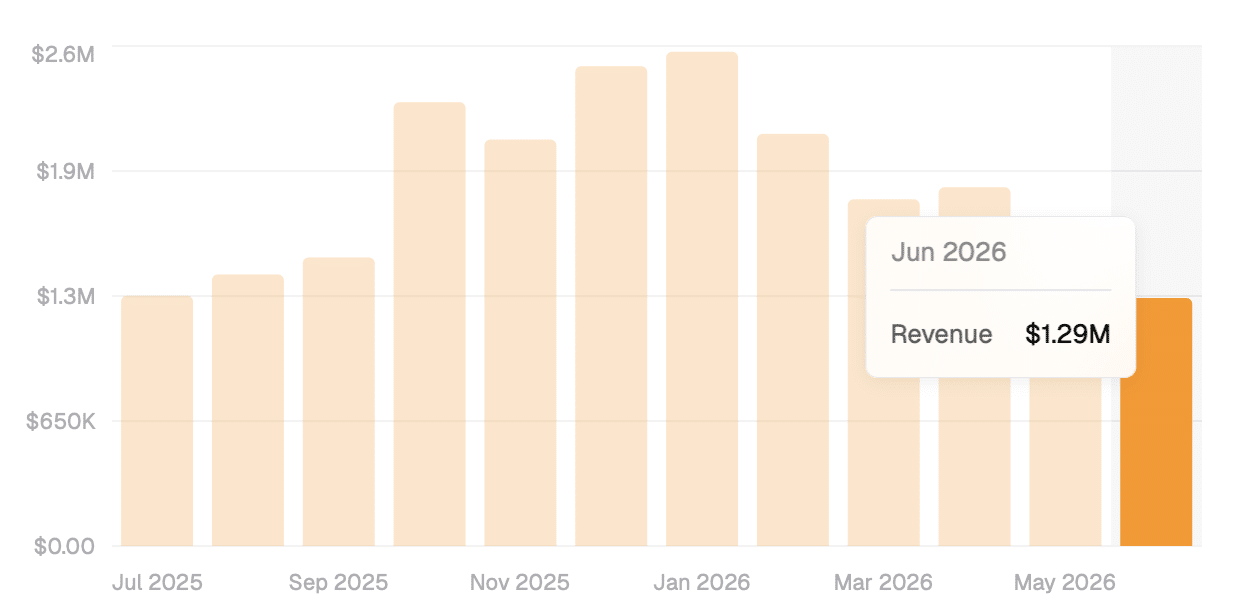
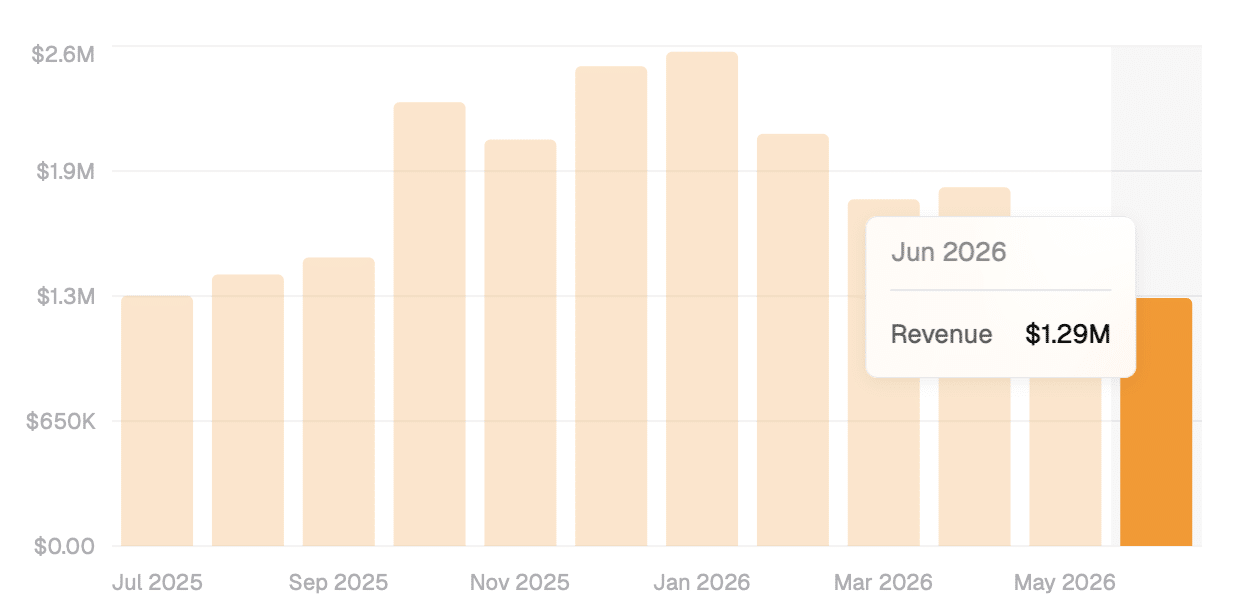
The SYRUP Strategic fund released a plan for a tiered buyback tied to a share of monthly revenue, under which repurchases could rise to as much as 30% once revenue climbs above $2 million.
Source: MapleFinance

That threshold is within reach given the protocol’s trajectory. Maple posted $4.4 million in second-quarter revenue, up 47% year-on-year, and now runs at $17.6 million in annualised recurring revenue, which works out to just under $1.5 million a month against June’s $1.29 million.

The framework would run for roughly six months if approved, landing at a point where the protocol’s revenue is closing in on the level that would unlock its steepest buyback tier.


Final Summary

  • Maple Finance’s SYRUP rallied 14% as H1 2026 assets under management reached $4.6 billion, up 81% year-on-year.
  • A proposed revenue-linked buyback could repurchase up to 30% of monthly revenue once it clears $2 million, and could contribute to shortterm outlook.


Criptomoedas em alta

Perguntas relacionadas

QWhat is the main reason behind Maple Finance's SYRUP token rallying 14% recently?

AThe main reason is the protocol's strengthening fundamentals, driven by capital inflows, fresh partnerships, and new product launches like syrupUSDG.

QHow has Maple Finance's Total Value Locked (TVL) changed recently, and what does it signify?

AMaple Finance's TVL surged by over $220 million in a day to reach a new high of $2.265 billion. This signifies strong capital inflows from investors with a long-term outlook.

QWhat is syrupUSDG and how does its demand impact the SYRUP token?

AsyrupUSDG is an interest-bearing token issued by Maple Finance for the USDG stablecoin. Rising demand for it increases activity on the Maple protocol, which in turn boosts demand for the native SYRUP token and tightens its available supply.

QWhat is the proposed plan regarding SYRUP buybacks, and how is it structured?

AThe SYRUP Strategic fund proposed a tiered, revenue-linked buyback plan. It would use a share of monthly revenue to repurchase SYRUP, with buybacks scaling up to as much as 30% of revenue once it climbs above $2 million per month.

QWhat were Maple Finance's key financial performance metrics mentioned for the first half of 2026?

AKey metrics for H1 2026 included: Assets Under Management reaching $4.6 billion (up 81% YoY), loans outstanding hitting an all-time high of $1.9 billion (up 123% YoY), and Q2 revenue of $4.4 million (up 47% YoY).

Leituras Relacionadas

Manufacturing's Share Drops Below 25%: Is Hangzhou Unconcerned?

Hangzhou is entering a critical phase of industrial restructuring. While its manufacturing-to-GDP ratio has fallen below 25%, the city is not alarmed. Instead, it is strategically navigating a dual focus: advancing advanced manufacturing and expanding its service sector, particularly producer services. Recently, the city celebrated the IPO of a humanoid robotics company, seen as a milestone in moving beyond its e-commerce era. Simultaneously, it set an ambitious target for its service sector: to exceed 2 trillion yuan in value by 2030, with producer services making up over 60%. Data shows a clear trend: the service sector's share of GDP has risen to 75.3%, while manufacturing's share has declined to around 20.1%. This shift revives the debate on whether a strong service sector weakens a city's manufacturing "foundation." Hangzhou's approach challenges the notion of a fixed manufacturing "red line" near 25%. The city argues that the quality and integration of industries matter more than simple ratios. Its strategy is "using software to drive hardware," leveraging its core strengths in digital economy and producer services—like R&D, software, and supply chain management—to empower and add value to manufacturing. This is embodied by its emerging "AI era" companies, whose innovation in Hangzhou feeds into national industrial chains. The city believes that for a hub like Hangzhou, the key is not merely boosting visible manufacturing output, but strengthening the "invisible" competitive edge provided by high-end producer services, which ultimately determine manufacturing profitability. National policy is also shifting from insisting on a "stable" manufacturing share to acknowledging a "reasonable" range, allowing for quality-focused development. Hangzhou's future industrial blueprint aims for a manufacturing share above 22% of GDP by 2027, coupled with a dominant, high-value service sector. The goal is not to choose between manufacturing and services, but to deeply integrate them, using advanced services as the accelerator for next-generation manufacturing.

marsbitHá 18m

Manufacturing's Share Drops Below 25%: Is Hangzhou Unconcerned?

marsbitHá 18m

SEC Suddenly Proposes "Regulation Crypto": U.S. Token Fundraising May Become Legal Again

On August 18, the U.S. Securities and Exchange Commission (SEC) proposed a landmark set of permanent rules, "Regulation Crypto Assets," specifically designed for crypto asset investment contracts. The 402-page proposal introduces two registration exemption paths and a groundbreaking safe harbor mechanism, representing the SEC's first dedicated crypto-specific regulatory framework. Two exemption tiers are proposed: a "Startup Exemption" allowing a one-time raise of up to $5 million within four years with basic disclosure requirements, and a "Financing Exemption" permitting raises of up to $75 million every 12 months with stricter obligations, including financial statements and ongoing reporting. Both paths require "principles-based narrative disclosure," a flexible approach distinct from traditional IPO forms. The most transformative element is the investment contract safe harbor. It provides a legal path for tokens to "graduate" from being classified as securities. If an issuer completes or permanently ceases its "essential managerial efforts" as promised in the investment contract and meets specific conditions, it can file with the SEC to have the token exit the securities framework. This creates a novel legal lifecycle where a token can begin as a regulated security for fundraising and later become a non-security asset as the network decentralizes. This move is seen as the SEC pragmatically filling a legislative vacuum, as the stalled CLARITY Act in Congress faces significant delays. The proposal aims to offer a compliant pathway for token offerings within the U.S., countering the trend of projects moving overseas. While currently a proposal open for a 60-day public comment period, it signals a major potential shift from an enforcement-heavy approach toward establishing clearer rules for the crypto industry.

marsbitHá 22m

SEC Suddenly Proposes "Regulation Crypto": U.S. Token Fundraising May Become Legal Again

marsbitHá 22m

Late Qing County Magistrates' 'Official Debt' and the Crypto World's 'Exchange Listings': The Cross-Temporal Truth of Financializing Power

This article draws parallels between financialization of power in late Qing Dynasty China and the modern cryptocurrency industry. It opens with a staggering contemporary corruption case involving billions, illustrating how official positions control massive cash flows, akin to toll booths. The core analysis focuses on Du Fengzhi, a late Qing county magistrate. His 22-year journey from passing the provincial exam to finally obtaining a post highlights how bureaucratic "qualification" (like a VC investment) doesn't guarantee immediate benefit. Crucially, upon receiving his appointment, Du had to borrow heavily—"official debt"—to cover travel and networking costs to actually assume his position. Lenders, seeing his future post as a revenue-generating asset, offered loans with exorbitant effective interest rates (e.g., borrowing 4000 taels but receiving only 2000), effectively discounting and financializing his future power. Once in office, Du faced immense pressure from both public tax quotas and his crippling private debt. His diaries reveal aggressive, sometimes extreme, tax collection methods (sealing ancestral temples, pressuring local gentry) to meet these demands. The article argues this created a system where public duty and private financial survival became indistinguishable, with corruption evolving from operational necessity to normalized practice. The piece consistently analogizes this to crypto: VC funding as mere "qualification," the costly "listing" process on exchanges, the role of market makers and KOLs as intermediaries akin to local gentry, and the relentless pressure on funded projects to deliver returns—often leading to perpetual pivots, artificial metrics, and ultimately, the extraction of value from retail liquidity. Both systems, it concludes, are driven by the financialization of future potential, trapping individuals in cycles of debt and obligation with limited alternatives for upward mobility.

marsbitHá 30m

Late Qing County Magistrates' 'Official Debt' and the Crypto World's 'Exchange Listings': The Cross-Temporal Truth of Financializing Power

marsbitHá 30m

U.S. Stock Market Trends (August 19th): AI Hardware Rally Loosens, Long-Term Bond Yields Challenge Tech Valuations

U.S. stocks weakened further on Tuesday, with major indices hitting two-week lows for a third consecutive session. Pressure centered on the AI hardware sector, as the previously rebounding Philadelphia Semiconductor Index fell sharply. Meanwhile, persistently high long-term Treasury yields and rising oil prices fueled by Middle East tensions prompted a cautious reassessment of high-valuation tech assets. Key closing data: The S&P 500 fell 0.69%, the Dow Jones dropped 0.22%, and the Nasdaq declined 1.33%. The 10-year Treasury yield hovered near 4.70%, while the 30-year yield briefly touched a new high since 2007 before settling around 5.28%. WTI crude rose to $84.94. The chip sector led the decline, with the Philadelphia Semiconductor Index dropping about 5%. Losses spread across memory, optical communication, and AI infrastructure stocks. This shift indicates investor focus is moving from chasing AI demand momentum to evaluating valuations and earnings timing. The "Magnificent Seven" stocks showed mixed performance, with pressure more concentrated on AI hardware than software giants. The market is observing whether capital will rotate back to large-cap tech, sustaining the internal AI sector rotation, or if the broader AI trade is entering a cooling phase. Chinese stocks were mostly weaker, with the Nasdaq Golden Dragon China Index down about 1%. Baidu's stock fell sharply post-earnings due to profit pressure from AI investments, while Alibaba gained. Persistently high long-term bond yields and rising oil prices are re-emerging as key anchors for U.S. stock pricing, constraining valuation multiples for AI-related companies. Corporate events, including earnings from Home Depot and AI financing news like Anthropic's reported credit line expansion, continue to highlight cost and capital expenditure pressures. Focus for the coming sessions: 1) Whether the 30-year Treasury yield stabilizes below 5.30%, and 2) The market's ability to absorb the chip sector sell-off, determining if it's a pre-earnings consolidation or the start of a broader AI hardware cool-down.

marsbitHá 34m

U.S. Stock Market Trends (August 19th): AI Hardware Rally Loosens, Long-Term Bond Yields Challenge Tech Valuations

marsbitHá 34m

Galaxy Research: Crypto Lending Contracts for Third Consecutive Quarter, Market Undergoing Orderly Deleveraging

**Galaxy Research Report: Crypto Lending Market Sees Orderly Deleveraging for Third Consecutive Quarter** The crypto asset-backed lending market contracted for a third consecutive quarter in Q2 2026, shrinking by $11.33B (-16.78%) to a total of $56.16B. This represents a 40.13% decline from the Q3 2025 peak. The process is marked by a controlled, "stair-step" decline rather than the sharp, cascading collapses seen in 2022, suggesting a healthier, more orderly deleveraging driven by market retrenchment rather than forced liquidations. Key findings include: * **CeFi vs. DeFi:** Centralized Finance (CeFi) lending ($22.98B) surpassed Decentralized Finance (DeFi) lending ($20.43B) for the first time since Q3 2023, as DeFi loan volumes fell 27.61% quarter-over-quarter. * **Market Leaders:** Tether remains the dominant CeFi lender, holding 58.54% market share. CeFi's top three players (Tether, Maple, Nexo) control nearly 75% of that segment. * **Corporate Debt:** Debt used by companies for digital asset treasury strategies declined by $1.5B to $16.1B, mainly due to a debt buyback by MicroStrategy. * **Rates & Leverage:** Stablecoin borrowing costs edged higher. Analysis of Aave V3 shows e-mode loans, primarily used for leveraged Ethereum staking strategies, carry significantly higher risk (debt-weighted avg. Health Factor ~1.06) compared to standard loans. * **Futures:** Aggregate futures open interest (OI) was relatively stable, down only 3.08% to $103.2B at quarter-end, though it has since rebounded. BTC and ETH futures OI together comprised 65% of the total. In conclusion, the crypto market continues to shed leverage in a measured manner. If this trend persists, the market may avoid the type of disorderly, cascading failures seen in the last cycle, even if lending activity continues to contract.

marsbitHá 54m

Galaxy Research: Crypto Lending Contracts for Third Consecutive Quarter, Market Undergoing Orderly Deleveraging

marsbitHá 54m

Trading

Spot

Artigos em Destaque

Como comprar SYRUP

Bem-vindo à HTX.com!Tornámos a compra de Maple Finance (SYRUP) simples e conveniente.Segue o nosso guia passo a passo para iniciar a tua jornada no mundo das criptos.Passo 1: cria a tua conta HTXUtiliza o teu e-mail ou número de telefone para te inscreveres numa conta gratuita na HTX.Desfruta de um processo de inscrição sem complicações e desbloqueia todas as funcionalidades.Obter a minha contaPasso 2: vai para Comprar Cripto e escolhe o teu método de pagamentoCartão de crédito/débito: usa o teu visa ou mastercard para comprar Maple Finance (SYRUP) instantaneamente.Saldo: usa os fundos da tua conta HTX para transacionar sem problemas.Terceiros: adicionamos métodos de pagamento populares, como Google Pay e Apple Pay, para aumentar a conveniência.P2P: transaciona diretamente com outros utilizadores na HTX.Mercado de balcão (OTC): oferecemos serviços personalizados e taxas de câmbio competitivas para os traders.Passo 3: armazena teu Maple Finance (SYRUP)Depois de comprar o teu Maple Finance (SYRUP), armazena-o na tua conta HTX.Alternativamente, podes enviá-lo para outro lugar através de transferência blockchain ou usá-lo para transacionar outras criptomoedas.Passo 4: transaciona Maple Finance (SYRUP)Transaciona facilmente Maple Finance (SYRUP) no mercado à vista da HTX.Acede simplesmente à tua conta, seleciona o teu par de trading, executa as tuas transações e monitoriza em tempo real.Oferecemos uma experiência de fácil utilização tanto para principiantes como para traders experientes.

320 Visualizações TotaisPublicado em {updateTime}Atualizado em 2026.06.02

Como comprar SYRUP

Discussões

Bem-vindo à Comunidade HTX. Aqui, pode manter-se informado sobre os mais recentes desenvolvimentos da plataforma e obter acesso a análises profissionais de mercado. As opiniões dos utilizadores sobre o preço de SYRUP (SYRUP) são apresentadas abaixo.

活动图片