Why Truly Mature Traders Are Starting to Monitor Bitcoin Volatility

marsbitPublicado em 2026-03-20Última atualização em 2026-03-20

Resumo

The article explains why sophisticated traders are increasingly focusing on Bitcoin volatility rather than just price direction. It argues that while price indicates where the market is, volatility reveals the density of risk and the path ahead. Many traders lose not because they misjudge direction, but because they misjudge volatility—entering or exiting at inopportune times due to unexpected swings. The text distinguishes between historical volatility (past price movements), implied volatility (market expectations derived from options pricing), and volatility indices like BVIX, EVIX, and Cboe’s BITVX, which make future volatility expectations visible and tradable. These instruments signal a maturation in crypto markets, shifting from purely trading price to also trading risk, uncertainty, and market expectations. A key insight is that low volatility does not mean low risk; it often masks growing fragility, as complacency leads to increased leverage and crowded strategies. When volatility is compressed, the risk of a sudden, extreme move (a "fat tail" event) rises. Conversely, high implied volatility may indicate overpriced fear, creating opportunities to sell volatility for seasoned traders. The article concludes that understanding volatility is essential for advanced trading—it helps with risk management, identifies mispriced expectations, and reveals market sentiment before price moves. As crypto develops better volatility infrastructure, traders who monitor indicators...

Author: Michel Athayde

Many traders have experienced the same kind of frustration: they correctly predicted the direction, but still ended up not making money.

You predicted Bitcoin would rise, and it did, but you chased the breakout and were quickly stopped out by a sharp pullback. You predicted the market reversal was coming, and it did, but before the big move truly unleashed, those whipsawing minor fluctuations had already exhausted your position, patience, and stop-loss space. Superficially, you lost to the rhythm; on a deeper level, you lost to a misjudgment of volatility.

This is precisely why many people, having long focused only on price, still struggle with trading. Price answers "where is the market now," while volatility answers "how restless might the market be next." The former describes the outcome, the latter describes the path; the former tells you the direction, the latter tells you the density of risk.

Therefore, truly mature market participants are no longer just looking at whether BTC will rise or fall, but at how the market is pricing "future volatility."

This is particularly noteworthy recently. More and more platforms and institutions are turning "crypto volatility" from a professional variable隐含 in options into more explicit indices and trading objects. Gate has already listed BVIX and EVIX perpetual contracts, and BitMart has also listed the corresponding BVIXUSDT and EVIXUSDT; meanwhile, Cboe announced in March 2026 the launch of BITVX based on IBIT options. According to its announcement, this index uses a VIX-like methodology to measure Bitcoin's 30-day forward-looking volatility.

This indicates that the crypto market is moving from "only trading price" to "simultaneously trading price, expectations, and risk."

What exactly is volatility?

To explain it in as straightforward a sentence as possible, volatility is the measure of the magnitude of price changes. It doesn't answer the direction, only "how much will it move."

This means that even if a market does not show obvious gains or losses, as long as the intraday and interday swings are large enough, volatility can be high. Conversely, even if a market is rising, as long as the process is smooth enough, volatility may not necessarily be high.

To understand Bitcoin volatility, it is most important to distinguish three levels.

The first level is historical volatility. It is calculated based on past price data, measuring how much BTC has actually fluctuated over a certain period. It's like a rearview mirror, telling you how bumpy the market has been in the past, but it cannot directly represent the future. Historical volatility is suitable for review, horizontal comparison, and risk control baselines, but not for direct prediction of the future.

The second level is implied volatility. It is not directly calculated from past prices, but is derived from option prices, reflecting the market's expectation of future volatility. Mainstream definitions generally emphasize that implied volatility reflects the market's expectation of the magnitude of future fluctuations, not the realized volatility itself. In other words, options are expensive not only because the market is bullish or bearish, but also because the market is putting a price on future uncertainty.

The third level is the volatility index. You can think of it as compressing the market's expectation of volatility over a future period into a more intuitive, observable, and comparable number. In traditional finance, the VIX is the most typical representative. Now, Bitcoin is also acquiring a similar "fear thermometer." Cboe's description of BITVX is that it is based on IBIT options, using its VIX methodology, to measure Bitcoin's 30-day forward-looking volatility.

From this perspective, the truly important thing about indicators like BVIX and EVIX is not whether the name is new, but that they have turned a core variable that originally only existed in complex derivative pricing into something more traders can directly understand and observe.

Why does price not moving not mean risk is low?

Many people are accustomed to interpreting "sideways movement" as "safe" and "low volatility" as "nothing's happening." But in the real market, the opposite is often true.

Calm prices only indicate that volatility has not been released for the time being; it does not mean that the risk has disappeared, nor does it mean the system is more stable. Often, long-suppressed low volatility is accompanied by a rise in something more hidden: fragility.

Because once the market gets used to calm, participant behavior changes accordingly. Leverage will slowly increase, stop-losses will gradually loosen, risk budgets will become more aggressive, and strategies like selling volatility, earning premium, and collecting time value will become increasingly crowded. On the surface, volatility disappears; but more accurately, risk is squeezed into a position that is harder to see.

This is also why the truly dangerous moments are often not when violent fluctuations are already happening, but when volatility has been compressed for a long time and everyone starts to believe that "nothing should go wrong."

Once an unexpected shock occurs at this time, the market faces not ordinary volatility, but the sudden realization of tail risk. Originally seemingly linear price changes can quickly turn into non-linear stampedes, chain liquidations, and liquidity evaporation. What many people earn during low volatility periods is just some small, very stable "calm returns"; but a fat tail extreme event is enough to swallow these returns principal and interest included.

So, low volatility does not naturally equal low risk. Often, it just transfers risk from "visible volatility" to "invisible fragility."

This is also why volatility is worth studying separately. It not only tells you whether the market has been moving a lot lately, but also reminds you: is the market's pricing of future uncertainty beginning to deviate from this surface calm?

For traders, there is a very important sentence here: When volatility is extremely compressed, do not take on extremely asymmetric risks for small profits. What you see in front of you may just be quiet; but what is accumulating deep in the market may be a violent release that has not yet been realized.

Why does volatility often reflect sentiment earlier than price?

Price is explicit; volatility is often leading.

A period where the chart may seem unchanged, the candlesticks even look boring, but as long as the market starts paying a higher premium for future uncertainty, volatility will move first. That is, the行情 hasn't truly developed yet, but capital is already paying for "the big move that might happen."

This is where volatility is more valuable than price. Price reflects the result of already concluded transactions, while volatility is closer to the提前 pricing of collective market psychology. It reflects not simply the bullish or bearish direction, but the degree of divergence, the density of anxiety, the intensity of expectations.

The reverse is also true. A decline in volatility does not automatically equal bullishness, nor does it automatically equal bearishness. A more common implication is that the market's divergence over the future path is narrowing, or short-term risks are considered less urgent. But another situation is equally important:持续 compression of volatility is sometimes not the disappearance of risk, but risk that has not yet materialized. Truly experienced traders will not just ask "will it rise," but will first ask: next, will volatility expand or continue to contract?

This is the core认知 of the entire article: Volatility is not an accessory to price, but the price of market expectations itself.

From BVIX, EVIX to BITVX: Volatility is becoming new infrastructure for the crypto market

If we broaden the perspective a bit, what products like BVIX, EVIX, and BITVX truly illustrate is not that another platform has listed two new products, but a clearer industry trend: the crypto market is gradually补全 the infrastructure layer of "volatility pricing."

Gate's announcement shows that BVIX and EVIX perpetual contracts were listed on January 28, 2026, supporting 1 to 50x leverage; BitMart also issued an announcement listing BVIXUSDT and EVIXUSDT perpetual contracts on the same day. Cboe announced in March 2026 that it plans to launch BITVX on March 23, introducing its VIX-style volatility methodology to the Bitcoin market.
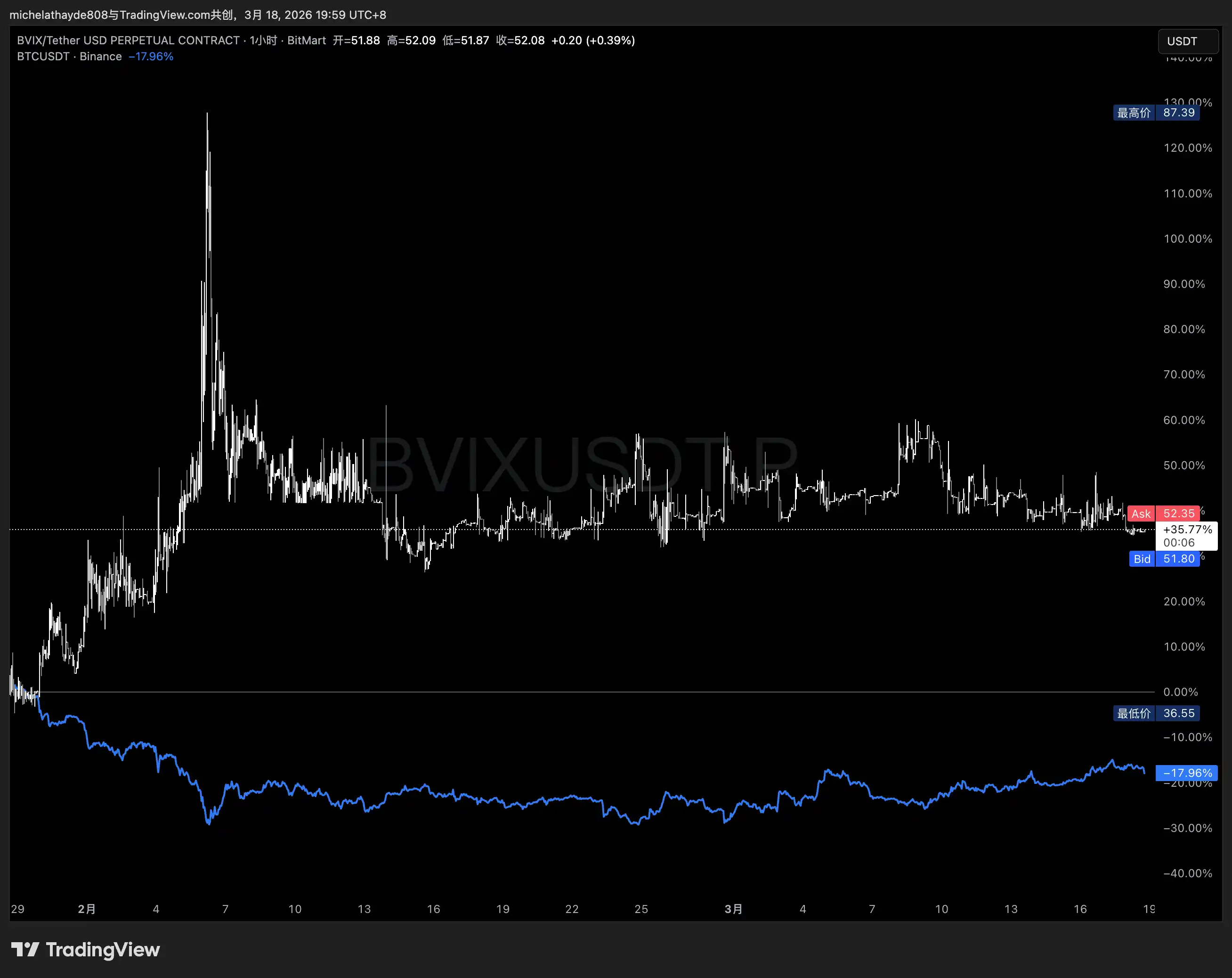
Figure: BVIX vs. BTC trend, gray-white candlesticks are BVIX, blue line is BTC

Looking at these events together, the meaning is clear: The expression of volatility around crypto assets is gradually changing from scattered, professional information hidden in the option surface to a more standardized, explicit index system.

The more mature a market is, the less it will only trade direction. It will also trade risk, trade divergence, trade the uncertainty of future paths. Whoever can more accurately understand what risk the market is actually putting a price on is closer to the true core of this market.

Therefore, the most noteworthy aspect of products like BVIX and EVIX is not whether they are new hot topics, but that they represent a change in the crypto market structure: this market is beginning to more seriously quote prices for "future uncertainty."

How to use volatility in实战?

Many people's first reaction when mentioning volatility is risk control. Actually, this is only half right. Volatility can certainly help you defend, but more importantly, it can also help you understand when the market is selling panic at a high price and when it is selling calm at a low price.

1. Defensive perspective: Don't chase in when sentiment is most expensive

When the price has just broken out, market sentiment quickly ignites, and BVIX or EVIX surges simultaneously, many people will instinctively feel "this is the real breakout." But from a volatility perspective, this often means the market is paying a high premium for future uncertainty.

This is not necessarily a time when you cannot go long, but you need to understand: what you are buying may not only be the direction, but also an already expensive emotional price.

When volatility is high, the margin for error in chasing rallies and selling dips usually decreases significantly. You might be right on direction, but because you entered at the point where sentiment was most euphoric and expectations were most expensive, you still end up not getting ideal returns. Being right on direction does not equal a correct trade; often, what eats away profits is not being wrong on direction, but buying too expensively.

2. Risk identification perspective: Surface calm does not necessarily mean真正的安全

Another more hidden and dangerous scenario is when prices narrow, the market is dull, and many people start to think "there's no risk now." But if you observe that the volatility structure begins to move abnormally, or the market's pricing for future events quietly rises, it indicates that the calm may only be a surface phenomenon.

The most important thing to do at this stage is not to immediately bet on a direction, but to first acknowledge one thing: the market内部 may be accumulating fragility that you cannot see with the naked eye.

For high-leverage traders, this stage is particularly dangerous. Because what truly destroys accounts is often not the big volatility you can see, but the fact that you increased your risk exposure when things "looked fine."

3. Offensive perspective: When panic is being sold at a high price, selling volatility may be more attractive

The真正 interesting thing about volatility is that it can not only signal danger but also provide offensive windows at the strategy level.

When BVIX, EVIX soar, or more broadly, when implied volatility is significantly higher than historical realized volatility, it indicates that the market is paying a very high premium for future uncertainty. For directional traders, this is often one of the most uncomfortable zones because what you are buying is not just the direction, but expensive panic itself.

But for more mature traders, this may instead imply another type of opportunity: selling overestimated volatility.

In the traditional derivatives framework, this type of thinking is typically manifested as selling high implied volatility options, collecting higher premiums, or executing systematic rolling short option strategies to earn sentiment premiums and time decay. Its core logic is not "I must be bearish," but "I think the market's pricing of future volatility is too high."

Of course, this is not a direction suitable for novices to imitate rashly. Selling volatility is essentially a business of making small money while carrying large risks, most afraid of tail events suddenly landing. It has very high requirements for margin management, position constraints, liquidity judgment, and tail hedging. Precisely for this reason, the真正 important thing is not to have everyone become a seller, but to understand a higher-dimensional trading logic: when others are trading direction, mature traders may be trading "whether expectations are overestimated."

4. Relative value perspective: Observing the volatility difference between BTC and ETH

In addition to looking at single volatility levels, the volatility difference between BTC and ETH is also worth observing.

If EVIX remains significantly higher than BVIX, it usually means the market believes ETH faces higher uncertainty, or is willing to pay a higher risk premium for ETH's future path. This does not necessarily give a simple bullish or bearish conclusion directly, but it can help you understand which asset capital is betting risk on, and also assist in judging whether the market currently prefers core hedging or high-elasticity speculation.

Often, the truly valuable information is not in one absolute number, but in the relative changes between different assets and different time periods. The volatility spread is, to some extent, the temperature difference of risk appetite.

The real upgrade is not knowing how to predict rise/fall, but knowing how to read "expectations"

Many traders, upon growing to a certain stage, slowly discover a fact: the hardest thing about the market is never guessing a single rise or fall, but understanding what the market is pricing.

Sometimes, the market prices direction; sometimes, the market prices liquidity; but at many critical moments, what the market is truly trading expensively is uncertainty itself.

This is also why volatility should not be understood as an accessory indicator to price. It is not a footnote next to the行情, nor is it an advanced term only option players need to care about. It is itself a kind of price, a price for future paths, risk distribution, and expectation divergence.

Price reflects the present; volatility prices the future.

And what is most expensive about the future is often not the trend itself, but people's fear of the unknown, or their mistaken belief in calm.

When more and more traders start paying attention to volatility indicators like BVIX, EVIX, and BITVX, what they are truly concerned about is no longer just whether Bitcoin will rise or fall, but:

Could this market be more violent than imagined?

Is this expectation already priced too high, or too low?

Am I trading direction, or overestimated emotion itself?

The crypto market is moving from "only trading price" to "trading expectations, trading risk, trading volatility." Whoever accepts this earlier will have a better chance of breaking free from the trading method of simply guessing direction and entering the next stage of truly understanding market structure.


Perguntas relacionadas

QWhat is the core reason why mature traders are paying attention to Bitcoin volatility?

AMature traders focus on Bitcoin volatility because it provides insight into the market's pricing of future uncertainty and risk density, rather than just the direction of price movement. It helps them understand the path and potential turbulence of the market, not just the destination.

QWhat are the three key layers of understanding Bitcoin volatility mentioned in the article?

AThe three layers are: 1) Historical Volatility, which measures past price movements; 2) Implied Volatility, which is derived from option prices and reflects the market's expectation of future volatility; and 3) Volatility Indices (like BVIX, EVIX, BITVX), which compress these expectations into a single, observable number.

QWhy can a period of low price volatility (calm market) actually be dangerous?

AA calm market with low volatility can be dangerous because it often masks rising fragility. It leads to increased leverage, relaxed stop-losses, and crowded 'sell volatility' strategies. This creates a situation where a single unexpected shock can trigger a non-linear cascade of liquidations and a rapid evaporation of liquidity, wiping out gains made during the calm period.

QHow can volatility be used from an offensive trading perspective?

AFrom an offensive perspective, when volatility indices like BVIX or EVIX are high, it indicates the market is paying a high premium for uncertainty (panic). This can present an opportunity for sophisticated traders to 'sell volatility' by writing options to collect the inflated premium, betting that the actual future volatility will be lower than what is currently priced in.

QWhat major shift does the emergence of products like BVIX, EVIX, and BITVX signal for the crypto market?

AThe emergence of these volatility indices signals that the crypto market is maturing beyond just 'trading price.' It is building the infrastructure to 'trade expectation, trade risk, and trade volatility' itself. The market is beginning to more formally and transparently price future uncertainty, moving towards the sophistication seen in traditional finance.

Leituras Relacionadas

Trading

Spot
Futuros

Artigos em Destaque

O que é BITCOIN

Compreender o HarryPotterObamaSonic10Inu (ERC-20) e a Sua Posição no Espaço Cripto Nos últimos anos, o mercado de criptomoedas assistiu a um aumento na popularidade das moedas meme, cativando não apenas os traders, mas também aqueles que procuram envolvimento comunitário e valor de entretenimento. Entre estes tokens únicos está o HarryPotterObamaSonic10Inu (ERC-20), um projeto intrigante que mistura referências culturais no tecido das criptomoedas. Este artigo explora os principais aspetos do HarryPotterObamaSonic10Inu, examinando os seus mecanismos, a sua ética orientada pela comunidade e o seu envolvimento com o vasto panorama cripto. O que é o HarryPotterObamaSonic10Inu (ERC-20)? Como o nome sugere, o HarryPotterObamaSonic10Inu é uma moeda meme construída na blockchain Ethereum, classificada sob o padrão ERC-20. Ao contrário das criptomoedas tradicionais, que podem enfatizar a utilidade prática ou o potencial de investimento, este token prospera no valor de entretenimento e na força da sua comunidade. O projeto visa promover um ambiente onde utilizadores envolvidos possam reunir-se, partilhar ideias e participar em atividades inspiradas por diversos fenómenos culturais. Uma característica notável do HarryPotterObamaSonic10Inu é a zero taxa sobre transações. Este elemento atraente visa encorajar a negociação e o envolvimento da comunidade, isento de encargos adicionais que podem desencorajar os traders de pequena escala. A oferta total da moeda está fixada em mil milhões de tokens, uma cifra que marca a sua intenção de manter uma circulação substancial dentro da comunidade. Criador do HarryPotterObamaSonic10Inu (ERC-20) As origens do HarryPotterObamaSonic10Inu estão um pouco envoltas em mistério; os detalhes sobre o criador permanecem desconhecidos. O desenvolvimento deste token carece de uma equipa identificável ou de um plano explícito, o que não é raro no setor das moedas meme. Em vez disso, o projeto surgiu de forma orgânica, com o seu progresso a depender fortemente do entusiasmo e da participação da sua comunidade. Investidores do HarryPotterObamaSonic10Inu (ERC-20) No que diz respeito a investimentos externos e apoios, o HarryPotterObamaSonic10Inu também permanece ambíguo. O token não lista quaisquer fundações de investimento conhecidas ou apoio organizacional significativo. Em vez disso, o “sangue vital” do projeto é a sua comunidade de base, que informa o seu crescimento e sustentabilidade através da ação coletiva e do envolvimento no espaço cripto. Como Funciona o HarryPotterObamaSonic10Inu (ERC-20)? Como uma moeda meme, o HarryPotterObamaSonic10Inu opera principalmente fora dos quadros tradicionais que muitas vezes governam o valor dos ativos. Existem vários aspetos distintivos que definem como o projeto funciona: Transações Sem Taxas: Sem taxas sobre transações, os utilizadores podem comprar e vender o token livremente, sem a preocupação de custos ocultos. Envolvimento da Comunidade: O projeto prospera na interação da comunidade, aproveitando plataformas de redes sociais para criar entusiasmo e facilitar a participação. Discussões, partilha de conteúdo e envolvimento são elementos cruciais que ajudam a expandir o seu alcance e a fomentar a lealdade entre os apoiantes. Sem Utilidade Prática: Deve ser notado que o HarryPotterObamaSonic10Inu não oferece utilidade concreta dentro do ecossistema financeiro. Em vez disso, é classificado como um token principalmente para entretenimento e atividades comunitárias. Referência Cultural: O token incorpora de forma inteligente elementos da cultura popular para atrair interesse, conectando-se tanto com entusiastas de memes como com seguidores de criptomoedas. HarryPotterObamaSonic10Inu exemplifica como as moedas meme operam de forma diferente de projetos de criptomoedas mais tradicionais, entrando no mercado como construções sociais inovadoras em vez de ativos utilitários. Linha do Tempo do HarryPotterObamaSonic10Inu (ERC-20) A história do HarryPotterObamaSonic10Inu é marcada por vários marcos notáveis: Criação: O token surgiu de um meme viral, capturando a imaginação de muitos entusiastas de criptomoedas. Datas específicas de criação não estão disponíveis, sublinhando a sua ascensão orgânica. Listagem em Exchanges: O HarryPotterObamaSonic10Inu conseguiu entrar em várias exchanges, permitindo um acesso e negociação mais fáceis pela comunidade. Iniciativas de Envolvimento da Comunidade: Atividades contínuas direcionadas a melhorar a interação comunitária, incluindo concursos, campanhas em redes sociais e geração de conteúdo por fãs e defensores. Planos de Expansão Futura: O roteiro do projeto inclui o lançamento de uma coleção de NFTs, mercadorias e um site de eCommerce relacionado aos seus temas culturais, envolvendo ainda mais a comunidade e tentando adicionar mais dimensões ao seu ecossistema. Pontos-Chave sobre o HarryPotterObamaSonic10Inu (ERC-20) Natureza Orientada pela Comunidade: O projeto prioriza a contribuição coletiva e a criatividade, assegurando que o envolvimento dos utilizadores está na vanguarda do seu desenvolvimento. Classificação como Moeda Meme: Representa o epítome da criptomoeda baseada em entretenimento, destacando-se dos veículos de investimento tradicionais. Sem Afiliação Direta com o Bitcoin: Apesar da semelhança no nome do ticker, o HarryPotterObamaSonic10Inu é distinto e não tem qualquer relação com o Bitcoin ou outras criptomoedas estabelecidas. Foco na Colaboração: O HarryPotterObamaSonic10Inu é projetado para criar um espaço de colaboração e partilha de histórias entre os seus detentores, proporcionando uma via para a criatividade e o fortalecimento da comunidade. Perspectivas Futuras: A ambição de expandir além da sua premissa inicial para NFTs e mercadorias delineia um caminho para o projeto potencialmente entrar em avenidas mais mainstream dentro da cultura digital. À medida que as moedas meme continuam a capturar a imaginação da comunidade cripto, HarryPotterObamaSonic10Inu (ERC-20) destaca-se devido aos seus laços culturais e abordagem centrada na comunidade. Embora possa não se encaixar no molde típico de um token orientado para utilidade, a sua essência reside na alegria e camaradagem fomentadas entre os seus apoiantes, destacando a natureza em evolução das criptomoedas em uma era cada vez mais digital. À medida que o projeto continua a desenvolver-se, será importante observar como as dinâmicas comunitárias influenciam a sua trajetória no panorama em constante mudança da tecnologia blockchain.

1.2k Visualizações TotaisPublicado em {updateTime}Atualizado em 2024.12.03

O que é BITCOIN

Como comprar BTC

Bem-vindo à HTX.com!Tornámos a compra de Bitcoin (BTC) simples e conveniente.Segue o nosso guia passo a passo para iniciar a tua jornada no mundo das criptos.Passo 1: cria a tua conta HTXUtiliza o teu e-mail ou número de telefone para te inscreveres numa conta gratuita na HTX.Desfruta de um processo de inscrição sem complicações e desbloqueia todas as funcionalidades.Obter a minha contaPasso 2: vai para Comprar Cripto e escolhe o teu método de pagamentoCartão de crédito/débito: usa o teu visa ou mastercard para comprar Bitcoin (BTC) instantaneamente.Saldo: usa os fundos da tua conta HTX para transacionar sem problemas.Terceiros: adicionamos métodos de pagamento populares, como Google Pay e Apple Pay, para aumentar a conveniência.P2P: transaciona diretamente com outros utilizadores na HTX.Mercado de balcão (OTC): oferecemos serviços personalizados e taxas de câmbio competitivas para os traders.Passo 3: armazena teu Bitcoin (BTC)Depois de comprar o teu Bitcoin (BTC), armazena-o na tua conta HTX.Alternativamente, podes enviá-lo para outro lugar através de transferência blockchain ou usá-lo para transacionar outras criptomoedas.Passo 4: transaciona Bitcoin (BTC)Transaciona facilmente Bitcoin (BTC) no mercado à vista da HTX.Acede simplesmente à tua conta, seleciona o teu par de trading, executa as tuas transações e monitoriza em tempo real.Oferecemos uma experiência de fácil utilização tanto para principiantes como para traders experientes.

3.9k Visualizações TotaisPublicado em {updateTime}Atualizado em 2025.03.21

Como comprar BTC

O que é $BITCOIN

OURO DIGITAL ($BITCOIN): Uma Análise Abrangente Introdução ao OURO DIGITAL ($BITCOIN) OURO DIGITAL ($BITCOIN) é um projeto baseado em blockchain que opera na rede Solana, com o objetivo de combinar as características dos metais preciosos tradicionais com a inovação das tecnologias descentralizadas. Embora partilhe um nome com o Bitcoin, frequentemente referido como “ouro digital” devido à sua percepção como uma reserva de valor, o OURO DIGITAL é um token separado projetado para criar um ecossistema único dentro da paisagem Web3. O seu objetivo é posicionar-se como um ativo digital alternativo viável, embora os detalhes sobre as suas aplicações e funcionalidades ainda estejam em desenvolvimento. O que é o OURO DIGITAL ($BITCOIN)? OURO DIGITAL ($BITCOIN) é um token de criptomoeda explicitamente projetado para uso na blockchain Solana. Em contraste com o Bitcoin, que fornece um papel amplamente reconhecido como armazenamento de valor, este token parece focar em aplicações e características mais amplas. Aspectos notáveis incluem: Infraestrutura Blockchain: O token é construído na blockchain Solana, conhecida pela sua capacidade de lidar com transações de alta velocidade e baixo custo. Dinâmicas de Oferta: O OURO DIGITAL tem um fornecimento máximo limitado a 100 quatrilhões de tokens (100P $BITCOIN), embora os detalhes sobre o seu fornecimento circulante ainda não tenham sido divulgados. Utilidade: Embora as funcionalidades precisas não estejam explicitamente delineadas, existem indicações de que o token poderia ser utilizado para várias aplicações, potencialmente envolvendo aplicações descentralizadas (dApps) ou estratégias de tokenização de ativos. Quem é o Criador do OURO DIGITAL ($BITCOIN)? Neste momento, a identidade dos criadores e da equipa de desenvolvimento por trás do OURO DIGITAL ($BITCOIN) permanece desconhecida. Esta situação é típica entre muitos projetos inovadores no espaço da blockchain, particularmente aqueles alinhados com finanças descentralizadas e fenómenos de moedas meme. Embora tal anonimato possa fomentar uma cultura orientada pela comunidade, intensifica as preocupações sobre governança e responsabilidade. Quem são os Investidores do OURO DIGITAL ($BITCOIN)? As informações disponíveis indicam que o OURO DIGITAL ($BITCOIN) não tem apoiantes institucionais conhecidos ou investimentos proeminentes de capital de risco. O projeto parece operar num modelo peer-to-peer focado no apoio e adoção da comunidade, em vez de rotas de financiamento tradicionais. A sua atividade e liquidez estão principalmente situadas em exchanges descentralizadas (DEXs), como a PumpSwap, em vez de plataformas de negociação centralizadas estabelecidas, destacando ainda mais a sua abordagem de base. Como Funciona o OURO DIGITAL ($BITCOIN) A mecânica operacional do OURO DIGITAL ($BITCOIN) pode ser elaborada com base no seu design de blockchain e nas características da rede: Mecanismo de Consenso: Ao aproveitar o exclusivo proof-of-history (PoH) da Solana combinado com um modelo de proof-of-stake (PoS), o projeto assegura uma validação eficiente das transações, contribuindo para o alto desempenho da rede. Tokenomics: Embora mecanismos deflacionários específicos não tenham sido extensivamente detalhados, o vasto fornecimento máximo de tokens implica que pode atender a microtransações ou casos de uso de nicho que ainda estão por definir. Interoperabilidade: Existe o potencial para integração com o ecossistema mais amplo da Solana, incluindo várias plataformas de finanças descentralizadas (DeFi). No entanto, os detalhes sobre integrações específicas permanecem não especificados. Cronologia de Eventos Chave Aqui está uma cronologia que destaca marcos significativos relacionados ao OURO DIGITAL ($BITCOIN): 2023: O lançamento inicial do token ocorre na blockchain Solana, marcado pelo seu endereço de contrato. 2024: O OURO DIGITAL ganha visibilidade ao tornar-se disponível para negociação em exchanges descentralizadas como a PumpSwap, permitindo que os utilizadores o negociem contra SOL. 2025: O projeto testemunha atividade de negociação esporádica e potencial interesse em envolvimentos liderados pela comunidade, embora não tenham sido documentadas parcerias ou avanços técnicos notáveis até ao momento. Análise Crítica Forças Escalabilidade: A infraestrutura subjacente da Solana suporta altos volumes de transações, o que pode aumentar a utilidade do $BITCOIN em vários cenários de transação. Acessibilidade: O potencial preço de negociação baixo por token pode atrair investidores de retalho, facilitando uma participação mais ampla devido a oportunidades de propriedade fracionada. Riscos Falta de Transparência: A ausência de apoiantes, desenvolvedores ou um processo de auditoria publicamente conhecidos pode gerar ceticismo em relação à sustentabilidade e confiabilidade do projeto. Volatilidade do Mercado: A atividade de negociação depende fortemente do comportamento especulativo, o que pode resultar em volatilidade significativa dos preços e incerteza para os investidores. Conclusão O OURO DIGITAL ($BITCOIN) surge como um projeto intrigante, mas ambíguo, dentro do ecossistema em rápida evolução da Solana. Embora tente aproveitar a narrativa do “ouro digital”, a sua divergência do papel estabelecido do Bitcoin como reserva de valor sublinha a necessidade de uma diferenciação mais clara da sua utilidade pretendida e estrutura de governança. A aceitação e adoção futuras dependerão provavelmente da abordagem da atual opacidade e da definição mais explícita das suas estratégias operacionais e económicas. Nota: Este relatório abrange informações sintetizadas disponíveis até outubro de 2023, e desenvolvimentos podem ter ocorrido além do período de pesquisa.

92 Visualizações TotaisPublicado em {updateTime}Atualizado em 2025.05.13

O que é $BITCOIN

Discussões

Bem-vindo à Comunidade HTX. Aqui, pode manter-se informado sobre os mais recentes desenvolvimentos da plataforma e obter acesso a análises profissionais de mercado. As opiniões dos utilizadores sobre o preço de BTC (BTC) são apresentadas abaixo.

活动图片













