Why Should We Pay Attention to Japanese Government Bond Yields for Their Impact on Gold and Bitcoin?

marsbitPublicado em 2026-01-23Última atualização em 2026-01-23

Resumo

This article explores the unusual divergence between gold and Bitcoin in response to rising Japanese Government Bond (JGB) yields. Typically, rising long-term yields suppress gold by increasing the opportunity cost of holding non-yielding assets. However, gold has recently moved in tandem with Japan’s 10-year yield, indicating a shift in market dynamics. This positive correlation suggests that markets are interpreting yield increases not as mere monetary tightening, but as a signal of credit risk and financial system stress—making gold a hedge against balance sheet vulnerabilities. In contrast, Bitcoin has maintained a negative correlation with JGB yields, underperforming as yields rise. This divergence highlights that Bitcoin is still reacting to yield increases as a tightening shock rather than a risk signal. Japan is a critical pressure point because its financial system is structurally exposed to rapid yield increases. Japanese banks hold significant long-duration JGBs, and a sharp, volatile rise in yields could strain the system, potentially triggering intervention by the Bank of Japan (BOJ). If the BOJ intervenes to stabilize yields, the article suggests gold may enter a consolidation phase as one of its key catalysts fades. Bitcoin, relieved of macro pressure, could see a rebound. The core insight is that JGB yields have become a barometer for global risk sentiment, with gold absorbing stress and Bitcoin reacting to it. Until Japanese yields stabilize, this divergen...

Editor's Note: The simultaneous rise in gold and Japan's 10-year yield contrasts sharply with the weakness in Bitcoin. This article points out that this divergence reflects a market shift from 'tightening trades' to 'risk pricing,' and every move by the Bank of Japan could become a key variable in breaking the current pattern.

One of the most intriguing macro trends currently is the联动 relationship between gold and Japan's 10-year government bond yield. These two assets are moving in sync, which defies the norm in a typical monetary policy tightening cycle.

The following will analyze why gold is following the movement of Japanese yields, why Japan has become a key pressure point in the market, and the potential impact on Bitcoin if the Bank of Japan intervenes.

Gold and Japanese Bonds Climb Together... While Bitcoin Moves in the Opposite Direction
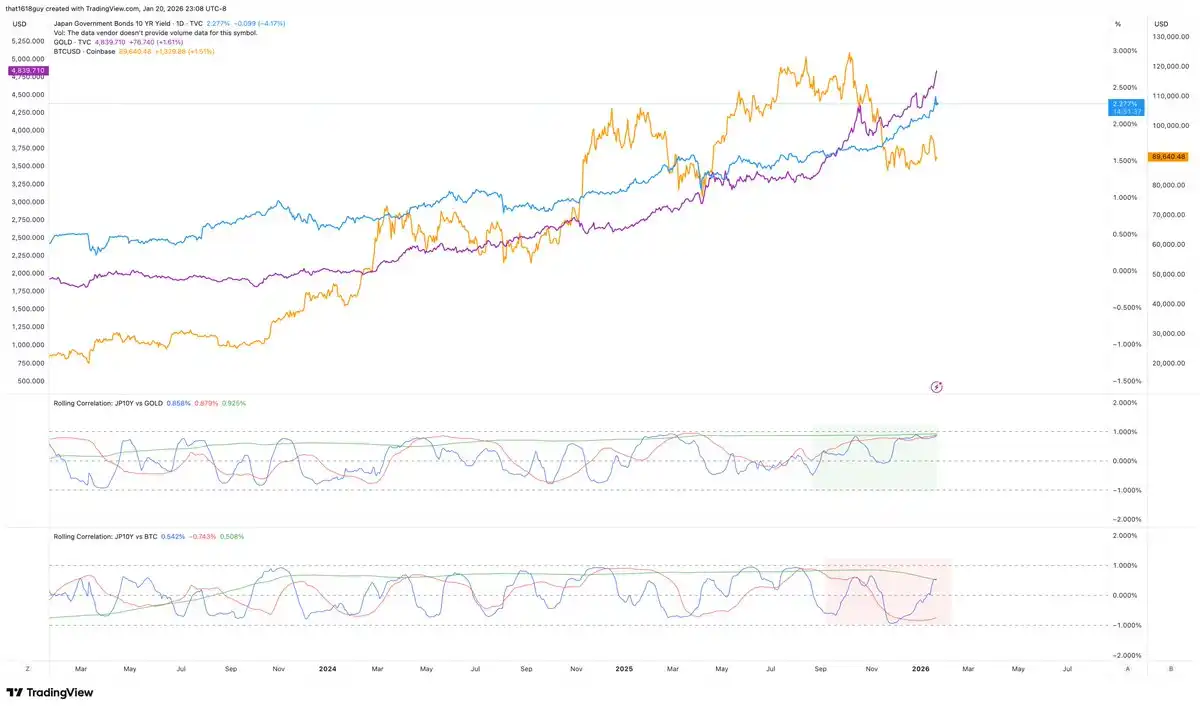
In a常规 environment, rising long-term yields suppress gold prices by increasing the opportunity cost of holding non-yielding assets. This negative correlation only breaks when yields deviate from the market's normal development and instead signal policy pressure. The current sharp surge in Japan's 10-year yield, with gold rising同步, precisely confirms the latter scenario.
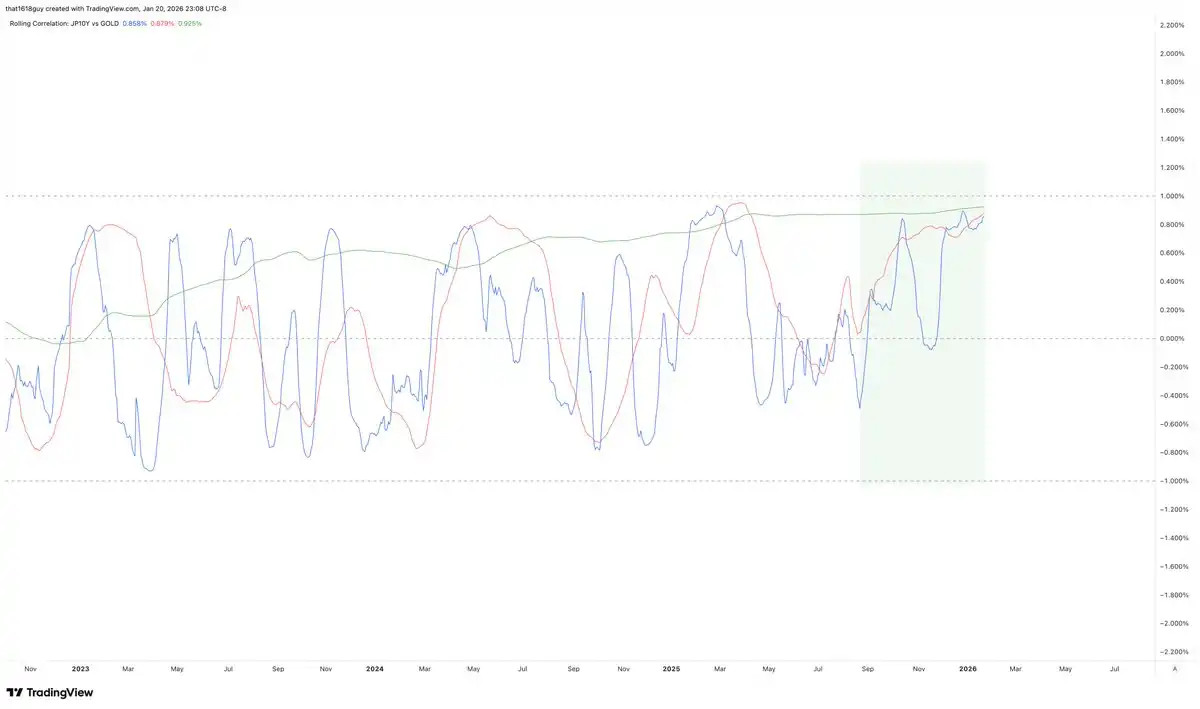
This correlation chart clearly reveals this shift.

The blue line in the chart shows the 30-day correlation between Japan's 10-year yield and gold. Although it still has fluctuations, the duration it stays in positive territory has significantly increased, rather than quickly falling into negative territory. This alone indicates that the traditional inverse relationship is weakening.

More importantly, the red line representing the 90-day correlation has followed suit and risen, indicating this is not short-term noise. Most convincing is the green line representing the 1-year correlation: it has steadily climbed and stabilized in positive territory.

When long-term correlations turn positive and remain high, it often signals a fundamental change in market logic. Rising Japanese bond yields no longer pose阻力 to gold but are instead interpreted by the market as a stress signal that gold is absorbing. This suggests the market views yield increases as a risk signal, not merely a tightening signal.

Even more interesting is that other markets haven't shown a similar phenomenon. During the same period, Bitcoin and Japan's 10-year yield have maintained a negative correlation.
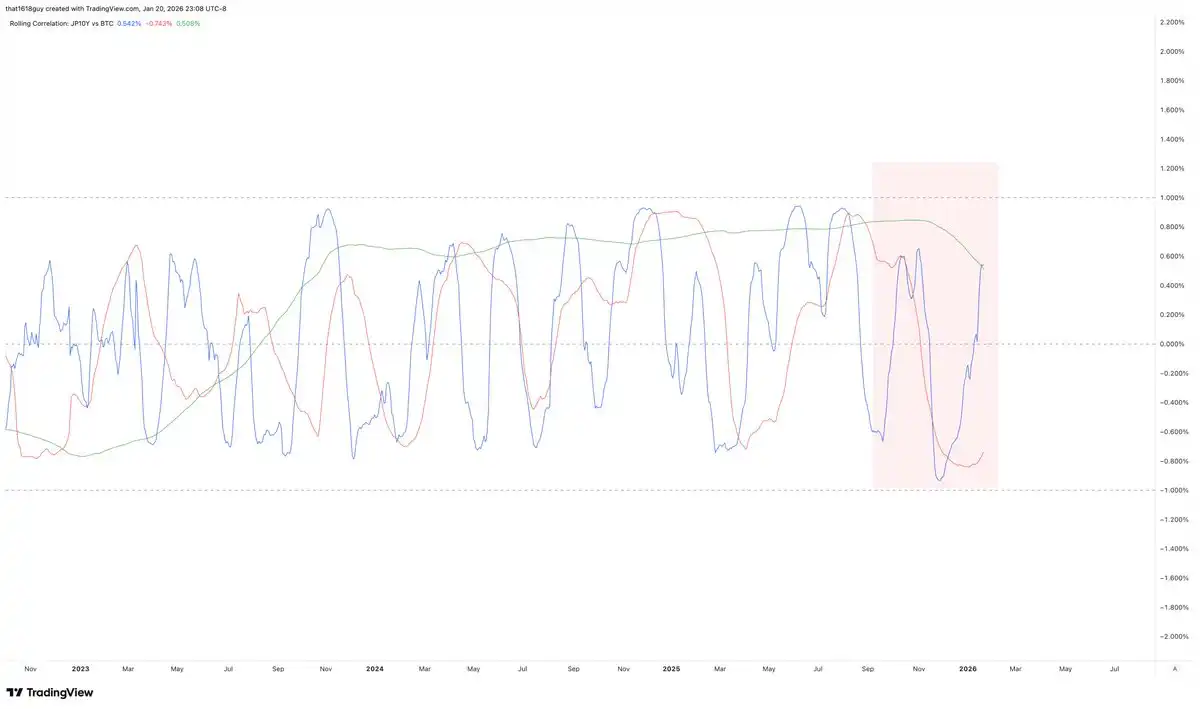
A second correlation chart highlights this contrast.

The 30-day and 90-day correlations between Japan's 10-year yield and Bitcoin, while volatile as expected, primarily operate below the zero axis, reflecting Bitcoin's sensitivity to short-term macro pressures. Most crucially, the green 1-year correlation line has turned downward and remains negative, indicating that over a longer time horizon, Bitcoin consistently faces pressure when Japanese yields rise.

In other words, to see sustainable signs of a rebound, we need Japan's 10-year yield to start cooling down—theoretically, this would also be reflected in the gold price.

How to Interpret the Current Market Logic

When gold and sovereign bond yields rise together, the market is pricing not economic growth or enhanced monetary policy discipline, but credit risk and balance sheet fragility.

This pattern typically emerges under the following circumstances: hedging demand overpowers arbitrage logic, policy control capabilities are questioned, and rising yields expose duration mismatches rather than抑制 economic activity. In this environment, gold acts less like an inflation hedge and more like a balance sheet hedge.

The inverse relationship between Bitcoin and Japanese yields reinforces this interpretation. The market views rising Japanese yields as a tightening shock. Gold benefits from this while Bitcoin does not. This current divergence is a key signal.

Why Japan is the Key Pressure Point
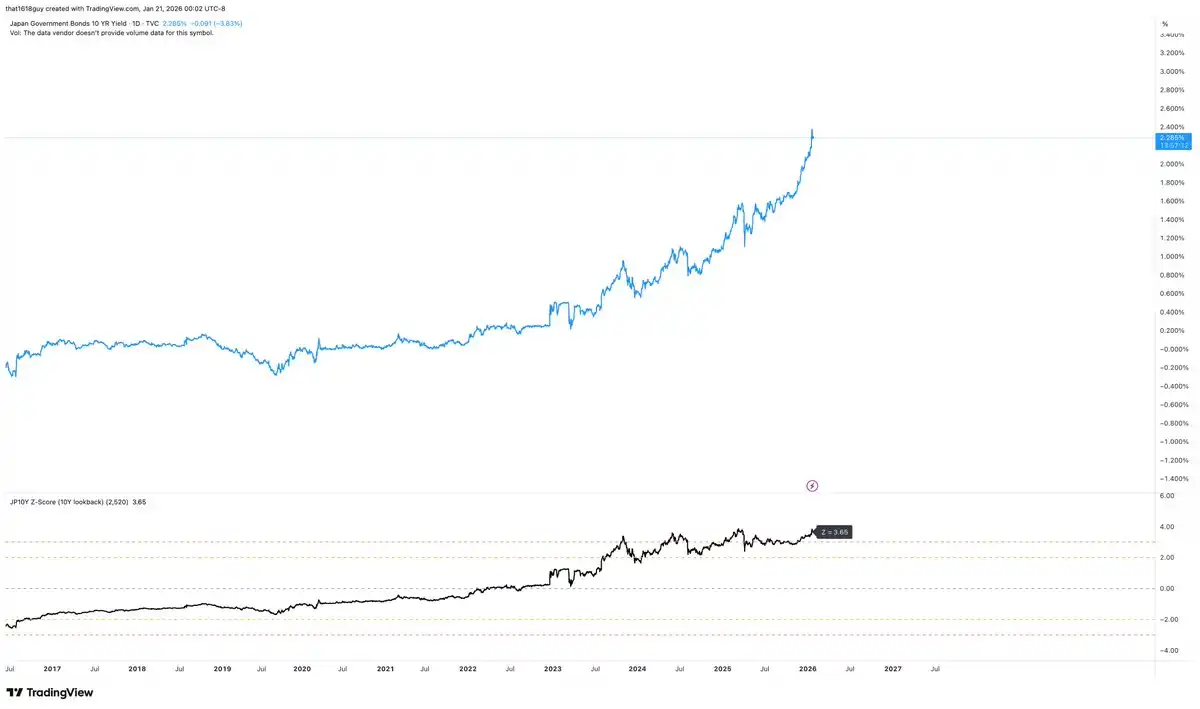
Japan has a unique sensitivity to this dynamic. The straight-line rise in Japan's 10-year government bond yield shown in the chart above is by no means a neutral event for its domestic financial system. The key is not just that yields are rising, but that the magnitude of the increase has reached statistically extreme values relative to Japan's own policy framework.

Calculated on a rolling 10-year window, the current Japan 10-year yield is about 3.65 standard deviations above its long-term average. This is equivalent to flipping a coin 13 times in a row and getting heads every time.

This is noteworthy in any market. But in Japan, where long-term yields have been strictly controlled for the past decade, a fluctuation of this magnitude clearly signals that the policy anchor is loosening. This is a classic特征 of the old order unraveling.

As important as the absolute level is the speed of the increase.
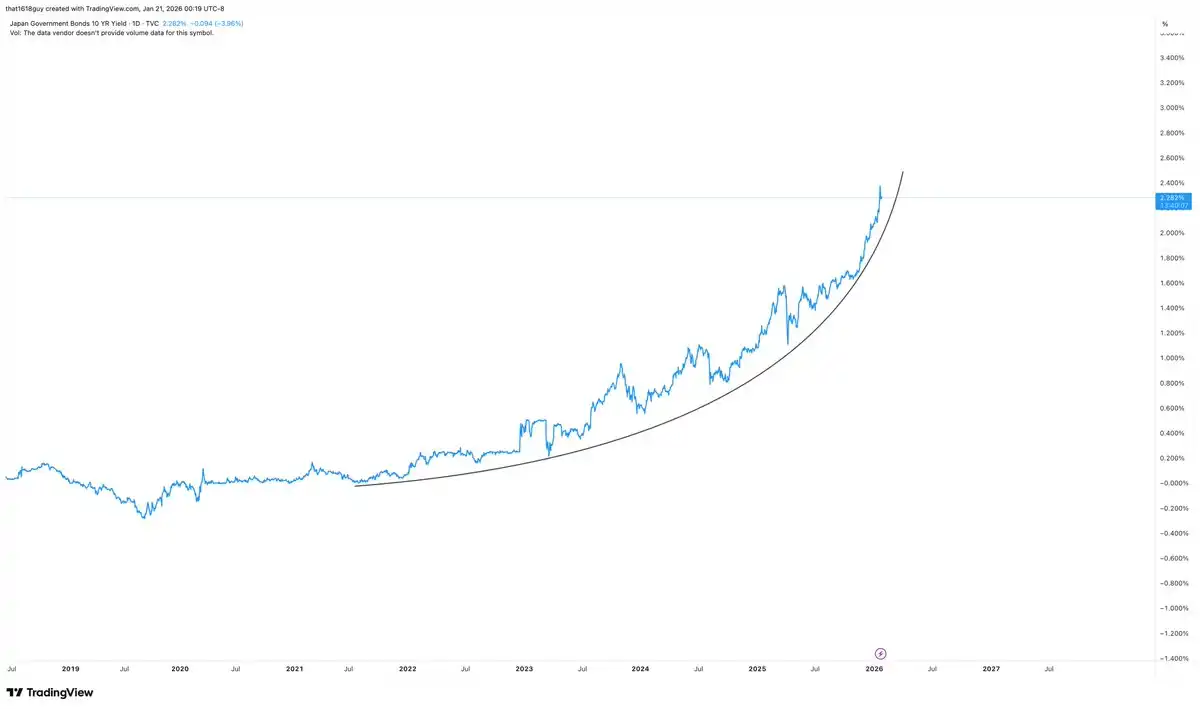
The steep slope of the recent yield surge has turned an interest rate move into a balance sheet event. Japan can gradually digest higher yields, but it struggles to cope calmly with a rapid duration repricing occurring abruptly within a financial system explicitly designed around yield suppression.

When yields shoot up vertically, the market is not just finding a new equilibrium; it is stress-testing all participants betting on the 'unchanged Japan model.'

Japanese banking institutions are structurally long duration and deeply hold JGBs as assets and collateral. This makes rapid yield increases inherently destabilizing, not merely restrictive. As yields spike sharply, bond portfolio market values shrink, collateral quality deteriorates, and financing conditions tighten within a system explicitly designed for yield suppression.

This is why the Bank of Japan has historically intervened when stress manifests in the data, not after the market has normalized. The BOJ doesn't need to wait for yields to hit an absolute threshold; accelerating moves of multiple standard deviations are often enough to trigger action.

Therefore, yield normalization in Japan is not a simple market adjustment but a balance sheet变动 that poses tangible transmission risks to the banking system, especially if market volatility is disorderly or one-way.

The current trajectory of Japan's 10-year government bonds significantly increases the motivation for the Bank of Japan to intervene. Such intervention does not necessarily require explicitly reinstating hard Yield Curve Control. Verbal guidance, targeted yield-smoothing operations, or more moderate control over the long-term bond market might be sufficient to slow the volatility in the yield curve and stabilize market conditions.

The Impact of BOJ Intervention on Gold
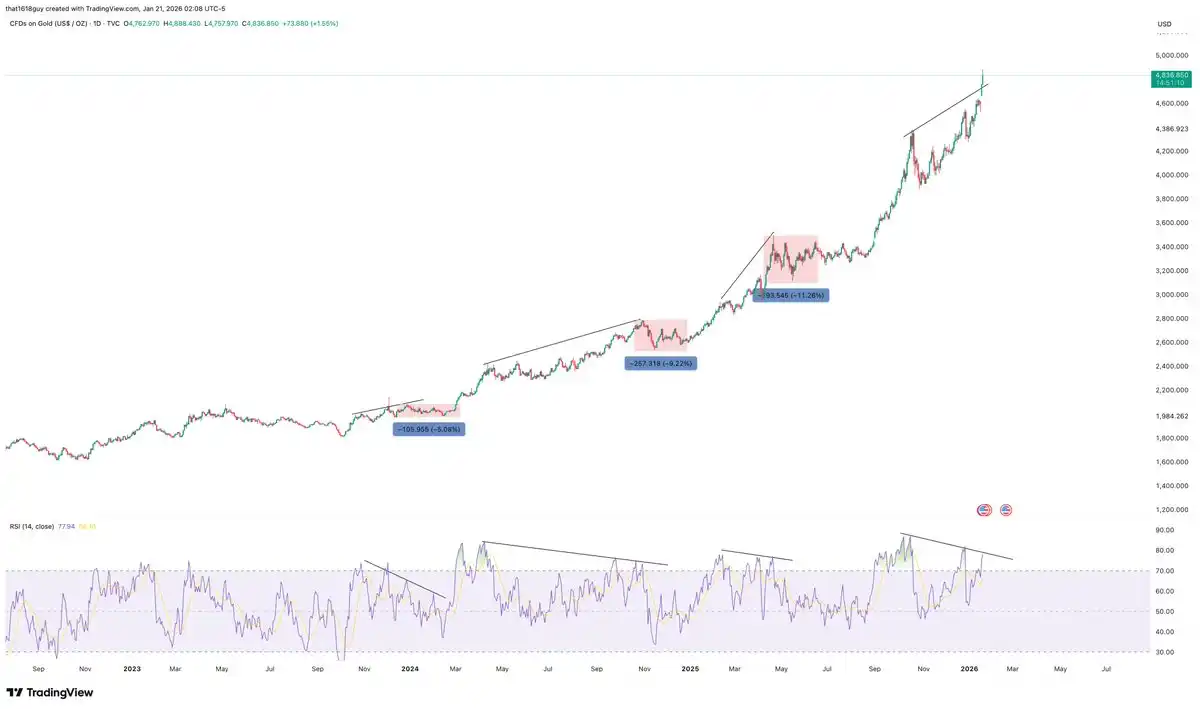
If the BOJ conducts credible intervention and regains control over long-end yields, this specific stress signal should weaken. This does not mean gold suddenly turns bearish, but it would likely remove a key catalyst for the current rally.

Combined with the analysis in the author's article 'Commodities Lead, Bitcoin Follows' published last week at Delphi Digital, the gold chart hints at this dynamic.

Although the overall uptrend remains intact, the upward momentum is no longer expanding at the same rate. The recent rally pushed the price to the upper edge of the rising channel but lacked the momentum confirmation seen in the early stages of the rise. Even as prices gradually move higher, the RSI indicator struggles to break previous highs, suggesting marginal buyers are becoming more cautious.

This aligns with a market that is structurally bullish but increasingly relies on policy stress rather than broad participation. Gold benefits from the vertical rise in Japan's 10-year yield, but this benefit manifests more in price persistence than acceleration. When the main catalyst is expected to be resolved, price action often shifts from impulsive to digestive.
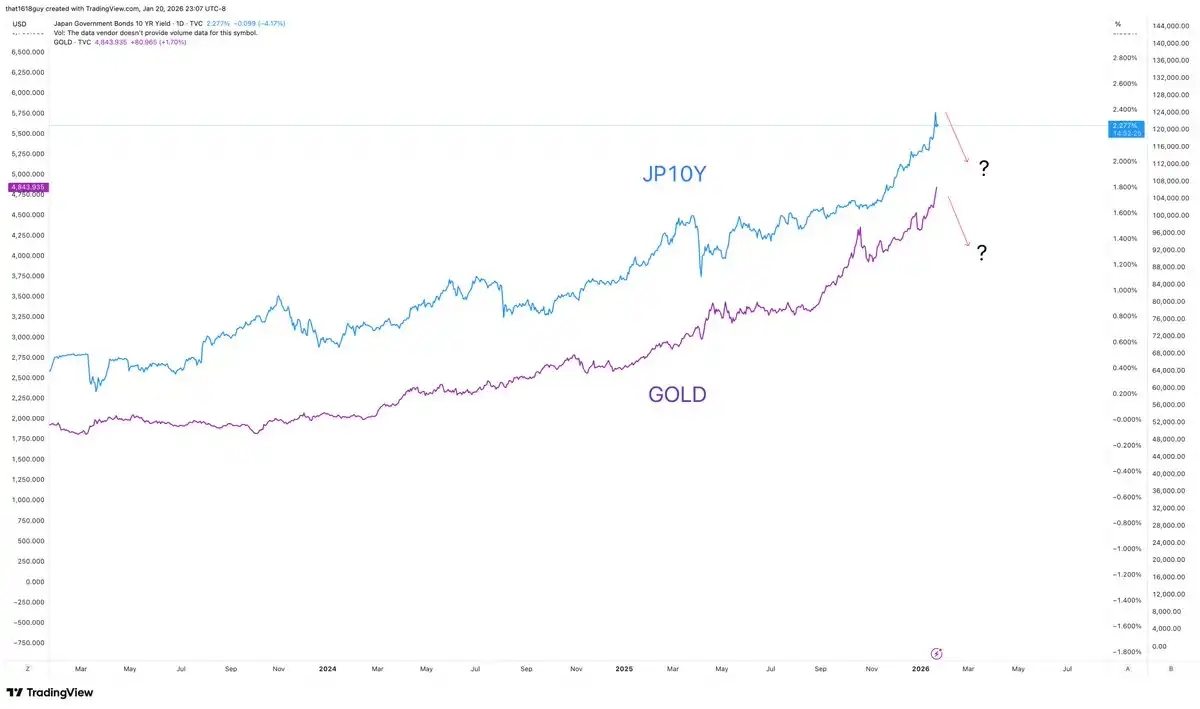
Decisive intervention by the BOJ would likely break the link between gold and Japanese yields, reduce the pricing of policy stress, and perfectly match the signals already emitted by the chart——the market is forming a local top or entering a consolidation phase, not a trend reversal. Such an outcome would allow gold to work off excess momentum through time rather than price, cooling the pace of advance while preserving the larger trend.

Structurally, gold's support does not rely on Japanese stress, but marginally it clearly benefits from it. If that pressure is contained, the chart shows the market is prepared to pause the commodity trade.

The Impact of BOJ Intervention on Bitcoin
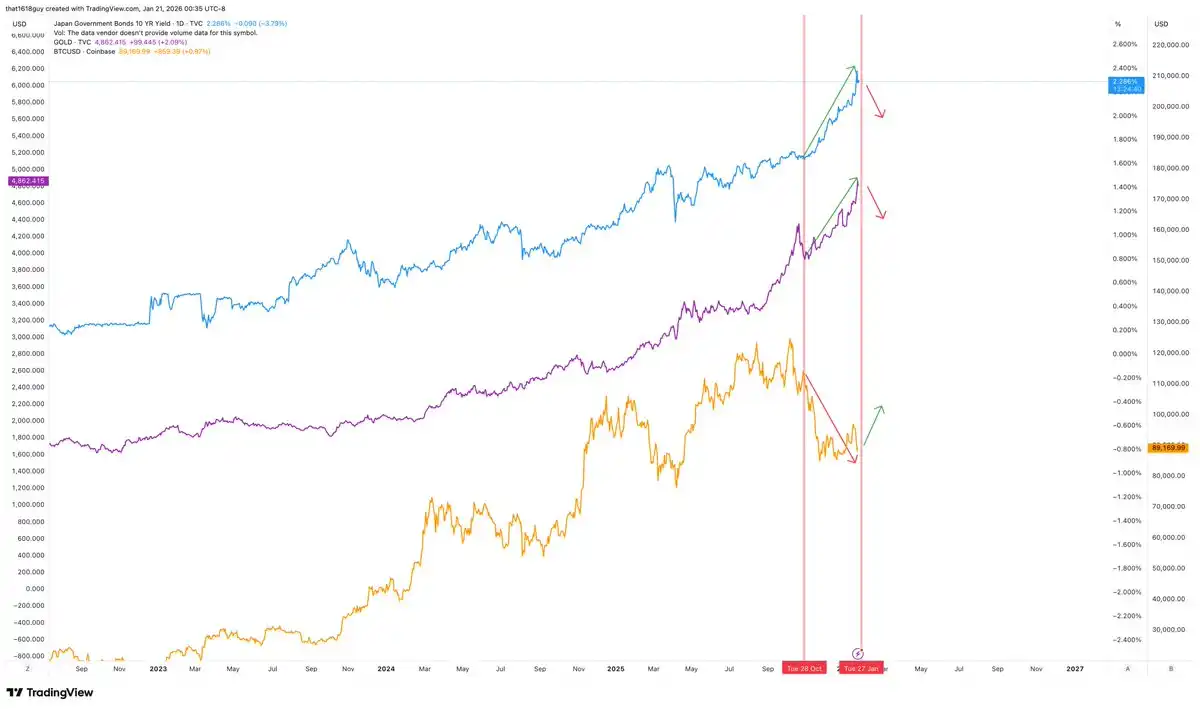
Given that Bitcoin's movement is inversely related to Japanese yields and gold, this relationship should also manifest when the BOJ finally decides to step in.

The chart already hints at this asymmetry: even as gold and Japanese yields continued to climb, Bitcoin, while weak, showed signs of stabilization rather than accelerated decline. This pattern fits an asset finding a bottom under macro pressure, remaining highly sensitive to any credible suppression measures.

If BOJ intervention materializes, Bitcoin's reaction is likely to differ from gold's. With global liquidity conditions stabilizing and the tightening shock from Japanese long-end yields easing, Bitcoin could experience a recovery rather than a pullback. In this sense, Bitcoin is not competing with gold in this mode; it's more like 'digital gold' waiting for the stress signal to be lifted.

Conclusion

The key insight is not that gold has peaked or that Japanese intervention is imminent, but that the market has already begun to treat Japanese yields as a global stress signal, and asset price behavior is adjusting accordingly.

Gold is absorbing this stress, while Bitcoin is reacting to it. The divergence between the two is revealing. As long as Japan's 10-year yield continues to rise unimpeded, gold's strength is logical. If the BOJ intervenes and regains control, the stress premium in gold should ease, and price action may shift from accelerating gains to choppy consolidation.

Regardless, the Japanese government bond market currently serves as the clearest window into how the market is pricing policy risk and balance sheet fragility. Until Japan's 10-year yield shows signs of softening, gold may continue its upward march, while Bitcoin's price performance may remain weak.


Perguntas relacionadas

QWhy is the positive correlation between gold and Japanese 10-year bond yields significant in the current market?

AThe positive correlation is significant because it signals a fundamental shift in market logic. Instead of rising yields suppressing gold (as in a typical tightening cycle), the market now interprets the surge in Japanese yields as a risk signal, particularly concerning credit risk and balance sheet fragility. Gold is acting as a balance sheet hedge rather than just an inflation hedge.

QHow does the relationship between Bitcoin and Japanese 10-year yields differ from that of gold?

ABitcoin maintains a negative correlation with Japanese 10-year yields, meaning its price tends to fall as yields rise. This contrasts with gold's positive correlation. This divergence indicates that the market views rising Japanese yields as a tightening shock that pressures Bitcoin, while gold benefits from the same risk-off sentiment.

QWhat makes Japan a critical pressure point in the global financial system according to the article?

AJapan is a critical pressure point because its financial system is structurally long duration and heavily exposed to Japanese Government Bonds (JGBs). A rapid, multi-standard deviation rise in yields creates instability by causing bond portfolio markdowns, deteriorating collateral values, and tightening funding conditions in a system designed for yield suppression, posing a传导风险 (transmission risk) to the banking sector.

QWhat impact would credible intervention by the Bank of Japan (BOJ) have on the price of gold?

ACredible BOJ intervention to control long-term yields would likely remove a key catalyst for gold's recent strength by reducing the policy stress premium priced into the metal. This would cause gold's price action to shift from impulsive gains to a consolidation phase, cooling the pace of the rally without necessarily reversing the overall bullish trend.

QHow would the Bitcoin market likely react to intervention by the Bank of Japan?

ABitcoin would likely experience a recovery or rally if the BOJ intervenes. Since Bitcoin has been negatively correlated with and pressured by rising Japanese yields, a successful intervention that stabilizes global liquidity conditions and eases the tightening shock from Japan's long-end would remove this headwind, allowing Bitcoin's price to rebound.

Leituras Relacionadas

a16z: AI's 'Amnesia', Can Continuous Learning Cure It?

The article "a16z: AI's 'Amnesia' – Can Continual Learning Cure It?" explores the limitations of current large language models (LLMs), which, like the protagonist in the film *Memento*, are trapped in a perpetual present—unable to form new memories after training. While methods like in-context learning (ICL), retrieval-augmented generation (RAG), and external scaffolding (e.g., chat history, prompts) provide temporary solutions, they fail to enable true internalization of new knowledge. The authors argue that compression—the core of learning during training—is halted at deployment, preventing models from generalizing, discovering novel solutions (e.g., mathematical proofs), or handling adversarial scenarios. The piece introduces *continual learning* as a critical research direction to address this, categorizing approaches into three paths: 1. **Context**: Scaling external memory via longer context windows, multi-agent systems, and smarter retrieval. 2. **Modules**: Using pluggable adapters or external memory layers for specialization without full retraining. 3. **Weights**: Enabling parameter updates through sparse training, test-time training, meta-learning, distillation, and reinforcement learning from feedback. Challenges include catastrophic forgetting, safety risks, and auditability, but overcoming these could unlock models that learn iteratively from experience. The conclusion emphasizes that while context-based methods are effective, true breakthroughs require models to compress new information into weights post-deployment, moving from mere retrieval to genuine learning.

marsbitHá 2h

a16z: AI's 'Amnesia', Can Continuous Learning Cure It?

marsbitHá 2h

Can a Hair Dryer Earn $34,000? Deciphering the Reflexivity Paradox in Prediction Markets

An individual manipulated a weather sensor at Paris Charles de Gaulle Airport with a portable heat source, causing a Polymarket weather market to settle at 22°C and earning $34,000. This incident highlights a fundamental issue in prediction markets: when a market aims to reflect reality, it also incentivizes participants to influence that reality. Prediction markets operate on two layers: platform rules (what outcome counts as a win) and data sources (what actually happened). While most focus on rules, the real vulnerability lies in the data source. If reality is recorded through a specific source, influencing that source directly affects market settlement. The article categorizes markets by their vulnerability: 1. **Single-point physical data sources** (e.g., weather stations): Easily manipulated through physical interference. 2. **Insider information markets** (e.g., MrBeast video details): Insiders like team members use non-public information to trade. Kalshi fined a剪辑师 $20,000 for insider trading. 3. **Actor-manipulated markets** (e.g., Andrew Tate’s tweet counts): The subject of the market can control the outcome. Evidence suggests Tate’sociated accounts coordinated to profit. 4. **Individual-action markets** (e.g., WNBA disruptions): A single person can execute an event to profit from their pre-placed bets. Kalshi and Polymarket handle these issues differently. Kalshi enforces strict KYC, publicly penalizes insider trading, and reports to regulators. Polymarket, with its anonymous wallet-based system, has historically been more permissive, arguing that insider information improves market accuracy. However, it cooperated with authorities in the "Van Dyke case," where a user traded on classified government information. The core paradox is reflexivity: prediction markets are designed to discover truth, but their financial incentives can distort reality. The more valuable a prediction becomes, the more likely participants are to influence the event itself. The market ceases to be a mirror of reality and instead shapes it.

marsbitHá 3h

Can a Hair Dryer Earn $34,000? Deciphering the Reflexivity Paradox in Prediction Markets

marsbitHá 3h

Trading

Spot
Futuros

Artigos em Destaque

O que é BITCOIN

Compreender o HarryPotterObamaSonic10Inu (ERC-20) e a Sua Posição no Espaço Cripto Nos últimos anos, o mercado de criptomoedas assistiu a um aumento na popularidade das moedas meme, cativando não apenas os traders, mas também aqueles que procuram envolvimento comunitário e valor de entretenimento. Entre estes tokens únicos está o HarryPotterObamaSonic10Inu (ERC-20), um projeto intrigante que mistura referências culturais no tecido das criptomoedas. Este artigo explora os principais aspetos do HarryPotterObamaSonic10Inu, examinando os seus mecanismos, a sua ética orientada pela comunidade e o seu envolvimento com o vasto panorama cripto. O que é o HarryPotterObamaSonic10Inu (ERC-20)? Como o nome sugere, o HarryPotterObamaSonic10Inu é uma moeda meme construída na blockchain Ethereum, classificada sob o padrão ERC-20. Ao contrário das criptomoedas tradicionais, que podem enfatizar a utilidade prática ou o potencial de investimento, este token prospera no valor de entretenimento e na força da sua comunidade. O projeto visa promover um ambiente onde utilizadores envolvidos possam reunir-se, partilhar ideias e participar em atividades inspiradas por diversos fenómenos culturais. Uma característica notável do HarryPotterObamaSonic10Inu é a zero taxa sobre transações. Este elemento atraente visa encorajar a negociação e o envolvimento da comunidade, isento de encargos adicionais que podem desencorajar os traders de pequena escala. A oferta total da moeda está fixada em mil milhões de tokens, uma cifra que marca a sua intenção de manter uma circulação substancial dentro da comunidade. Criador do HarryPotterObamaSonic10Inu (ERC-20) As origens do HarryPotterObamaSonic10Inu estão um pouco envoltas em mistério; os detalhes sobre o criador permanecem desconhecidos. O desenvolvimento deste token carece de uma equipa identificável ou de um plano explícito, o que não é raro no setor das moedas meme. Em vez disso, o projeto surgiu de forma orgânica, com o seu progresso a depender fortemente do entusiasmo e da participação da sua comunidade. Investidores do HarryPotterObamaSonic10Inu (ERC-20) No que diz respeito a investimentos externos e apoios, o HarryPotterObamaSonic10Inu também permanece ambíguo. O token não lista quaisquer fundações de investimento conhecidas ou apoio organizacional significativo. Em vez disso, o “sangue vital” do projeto é a sua comunidade de base, que informa o seu crescimento e sustentabilidade através da ação coletiva e do envolvimento no espaço cripto. Como Funciona o HarryPotterObamaSonic10Inu (ERC-20)? Como uma moeda meme, o HarryPotterObamaSonic10Inu opera principalmente fora dos quadros tradicionais que muitas vezes governam o valor dos ativos. Existem vários aspetos distintivos que definem como o projeto funciona: Transações Sem Taxas: Sem taxas sobre transações, os utilizadores podem comprar e vender o token livremente, sem a preocupação de custos ocultos. Envolvimento da Comunidade: O projeto prospera na interação da comunidade, aproveitando plataformas de redes sociais para criar entusiasmo e facilitar a participação. Discussões, partilha de conteúdo e envolvimento são elementos cruciais que ajudam a expandir o seu alcance e a fomentar a lealdade entre os apoiantes. Sem Utilidade Prática: Deve ser notado que o HarryPotterObamaSonic10Inu não oferece utilidade concreta dentro do ecossistema financeiro. Em vez disso, é classificado como um token principalmente para entretenimento e atividades comunitárias. Referência Cultural: O token incorpora de forma inteligente elementos da cultura popular para atrair interesse, conectando-se tanto com entusiastas de memes como com seguidores de criptomoedas. HarryPotterObamaSonic10Inu exemplifica como as moedas meme operam de forma diferente de projetos de criptomoedas mais tradicionais, entrando no mercado como construções sociais inovadoras em vez de ativos utilitários. Linha do Tempo do HarryPotterObamaSonic10Inu (ERC-20) A história do HarryPotterObamaSonic10Inu é marcada por vários marcos notáveis: Criação: O token surgiu de um meme viral, capturando a imaginação de muitos entusiastas de criptomoedas. Datas específicas de criação não estão disponíveis, sublinhando a sua ascensão orgânica. Listagem em Exchanges: O HarryPotterObamaSonic10Inu conseguiu entrar em várias exchanges, permitindo um acesso e negociação mais fáceis pela comunidade. Iniciativas de Envolvimento da Comunidade: Atividades contínuas direcionadas a melhorar a interação comunitária, incluindo concursos, campanhas em redes sociais e geração de conteúdo por fãs e defensores. Planos de Expansão Futura: O roteiro do projeto inclui o lançamento de uma coleção de NFTs, mercadorias e um site de eCommerce relacionado aos seus temas culturais, envolvendo ainda mais a comunidade e tentando adicionar mais dimensões ao seu ecossistema. Pontos-Chave sobre o HarryPotterObamaSonic10Inu (ERC-20) Natureza Orientada pela Comunidade: O projeto prioriza a contribuição coletiva e a criatividade, assegurando que o envolvimento dos utilizadores está na vanguarda do seu desenvolvimento. Classificação como Moeda Meme: Representa o epítome da criptomoeda baseada em entretenimento, destacando-se dos veículos de investimento tradicionais. Sem Afiliação Direta com o Bitcoin: Apesar da semelhança no nome do ticker, o HarryPotterObamaSonic10Inu é distinto e não tem qualquer relação com o Bitcoin ou outras criptomoedas estabelecidas. Foco na Colaboração: O HarryPotterObamaSonic10Inu é projetado para criar um espaço de colaboração e partilha de histórias entre os seus detentores, proporcionando uma via para a criatividade e o fortalecimento da comunidade. Perspectivas Futuras: A ambição de expandir além da sua premissa inicial para NFTs e mercadorias delineia um caminho para o projeto potencialmente entrar em avenidas mais mainstream dentro da cultura digital. À medida que as moedas meme continuam a capturar a imaginação da comunidade cripto, HarryPotterObamaSonic10Inu (ERC-20) destaca-se devido aos seus laços culturais e abordagem centrada na comunidade. Embora possa não se encaixar no molde típico de um token orientado para utilidade, a sua essência reside na alegria e camaradagem fomentadas entre os seus apoiantes, destacando a natureza em evolução das criptomoedas em uma era cada vez mais digital. À medida que o projeto continua a desenvolver-se, será importante observar como as dinâmicas comunitárias influenciam a sua trajetória no panorama em constante mudança da tecnologia blockchain.

1.2k Visualizações TotaisPublicado em {updateTime}Atualizado em 2024.12.03

O que é BITCOIN

Como comprar BTC

Bem-vindo à HTX.com!Tornámos a compra de Bitcoin (BTC) simples e conveniente.Segue o nosso guia passo a passo para iniciar a tua jornada no mundo das criptos.Passo 1: cria a tua conta HTXUtiliza o teu e-mail ou número de telefone para te inscreveres numa conta gratuita na HTX.Desfruta de um processo de inscrição sem complicações e desbloqueia todas as funcionalidades.Obter a minha contaPasso 2: vai para Comprar Cripto e escolhe o teu método de pagamentoCartão de crédito/débito: usa o teu visa ou mastercard para comprar Bitcoin (BTC) instantaneamente.Saldo: usa os fundos da tua conta HTX para transacionar sem problemas.Terceiros: adicionamos métodos de pagamento populares, como Google Pay e Apple Pay, para aumentar a conveniência.P2P: transaciona diretamente com outros utilizadores na HTX.Mercado de balcão (OTC): oferecemos serviços personalizados e taxas de câmbio competitivas para os traders.Passo 3: armazena teu Bitcoin (BTC)Depois de comprar o teu Bitcoin (BTC), armazena-o na tua conta HTX.Alternativamente, podes enviá-lo para outro lugar através de transferência blockchain ou usá-lo para transacionar outras criptomoedas.Passo 4: transaciona Bitcoin (BTC)Transaciona facilmente Bitcoin (BTC) no mercado à vista da HTX.Acede simplesmente à tua conta, seleciona o teu par de trading, executa as tuas transações e monitoriza em tempo real.Oferecemos uma experiência de fácil utilização tanto para principiantes como para traders experientes.

3.8k Visualizações TotaisPublicado em {updateTime}Atualizado em 2025.03.21

Como comprar BTC

O que é $BITCOIN

OURO DIGITAL ($BITCOIN): Uma Análise Abrangente Introdução ao OURO DIGITAL ($BITCOIN) OURO DIGITAL ($BITCOIN) é um projeto baseado em blockchain que opera na rede Solana, com o objetivo de combinar as características dos metais preciosos tradicionais com a inovação das tecnologias descentralizadas. Embora partilhe um nome com o Bitcoin, frequentemente referido como “ouro digital” devido à sua percepção como uma reserva de valor, o OURO DIGITAL é um token separado projetado para criar um ecossistema único dentro da paisagem Web3. O seu objetivo é posicionar-se como um ativo digital alternativo viável, embora os detalhes sobre as suas aplicações e funcionalidades ainda estejam em desenvolvimento. O que é o OURO DIGITAL ($BITCOIN)? OURO DIGITAL ($BITCOIN) é um token de criptomoeda explicitamente projetado para uso na blockchain Solana. Em contraste com o Bitcoin, que fornece um papel amplamente reconhecido como armazenamento de valor, este token parece focar em aplicações e características mais amplas. Aspectos notáveis incluem: Infraestrutura Blockchain: O token é construído na blockchain Solana, conhecida pela sua capacidade de lidar com transações de alta velocidade e baixo custo. Dinâmicas de Oferta: O OURO DIGITAL tem um fornecimento máximo limitado a 100 quatrilhões de tokens (100P $BITCOIN), embora os detalhes sobre o seu fornecimento circulante ainda não tenham sido divulgados. Utilidade: Embora as funcionalidades precisas não estejam explicitamente delineadas, existem indicações de que o token poderia ser utilizado para várias aplicações, potencialmente envolvendo aplicações descentralizadas (dApps) ou estratégias de tokenização de ativos. Quem é o Criador do OURO DIGITAL ($BITCOIN)? Neste momento, a identidade dos criadores e da equipa de desenvolvimento por trás do OURO DIGITAL ($BITCOIN) permanece desconhecida. Esta situação é típica entre muitos projetos inovadores no espaço da blockchain, particularmente aqueles alinhados com finanças descentralizadas e fenómenos de moedas meme. Embora tal anonimato possa fomentar uma cultura orientada pela comunidade, intensifica as preocupações sobre governança e responsabilidade. Quem são os Investidores do OURO DIGITAL ($BITCOIN)? As informações disponíveis indicam que o OURO DIGITAL ($BITCOIN) não tem apoiantes institucionais conhecidos ou investimentos proeminentes de capital de risco. O projeto parece operar num modelo peer-to-peer focado no apoio e adoção da comunidade, em vez de rotas de financiamento tradicionais. A sua atividade e liquidez estão principalmente situadas em exchanges descentralizadas (DEXs), como a PumpSwap, em vez de plataformas de negociação centralizadas estabelecidas, destacando ainda mais a sua abordagem de base. Como Funciona o OURO DIGITAL ($BITCOIN) A mecânica operacional do OURO DIGITAL ($BITCOIN) pode ser elaborada com base no seu design de blockchain e nas características da rede: Mecanismo de Consenso: Ao aproveitar o exclusivo proof-of-history (PoH) da Solana combinado com um modelo de proof-of-stake (PoS), o projeto assegura uma validação eficiente das transações, contribuindo para o alto desempenho da rede. Tokenomics: Embora mecanismos deflacionários específicos não tenham sido extensivamente detalhados, o vasto fornecimento máximo de tokens implica que pode atender a microtransações ou casos de uso de nicho que ainda estão por definir. Interoperabilidade: Existe o potencial para integração com o ecossistema mais amplo da Solana, incluindo várias plataformas de finanças descentralizadas (DeFi). No entanto, os detalhes sobre integrações específicas permanecem não especificados. Cronologia de Eventos Chave Aqui está uma cronologia que destaca marcos significativos relacionados ao OURO DIGITAL ($BITCOIN): 2023: O lançamento inicial do token ocorre na blockchain Solana, marcado pelo seu endereço de contrato. 2024: O OURO DIGITAL ganha visibilidade ao tornar-se disponível para negociação em exchanges descentralizadas como a PumpSwap, permitindo que os utilizadores o negociem contra SOL. 2025: O projeto testemunha atividade de negociação esporádica e potencial interesse em envolvimentos liderados pela comunidade, embora não tenham sido documentadas parcerias ou avanços técnicos notáveis até ao momento. Análise Crítica Forças Escalabilidade: A infraestrutura subjacente da Solana suporta altos volumes de transações, o que pode aumentar a utilidade do $BITCOIN em vários cenários de transação. Acessibilidade: O potencial preço de negociação baixo por token pode atrair investidores de retalho, facilitando uma participação mais ampla devido a oportunidades de propriedade fracionada. Riscos Falta de Transparência: A ausência de apoiantes, desenvolvedores ou um processo de auditoria publicamente conhecidos pode gerar ceticismo em relação à sustentabilidade e confiabilidade do projeto. Volatilidade do Mercado: A atividade de negociação depende fortemente do comportamento especulativo, o que pode resultar em volatilidade significativa dos preços e incerteza para os investidores. Conclusão O OURO DIGITAL ($BITCOIN) surge como um projeto intrigante, mas ambíguo, dentro do ecossistema em rápida evolução da Solana. Embora tente aproveitar a narrativa do “ouro digital”, a sua divergência do papel estabelecido do Bitcoin como reserva de valor sublinha a necessidade de uma diferenciação mais clara da sua utilidade pretendida e estrutura de governança. A aceitação e adoção futuras dependerão provavelmente da abordagem da atual opacidade e da definição mais explícita das suas estratégias operacionais e económicas. Nota: Este relatório abrange informações sintetizadas disponíveis até outubro de 2023, e desenvolvimentos podem ter ocorrido além do período de pesquisa.

92 Visualizações TotaisPublicado em {updateTime}Atualizado em 2025.05.13

O que é $BITCOIN

Discussões

Bem-vindo à Comunidade HTX. Aqui, pode manter-se informado sobre os mais recentes desenvolvimentos da plataforma e obter acesso a análises profissionais de mercado. As opiniões dos utilizadores sobre o preço de BTC (BTC) são apresentadas abaixo.

活动图片













