Why LAB crypto’s 34% crash has traders watching THIS support

ambcryptoPublicado em 2026-07-02Última atualização em 2026-07-02

Resumo

LAB crypto experienced a sharp 34% crash to $9.00, driven by the unwinding of excessive leverage and concerns over upcoming token unlocks and concentrated ownership. Despite a 121% surge in daily trading volume to $58.71 million, market activity was dominated by position closures, with Open Interest falling 23% to $130.39 million, indicating a broad reduction in speculative exposure without significant new buying. The price is now testing a crucial support level at $7.65, with the MACD indicating strong bearish momentum. A breakdown below this support could target the next major level near $4.00. Persistent negative funding rates confirm that short sellers remain in control of the derivatives market, sustaining the bearish pressure. The token's near-term outlook hinges on whether buyers can successfully defend the $7.65 support zone.

LAB recorded one of its sharpest daily declines after excessive leverage unwound and tokenomics concerns weighed heavily on sentiment. At the time of writing, the token traded at $9.00, down 34% over the past 24 hours, while its market capitalization declined to $3.88 billion.

Despite the sell-off, trading activity accelerated as daily volume climbed 121% to approximately $58.71 million, showing that market participation increased during the decline. Reports highlighting upcoming token unlocks and concerns over concentrated token ownership added further pressure, prompting participants to reassess LAB’s valuation.

As a result, leveraged positions closed rapidly, while heightened uncertainty encouraged additional selling across both spot and derivatives markets.

Leverage rapidly disappeared from LAB’s market

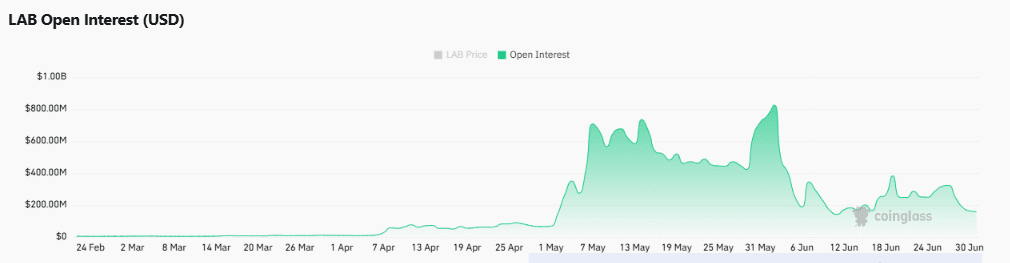
During the decline, derivatives activity reflected a broad reduction in speculative exposure rather than fresh risk-taking.

At press time, Open Interest (OI) fell 23.01% to $130.39 million, indicating that traders closed positions instead of adding new leverage during the decline. The contraction suggests that long positions absorbed most of the selling pressure as the market reacted to deteriorating sentiment.

Trading volume remained elevated despite the decline in OI, reinforcing the view that position unwinding dominated market activity. However, the absence of rising OI alongside heavy volume showed that new buyers had not stepped in aggressively.

Instead, capital exited leveraged positions while participants reduced exposure amid growing uncertainty surrounding LAB’s near-term outlook.
Source: CoinGlass

Can LAB defend its final support zone?

LAB approached the $7.65 support after a sharp rejection from the $20 resistance area, leaving sellers firmly in control of the broader trend.

Price closed near $9.04, placing the token only a short distance above this key demand level. At the time of writing, the MACD remained bearish as the MACD line stayed below the signal line.

The histogram continued expanding deeper into negative territory, confirming that downside pressure had strengthened throughout the latest decline. A decisive loss of $7.65 would expose the next major support near $4.00, where buyers previously emerged.

However, if buyers defend the current zone successfully, LAB could attempt a relief rebound toward $7.65 before challenging higher resistance levels, although confirmation would still require improving technical strength.
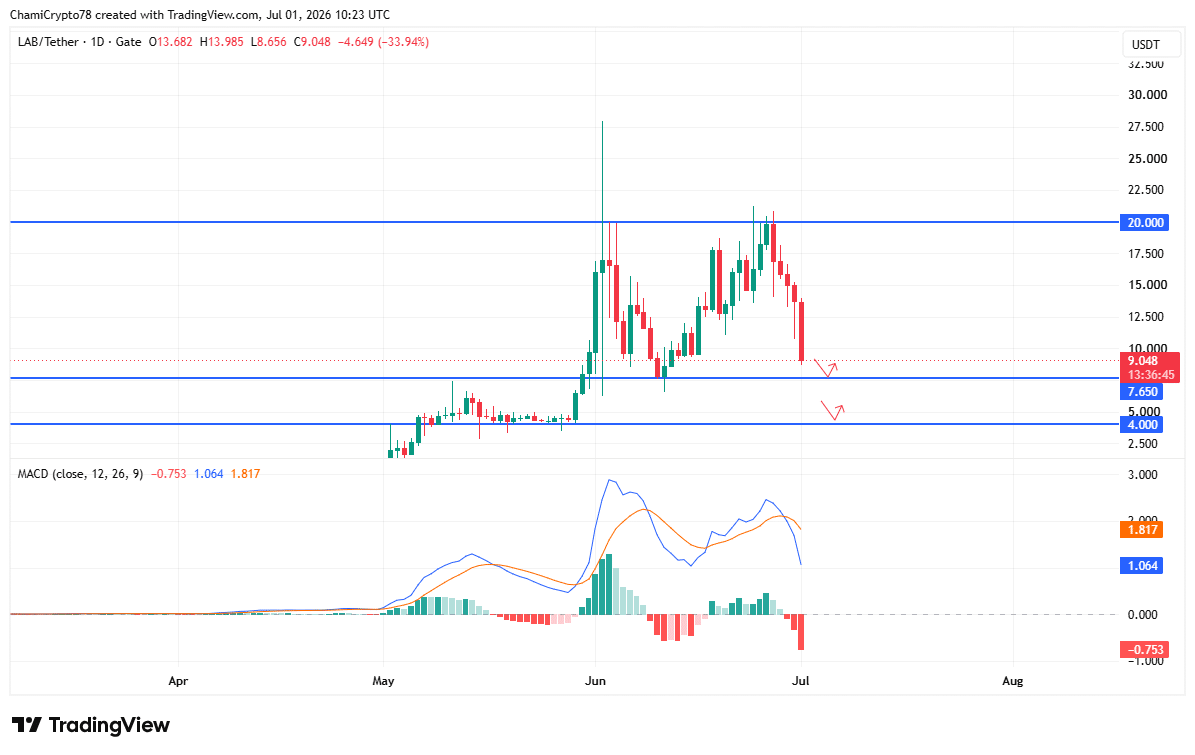
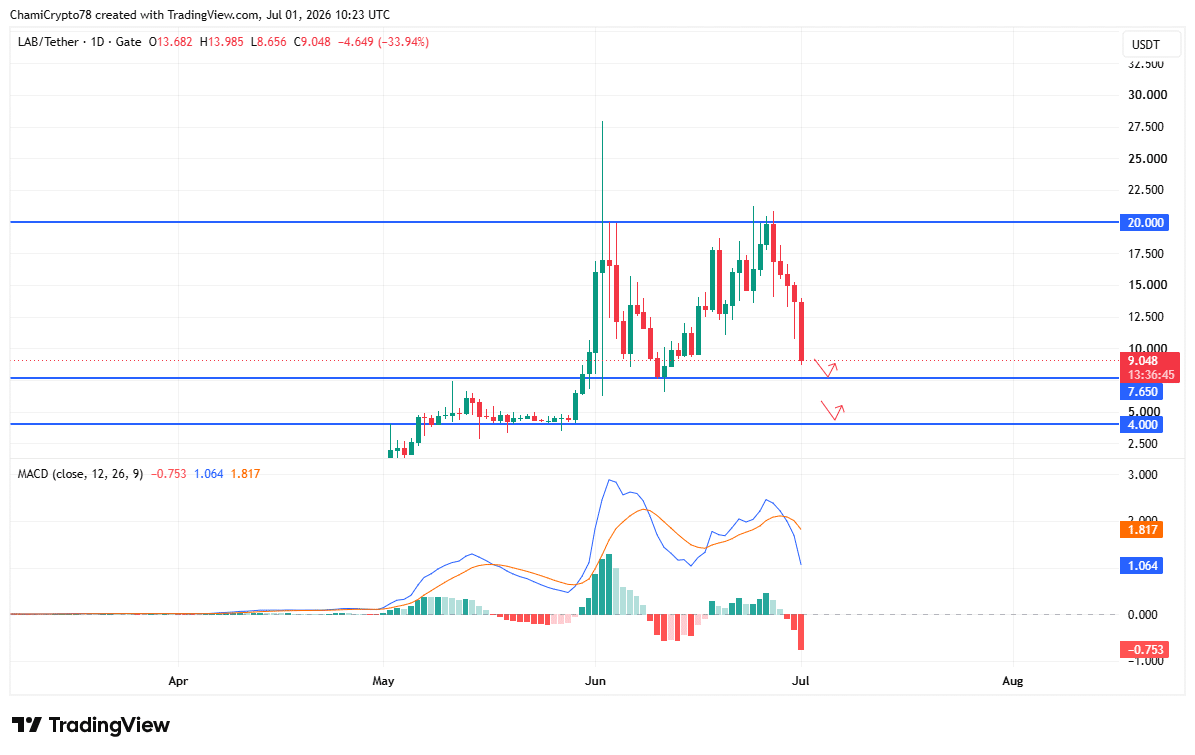
Source: TradingView

Why are short sellers still in control?

Funding data continued supporting the bearish derivatives outlook as the OI-Weighted Funding Rate remained below zero throughout the recent decline. The latest reading stood at approximately -0.1768%, showing that short sellers continued paying to maintain their positions.

Persistent negative funding reflected sustained bearish conviction despite the sharp correction. Unlike temporary funding dips, this trend extended across several sessions and aligned with the decline in OI, reinforcing the broader risk-off environment.

Although funding had not reached the extreme levels seen earlier in June, it still indicated that bearish positioning dominated the derivatives market. Until funding recovers toward positive territory, sellers would likely retain the upper hand.
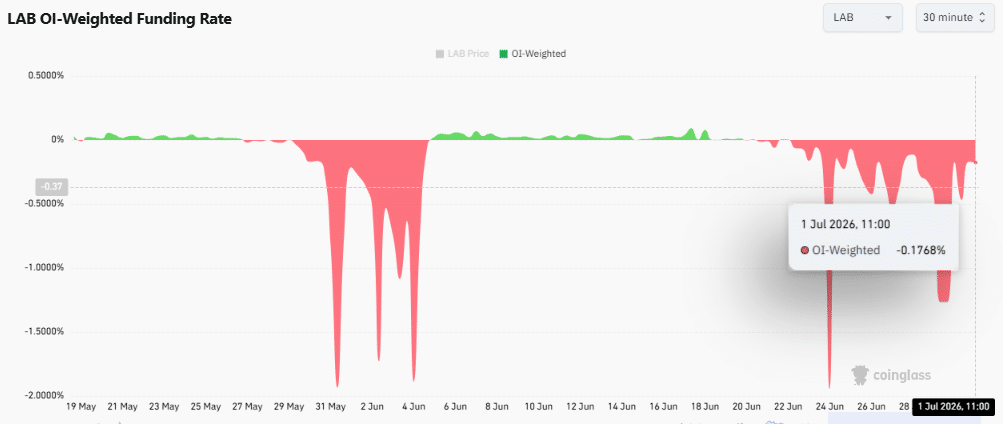
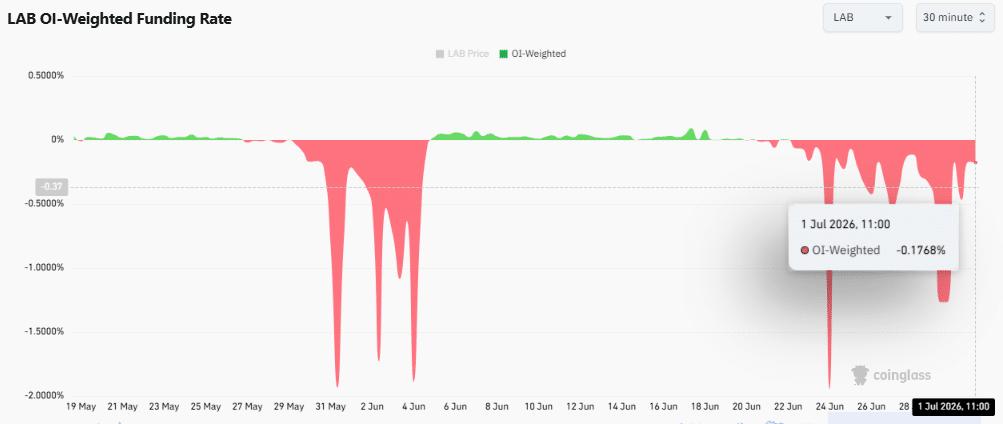
Source: CoinGlass

If buyers defend the $7.65 support, the token could stabilize and attempt a recovery.

However, a confirmed breakdown below that level would likely shift attention toward the $4.00 support as bearish pressure remained dominant.


Final Summary

  • LAB trading volume surged while leverage rapidly exited, highlighting aggressive risk reduction across derivatives.
  • Bearish funding and weakening technical structure kept sellers firmly in control near critical support.

Criptomoedas em alta

Perguntas relacionadas

QWhat were the main reasons for LAB crypto's 34% price crash mentioned in the article?

AThe main reasons were the unwinding of excessive leverage and concerns over tokenomics, specifically upcoming token unlocks and concentrated token ownership, which weighed heavily on sentiment.

QAccording to the article, what key support level is LAB approaching after its decline?

ALAB is approaching the $7.65 support level after a sharp rejection from the $20 resistance area.

QWhat does the decline in Open Interest (OI) for LAB derivatives indicate about trader behavior?

AThe 23.01% decline in Open Interest indicates that traders were closing existing leveraged positions rather than adding new leverage, showing a broad reduction in speculative exposure and risk-taking during the decline.

QWhat does the persistently negative OI-Weighted Funding Rate suggest about market sentiment?

AThe persistently negative OI-Weighted Funding Rate suggests sustained bearish conviction, with short sellers paying to maintain their positions. It indicates that sellers retain the upper hand and bearish positioning dominates the derivatives market.

QWhat are the potential price targets mentioned if LAB loses the $7.65 support level?

AIf LAB decisively loses the $7.65 support level, it would expose the next major support near $4.00.

Leituras Relacionadas

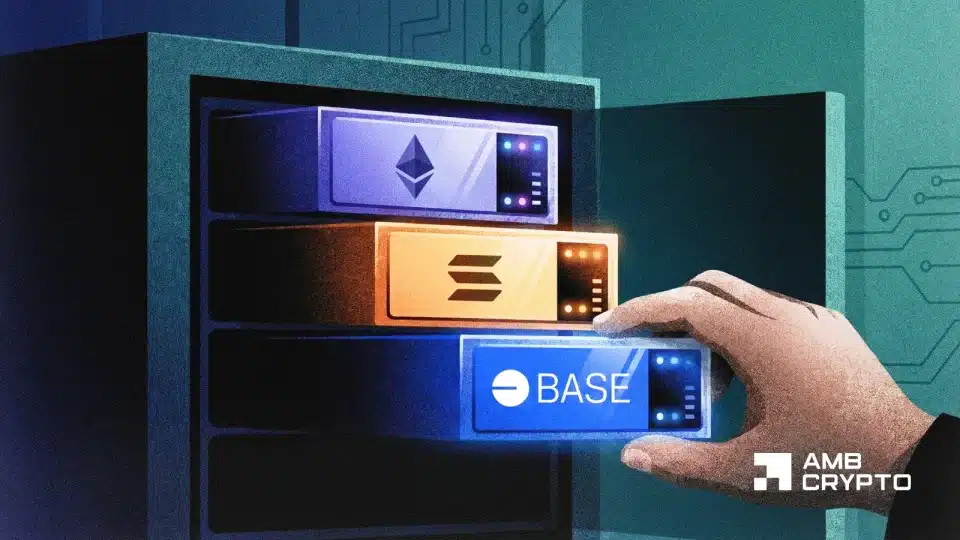
Why 2026 could redefine Ethereum, Solana, Base and Avalanche

Blockchain infrastructure is undergoing a major coordinated transformation, driven by institutional demand for reliability, compliance, and predictable settlement. Over $30 billion in Real-World Assets (RWA) on-chain has exposed network weaknesses. Major blockchains are responding with foundational upgrades, moving beyond incremental speed improvements. Ethereum's "Glamsterdam" upgrade, planned for H1 2026, will significantly increase gas limits and introduce features like PBS (pre-blocked state) for enhanced settlement and parallel execution. Solana's "Alpenglow," targeting a mainnet launch in H2 2026, focuses on reducing finality time dramatically and freeing network resources to improve reliability. Beyond speed, compliance is critical. Base's "Beryl" upgrade in Q3 2026 will introduce a standardized, regulatory-compliant token framework (B20). Avalanche's "Octane" upgrade aims to boost transaction processing and reduce costs for enterprise applications. Even Bitcoin is evolving with the potential activation of OP_CAT by late 2026/early 2027. The competition is shifting. While technical upgrades are widespread, institutions will ultimately allocate capital based on proven execution, operational resilience, and regulatory compatibility during market stress. Ethereum currently leads in tokenized assets, while networks like Base and Solana are strengthening their institutional offerings. The blockchain that best delivers reliable, compliant, and uninterrupted service is poised to attract the greatest share of future institutional capital.

ambcryptoHá 7m

Why 2026 could redefine Ethereum, Solana, Base and Avalanche

ambcryptoHá 7m

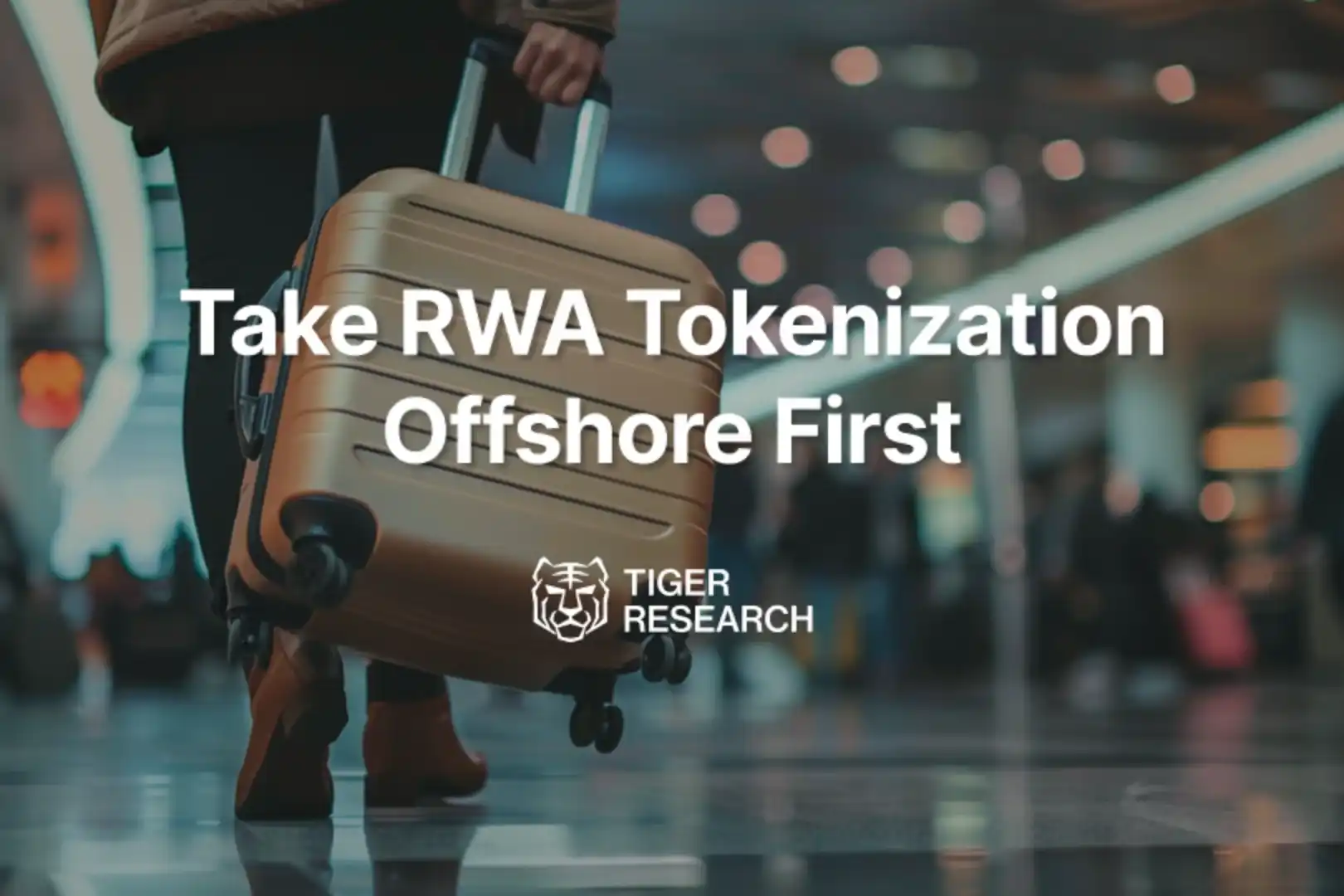
Tiger Research: Take RWA Tokenization Overseas First

This article discusses the strategic choices facing financial institutions in jurisdictions lacking mature regulatory frameworks for Real-World Asset (RWA) tokenization. With the market growing rapidly, institutions must choose between waiting for local legislation, using regulatory sandboxes, or—the recommended priority—expanding into overseas markets to gain early experience. Successfully launching cross-border RWA tokenization requires meticulous preparation across six key areas: establishing an overseas base (e.g., Hong Kong, Singapore, the U.S.), securing necessary licenses, defining the tokenized asset (with bonds being simpler than non-standard assets), defining the target investor scope, deciding on settlement currencies/payment flows, and designing operational requirements like custody and on-chain governance. The article outlines two primary strategic paths: a direct "onshore" path and a "native on-chain" path. The direct path involves setting up a legal entity and obtaining licenses in a mature jurisdiction like Hong Kong, Singapore, or the U.S., leveraging existing platforms (e.g., DigiFT, Securitize) for efficiency. The alternative native on-chain path involves partnering with compliant, decentralized platforms (e.g., Ondo, Plume Nest) that use structures like offshore SPVs to facilitate tokenization and access DeFi liquidity, offering speed and broader reach but with greater structural complexity. The core argument is that institutions should not wait for perfect domestic regulation. A detailed hypothetical case study illustrates the multi-step, 6-12 month process of launching an overseas tokenized bond. The key takeaway is that the essence of a tokenization business lies not in the technology but in successfully executing the entire sales and operational process. The market is moving forward, and the time to act is now.

marsbitHá 18m

Tiger Research: Take RWA Tokenization Overseas First

marsbitHá 18m

Chain Gaming Giant YGG Capitulates, Losing $15 Billion in Value Over 5 Years

The leading blockchain gaming guild Yield Guild Games (YGG) is shutting down its publishing arm, YGG Play, announced on July 6th by its official account and co-founder Gabby Dizon. The platform and its supported games will be phased out by July 31st. While YGG Play successfully validated a market for casual, crypto-native mobile games—generating over $9M in total revenue, including $876,000 in Q1 2026—Dizon stated the closure was a market-driven decision. He cited insufficient liquidity and declining user confidence in the macroeconomic environment, making the business commercially unsustainable. Founded in 2020, YGG rose to prominence during the Play-to-Earn (P2E) boom, particularly with Axie Infinity, organizing players and managing assets. Its token price soared above $10 during the 2021 bull market. However, the 2022 crypto downturn exposed the fragility of P2E economic models. YGG attempted to pivot in 2025 with the YGG Play publishing initiative, focusing on short-session casual games. The shutdown reflects broader struggles in the Web3 gaming sector. An April 2026 report highlighted a "structural mismatch" between speculative financial designs and genuine player entertainment needs, leading to an estimated $15 billion in destroyed capital. The report noted that 93% of roughly 3,200 tracked blockchain game projects are now "functionally dead," with token prices down an average of 95% from 2022 peaks. YGG itself is now pivoting its strategy entirely towards the AI Data Economy, aiming to build B2B pipelines around gaming datasets.

Foresight NewsHá 36m

Chain Gaming Giant YGG Capitulates, Losing $15 Billion in Value Over 5 Years

Foresight NewsHá 36m

Trading

Spot

Artigos em Destaque

Como comprar ONE

Bem-vindo à HTX.com!Tornámos a compra de Harmony (ONE) simples e conveniente.Segue o nosso guia passo a passo para iniciar a tua jornada no mundo das criptos.Passo 1: cria a tua conta HTXUtiliza o teu e-mail ou número de telefone para te inscreveres numa conta gratuita na HTX.Desfruta de um processo de inscrição sem complicações e desbloqueia todas as funcionalidades.Obter a minha contaPasso 2: vai para Comprar Cripto e escolhe o teu método de pagamentoCartão de crédito/débito: usa o teu visa ou mastercard para comprar Harmony (ONE) instantaneamente.Saldo: usa os fundos da tua conta HTX para transacionar sem problemas.Terceiros: adicionamos métodos de pagamento populares, como Google Pay e Apple Pay, para aumentar a conveniência.P2P: transaciona diretamente com outros utilizadores na HTX.Mercado de balcão (OTC): oferecemos serviços personalizados e taxas de câmbio competitivas para os traders.Passo 3: armazena teu Harmony (ONE)Depois de comprar o teu Harmony (ONE), armazena-o na tua conta HTX.Alternativamente, podes enviá-lo para outro lugar através de transferência blockchain ou usá-lo para transacionar outras criptomoedas.Passo 4: transaciona Harmony (ONE)Transaciona facilmente Harmony (ONE) no mercado à vista da HTX.Acede simplesmente à tua conta, seleciona o teu par de trading, executa as tuas transações e monitoriza em tempo real.Oferecemos uma experiência de fácil utilização tanto para principiantes como para traders experientes.

326 Visualizações TotaisPublicado em {updateTime}Atualizado em 2026.06.02

Como comprar ONE

Discussões

Bem-vindo à Comunidade HTX. Aqui, pode manter-se informado sobre os mais recentes desenvolvimentos da plataforma e obter acesso a análises profissionais de mercado. As opiniões dos utilizadores sobre o preço de ONE (ONE) são apresentadas abaixo.

活动图片