Why Is Wall Street Collectively Shorting the Crypto Leader Strategy?

marsbitPublicado em 2026-02-27Última atualização em 2026-02-27

Resumo

The Financial Times' Alphaville column highlighted that S&P 500 short interest has reached a multi-year high, with MicroStrategy (referred to as "Strategy" in the text) being the most shorted stock at 14% of its market value, followed by Coinbase at 11%. This indicates significant skepticism toward MicroStrategy, a major crypto-related company. Analysts, including former investment banker Craig Coben, criticize MicroStrategy’s business model, which involves accumulating Bitcoin without generating cash flow, leading to continuous financing and dilution of shareholder equity. The company tends to buy Bitcoin at market peaks, a systemic flaw. While some short positions may hedge Bitcoin exposure, the high short interest reflects broad bearish sentiment. MicroStrategy’s CEO, Michael Saylor, promotes a "digital asset" framework where Bitcoin serves as foundational capital," followed by "digital credit" (perpetual preferred shares) and "digital currency" (stablecoins). This model relies on perpetual debt issuance, similar to U.S. Treasuries, assuming Bitcoin’s long-term appreciation. The company claims it would only face liquidity issues if Bitcoin stays below $8,000 for 4-5 years—a scenario that would likely cripple the broader crypto industry. Despite short-term stability, Wall Street remains skeptical. Hedge funds use MicroStrategy to hedge against Bitcoin’s volatility, and short sellers target it as a proxy for crypto downturns. Saylor’s ambition to build a new monetar...

On February 24, the Financial Times' Alphaville column published an article titled "Mirror mirror on the wall, what is the most shorted stock of them all?" providing some very interesting data.

The article shows that the median short interest in S&P 500 index constituents has climbed to 2.7%, reaching one of the highest levels in nearly a decade. Among all the constituents, Strategy leads with a short interest accounting for 14% of its market value, while Coinbase ranks fourth with 11%. This means that among all U.S. listed companies with a market capitalization exceeding $25 billion, Strategy is the least favored.

Articles published in the Alphaville column do not represent the views of the Financial Times; its characteristic is sharp and unsparing language. Even as cryptocurrency has gradually moved into the mainstream today, articles about cryptocurrency in the Alphaville column still spare no effort in criticizing it. Whether Bitcoin is $10 or $100,000, they consistently believe cryptocurrency is meaningless.

On February 2, Craig Coben, a veteran investment banker and former Vice Chairman of Global Capital Markets and Head of Global Equity Capital Markets at Merrill Lynch, also published an article in the Alphaville column criticizing Strategy's model.

Craig Coben's views are not extreme; he similarly believes that Strategy does not face a short-term "run" risk and currently has no liquidity crisis. However, he pointed out some core issues, such as the fact that the model of hoarding Bitcoin does not generate cash flow, thus requiring constant financing and diluting common shareholders' equity. Additionally, Strategy's tendency to buy when market sentiment is high and Bitcoin prices are elevated is a systemic, unsolvable problem.

Regarding Strategy's high short interest, some analysts believe that not all short positions are "naked shorts" against Strategy; some may be used by hedge funds to hedge their Bitcoin spot holdings. Nevertheless, it still indicates that there are many people bearish on Strategy, at the very least, everyone believes that if Bitcoin falls, Strategy cannot remain unscathed.

In Craig Coben's article, he mentioned that Strategy refers to the five types of perpetual preferred stock it issued as "digital credit," a concept that Michael Saylor has been emphasizing since the end of last year.
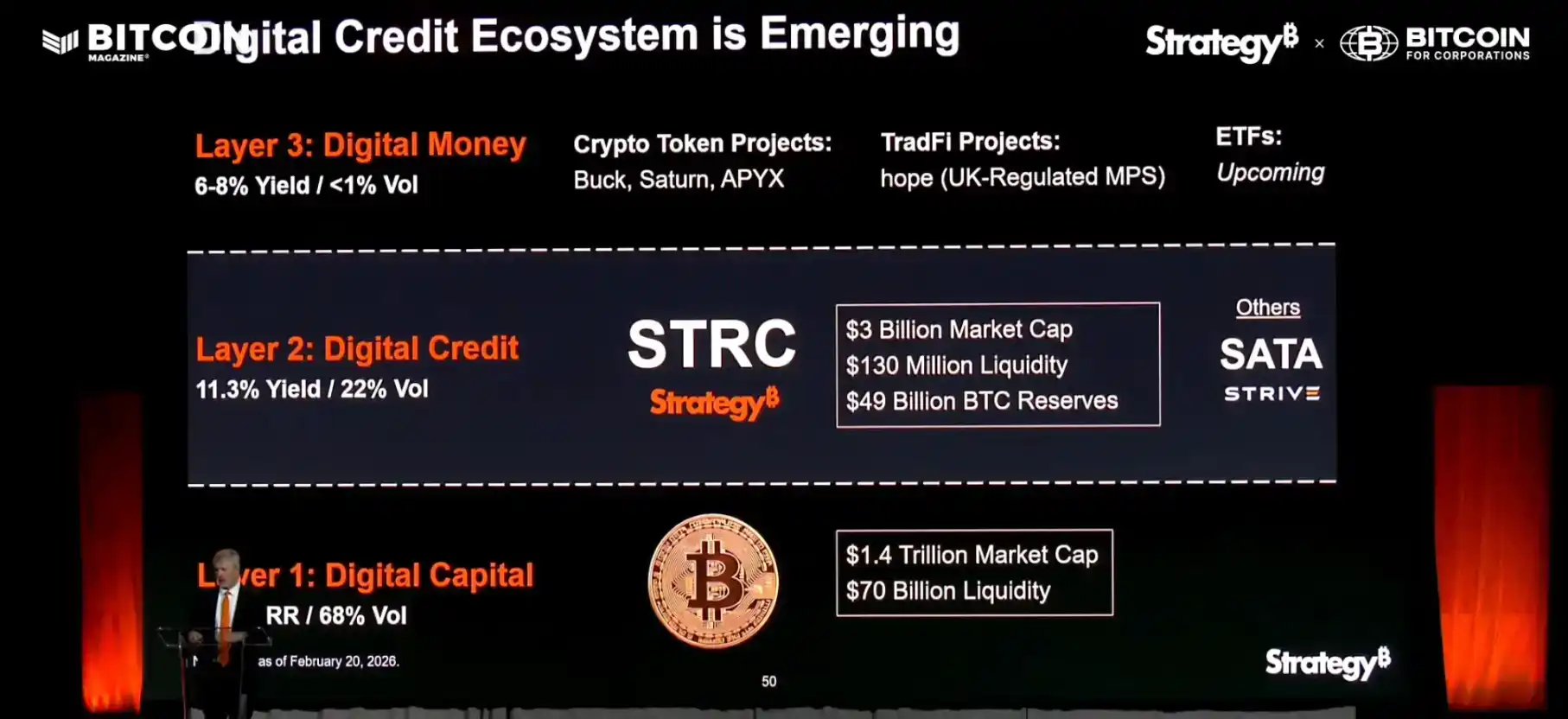
In this conceptual framework, the first layer, "digital capital," is Bitcoin. The second layer, "digital credit (or digital debt)," consists of the various perpetual preferred stocks issued by Strategy. These preferred stocks come with high yields, and Strategy must pay corresponding interest to holders annually.

The third layer is "digital currency," which refers to currencies, including stablecoins, issued based on the financial products in the second layer for trading. For example, Saturn in the diagram above plans to issue the USDat stablecoin based on STRC and U.S. Treasury bonds; this project has also received investment from YZi Labs.

If this logic isn't clear, you can draw an analogy with the United States. The U.S. continuously issues Treasury bonds based on its influence, only needing to pay interest before maturity and using new debt to repay old debt upon maturity. As long as the U.S.'s international influence and the status of the dollar do not weaken, this game can continue indefinitely. For Strategy, Bitcoin is like the U.S. influence, digital credit is like U.S. Treasury bonds, and Strategy also needs to borrow new debt to pay the annual preferred stock interest. However, as long as the price of Bitcoin continues to rise in the long term and drives Strategy's stock price up, the company can continuously issue new shares to finance the purchase of more Bitcoin and pay interest, continuing this cycle.

Michael Saylor is a firm believer that Bitcoin will change everything. In his view, Bitcoin's infinite rise is a more reliable bet than the U.S. winning forever, so he is more willing to issue currency based on an asset that is "destined" to continuously appreciate, just as the U.S. dollar was initially pegged to gold.

Strategy's strategy is not new; it only needs to ensure it has enough cash to pay interest to continuously finance the purchase of Bitcoin. Like U.S. Treasury bonds, this is a game that everyone knows will eventually reach its end one day, but no one can determine how long it can last. Strategy's current financial reserves are also sufficient; its CEO stated that Strategy would only be forced to sell Bitcoin if the price remained below $8,000 for 4 to 5 consecutive years.

If this extreme condition were actually met, not just Strategy, but the entire Web3 industry might disappear.

Even an old-school banker like Craig Coben must admit that Strategy will not face financial problems in the short term. However, for hedge funds, Strategy is a good tool for hedging against a decline in Bitcoin; for short sellers, it is reasonable to short a system that only functions normally when Bitcoin rises during a cryptocurrency downturn. At least for now, there aren't many reasons to be bullish on Strategy.

Michael Saylor's ambition to leverage Bitcoin to launch a new currency is itself interesting. The U.S. dollar is used to buy Bitcoin, and the U.S. dollar is also used to pay interest. The goal of a system built with billions of U.S. dollars is ultimately to destroy the very bricks and mortar that built it. Perhaps the elites on Wall Street are also chuckling; after all, they have no interest in researching whether Strategy can truly become a century-old company. They only care about when your stock price will rise and when it will fall.

Michael Saylor believes Bitcoin will inevitably continue to hit new highs, so he uses it as the cornerstone of everything; holders and users of the U.S. dollar believe the United States will continue to prosper, so they tacitly allow the constant raising of the U.S. debt ceiling. Both are acts of belief—so which is more advanced than the other?


Perguntas relacionadas

QWhy is MicroStrategy the most shorted stock among S&P 500 companies with a market cap over $25 billion?

AAccording to the Financial Times' Alphaville column, MicroStrategy has the highest short interest at 14% of its market value among S&P 500 companies with a market cap over $25 billion, making it the most heavily shorted stock in that category. This indicates a significant lack of confidence from investors, who are betting that its stock price will decline.

QWhat are the core problems with MicroStrategy's business model as pointed out by Craig Coben?

ACraig Coben pointed out that MicroStrategy's model of hoarding Bitcoin does not generate cash flow, forcing the company to continuously raise capital, which dilutes the equity of common shareholders. He also criticized its strategy of buying Bitcoin when market sentiment is high and prices are elevated, a systemic issue with no easy solution.

QWhat are the three layers in Michael Saylor's concept of 'digital credit'?

AThe three layers are: 1) 'Digital Capital,' which is Bitcoin itself. 2) 'Digital Credit (or Digital Debt),' which refers to the various perpetual preferred shares issued by the company. 3) 'Digital Currency,' which are currencies, including stablecoins, issued based on the financial products from the second layer and intended for transactions.

QHow does MicroStrategy's financial strategy resemble that of the U.S. government's debt system?

AMicroStrategy's strategy is analogous to the U.S. debt system. The company uses Bitcoin (like U.S. influence) as its foundation to issue 'digital credit' (like U.S. Treasury bonds). It plans to pay the interest on these instruments by continuously issuing new debt or equity, similar to how the U.S. refinances its debt, as long as the value of its foundational asset (Bitcoin) is perceived to be rising.

QUnder what extreme condition would MicroStrategy be forced to sell its Bitcoin holdings?

AMicroStrategy's CEO has stated that the company would only be forced to sell its Bitcoin if the price remained below $8,000 for a sustained period of 4 to 5 years. Such an extreme scenario would likely indicate a catastrophic collapse for the entire Web3 and cryptocurrency industry.

Leituras Relacionadas

UNI Doubles in Two Months Against the Trend: A 5-Year-Overdue Value Realization

Amidst a generally stagnant crypto market in June and July, UNI, the governance token of Uniswap, saw a significant surge, nearly doubling in price from around $2.3 to $4.6. This rally represents a delayed but significant value reassessment, triggered by the practical implementation of its long-debated "fee switch" mechanism. The key turning point was the on-chain execution of the UNIfication proposal in December 2025. It activated a protocol fee on select pools, directed Unichain sequencer revenue (net of costs) to a communal treasury, executed a one-time burn of 100 million UNI, and established a system where all protocol revenue flows into a "TokenJar" contract. This treasury has a single exit: purchasing and permanently burning UNI via a "Firepit" contract. Initially, the market reacted tepidly as the generated revenue and corresponding burn rate were modest. The narrative shifted dramatically in July 2025 with two major developments. First, the launch of Robinhood Chain, tailored for tokenized stocks, rapidly became a primary source of volume and fees for Uniswap, at one point contributing nearly half of its weekly fees. Second, governance votes successfully expanded the fee mechanism to v4 pools and initiated a temperature check for fees on Robinhood Chain. The activation of v4 fees caused the protocol's daily revenue earmarked for UNI burns to nearly triple. The core of UNI's recent price action is the transition from a pure governance token to a cash-flow asset with a permanent, protocol-funded buyer. Its effectiveness is amplified by UNI's mature and widely distributed supply, with no major impending unlocks to dilute the impact of the buybacks. The sustainability of this rally now hinges on whether the transaction volume, particularly on Robinhood Chain, persists after its initial gas subsidies expire, determining if this is a genuine value realization or a subsidy-fueled spike.

marsbitHá 1h

UNI Doubles in Two Months Against the Trend: A 5-Year-Overdue Value Realization

marsbitHá 1h

Breaking: Google Earth Urgently Pulls Back Nano Banana 2 Image Generation Feature!

Google Earth's newly launched "Create image" feature, powered by the Nano Banana 2 AI image generation model, was abruptly withdrawn shortly after its release due to being "played" by users. The feature allowed users to generate and overlay AI-created visuals directly onto real-world satellite and 3D maps in Google Earth. The tool enabled creative applications like historical recreations (e.g., visualizing ancient Pompeii), generating informational graphics for landmarks, and envisioning architectural projects or futuristic cityscapes on real terrain. It operated under "geospatial grounding," meaning the AI respected the underlying geography, topography, and perspective of the chosen map view. The model also integrated with Gemini to retrieve relevant factual information. However, upon release, users quickly tested its limits. A prominent example involved reimagining Philadelphia's historic Independence Hall as a post-apocalyptic ruin overrun by "happy" zombies, evil clowns, and giant alien mechs. This highlighted both the feature's playful potential and its risks regarding the generation of inappropriate or misleading content on realistic maps, leading to its swift temporary removal. Google stated it would re-release the feature after implementing "enhanced guardrails." Analysts note this move strategically leverages Google's vast proprietary geospatial data, positioning its AI not just for artistic generation but for spatially accurate world visualization—a unique advantage in the competitive AI image generation landscape.

marsbitHá 2h

Breaking: Google Earth Urgently Pulls Back Nano Banana 2 Image Generation Feature!

marsbitHá 2h

Altman Admits: Overestimated AI Snatching Jobs! Huang Renxun: The Unemployment Narrative Is Completely Backwards

Sam Altman has revised his earlier predictions about AI rapidly replacing jobs, admitting he overestimated the speed at which AI would eliminate entry-level white-collar roles. Speaking on the "Invest Like the Best" podcast, he stated that people do not truly want an AI CEO, as accountability and human connection remain critical. He found that individuals prefer interacting with people who can be held responsible for decisions. Similarly, NVIDIA's Jensen Huang argued that the narrative of AI destroying jobs is misguided. He distinguishes between tasks and jobs, noting that while AI can automate specific tasks, entire jobs—encompassing communication, judgment, coordination, and accountability—are not eliminated. He cited examples like radiologists and software engineers, where demand for these roles has increased as AI handles repetitive tasks, allowing for business expansion and the creation of more positions. Data from a University of Maryland and LinkUp study supports this, showing that U.S. job postings for new graduates have actually risen, countering the fear of vanishing entry-level roles. However, a significant shift is occurring: the traditional entry-level tasks that help newcomers gain experience are being automated, making initial career access more challenging. The key insight is that as AI takes over standardized tasks, the enduring value of human work shifts toward areas of responsibility, trust-building, and final decision-making—aspects that AI cannot replicate. The real "moat" for professionals lies in these irreplaceable human elements.

marsbitHá 2h

Altman Admits: Overestimated AI Snatching Jobs! Huang Renxun: The Unemployment Narrative Is Completely Backwards

marsbitHá 2h

Trading

Spot
活动图片