Why is Ethereum Urgently Needing ZK-ification?

marsbitPublicado em 2026-01-13Última atualização em 2026-01-13

Resumo

The article discusses the urgent need for Ethereum to adopt zero-knowledge (ZK) technology as a core narrative for its future development. While Ethereum previously focused on ICOs, DeFi, and being a global financial settlement layer, it now lacks a compelling new narrative. ZK technology is highlighted as a critical solution, with Ethereum being the blockchain most invested in its development. ZK-EVM has reached the Alpha stage, a milestone celebrated by Vitalik Buterin. The primary motivation for ZK integration is to maintain Ethereum’s decentralization while improving scalability. Currently, increasing the Gas limit boosts TPS but raises node operation costs, potentially centralizing the network. ZK proofs allow nodes to verify transactions efficiently without expensive hardware upgrades, similar to automated exam grading versus manual checking. ZK itself doesn’t directly increase TPS but enables future Gas limit hikes with minimal node cost increases. The recent Fusaka upgrade, including PeerDAS, advances this goal. A ZK-powered Ethereum could achieve over 1000 TPS, strengthening its narrative. The article also addresses the role of third-party ZK teams (e.g., Polygon, Scroll, ZKsync, Taiko), which remain crucial for innovation and testing different ZK-EVM types (Type 1 to 4). ZK-VMs, like Brevis, are noted for higher performance and diversity, as they aren’t constrained by EVM compatibility. While ZK L1 may attract some L2 users, it also benefits L2s by reducing costs...

One of the most frequently asked questions recently is, how to view Ethereum's narrative?

Admittedly, Ethereum focused on ICOs and the world computer in 2017, and on DeFi and the financial settlement layer in 2021. However, for the 2025 cycle, there seems to be few new narratives that can match the height of the old ones.

Perhaps ETF and Staking ETF count as half, but this is not within the control of Ethereum developers. If there is another half, it can only be ZK.

Ethereum is undoubtedly the public chain that has bet the most on ZK in the entire Crypto world.

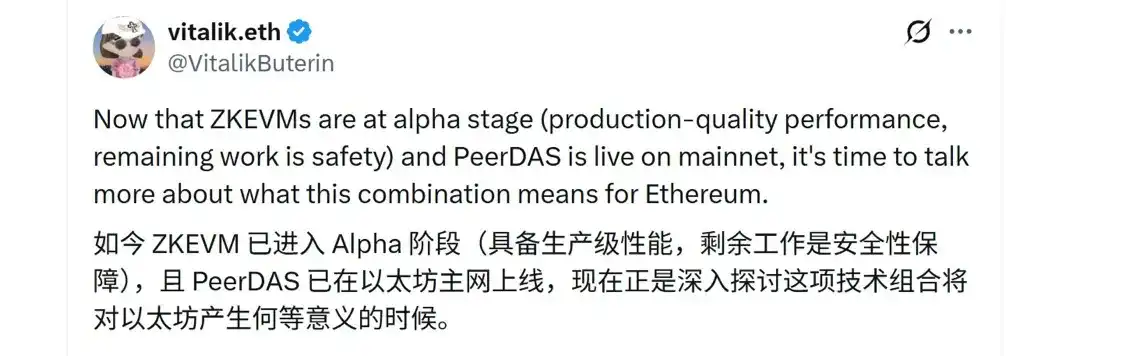
A few days ago, Vitalik was quite excited. He officially announced on Twitter that ZKEVM has now entered the Alpha stage.
Why is Ethereum so persistent about ZK?

Actually, Ethereum's TPS is not low anymore, with the theoretical peak already increased to over 200 TPS. The main reason is that Ethereum has repeatedly raised the Gas limit.
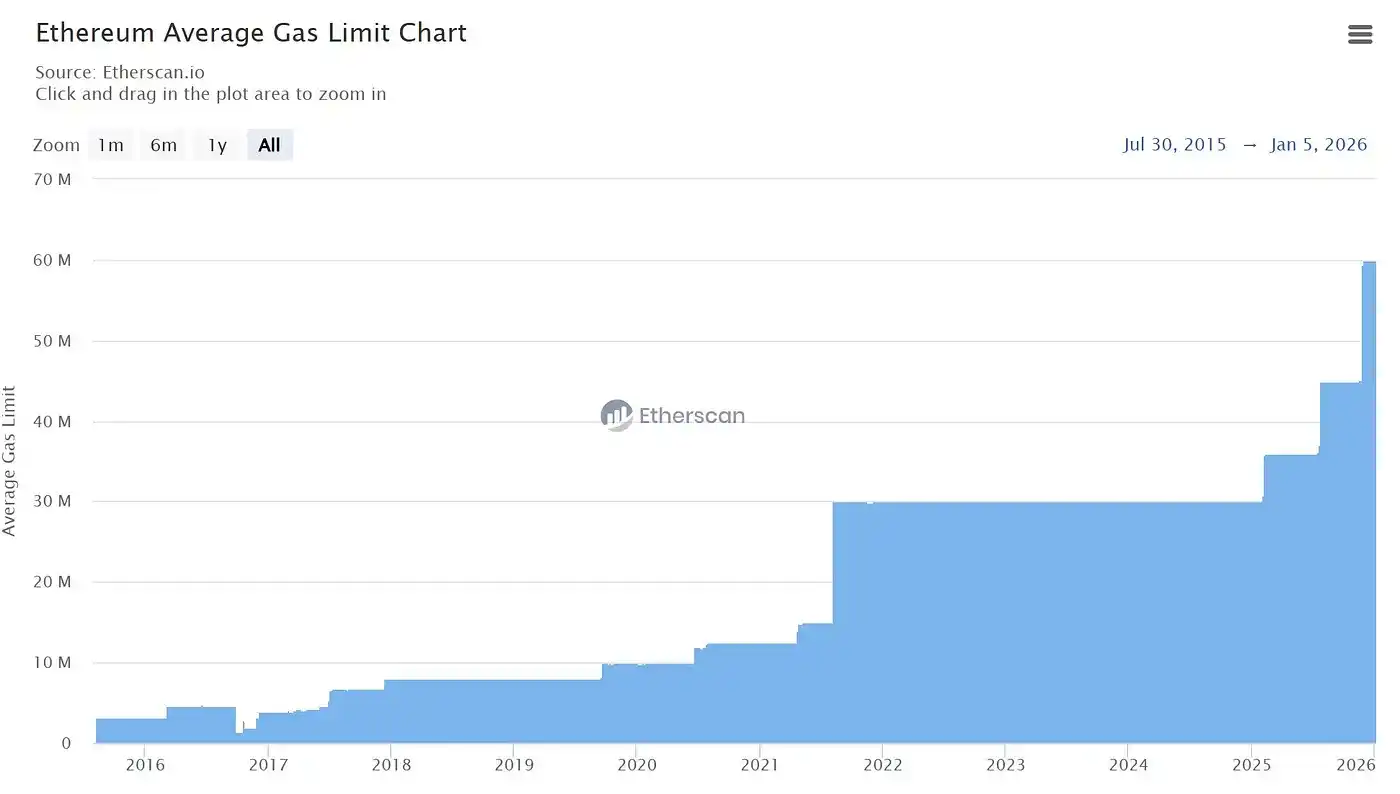
However, raising the Gas limit comes at a cost and cannot be done indefinitely. Its cost is that nodes need more expensive servers to run.

But Ethereum also wants to maintain its proud high degree of decentralization, so it cannot push node server performance too high (refer to Solana, where a single server is about 5–10 times more expensive than an ETH server).

Therefore, the mainnet must be ZK-ified. Note, this is not about creating a few ZK L2s; this is a full ZK-ification of the L1 mainnet.

So what are the benefits after ZK-ification?

Those ETH nodes can simply verify these ZK proofs, without needing to tediously verify transactions one by one as in the past.
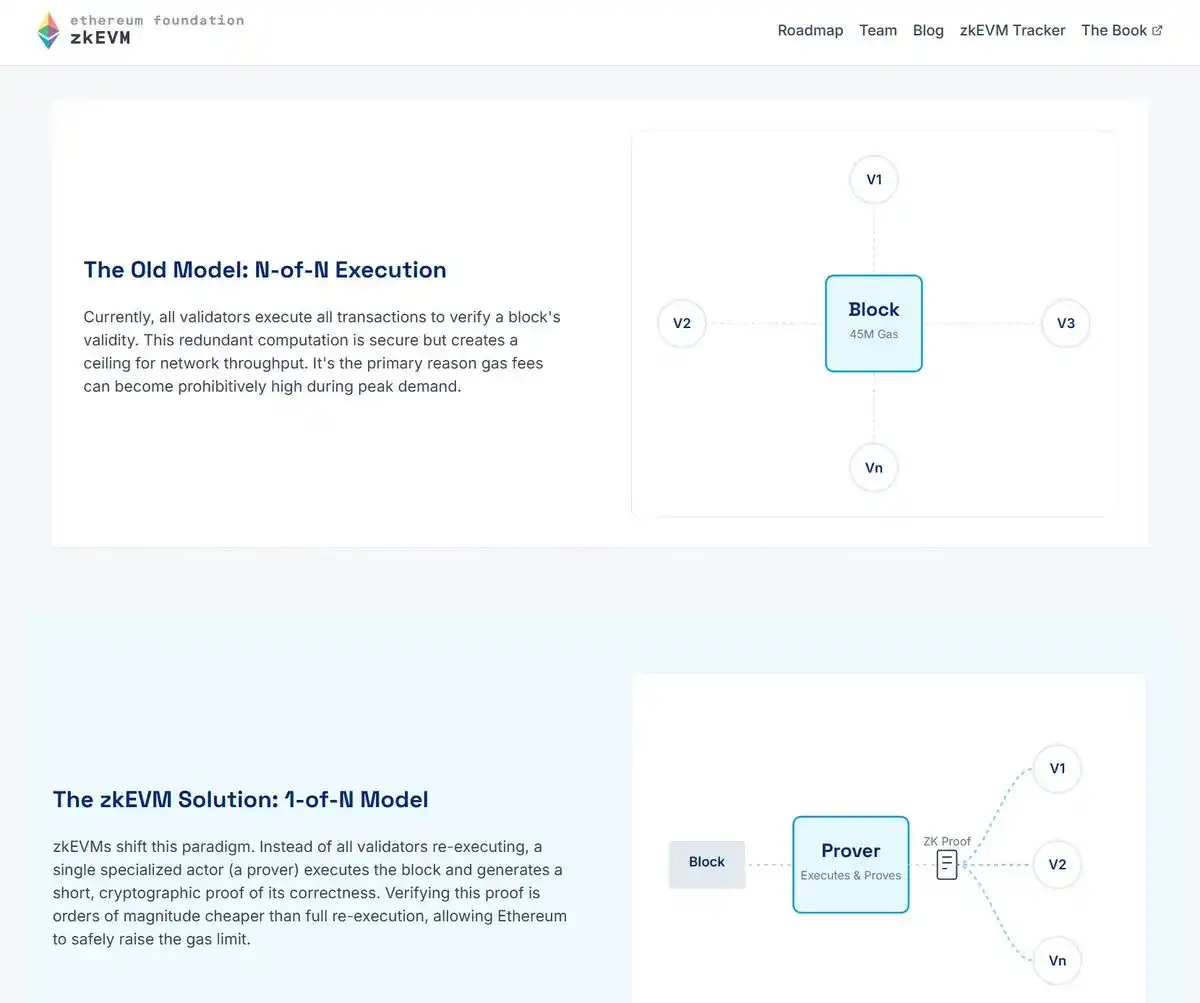
For example, if you are a grading teacher (node), the transactions are the students' exam papers.

In the past, manually grading papers was slow. But since the invention of the answer sheet (ZK-ification)神器, the machine calculates the total score in a second, so as a teacher, aren't you much more relaxed?

You are relaxed; in the past, one person could only grade 50 papers, but now they can grade 1000. The person is the same, but efficiency skyrockets.

Therefore, Ethereum must first ZK-ify the mainnet, and then it can significantly raise the Gas limit again.

ZK-ification itself does not directly increase TPS; it is a prerequisite. Improving performance still relies on raising the Gas limit, but after ZK-ification, nodes do not need to increase server costs much, making the代价很小.

After the recent Fusaka upgrade (especially the PeerDAS upgrade) performed well, Ethereum has taken another step closer to mainnet ZK-ification, which is why Vitalik is so excited.

Imagine a mainnet with TPS breaking thousands; for Ethereum, that indeed counts as a decent narrative.

Someone raised a question:

If Ethereum itself builds a ZK-EVM for the mainnet, are other ZK teams still meaningful?

First, the conclusion is, they are still meaningful.

Why?

First, ZK engineering is one of the most difficult developments in the entire network, sitting at the same table as FHE. It requires a large number of cryptography talents.

It is believed that the ETH Foundation has some reserves in this area, but as an open-source community, Ethereum adheres to the philosophy that many hands make light work. It needs a large number of third-party ZK teams for trial, error, and innovation. In return, Ethereum will give substantial support.

Second, there are four types of ZK-EVM, from type 1 to type 4. Several groups, including Polygon, Scroll, ZKsync, and Taiko, are like each认领任务,分别实现其中一个类型.

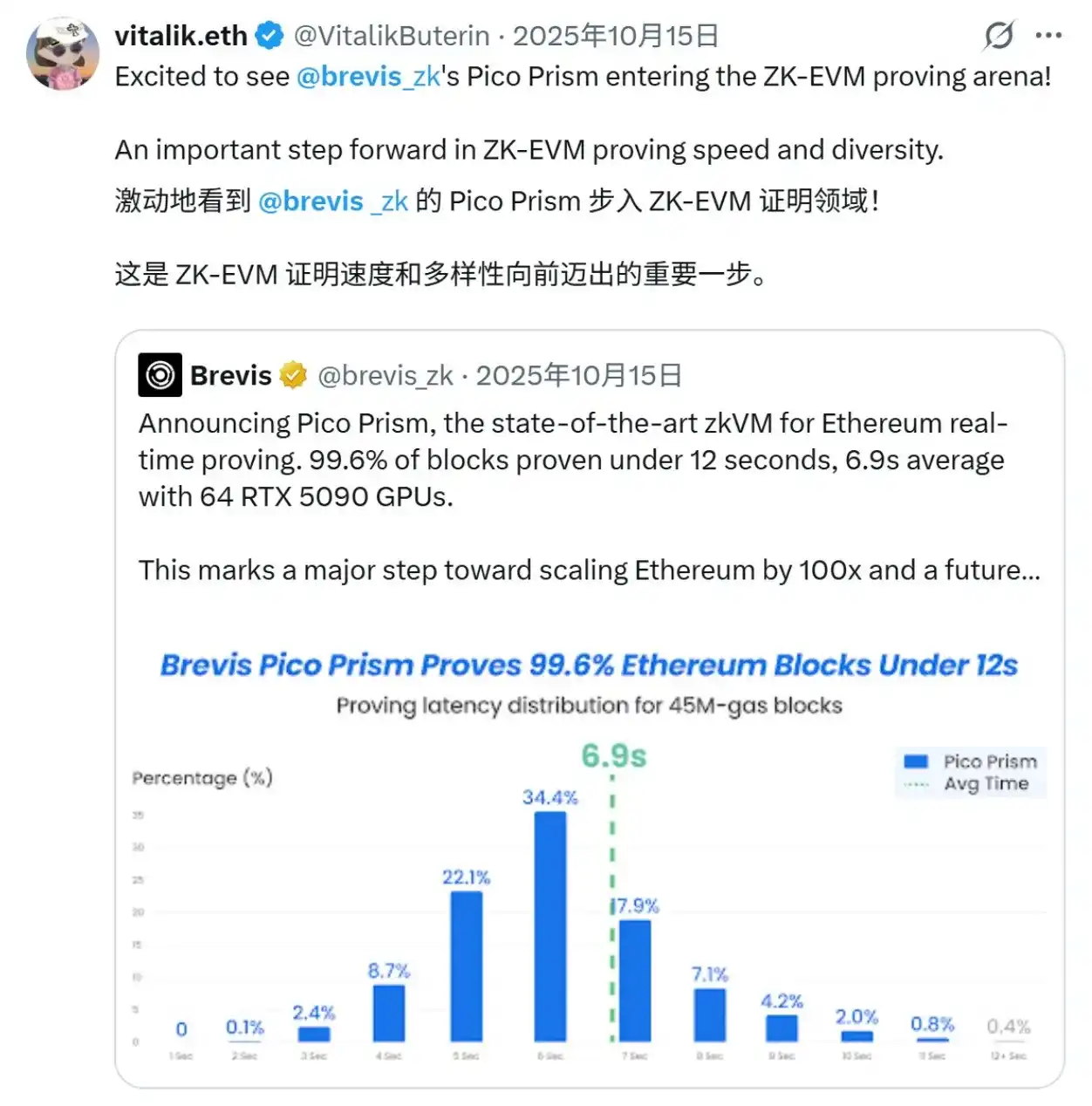
Additionally, there is ZK-VM, such as Brevis.

In fact, ZK-VM's position is even more stable compared to ZK-EVM.

The reason is that among the four major ZK-EVM types, it is highly likely that one with the best cost-performance ratio will eventually be chosen to become part of the designated solution for Ethereum's mainnet ZK-EVM, which may affect the other three.

However, for ZK-VM, it is not EVM-compatible by nature, so it will definitely be part of Ethereum's diversity.

Moreover, since VM is not constrained by EVM limitations, its performance can run very high. Ethereum's ZK-EVM poses no threat to it; instead, the Ethereum official will continue to encourage it.

For example, Vitalik previously specifically mentioned the performance of Brevis's ZK-VM and expressed期待它们进入 ZK-EVM 领域.
What about L2?There might be some impact, but it's still not significant.

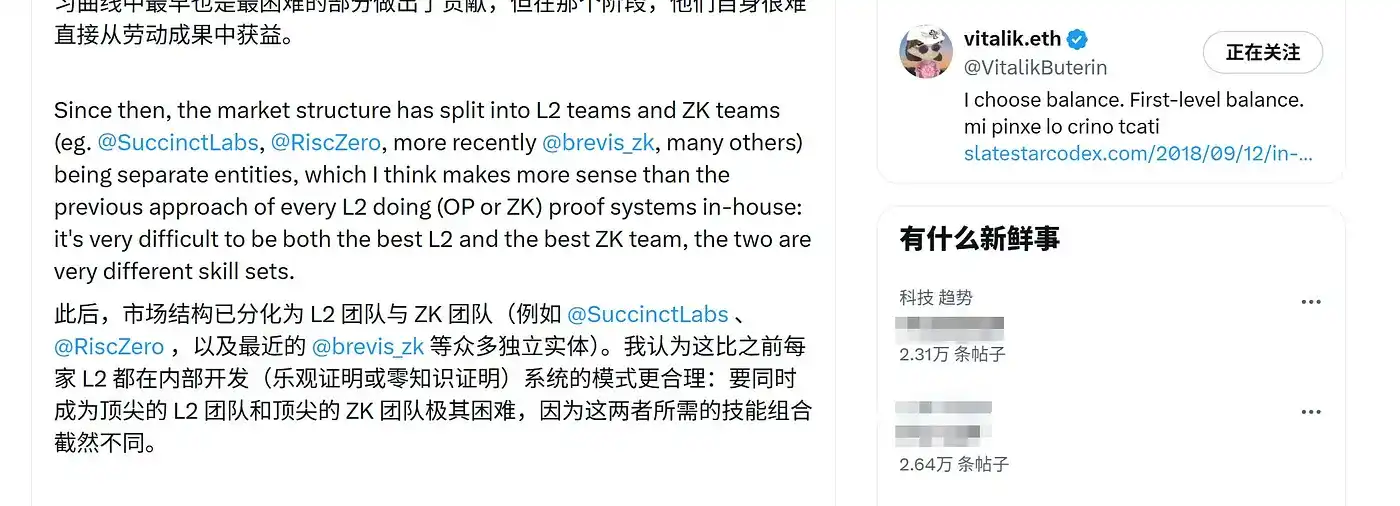
Vitalik once said when discussing Polygon that ZK and L2 should be separated比较好.

The ZK-ified L1 will certainly attract back some users from ZK L2s. After all, if L1 is cheap enough, the number of users on L2 may decrease.

But think about it the other way: if L1 is the foundation and L2 is the skyscraper, the foundation must be as solid as possible. So, if the L1 mainnet is ZK-ified, L2 fees will also decrease, which is beneficial.

Moreover, in that tweet, Vitalik also specifically mentioned Brevis, which works on ZK-VM. The reason is that much of Brevis's ZK work is not limited to L2, meaning "ZK research and L2 research are separated."

For example, they have a ZK computing power market, helping with ZK-ified reward distribution for Uniswap's hooks, which is application-driven.
In summary, Ethereum has been online for 10 years now, and the slogan of ZK-ification has been proposed for five or six years. After continuous cultivation, ZK-ification has finally entered the Alpha stage. This is thanks to the continuous investment from Ethereum and numerous third-party ZK teams including Brevis and Polygon.

Perguntas relacionadas

QWhy does Ethereum urgently need to become ZK-based according to the article?

AEthereum needs to become ZK-based to significantly increase its TPS by raising the Gas limit without forcing node operators to use prohibitively expensive servers, thereby preserving its high degree of decentralization while scaling.

QWhat is the role of ZK technology in improving Ethereum's node efficiency?

AZK technology allows nodes to simply verify cryptographic proofs of transaction batches instead of manually verifying each transaction individually, dramatically increasing the number of transactions a node can process without a proportional increase in computational cost.

QHow does the article differentiate between ZK-EVM and ZK-VM, and which one is considered more stable?

AThe article states that ZK-VM is considered more stable because it is not EVM-compatible and exists as part of Ethereum's diversity. It is not threatened by Ethereum's own ZK-EVM development and is performance-optimized without EVM constraints.

QWhat impact might a ZK-based Ethereum L1 have on existing ZK L2s?

AA cheaper and more scalable ZK-based L1 might attract some users back from L2s. However, it also benefits L2s by providing a more robust foundational layer (L1), which can lead to lower fees on L2s as well.

QWhat is the significance of the 'Alpha stage' announcement for ZKEVM mentioned in the article?

AThe announcement that ZKEVM has entered its Alpha stage signifies a major milestone after years of development, indicating that the core technology for Ethereum's full ZK integration is becoming operational and bringing the vision of a high-TPS, decentralized mainnet closer to reality.

Leituras Relacionadas

South Korean Stocks Plunge, Global Funds Liquidate: Has the Semiconductor Fundamentals Really Changed?

South Korean stocks experienced their sharpest decline of the year, with the KOSPI index plunging nearly 9% on Monday, triggering a market circuit breaker. Leading semiconductor firms Samsung Electronics and SK Hynix were heavily sold off, raising questions about whether the AI-driven bull market has reached an inflection point. This sell-off was largely triggered by a significant drop in the U.S. semiconductor sector late last week. Concurrently, NVIDIA CEO Jensen Huang visited Seoul over the weekend, meeting with top executives from SK Group, Samsung, LG, and NAVER. He announced a new multi-year partnership with SK Hynix to co-develop next-generation memory products for AI data centers. Huang emphasized that AI infrastructure build-out remains in its early stages, creating a stark contrast between market panic and ongoing, strengthened industry collaboration. The article argues that South Korea has become one of the most sensitive markets for global AI-related capital flows, functioning like a large AI memory ETF due to the heavy weighting of its chipmakers. The current market turmoil reflects a shift in investor focus: from simply betting on overall AI growth to scrutinizing which companies will actually capture the profits from that growth. This "profit pool reassessment" phase is causing high volatility based on supply chain news and earnings guidance. Ultimately, the direction of the Korean market will be determined by external factors—NVIDIA's orders, HBM supply-demand dynamics, and capital expenditures from cloud service providers—rather than domestic conditions. The disconnect between sharp price corrections and continued strong signals from the industry core leaves the market at a crossroads, awaiting clearer data on the durability of AI infrastructure demand.

marsbitHá 33m

South Korean Stocks Plunge, Global Funds Liquidate: Has the Semiconductor Fundamentals Really Changed?

marsbitHá 33m

Trump in Talks with AI Companies Over Profit Sharing, A Narrative Pressure of Industrial Revolution Scale Begins

In recent AI market discussions, a new dimension beyond growth and profits has emerged: the question of how the immense wealth potentially generated by AI should be shared with the wider public. Triggered by reports of White House officials discussing "voluntary equity transfers" with top AI firms, similar to models like Alaska's Permanent Fund, the conversation focuses on public wealth funds. OpenAI's own whitepaper proposes such funds, allowing households without direct tech stock ownership to benefit from AI gains. More radical proposals, like Bernie Sanders' call for high public equity stakes and board seats, represent an extreme end of the spectrum. Currently, these are early-stage policy probes, not enacted laws. OpenAI's initiative is seen as an attempt to secure "social license" for its future expansion, mitigating risks of public backlash, stricter regulation, or anti-trust actions as AI's economic impact grows. The core market implication is the introduction of a "policy discount" to AI valuations, particularly for private model companies like OpenAI, Anthropic, and xAI. Investors must now consider not just future earnings but also what portion might be allocated to public mechanisms. The impact varies greatly based on the mechanism. A small, voluntary transfer of non-voting economic rights (e.g., 5%) acts as a quantifiable long-term cost. Government acquisition of economic rights via warrants tied to support differs from direct equity with governance power. The most disruptive scenario would be forced high-percentage public ownership affecting control and innovation incentives. Key signals to watch include whether other AI companies follow suit, if the White House formalizes proposals, related disclosures in future IPO documents, and any market price reactions. For now, this represents a shift from pricing pure AI growth to pricing its potential distribution. A manageable, voluntary economic share is akin to an insurance cost for societal acceptance, while a forced shift toward control and governance would fundamentally alter valuation logic.

marsbitHá 37m

Trump in Talks with AI Companies Over Profit Sharing, A Narrative Pressure of Industrial Revolution Scale Begins

marsbitHá 37m

From Record Highs to a Two-Week Low: Why Did AI Concept Stocks Suddenly Pull Back?

From Record Highs to Two-Week Lows: Why Did AI Stocks Suddenly Pull Back? U.S. stock indices, led by the tech-heavy Nasdaq 100, fell sharply to two-week lows. This marked a reversal from earlier in the week when AI infrastructure and semiconductor stocks had propelled major indices to record highs. Investors are rotating out of these previously high-flying tech sectors into other areas. The sell-off was driven by profit-taking and concerns that the AI rally had become overextended, exacerbated by chipmaker Broadcom's sales outlook falling short of lofty market expectations. The decline accelerated following a stronger-than-expected U.S. May nonfarm payrolls report, which showed 172,000 jobs added versus an estimated 88,000. This data sparked a jump in bond yields, with the 10-year Treasury yield rising to 4.553%, as it reinforced market speculation that the Federal Reserve's next move could be a rate hike rather than a cut. Globally, equities also declined, with European and Asian markets falling. Within the U.S. market, chip and AI-related stocks like Super Micro Computer and Arm Holdings led the losses, dropping over 7%. Cryptocurrency-linked stocks and mining shares also fell sharply amid drops in Bitcoin and commodity prices. While the overall Q1 earnings season remained solid, with 83% of S&P 500 companies beating estimates, the weakness was concentrated in tech. Excluding the tech sector, Q1 earnings growth was around 3%, the weakest in two years.

marsbitHá 37m

From Record Highs to a Two-Week Low: Why Did AI Concept Stocks Suddenly Pull Back?

marsbitHá 37m

JP Morgan Mid-Year Research Report Analysis: The AI Supercycle is Not Over, Reduce Cash Holdings + Allocate to Real Assets

JP Morgan's 2026 Mid-Year Outlook argues the AI supercycle is far from over, despite market pessimism. The report advises clients to reduce cash holdings, increase allocations to real assets as an inflation hedge, and focus on emerging markets. Key conclusions include: 1. **AI Supercycle Intact**: Hyperscalers' 2026 capex forecasts exceed $650B, with AI contributing to GDP growth. However, their financial profile is shifting toward heavy investment, compressing free cash flow. 2. **SaaS Disruption**: Traditional software companies are being negatively impacted by AI, with significant stock declines and pressure in credit markets. 3. **Persistent Inflation**: Core inflation is structurally higher post-pandemic. Holding excess cash and bonds leads to real wealth erosion. Recommendations include commodities, infrastructure, real estate, and gold. 4. **Geopolitical Shocks & Opportunities**: The Hormuz Strait blockade caused a major oil shock, but JP Morgan views the subsequent equity market pullback as a buying opportunity. "Fragmentation" is creating pockets of value, notably in resource-rich Latin America, AI-supply-chain-linked East Asia, and deeply discounted Chinese equities, where a policy shift could trigger a re-rating. 5. **Regional Views**: The firm is cautious on Europe due to high energy costs and lower innovation investment, preferring US and select EM exposures. In short, JP Morgan sees market volatility as an entry point but recommends a portfolio pivot: favor AI infrastructure, real assets, and EM, while avoiding excess cash, vulnerable software firms, and traditional 60/40 stock-bond allocations.

marsbitHá 1h

JP Morgan Mid-Year Research Report Analysis: The AI Supercycle is Not Over, Reduce Cash Holdings + Allocate to Real Assets

marsbitHá 1h

Trading

Spot
Futuros

Artigos em Destaque

Como comprar ZK

Bem-vindo à HTX.com!Tornámos a compra de ZKsync (ZK) simples e conveniente.Segue o nosso guia passo a passo para iniciar a tua jornada no mundo das criptos.Passo 1: cria a tua conta HTXUtiliza o teu e-mail ou número de telefone para te inscreveres numa conta gratuita na HTX.Desfruta de um processo de inscrição sem complicações e desbloqueia todas as funcionalidades.Obter a minha contaPasso 2: vai para Comprar Cripto e escolhe o teu método de pagamentoCartão de crédito/débito: usa o teu visa ou mastercard para comprar ZKsync (ZK) instantaneamente.Saldo: usa os fundos da tua conta HTX para transacionar sem problemas.Terceiros: adicionamos métodos de pagamento populares, como Google Pay e Apple Pay, para aumentar a conveniência.P2P: transaciona diretamente com outros utilizadores na HTX.Mercado de balcão (OTC): oferecemos serviços personalizados e taxas de câmbio competitivas para os traders.Passo 3: armazena teu ZKsync (ZK)Depois de comprar o teu ZKsync (ZK), armazena-o na tua conta HTX.Alternativamente, podes enviá-lo para outro lugar através de transferência blockchain ou usá-lo para transacionar outras criptomoedas.Passo 4: transaciona ZKsync (ZK)Transaciona facilmente ZKsync (ZK) no mercado à vista da HTX.Acede simplesmente à tua conta, seleciona o teu par de trading, executa as tuas transações e monitoriza em tempo real.Oferecemos uma experiência de fácil utilização tanto para principiantes como para traders experientes.

175 Visualizações TotaisPublicado em {updateTime}Atualizado em 2026.06.02

Como comprar ZK

Discussões

Bem-vindo à Comunidade HTX. Aqui, pode manter-se informado sobre os mais recentes desenvolvimentos da plataforma e obter acesso a análises profissionais de mercado. As opiniões dos utilizadores sobre o preço de ZK (ZK) são apresentadas abaixo.

活动图片