Why Hyperliquid’s $48B oil-driven volume could signal a crypto reset

ambcryptoPublicado em 2026-03-20Última atualização em 2026-03-20

Resumo

Middle East tensions are causing a significant oil supply shock, driving traders to seek 24/7 exposure through perpetual contracts on Hyperliquid. This has positioned Hyperliquid as the leading perp DEX by volume, with weekly trades nearing $48 billion. The platform's native token, HYPE, has surged 30% monthly, diverging from most altcoins. However, this rally is fueled by leveraged long positions and geopolitical FOMO. Analysts suggest that an unwind of these crowded oil trades on Hyperliquid could signal easing tensions and potentially trigger a broader crypto market reset towards risk-on sentiment.

A supply shock is a strong catalyst, especially for traders chasing short-term upside.

Currently, the West Asian crisis is driving a real supply-side squeeze in the oil market. As a result, investor sentiment is shifting, with oil flows picking up and traders increasingly positioning for further upside. In short, long positions are becoming more aggressive as the narrative gains momentum.

Against this backdrop, Hyperliquid [HYPE] is starting to stand out as a key beneficiary. According to DeFiLlama data, it’s now leading perp DEX volume, with weekly volume nearing $48 billion, roughly 2x larger than the next platform in line.
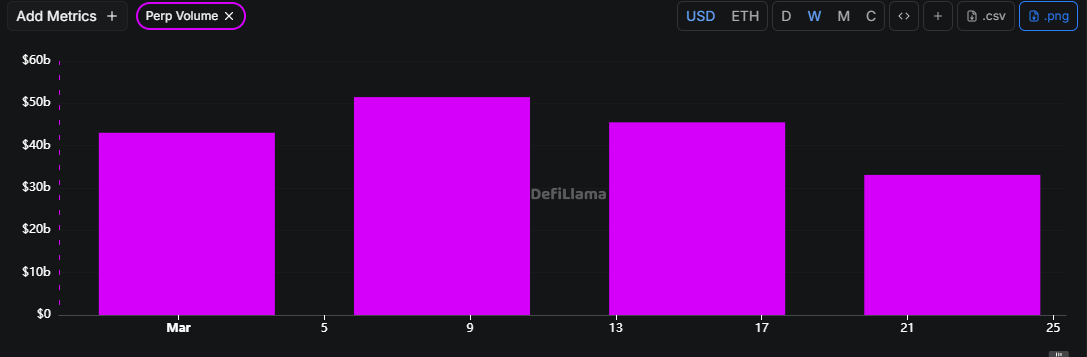
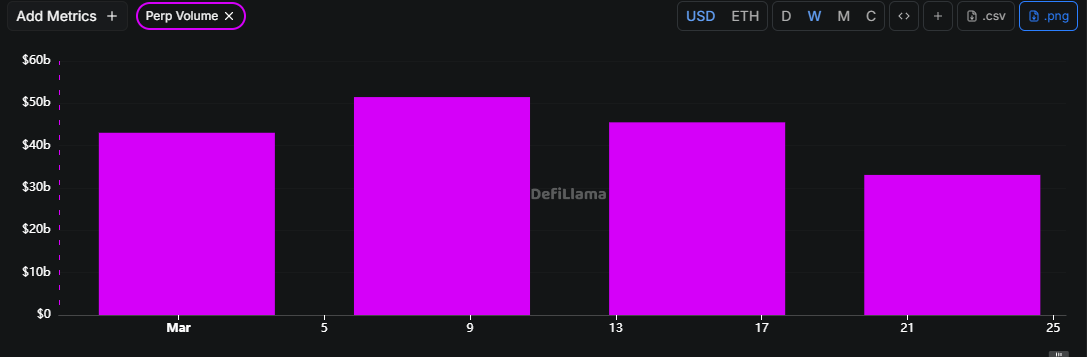
Source: DeFiLlama

Importantly, this shift is also catching the attention of major TradFi players.

JPMorgan analysts, for instance, point to traders chasing 24/7 oil exposure as the main driver behind the spike in Hyperliquid’s perp DEX volume, a gap TradFi markets still don’t cover. As a result, Hyperliquid is gaining an edge in capturing incremental flow and liquidity.

Notably, this on-chain activity is showing up in HYPE’s price action as well. On the monthly chart, HYPE is up roughly 30%, clearly diverging from other high-cap altcoins that are mostly printing single-digit gains. In short, the market is starting to price in this edge.

However, with HYPE now running into resistance around the $2.3k level, a strong case remains that macro FUD and crowded positioning are driving this move rather than a sustained trend. Consequently, if flows cool or positioning gets too crowded, it increases the risk of an unwind.

So the key question is: If we start to see large long squeezes and exits on Hyperliquid, could that flush act as a signal for a market reset and indicate when the broader crypto market flips back to risk-on?

Traders piling into oil on Hyperliquid raise the question of a reset

The conflict in the Middle East has thrown the global oil market into disarray.

According to the Kobeissi Letter, oil prices have jumped sharply since December, and Saudi Arabia’s prediction markets are calling for the war to last through April, with $180 tagged as the “base case” for oil. In short, the market is bracing for continued volatility and supply-driven moves.

In this setup, Lookonchain flagged a trader depositing 4.105 million USDC on Hyperliquid to open a 5x long on $20.19 Brent oil, showing how traders are chasing FOMO and using leverage to capture outsized returns in the oil market. The bigger picture, though? Moves like this underline Hyperliquid’s central role in enabling perp trades and explain why its DEX volume keeps hitting new highs.
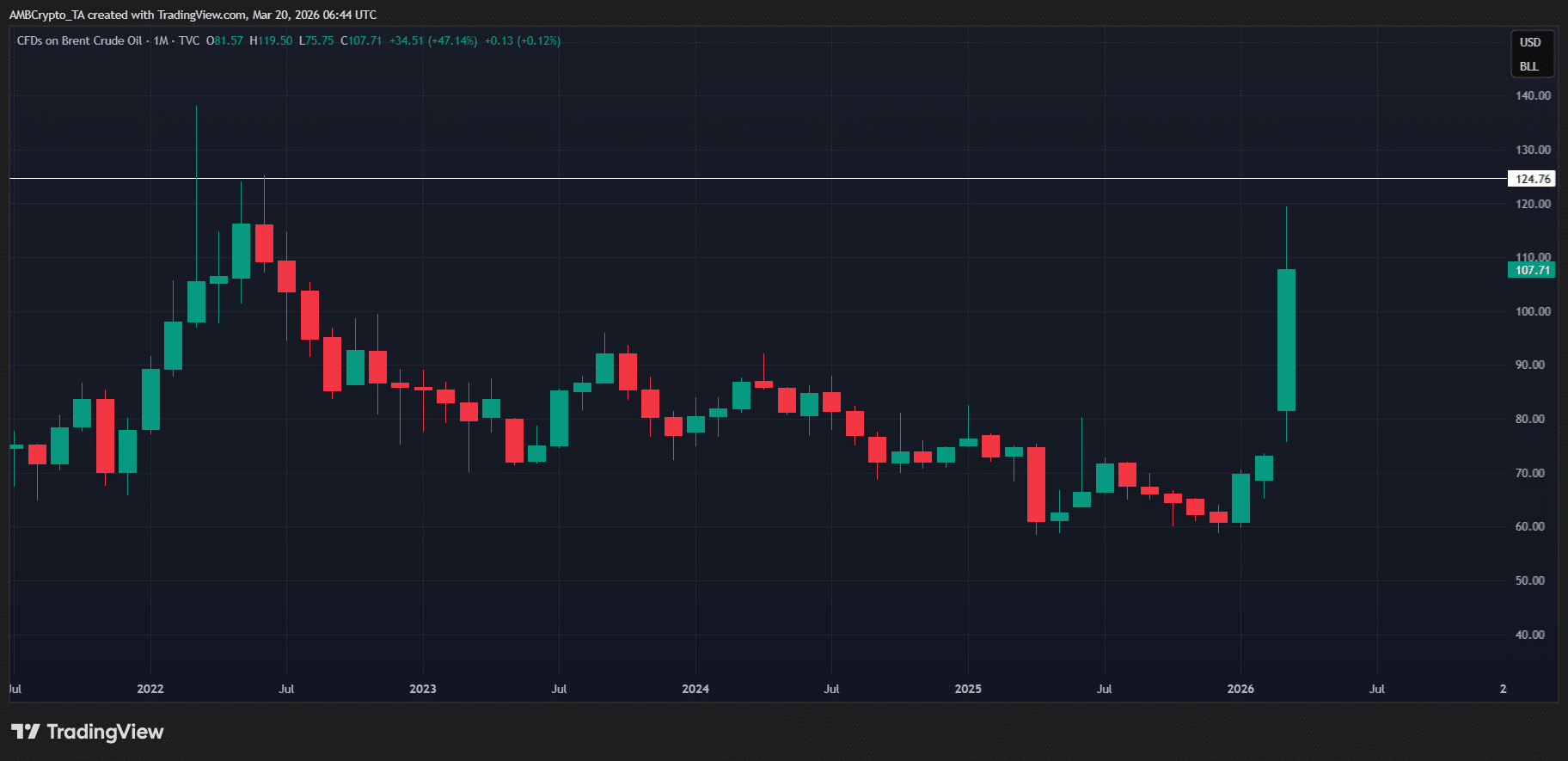
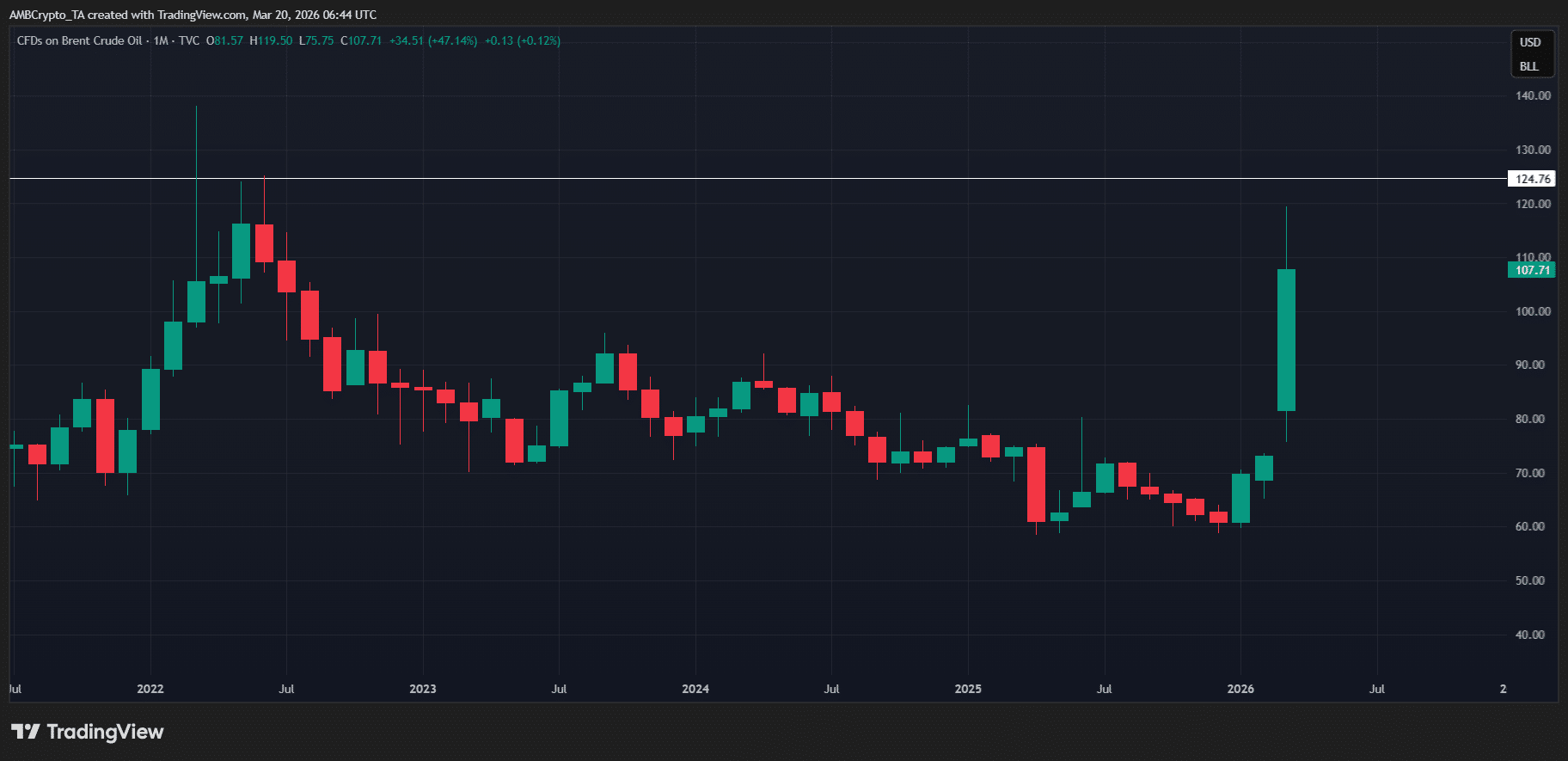
Source: TradingView (BRENT OIL/USD)

From a technical angle, these perp bets on Hyperliquid make total sense.

As the chart above shows, Brent Oil is up a massive 47% so far in March, marking its first 40%+ monthly rally since the COVID-19 crisis. Prices have already bounced back to 2022 levels around $110, with this trade’s liquidation set at $87.87, leaving the trader comfortably sitting on significant unrealized gains.

Meanwhile, the broader crypto market is still stuck around a $2.4 trillion market cap. Capital rotation into risk assets looks capped as traders chase oil momentum, with Hyperliquid standing out as the only altcoin posting double-digit gains.

According to AMBCrypto, this is a key trend to watch. The crypto market’s next risk-on move seems tied to long crowding on Hyperliquid. Once those positions start to unwind, it could signal geopolitical tensions easing and open the door for a broader risk-on rotation.


Final Summary

  • Middle East tensions are driving a supply shock in oil, fueling FOMO-driven longs on Hyperliquid and pushing HYPE up 30%, highlighting its central role in perp trading.
  • Brent oil rallies 47% in March while crypto remains stuck, showing that broader risk-on moves may hinge on potential unwind on Hyperliquid.


Perguntas relacionadas

QWhat is the main driver behind the spike in Hyperliquid's perp DEX volume according to JPMorgan analysts?

AJPMorgan analysts point to traders chasing 24/7 oil exposure as the main driver behind the spike in Hyperliquid's perp DEX volume, a gap that TradFi markets still don't cover.

QHow much has the price of HYPE increased on the monthly chart, and how does this compare to other altcoins?

AOn the monthly chart, HYPE is up roughly 30%, clearly diverging from other high-cap altcoins that are mostly printing single-digit gains.

QWhat is the 'base case' price target for oil according to Saudi Arabia's prediction markets mentioned in the article?

ASaudi Arabia's prediction markets are calling for the war to last through April, with $180 tagged as the 'base case' for oil.

QWhat specific example does Lookonchain provide to show how traders are chasing oil FOMO on Hyperliquid?

ALookonchain flagged a trader depositing 4.105 million USDC on Hyperliquid to open a 5x long on $20.19 Brent oil.

QAccording to the article, what could a potential unwind of long positions on Hyperliquid signal for the broader crypto market?

AA potential unwind of long positions on Hyperliquid could signal that geopolitical tensions are easing and open the door for a broader risk-on rotation in the crypto market.

Leituras Relacionadas

How Difficult is Chip Making? A Division Error Costs 475 Million Dollars

How Hard Is It to Make a Chip? A Division Error Cost $475 Million Chip expert Shi Kan, a researcher at the Chinese Academy of Sciences and a popular tech creator, explains the immense challenges of chip development. Chips are foundational to modern technology, but their creation is extraordinarily difficult. The journey from sand to a functional chip involves complex design and manufacturing, but a critical bottleneck is verification—ensuring the design works flawlessly before costly production. A single, undetected bug can have catastrophic consequences, as illustrated by the infamous 1994 Intel Pentium FDIV bug. A flaw in the floating-point division unit forced a recall costing $475 million. Unlike software, chips cannot be easily patched after manufacture, making "first-time success" paramount. However, industry surveys show only 24% of chip projects achieve this; over three-quarters require at least one costly re-spin due to design flaws. Verification has thus become the dominant phase, consuming up to 70% of the design cycle. The core challenge is a "verification impossible triangle" between high performance, good debuggability, and low cost. Exhaustively verifying a modern CPU core could take 15,000 years with software simulation, or 30 years with advanced hardware emulation—timeframes utterly impractical for development. Despite being essential, verification is often seen as unglamorous "dirty work," receiving less academic attention than fields like AI. Shi and his team are tackling this by developing an agile verification research framework called ENCORE, based on FPGA technology, to improve verification efficiency and debug capability. Beyond research, Shi engages in public science communication through long-form video content, aiming to demystify chip technology, AI, and computer science. He argues for the value of pursuing "hard and long-term" endeavors, whether in the meticulous world of chip verification or in creating substantive educational content, believing such sustained effort is likely the right path forward.

marsbitHá 10m

How Difficult is Chip Making? A Division Error Costs 475 Million Dollars

marsbitHá 10m

Blockchain Has Finally Started to Sail into the Mainstream After 18 Years

Blockchain Finds Its True Path After 18 Years: Becoming the Financial Backbone for AI Agents and Autonomy This analysis explores a pivotal shift in the blockchain and crypto investment landscape, driven by the dominance of AI. Major venture capital firms, including Variant, Paradigm, Haun Ventures, and YZi Labs, are moving beyond pure "crypto" investment theses. They are expanding their focus to AI, robotics, and frontier tech, signaling that blockchain is no longer seen as a standalone sector but as an underlying infrastructure layer. The core argument is that blockchain's killer application may not be user-facing apps, but rather providing the economic rails for the coming wave of AI agents, autonomous robots, and automated systems. Key capabilities like self-custody wallets, programmable stablecoins for micropayments, on-chain identity, and verifiable smart contracts are positioned as essential for a future where machines conduct economic activity. The recent $1.4 billion investment by Tether (via its venture arm) in German robotics company NEURA Robotics exemplifies this, aiming to embed Tether's wallet tools directly into robots for autonomous transactions. While many "AI + Crypto" projects remain superficial, the article concludes that true value lies where crypto is a necessary component—enabling machine-to-machine payments, agent autonomy, verifiable data provenance, and open financial settlement for the AI era. For crypto venture capital, this convergence with AI represents both an adaptation to shifting capital flows and a potential path to unlocking the large-scale, non-speculative utility the industry has long sought.

marsbitHá 31m

Blockchain Has Finally Started to Sail into the Mainstream After 18 Years

marsbitHá 31m

Blockchain has finally begun sailing toward the main channel after 18 years

After 18 years of development, blockchain technology is beginning to move from a specialized niche into mainstream adoption, according to a recent industry analysis. The shift is reflected in the changing strategies of major crypto venture capital firms, which are expanding their focus beyond pure "digital ownership" towards broader themes like "autonomy." The report highlights that leading VC firms like Variant, Paradigm, Haun Ventures, and YZi Labs are broadening their investment mandates to include not only crypto but also artificial intelligence (AI), robotics, biotech, and other frontier technologies. This reflects a recognition that the isolated "crypto investment" narrative is losing appeal to limited partners (LPs) as capital and attention increasingly flow toward AI and other high-growth tech sectors. A key emerging thesis is that blockchain's most significant future application may not be as a consumer-facing product, but as the underlying economic and settlement infrastructure for the AI era. As AI agents and autonomous systems become more prevalent, they will require programmable, global, and low-cost payment networks (like stablecoins), verifiable digital identities, and secure wallets to manage transactions and assets on behalf of users. The investment by stablecoin issuer Tether into robotics company NEURA, with plans to integrate its wallet technology, is cited as a prime example of this convergence. However, the article cautions that simply labeling projects as "AI + Crypto" is insufficient. True value lies in integrations where blockchain technology is essential—such as enabling machine-to-machine micropayments, verifiable data provenance for AI, or transparent governance for autonomous organizations—rather than being a superficial marketing add-on. In conclusion, while AI currently dominates the tech narrative and capital flows, it may ultimately create the real-world, high-frequency demand that the crypto industry has long sought. For crypto VCs and projects, the path forward is to position blockchain not as a competing sector, but as a critical foundational layer powering autonomy and economic activity in an AI-driven future.

链捕手Há 37m

Blockchain has finally begun sailing toward the main channel after 18 years

链捕手Há 37m

Y Combinator Co-founder: How to Make a Billion Dollars?

The Y Combinator co-founder argues that becoming a billionaire by founding a successful startup is not only possible but demonstrably achievable without unfair or unethical practices. He disputes a politician's claim to the contrary, using the example of a founder whose company grew at 93% monthly solely through creating a product users loved and recommended. The core mechanism is exponential growth. A conservative 15% monthly growth rate compounds to a 4384x increase over five years, which can easily lead to billion-dollar valuations and founder wealth. The process depends on two key variables: the growth rate and the duration it can be sustained. A high growth rate stems from a great product that users naturally promote, while a long duration requires a large enough market. For aspiring founders, especially young ones, the simplest path is to build something they and their friends genuinely need. Young people's current needs often predict future mass-market trends. He advises against actively "searching" for ideas, as this tends to filter out unconventional but promising ones. Instead, inspiration should come from working on interesting projects with friends, as many iconic companies (e.g., Apple, Facebook) started this way. Ultimately, building a massively valuable startup is not about exploitation but empathy: deeply understanding a user group and building a product that significantly improves their lives. This, powered by exponential growth in a large market, is the legitimate path to immense wealth creation.

Foresight NewsHá 40m

Y Combinator Co-founder: How to Make a Billion Dollars?

Foresight NewsHá 40m

Trading

Spot
Futuros
活动图片