Why Do DeFi Users Reject Fixed Rates?

Odaily星球日报Publicado em 2025-12-21Última atualização em 2025-12-21

Resumo

Fixed-rate lending has consistently struggled to gain traction in DeFi, not because users inherently reject it, but due to a fundamental mismatch between product design and the actual behavior of capital in the ecosystem. DeFi protocols are built as on-demand money markets, where lenders—acting like cash managers—prioritize liquidity, composability, and the ability to exit or reallocate funds instantly. They accept lower yields in exchange for these features. In contrast, fixed-rate products require locking funds for a duration, sacrificing this flexibility for a modest premium that often fails to adequately compensate for the loss of optionality. Most crypto borrowing is not long-term credit but leveraged, tactical activity like basis trading and collateral recycling, where borrowers also prefer floating rates for their flexibility. This creates a one-sided market: lenders demand a premium to lock funds, but borrowers are unwilling to pay it. Fixed-rate markets fragment liquidity across maturities, leading to poor secondary markets and significant price impacts for early exits. While fixed-rate products can exist in niche, hold-to-maturity forms, they are structurally disadvantaged. The lender base, composed of mercenary capital seeking liquidity, will likely keep floating-rate money markets like Aave as the default, with fixed-rate serving only as an optional overlay for those explicitly seeking duration exposure.

Original byPrince

Compiled | Odaily Planet Daily Golem(@web 3_golem)

The failure of fixed-rate lending in the crypto space is not solely because DeFi users reject it. Another reason for its failure is that DeFi protocols designed credit products based on money market assumptions and then deployed them into a liquidity-oriented ecosystem; the mismatch between user assumptions and actual capital behavior has kept fixed-rate lending a niche market.

Fixed-Rate Products Are Unpopular in the Crypto Space

Today, almost all mainstream lending protocols are building fixed-rate products, largely driven by RWA. This trend is understandable because once closer to real-world credit, fixed terms and predictable payments become crucial. In this context, fixed-rate lending seems like the inevitable choice.

Borrowers crave certainty: fixed payments, known terms, no surprise repricing. If DeFi is to function like real finance, then fixed-rate lending should play a central role.

Yet, every cycle proves the opposite. The floating-rate money market is huge, while the fixed-rate market remains sluggish. Most "fixed' products end up performing like niche bonds held to maturity.

This is no accident; it reflects the composition of market participants and how these markets are designed.

TradFi Has Credit Markets, DeFi Relies on Money Markets

Fixed-rate loans work in the traditional financial system because the system is built around time. The yield curve anchors prices, and benchmark rates move relatively slowly. Some institutions have the explicit mandate to hold duration, manage mismatches, and remain solvent when funds flow one way.

Banks issue long-term loans (mortgages being the most obvious example) and fund them with liabilities that don't belong to 'mercenary capital.' When rates move, they don't need to liquidate assets immediately. Duration management is achieved through balance sheet construction, hedging, securitization, and a deep layer of intermediation dedicated to risk-sharing.

The key isn't the existence of fixed-rate loans, but that there is always someone to absorb the mismatch when the terms of lenders and borrowers don't perfectly align.

DeFi never built such a system.

What DeFi built is more like on-demand money markets. Most capital providers have simple expectations: earn yield on idle funds while maintaining liquidity. This preference quietly determines which products can scale.

When lenders behave like cash managers, markets clear around products that feel like cash, not those that feel like credit.

How DeFi Lenders Understand the Meaning of "Lending"

The most important distinction is not fixed vs. floating rates, but the withdrawal promise.

In a floating-rate pool like Aave, providers get a token that is essentially a liquidity inventory. They can withdraw funds at any time, rotate capital when better opportunities arise, and often use their positions as collateral elsewhere. This optionality is itself a product.

Lenders accept a slightly lower yield for this. But they are not stupid; they are paying for liquidity, composability, and the ability to reprice without additional cost.

Using a fixed rate upends this relationship. To get the duration premium, lenders must give up flexibility and accept their funds being locked for a period. This trade is sometimes justified, but only if the compensation is right. In practice, most fixed-rate schemes don't offer enough compensation to offset the loss of optionality.

Why Does Liquid Collateral Pull Rates Towards Floating?

Today, most large-scale crypto lending is not credit in the traditional sense. It is essentially margin and repo-style lending backed by highly liquid collateral. Such markets naturally gravitate towards floating rates.

In traditional finance, repo and margin financing also reprice continuously. The collateral is liquid, risk is marked-to-market. Both parties expect the relationship to adjust at any time, and the same is true for crypto lending.

This also explains an issue lenders often overlook.

To gain liquidity, lenders have effectively accepted far less economic benefit than the nominal rate suggests.

On Aave, there is a large spread between what borrowers pay and what lenders earn. Part of this is protocol fees, but a significant portion is because the utilization ratio must be kept below a certain level to ensure smooth withdrawals under stress.
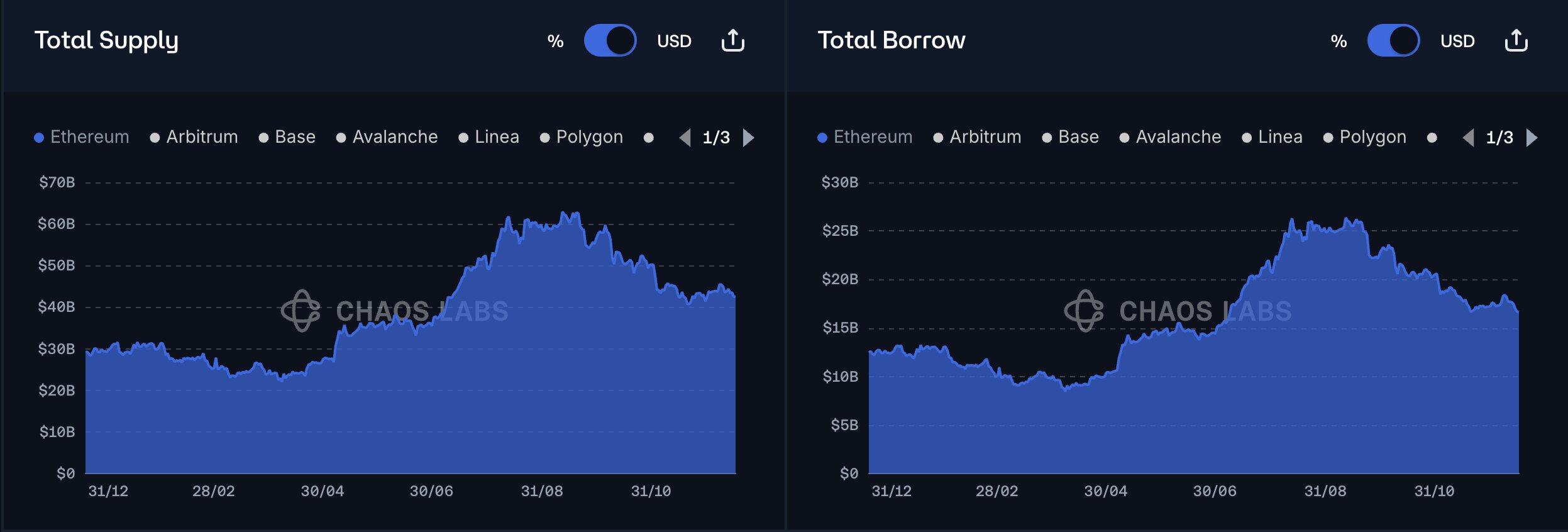
Aave One-Year Supply vs. Demand

This spread manifests as a lower yield, which is the price lenders pay to ensure smooth withdrawals.

Therefore, when a fixed-rate product appears, offering a modest premium in exchange for locking funds, it is not competing against a neutral benchmark product, but against a product that intentionally suppresses yield but is highly liquid and safe.

Winning requires much more than offering a slightly higher APR.

Why Do Borrowers Still Tolerate Floating-Rate Markets?

Generally, borrowers like certainty, but most on-chain lending is not home mortgages. It involves leverage, basis trading, avoiding liquidation, collateral recycling, and tactical balance sheet management.

As @SilvioBusonero showed in his analysis of Aave borrowers, most on-chain debt relies on revolving loans and basis strategies, not long-term financing.

These borrowers don't want to pay a high premium for long-term loans because they don't plan to hold them long. They want to lock in rates when convenient and refinance when not. If rates work for them, they keep the position. If things go wrong, they close quickly.

Thus, we end up with a market where lenders demand a premium to lock funds, but borrowers are unwilling to pay that fee.

This is why fixed-rate markets keep evolving into one-sided markets.

Fixed-Rate Markets Are a One-Sided Market Problem

The failure of fixed rates in crypto is often blamed on implementation. Auction mechanisms vs. AMMs (Automated Market Makers), rounds vs. pools, better yield curves, better UX, etc.

Many different mechanisms have been tried. Term Finance does auctions, Notional built explicit term instruments, Yield tried term-based automated vault mechanisms (AMM), Aave even tried simulating fixed-rate lending within a pool system.

The designs vary, but the outcome converges. The deeper issue is the mindset behind it.

The argument ultimately turns to market structure. Some argue that most fixed-rate protocols try to make credit feel like a variant of a money market. They retain pools, passive deposits, and liquidity promises, merely changing how the rate is quoted. Superficially, this makes fixed rates more palatable, but it also forces credit to inherit the constraints of money markets.

Fixed rate isn't just a different rate; it's a different product.

Meanwhile, the argument that these products are built for a future user base is only partially correct. The expectation was that institutions, long-term depositors, and credit-native borrowers would flood in and become the backbone of these markets. But the capital that actually flooded in was more like active capital.

Institutional investors showed up as asset allocators, strategists, and traders; long-term depositors never reached meaningful scale; native credit borrowers do exist, but borrowers are not the anchor of lending markets, lenders are.

Therefore, the limiting factor was never purely distribution, but the interaction of capital behavior with the wrong market structure.

For fixed-rate mechanisms to work at scale, one of the following must be true:

  1. Lenders are willing to accept locked funds;
  2. There is a deep secondary market where lenders can exit at reasonable prices;
  3. Someone hoards duration funds, allowing lenders to pretend they have liquidity.

DeFi lenders mostly refuse condition 1, secondary markets for term risk remain thin, and condition 3 quietly reshapes balance sheets, which is what most protocols try to avoid.

This is why fixed-rate mechanisms are always pushed into a corner, barely surviving, never becoming the default place for capital.

Term Segmentation Leads to Liquidity Fragmentation, Secondary Markets Remain Weak

Fixed-rate products create term segmentation, and term segmentation leads to liquidity fragmentation.

Each maturity is a different financial instrument with different risks. A claim expiring next week is fundamentally different from one expiring in three months. If a lender wants to exit early, they need someone to buy that specific claim at that specific time.

This means either:

  • Multiple independent pools (one for each maturity)
  • A genuine order book with genuine market makers quoting across the yield curve

DeFi hasn't delivered a durable version of the second option for credit, at least not at scale yet.

What we see instead is a familiar phenomenon: worse liquidity, larger price impact. 'Early exit' becomes 'you can exit, but at a discount,' a discount that sometimes eats most of the lender's expected yield.

Once a lender experiences this, the position stops feeling like a deposit and becomes an asset to be managed. After that, most capital quietly flows out.

A Concrete Comparison: Aave vs. Term Finance

Let's look at where the money actually goes.

Aave operates at massive scale, with billions in loans, while Term Finance is well-designed and fulfills everything fixed-rate advocates want, yet remains small compared to money markets. This gap isn't branding; it reflects the actual preferences of lenders.

On Ethereum Aave v3, USDC providers get ~3% APY while maintaining instant liquidity and highly composable positions. Borrowers pay ~5% APY over the same horizon.

In contrast, Term Finance often clears 4-week fixed-rate USDC auctions in the mid-single digits, sometimes higher, depending on collateral and conditions. On the surface, this seems better.

But the key is the lender's perspective.

If you are a lender considering these two options:

  • ~3.5% yield, cash-like (exit anytime, rotate anytime, use position elsewhere);
  • ~5% yield, bond-like (hold to maturity, exit liquidity limited unless someone takes over).
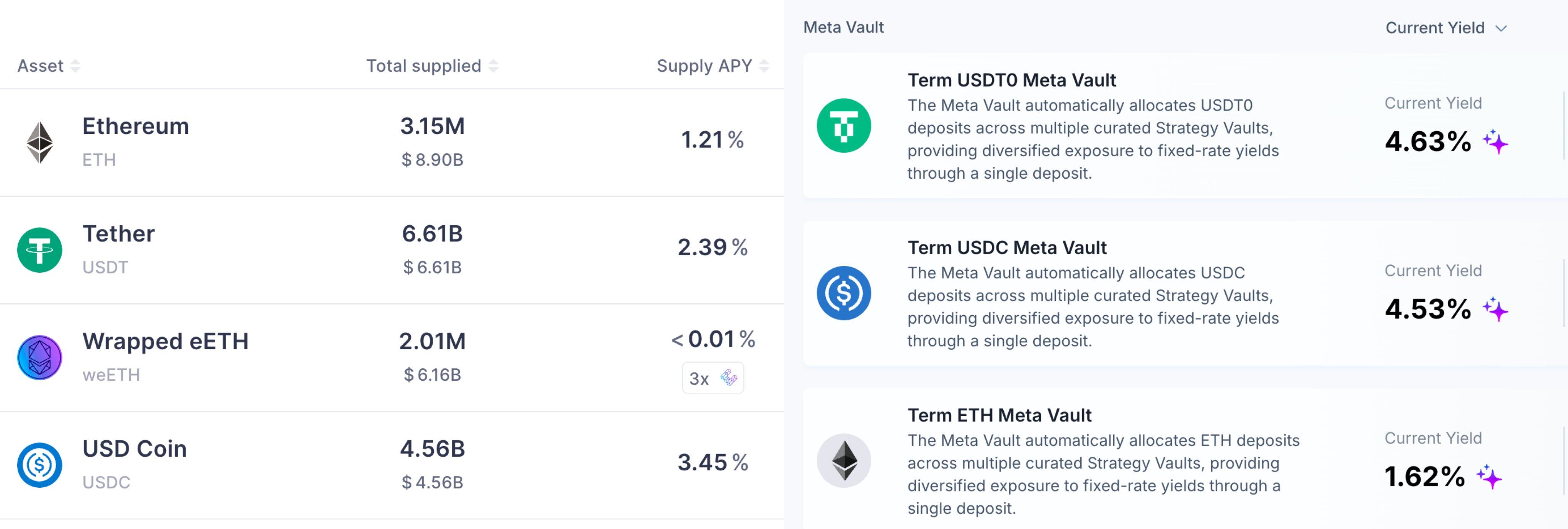
Aave vs. Term Finance Annual Percentage Yield (APY) Comparison

Many DeFi lenders choose the former, even if the latter is numerically higher. Because the number isn't the full return; the full return includes the optionality.

Fixed-rate markets require DeFi lenders to be bond buyers, while in this ecosystem, most capital is trained to be mercenary liquidity providers.

This preference explains why liquidity concentrates in specific areas. Once liquidity is insufficient, borrowers immediately feel the impact of worse execution efficiency and constrained funding capacity, and they revert to floating rates.

Why Fixed Rates Might Never Be the Default in Crypto

Fixed rates can exist; they can even be healthy.

But they won't be the default place for DeFi lenders to park capital, at least not until the lender base changes.

As long as most lenders expect par liquidity, value composability as much as yield, and prefer positions that adapt automatically, fixed rates remain structurally disadvantaged.

Floating-rate markets won because they match the actual behavior of participants. They are money markets for liquid capital, not credit markets for long-term assets.

What Needs to Change for Fixed-Rate Products?

If fixed rates are to work, they must be treated as credit, not masquerading as savings accounts.

Early exit must be priced, not just promised; term risk must be explicit; when funds flow in opposite directions, someone must be willing to take the other side.

The most viable path is a hybrid model. Floating rates as the base layer for capital placement, fixed rates as an optional tool for those explicitly looking to buy or sell duration.

The more realistic path isn't forcing fixed rates into money markets, but preserving liquidity flexibility while providing opt-in pathways for those seeking certainty.


Perguntas relacionadas

QWhy do DeFi users generally reject fixed-rate lending products?

ADeFi users reject fixed-rate lending primarily because it conflicts with their preference for liquidity and flexibility. Most DeFi lenders act as opportunistic liquidity providers, valuing the ability to withdraw funds instantly, rotate capital, and use positions as collateral. Fixed-rate products lock funds for a period, removing these options, and the compensation offered is often insufficient to justify the loss of liquidity.

QHow does the structure of DeFi lending markets favor floating rates over fixed rates?

ADeFi lending markets are structured like on-demand money markets, not traditional credit markets. They rely on highly liquid collateral and are used for strategies like leverage, basis trading, and tactical balance sheet management. Both lenders and borrowers prefer the flexibility of floating rates, which allow for immediate repricing and easy exit, making fixed-rate products less attractive and scalable.

QWhat is the key difference between TradFi credit markets and DeFi money markets that affects fixed-rate adoption?

ATradFi credit markets are built around time, with institutions managing duration mismatches through hedging, securitization, and deep intermediation layers. In contrast, DeFi money markets are designed for liquidity, with lenders expecting cash-like behavior—instant withdrawals and reusability of positions. This fundamental mismatch in structure and participant behavior makes fixed-rate lending niche in DeFi.

QWhy do fixed-rate markets in DeFi often become one-sided markets?

AFixed-rate markets become one-sided because lenders demand a premium for locking funds, but borrowers—often engaged in short-term strategies like leverage and basis trading—are unwilling to pay that premium. This misalignment between lender and borrower preferences results in limited demand for fixed-rate products, causing them to remain small and illiquid.

QWhat conditions are necessary for fixed-rate lending to work at scale in DeFi?

AFor fixed-rate lending to work at scale in DeFi, one of the following must hold: 1) Lenders must accept fund lock-ups willingly; 2) A deep secondary market must exist for lenders to exit positions at reasonable prices; or 3) Entities must accumulate duration risk, allowing lenders to retain liquidity. Currently, DeFi lenders reject lock-ups, secondary markets are weak, and protocols avoid duration risk absorption, limiting fixed-rate adoption.

Leituras Relacionadas

Different Choices After the Plunge: Institutions Buy the Dip, Traders Shift to US Stocks

Title: Diverging Strategies After the Crash: Institutions Buying the Dip, Traders Shifting to US Stocks Following a sharp decline where Bitcoin briefly fell below $60,000 on June 6th, market sentiment remains "extreme fear" despite a partial recovery. This has led to varied responses from major market participants. Several institutional figures and analysts present a cautiously optimistic long-term view for Bitcoin. Glassnode's co-founder identifies $46k-$54k as a probable key bottom range based on historical on-chain models, while a Standard Chartered executive suggests the bottom is nearly formed. Strive's CEO points to Bitcoin touching its 200-week moving average as a historically reliable buy signal. Analysts highlight metrics like MVRV ratio and the "Power Law" model indicating Bitcoin is in an extremely undervalued zone. Conversely, some traders are exiting the crypto space. One trader cited a more attractive risk/reward profile and deeper research opportunities in US stocks, particularly with AI-related equities outperforming and capital rotating away from crypto. This shift is partly attributed to perceived ongoing risks, including those related to Strategy's Bitcoin sales. Market prediction data suggests a high probability (72%) of Bitcoin falling below $55,000, but lower odds for a deeper crash below $35k-$40k. The overall picture is one of division: institutions and long-term analysts see a accumulating opportunity, while some active traders are seeking alpha elsewhere amidst the volatility and shifting capital flows.

marsbitHá 42m

Different Choices After the Plunge: Institutions Buy the Dip, Traders Shift to US Stocks

marsbitHá 42m

Tech Stocks in the Midst of Deleveraging: Rather Than Rushing to Buy the Dip, Wait for the Macro Environment to Stabilize First

"Technology Stocks in Deleveraging Phase: Wait for Macro Stability Before Buying the Dip" The current sell-off in tech/AI stocks is primarily driven by macro headwinds, not a breakdown in AI fundamentals. After a parabolic rise, the market faced a perfect storm: an overcrowded trade, a massive SpaceX IPO draining liquidity, pre-CPI/PPI/FOMC hedging, and strong jobs data renewing "higher-for-longer" rate fears. This triggered a concentrated deleveraging in hot tech names. Key historical context: Unlike the December 2023 sell-off focused on AI capex returns, the current correction centers on the "denominator" – rising concerns over rates, inflation, the Fed, geopolitics, and liquidity. Leading memory stocks like Micron have seen ~20% pullbacks, significant but not yet at panic levels seen in March. The intense selling wave may be largely over, but a quick V-shaped recovery is unlikely. The market will likely churn in high volatility, awaiting clarity. The immediate catalyst needed for a sustainable reversal is a "stop-bleeding" signal from macro conditions. This doesn't require a major positive shock (like the April Iran ceasefire), but simply a halt to further deterioration: CPI not surprising hotter, Treasury yields stabilizing, the Fed not turning more hawkish, and post-SpaceX IPO liquidity easing. Once macro pressure plateaus, the intact AI investment thesis – centered on persistent compute/memory shortages and accelerating commercialization – can quickly regain market focus. The strategy is clear: prioritize monitoring macro stabilization over rushing to bottom-fish individual AI stories. Patience is key.

marsbitHá 49m

Tech Stocks in the Midst of Deleveraging: Rather Than Rushing to Buy the Dip, Wait for the Macro Environment to Stabilize First

marsbitHá 49m

South Korean Stocks Plunge, Global Funds Liquidate: Has the Semiconductor Fundamentals Really Changed?

South Korean stocks experienced their sharpest decline of the year, with the KOSPI index plunging nearly 9% on Monday, triggering a market circuit breaker. Leading semiconductor firms Samsung Electronics and SK Hynix were heavily sold off, raising questions about whether the AI-driven bull market has reached an inflection point. This sell-off was largely triggered by a significant drop in the U.S. semiconductor sector late last week. Concurrently, NVIDIA CEO Jensen Huang visited Seoul over the weekend, meeting with top executives from SK Group, Samsung, LG, and NAVER. He announced a new multi-year partnership with SK Hynix to co-develop next-generation memory products for AI data centers. Huang emphasized that AI infrastructure build-out remains in its early stages, creating a stark contrast between market panic and ongoing, strengthened industry collaboration. The article argues that South Korea has become one of the most sensitive markets for global AI-related capital flows, functioning like a large AI memory ETF due to the heavy weighting of its chipmakers. The current market turmoil reflects a shift in investor focus: from simply betting on overall AI growth to scrutinizing which companies will actually capture the profits from that growth. This "profit pool reassessment" phase is causing high volatility based on supply chain news and earnings guidance. Ultimately, the direction of the Korean market will be determined by external factors—NVIDIA's orders, HBM supply-demand dynamics, and capital expenditures from cloud service providers—rather than domestic conditions. The disconnect between sharp price corrections and continued strong signals from the industry core leaves the market at a crossroads, awaiting clearer data on the durability of AI infrastructure demand.

marsbitHá 1h

South Korean Stocks Plunge, Global Funds Liquidate: Has the Semiconductor Fundamentals Really Changed?

marsbitHá 1h

Trump in Talks with AI Companies Over Profit Sharing, A Narrative Pressure of Industrial Revolution Scale Begins

In recent AI market discussions, a new dimension beyond growth and profits has emerged: the question of how the immense wealth potentially generated by AI should be shared with the wider public. Triggered by reports of White House officials discussing "voluntary equity transfers" with top AI firms, similar to models like Alaska's Permanent Fund, the conversation focuses on public wealth funds. OpenAI's own whitepaper proposes such funds, allowing households without direct tech stock ownership to benefit from AI gains. More radical proposals, like Bernie Sanders' call for high public equity stakes and board seats, represent an extreme end of the spectrum. Currently, these are early-stage policy probes, not enacted laws. OpenAI's initiative is seen as an attempt to secure "social license" for its future expansion, mitigating risks of public backlash, stricter regulation, or anti-trust actions as AI's economic impact grows. The core market implication is the introduction of a "policy discount" to AI valuations, particularly for private model companies like OpenAI, Anthropic, and xAI. Investors must now consider not just future earnings but also what portion might be allocated to public mechanisms. The impact varies greatly based on the mechanism. A small, voluntary transfer of non-voting economic rights (e.g., 5%) acts as a quantifiable long-term cost. Government acquisition of economic rights via warrants tied to support differs from direct equity with governance power. The most disruptive scenario would be forced high-percentage public ownership affecting control and innovation incentives. Key signals to watch include whether other AI companies follow suit, if the White House formalizes proposals, related disclosures in future IPO documents, and any market price reactions. For now, this represents a shift from pricing pure AI growth to pricing its potential distribution. A manageable, voluntary economic share is akin to an insurance cost for societal acceptance, while a forced shift toward control and governance would fundamentally alter valuation logic.

marsbitHá 1h

Trump in Talks with AI Companies Over Profit Sharing, A Narrative Pressure of Industrial Revolution Scale Begins

marsbitHá 1h

From Record Highs to a Two-Week Low: Why Did AI Concept Stocks Suddenly Pull Back?

From Record Highs to Two-Week Lows: Why Did AI Stocks Suddenly Pull Back? U.S. stock indices, led by the tech-heavy Nasdaq 100, fell sharply to two-week lows. This marked a reversal from earlier in the week when AI infrastructure and semiconductor stocks had propelled major indices to record highs. Investors are rotating out of these previously high-flying tech sectors into other areas. The sell-off was driven by profit-taking and concerns that the AI rally had become overextended, exacerbated by chipmaker Broadcom's sales outlook falling short of lofty market expectations. The decline accelerated following a stronger-than-expected U.S. May nonfarm payrolls report, which showed 172,000 jobs added versus an estimated 88,000. This data sparked a jump in bond yields, with the 10-year Treasury yield rising to 4.553%, as it reinforced market speculation that the Federal Reserve's next move could be a rate hike rather than a cut. Globally, equities also declined, with European and Asian markets falling. Within the U.S. market, chip and AI-related stocks like Super Micro Computer and Arm Holdings led the losses, dropping over 7%. Cryptocurrency-linked stocks and mining shares also fell sharply amid drops in Bitcoin and commodity prices. While the overall Q1 earnings season remained solid, with 83% of S&P 500 companies beating estimates, the weakness was concentrated in tech. Excluding the tech sector, Q1 earnings growth was around 3%, the weakest in two years.

marsbitHá 1h

From Record Highs to a Two-Week Low: Why Did AI Concept Stocks Suddenly Pull Back?

marsbitHá 1h

Trading

Spot
Futuros
活动图片




