Why Do Bitcoin and Ethereum Fall But Not Rise?

marsbitPublicado em 2026-01-30Última atualização em 2026-01-30

Resumo

This article analyzes why Bitcoin (BTC) and Ethereum (ETH) have underperformed other risk assets like stocks and commodities recently, despite a generally bullish macro environment. The core argument is that the underperformance is not primarily a macro issue, but a result of the crypto market's own structural dynamics and its ongoing deleveraging cycle. Key reasons identified include: - The crypto market is in the late stages of a deleveraging process, which began with a sharp sell-off in October, wiping out highly-leveraged speculative capital (especially from retail traders) and making the market fragile and risk-averse. - A significant amount of retail capital has been diverted to other booming assets like AI-related stocks and precious metals, which are experiencing their own FOMO-driven rallies. - Crypto markets remain structurally isolated from traditional finance (TradFi), with barriers to capital flow between them. - The market is still dominated by retail traders and passive funds (like ETFs), making it susceptible to emotional narratives, market micro-structure manipulation, and high volatility amplified by the use of high leverage (10x-20x) by散户. This creates an environment where concentrated selling in low-liquidity hours can trigger cascading liquidations. - The author draws historical parallels to the deleveraging of China's A-share market in 2015 and compares ETH's current price action to Tesla's in 2024, suggesting both are in a prolonged consolidation phase...

Editor's Note: Against the backdrop of rising multiple asset classes, the periodic stagnation of BTC and ETH is often simplistically attributed to their 'risk asset attributes'. This article argues that the core of the issue lies not in macro factors, but in the crypto market's own deleveraging phase and market structure.

As deleveraging nears its end and trading activity falls to low levels, existing capital struggles to counter short-term volatility amplified by highly leveraged retail investors, passive funds, and speculative trading. Before new capital inflows and FOMO sentiment return, the market is more sensitive to negative narratives, which is a structural outcome.

Historical analogies suggest this performance is more likely a phase of adjustment within a long-term cycle rather than a failure of fundamentals. This article attempts to move beyond short-term price movements, starting from cycles and structure, to re-understand the current position of BTC and ETH.

The following is the original text:

Bitcoin (BTC) and Ethereum (ETH) have recently significantly underperformed other risk assets.


We believe the main reasons for this phenomenon include: the stage of the trading cycle, market microstructure, and market manipulation by certain exchanges, market makers, or speculative funds.

Market Background

Firstly, the deleveraging-driven decline that began last October has dealt a heavy blow to highly leveraged participants, especially retail traders. A large amount of speculative capital has been washed out, leaving the overall market fragile and risk-averse.

At the same time, AI-related stocks in China, Japan, South Korea, and the US experienced extremely aggressive rallies; the precious metals market also saw a meme-like surge driven by FOMO (Fear Of Missing Out) sentiment. The rise of these assets absorbed a significant amount of retail capital—a point that is particularly crucial, as retail investors in Asia and the US remain the primary trading force in the crypto market.

Another structural issue is that crypto assets have not yet been truly integrated into the traditional financial system. In TradFi, commodities, stocks, and forex can be traded within a single account, with almost no friction for asset allocation shifts; however, in reality, moving funds from TradFi to crypto still faces multiple hurdles—regulatory, operational, and psychological.

Furthermore, the proportion of professional institutional investors in the crypto market remains limited. Most participants are not professional investors, lack independent analytical frameworks, and are easily influenced by speculative capital or exchanges that also act as market makers, thus being led by emotion and narrative. Narratives such as the 'four-year cycle' or 'Santa Claus rally' are repeatedly emphasized, despite lacking rigorous logic or solid data support.

Overly linear thinking is prevalent in the market, for instance, directly attributing BTC's price fluctuations to a single event like the JPY appreciation in July 2024, without deeper analysis. Such narratives are often quickly disseminated and have a direct impact on prices.

Next, we will move away from short-term narratives and analyze this issue from an independent thinking perspective.

Time Dimension is Crucial

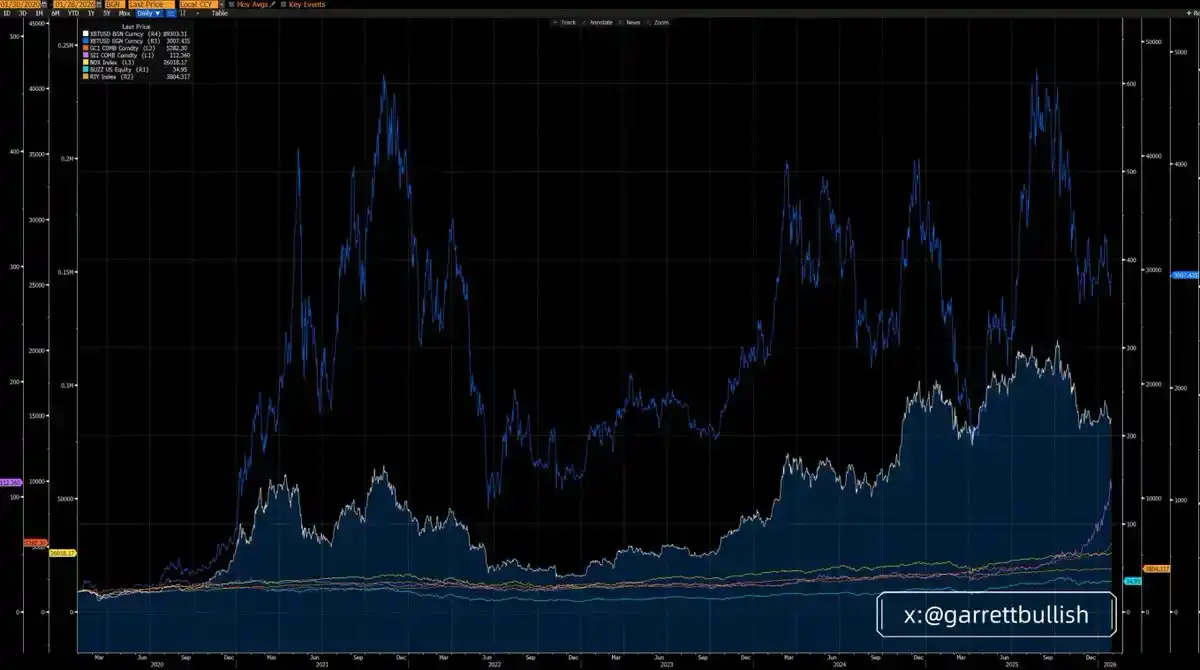
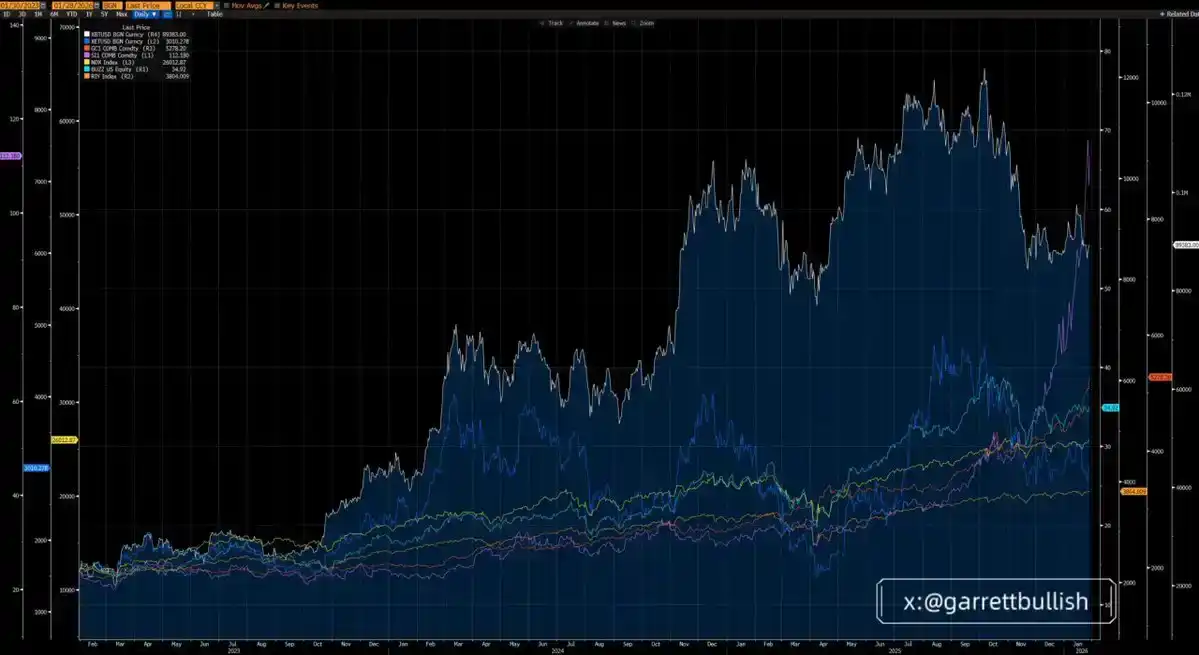
If viewed from a three-year cycle, BTC and ETH have indeed underperformed most major assets, with ETH being the weakest.

However, if extended to a six-year cycle (since March 12, 2020), the performance of BTC and ETH is significantly better than most assets, and ETH actually becomes the top performer.

From a longer time dimension and placed within a macro context, the current so-called 'short-term underperformance' is essentially a process of mean reversion within a longer historical cycle.

Ignoring the underlying logic and focusing only on short-term price fluctuations is one of the most common, and fatal, errors in investment analysis.

Rotation is a Normal Phenomenon

Before the short squeeze in silver prices last October, silver was also one of the worst-performing risk assets; yet now, on a three-year cycle dimension, silver has become the top-performing asset.

This change is highly similar to the current situation of BTC and ETH. Although they are underperforming in the short term, they remain among the most advantageous asset classes on a six-year cycle dimension.

As long as BTC's narrative as 'digital gold' and a store of value is not fundamentally disproven, as long as ETH continues to integrate with the AI wave and exists as core infrastructure in the RWA (Real World Assets) trend, there is no rational basis to believe they will consistently underperform other assets in the long run.

Emphasizing again: ignoring fundamentals and cherry-picking short-term price movements to draw conclusions is a serious analytical error.
Market Structure and Deleveraging

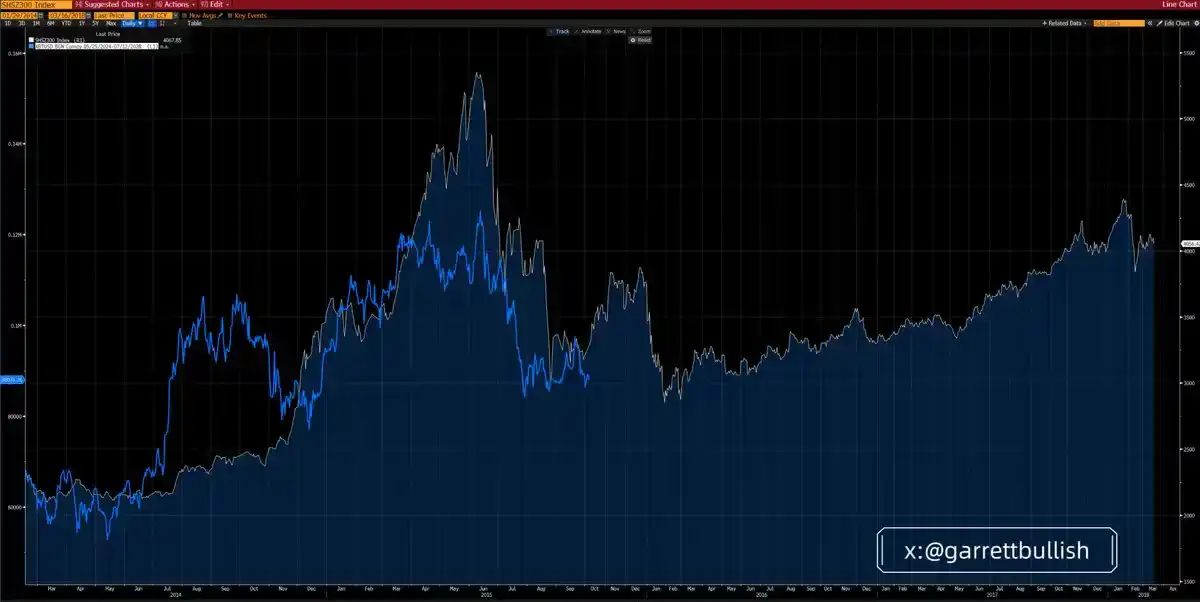
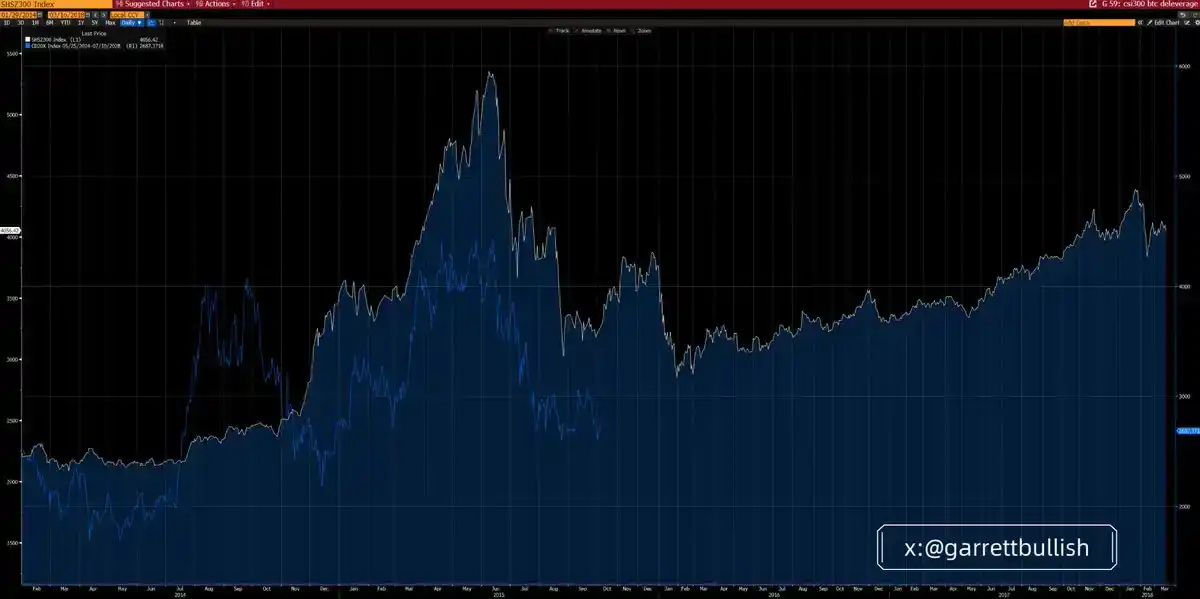
The current crypto market shows a striking similarity to the environment of China's A-share market in 2015 after a leverage-driven rally entered a deleveraging phase.

In June 2015, after a leverage-driven bull market stalled and the valuation bubble burst, the A-share market entered an A–B–C three-wave decline structure conforming to Elliott Wave Theory. After the C-wave bottomed, the market experienced months of sideways consolidation before gradually transitioning into a multi-year bull market.

The core drivers of that long-term bull market came from low valuations of blue-chip assets, improved macro policy environment, and significant monetary easing.

Bitcoin (BTC) and the CD20 index have almost completely replicated this 'leverage up - deleverage' evolution path in the current cycle, showing high consistency in both timing and structural form.

The underlying similarities are very clear: both market environments feature high leverage, extreme volatility, tops driven by valuation bubbles and herd behavior, repeated deleveraging shocks, a long and slow decline process, continuously falling volatility, and futures markets in a long-term contango structure.

In the current market, this contango structure is reflected in the discount of share prices of DAT (Digital Asset Treasury) related listed companies (like MSTR, BMNR) relative to their mNAV (adjusted Net Asset Value).

Meanwhile, the macro environment is gradually improving. Regulatory certainty is increasing, for example, through the ongoing promotion of legislation like the 'Clarity Act'; the US SEC and CFTC are also actively promoting the development of on-chain US equities trading.

Monetary conditions are also easing: rate cut expectations are heating up, quantitative tightening (QT) is nearing its end, repo market liquidity continues to be injected, and expectations of a more dovish stance from the next Fed chair are collectively improving the overall liquidity environment.
ETH and Tesla: An Informative Analogy

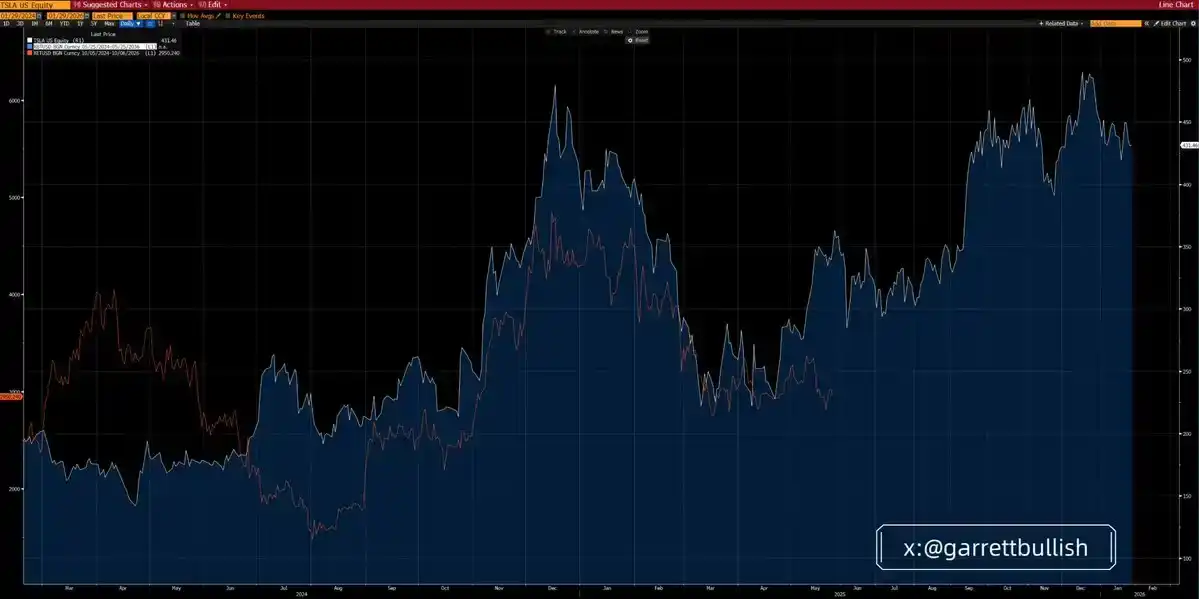
ETH's recent price action is highly similar to Tesla's (TSLA) performance in 2024.

At that time, Tesla's stock price first formed a head and shoulders bottom structure, then rebounded, consolidated sideways, surged again, entered a longer topping phase, fell rapidly, and then experienced a prolonged sideways consolidation at low levels.

It wasn't until May 2025 that Tesla finally broke out upwards, officially starting a new bull market. Its upward momentum came mainly from sales growth in the Chinese market, increased probability of Trump's election, and the commercialization of political networks.

From the current stage, ETH shows high similarity to Tesla at that time, both in technical patterns and fundamental background.

The underlying logic is also comparable: both carry technological narratives and meme attributes, attracted large amounts of highly leveraged capital, experienced violent fluctuations, peaked in valuation bubbles driven by herd behavior, and then entered an adjustment cycle of repeated deleveraging.

Over time, market volatility has gradually decreased, while fundamentals and the macro environment continue to improve.
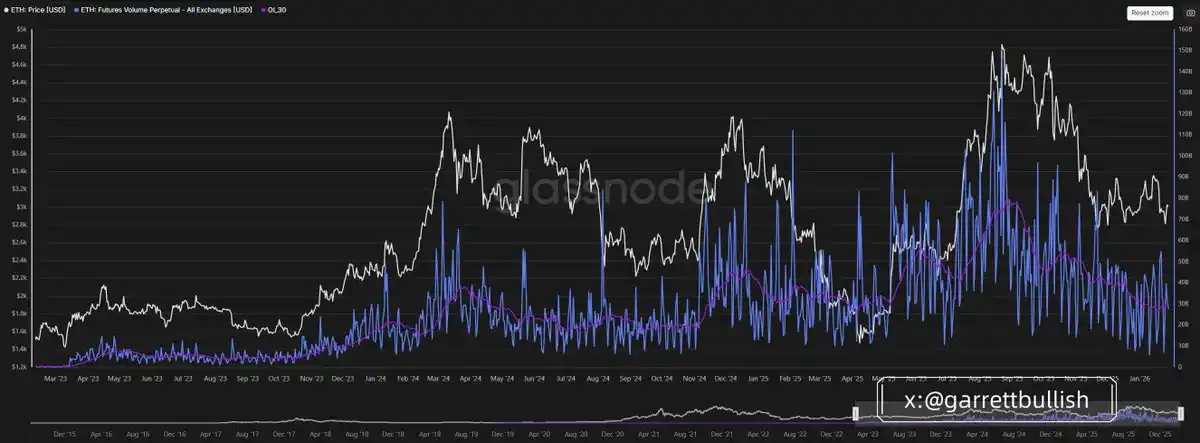
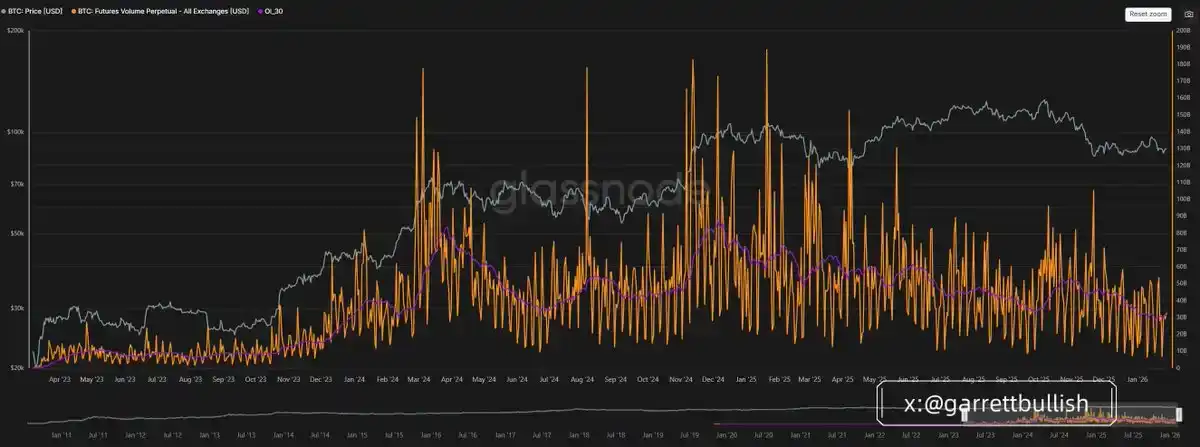
Looking at futures trading volume, market activity for BTC and ETH has neared historical lows, indicating the deleveraging process is approaching its end.

Are BTC and ETH 'Risk Assets'?

Recently, a rather strange narrative has emerged in the market: simply defining BTC and ETH as 'risk assets' and using this to explain why they haven't followed the rise of US stocks, A-shares, precious metals, or base metals.

By definition, risk assets typically feature high volatility and high beta. From both behavioral finance and quantitative statistical perspectives, US equities, A-shares, base metals, BTC, and ETH all meet this standard and often benefit in 'risk-on' environments.

But BTC and ETH possess additional attributes. Due to the DeFi ecosystem and on-chain settlement mechanisms, they also exhibit safe-haven characteristics similar to precious metals in specific situations, especially when geopolitical pressures rise.

Labeling BTC and ETH simply as 'pure risk assets' and asserting they cannot benefit from macro expansion based on this is essentially a narrative that selectively emphasizes negative factors.

Frequently cited examples include:

Potential EU-US tariff conflicts triggered by the Greenland issue

Canada-US tariff disputes

And potential military conflict between the US and Iran

This line of argument is essentially 'cherry-picking' and applying a double standard.

Theoretically, if these risks were truly systemic, then all risk assets should fall in sync, except perhaps base metals which might benefit from war demand. But the reality is that these risks lack the foundation to escalate into major systemic shocks.

AI and high-tech related demand remains extremely strong and is largely unaffected by geopolitical noise, especially in core economies like China and the US. Therefore, the stock market has not priced these risks substantively.

More importantly, most of these concerns have been downgraded or factually disproven. This leads to a key question: Why are BTC and ETH exceptionally sensitive to negative narratives, yet slow to react to positive developments or the subsidence of negative factors?

The Real Reasons

We believe the reasons lie primarily in the structural problems of the crypto market itself. The current market is at the tail end of a deleveraging cycle, with overall participant sentiment tight and highly sensitive to downside risks.

The crypto market is still dominated by retail investors, with limited participation from professional institutions. ETF flows reflect more passive sentiment following rather than active allocation based on fundamentals and judgment.

Similarly, the accumulation methods of most DATs (Digital Asset Treasuries) are also passive—whether through direct operation or third-party passive fund managers, often using non-aggressive algorithmic trading strategies like VWAP, TWAP, with the core goal of reducing intraday volatility.

This stands in stark contrast to speculative funds, whose main goal is precisely to create intraday volatility—and at this stage, this volatility manifests more on the downside, to manipulate price action.

At the same time, retail traders commonly use 10–20x leverage. This makes exchanges, market makers, or speculative funds more inclined to profit from market microstructure rather than endure medium-to-long-term price fluctuations.

We often observe concentrated selling during periods of thin liquidity, especially when Asian or US investors are asleep, for example, between 00:00–08:00 Asia time. Such fluctuations often trigger chain reactions, including liquidations, margin calls, and passive selling, further amplifying the decline.
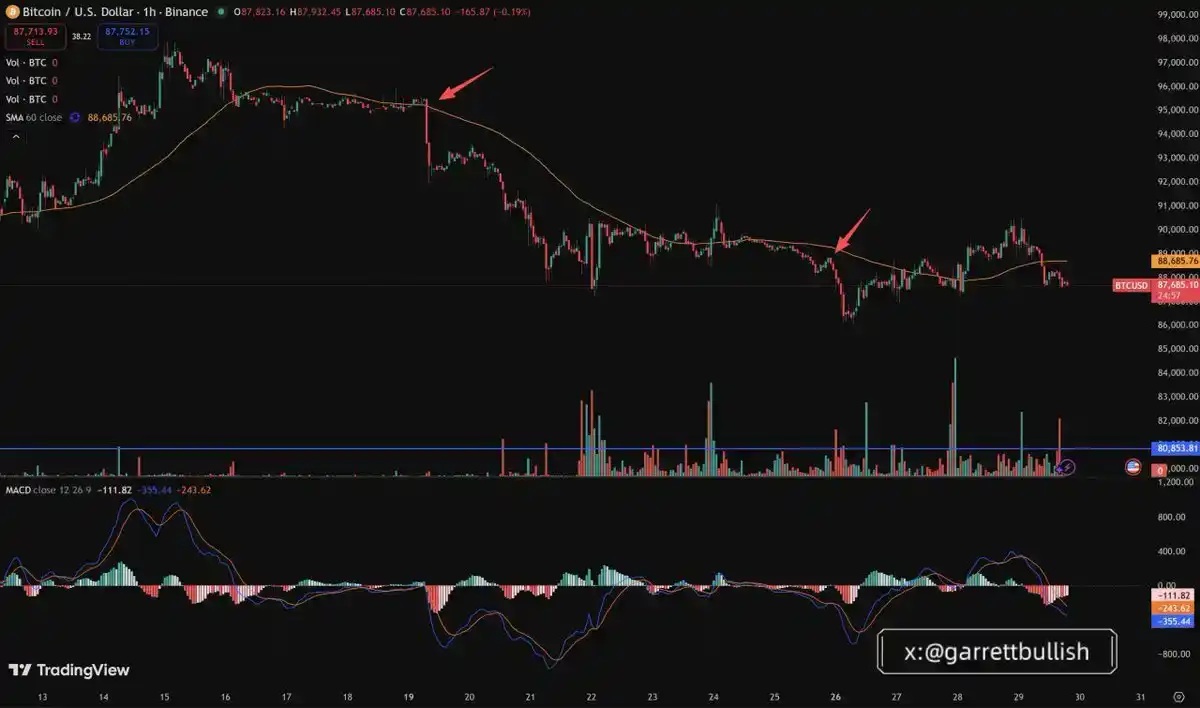
In the absence of substantial new capital inflows, or before FOMO sentiment returns, relying solely on existing capital is insufficient to counter the aforementioned types of market behavior.

Definition of Risk Assets

Risk Assets refer to financial instruments with certain risk characteristics, including stocks, commodities, high-yield bonds, real estate, and currencies.

Broadly speaking, risk assets refer to any financial security or investment vehicle not considered 'risk-free'. The common feature of such assets is that their prices are volatile and their value can change significantly over time.

Common types of risk assets include:

Equities / Stocks:
Shares of publicly traded companies, whose prices are affected by market conditions, company performance, and other factors, and can be highly volatile.

Commodities:
Physical assets like crude oil, gold, agricultural products, etc., whose prices are mainly influenced by changes in supply and demand.

High-Yield Bonds:
Bonds that offer higher interest rates due to lower credit ratings, but also come with higher default risk.

Real Estate:
Real property investments, whose value fluctuates with market cycles, economic conditions, and policy changes.

Currencies:
Various currencies in the foreign exchange market, whose prices can fluctuate rapidly due to geopolitical events, macroeconomic data, and policy changes.

Main Characteristics of Risk Assets

Volatility
Risk asset prices fluctuate frequently, which can lead to both gains and losses.

Coexistence of Return and Risk
Generally, the higher the risk of an asset, the higher the potential return, but also the greater the probability of loss.

High Sensitivity to Market Environment
The value of risk assets is influenced by various factors, including interest rate changes, macroeconomic conditions, and investor sentiment.

Perguntas relacionadas

QAccording to the article, what are the main reasons for Bitcoin and Ethereum's recent underperformance compared to other risk assets?

AThe main reasons are the stage of the trading cycle (deleveraging), the market microstructure, and market manipulation by some exchanges, market makers, or speculative funds.

QHow does the article explain the difference in performance of BTC and ETH when viewed on a 3-year versus a 6-year timeline?

AOn a 3-year timeline, BTC and ETH underperformed most major assets, with ETH being the weakest. However, on a 6-year timeline (since March 2020), they significantly outperformed most assets, with ETH being the strongest performer.

QWhat historical market does the article compare the current crypto market structure to, and what are the key characteristics they share?

AThe article compares it to the Chinese A-share market in 2015 after its leveraged-driven bull market. The key shared characteristics are high leverage, extreme volatility, a bubble top driven by valuation and herd behavior, repeated deleveraging shocks, a long and drawn-out decline, falling volatility, and a persistent contango structure in futures markets.

QWhy does the article argue that simply labeling BTC and ETH as 'risk assets' is an incomplete explanation for their recent price action?

ABecause while they are risk assets, they also possess additional safe-haven attributes similar to precious metals due to the DeFi ecosystem and on-chain settlement mechanisms, especially during rising geopolitical tensions. The label is a form of cherry-picking negative narratives.

QWhat structural issue within the crypto market itself does the article identify as a key amplifier of downside price moves?

AThe market is dominated by retail traders using high leverage (10-20x). This allows exchanges, market makers, or speculative funds to profit from market microstructure by engineering downward price moves, which trigger cascading liquidations and forced selling, especially during low-liquidity hours.

Leituras Relacionadas

How Many Tokens Away Is Yang Zhilin from the 'Moon Chasing the Light'?

The article explores the intense competition between two leading Chinese AI companies, DeepSeek and Kimi (Moon Dark Side), and the mounting pressure on Yang Zhilin, the founder of Kimi. While DeepSeek re-emerged after 15 months of silence with its powerful V4 model—boasting 1.6 trillion parameters and low-cost, long-context capabilities—Kimi has been focusing on long-context processing and multi-agent systems with its K2.6 model. Yang faces a threefold challenge: technological rivalry, commercialization pressure, and investor expectations. Despite Kimi’s high valuation (reaching $18 billion), its revenue heavily relies on a single product with low paid conversion rates, while DeepSeek’s strategic silence and open-source influence have strengthened its market position and valuation prospects, now targeting over $20 billion. Both companies reflect broader trends in China’s AI ecosystem: Kimi aims for global influence through open-source contributions and agent-based advancements, while DeepSeek prioritizes foundational innovation and hardware independence, notably shifting to Huawei’s chips. Their competition is seen as vital for China’s AI progress, with the gap between top Chinese and U.S. models narrowing to just 2.7% on the Elo rating scale. Ultimately, the article argues that this rivalry, though anxiety-inducing for leaders like Zhilin, is essential for driving innovation and solidifying China’s role in the global AI landscape.

marsbitHá 10h

How Many Tokens Away Is Yang Zhilin from the 'Moon Chasing the Light'?

marsbitHá 10h

Trading

Spot
Futuros

Artigos em Destaque

O que é BITCOIN

Compreender o HarryPotterObamaSonic10Inu (ERC-20) e a Sua Posição no Espaço Cripto Nos últimos anos, o mercado de criptomoedas assistiu a um aumento na popularidade das moedas meme, cativando não apenas os traders, mas também aqueles que procuram envolvimento comunitário e valor de entretenimento. Entre estes tokens únicos está o HarryPotterObamaSonic10Inu (ERC-20), um projeto intrigante que mistura referências culturais no tecido das criptomoedas. Este artigo explora os principais aspetos do HarryPotterObamaSonic10Inu, examinando os seus mecanismos, a sua ética orientada pela comunidade e o seu envolvimento com o vasto panorama cripto. O que é o HarryPotterObamaSonic10Inu (ERC-20)? Como o nome sugere, o HarryPotterObamaSonic10Inu é uma moeda meme construída na blockchain Ethereum, classificada sob o padrão ERC-20. Ao contrário das criptomoedas tradicionais, que podem enfatizar a utilidade prática ou o potencial de investimento, este token prospera no valor de entretenimento e na força da sua comunidade. O projeto visa promover um ambiente onde utilizadores envolvidos possam reunir-se, partilhar ideias e participar em atividades inspiradas por diversos fenómenos culturais. Uma característica notável do HarryPotterObamaSonic10Inu é a zero taxa sobre transações. Este elemento atraente visa encorajar a negociação e o envolvimento da comunidade, isento de encargos adicionais que podem desencorajar os traders de pequena escala. A oferta total da moeda está fixada em mil milhões de tokens, uma cifra que marca a sua intenção de manter uma circulação substancial dentro da comunidade. Criador do HarryPotterObamaSonic10Inu (ERC-20) As origens do HarryPotterObamaSonic10Inu estão um pouco envoltas em mistério; os detalhes sobre o criador permanecem desconhecidos. O desenvolvimento deste token carece de uma equipa identificável ou de um plano explícito, o que não é raro no setor das moedas meme. Em vez disso, o projeto surgiu de forma orgânica, com o seu progresso a depender fortemente do entusiasmo e da participação da sua comunidade. Investidores do HarryPotterObamaSonic10Inu (ERC-20) No que diz respeito a investimentos externos e apoios, o HarryPotterObamaSonic10Inu também permanece ambíguo. O token não lista quaisquer fundações de investimento conhecidas ou apoio organizacional significativo. Em vez disso, o “sangue vital” do projeto é a sua comunidade de base, que informa o seu crescimento e sustentabilidade através da ação coletiva e do envolvimento no espaço cripto. Como Funciona o HarryPotterObamaSonic10Inu (ERC-20)? Como uma moeda meme, o HarryPotterObamaSonic10Inu opera principalmente fora dos quadros tradicionais que muitas vezes governam o valor dos ativos. Existem vários aspetos distintivos que definem como o projeto funciona: Transações Sem Taxas: Sem taxas sobre transações, os utilizadores podem comprar e vender o token livremente, sem a preocupação de custos ocultos. Envolvimento da Comunidade: O projeto prospera na interação da comunidade, aproveitando plataformas de redes sociais para criar entusiasmo e facilitar a participação. Discussões, partilha de conteúdo e envolvimento são elementos cruciais que ajudam a expandir o seu alcance e a fomentar a lealdade entre os apoiantes. Sem Utilidade Prática: Deve ser notado que o HarryPotterObamaSonic10Inu não oferece utilidade concreta dentro do ecossistema financeiro. Em vez disso, é classificado como um token principalmente para entretenimento e atividades comunitárias. Referência Cultural: O token incorpora de forma inteligente elementos da cultura popular para atrair interesse, conectando-se tanto com entusiastas de memes como com seguidores de criptomoedas. HarryPotterObamaSonic10Inu exemplifica como as moedas meme operam de forma diferente de projetos de criptomoedas mais tradicionais, entrando no mercado como construções sociais inovadoras em vez de ativos utilitários. Linha do Tempo do HarryPotterObamaSonic10Inu (ERC-20) A história do HarryPotterObamaSonic10Inu é marcada por vários marcos notáveis: Criação: O token surgiu de um meme viral, capturando a imaginação de muitos entusiastas de criptomoedas. Datas específicas de criação não estão disponíveis, sublinhando a sua ascensão orgânica. Listagem em Exchanges: O HarryPotterObamaSonic10Inu conseguiu entrar em várias exchanges, permitindo um acesso e negociação mais fáceis pela comunidade. Iniciativas de Envolvimento da Comunidade: Atividades contínuas direcionadas a melhorar a interação comunitária, incluindo concursos, campanhas em redes sociais e geração de conteúdo por fãs e defensores. Planos de Expansão Futura: O roteiro do projeto inclui o lançamento de uma coleção de NFTs, mercadorias e um site de eCommerce relacionado aos seus temas culturais, envolvendo ainda mais a comunidade e tentando adicionar mais dimensões ao seu ecossistema. Pontos-Chave sobre o HarryPotterObamaSonic10Inu (ERC-20) Natureza Orientada pela Comunidade: O projeto prioriza a contribuição coletiva e a criatividade, assegurando que o envolvimento dos utilizadores está na vanguarda do seu desenvolvimento. Classificação como Moeda Meme: Representa o epítome da criptomoeda baseada em entretenimento, destacando-se dos veículos de investimento tradicionais. Sem Afiliação Direta com o Bitcoin: Apesar da semelhança no nome do ticker, o HarryPotterObamaSonic10Inu é distinto e não tem qualquer relação com o Bitcoin ou outras criptomoedas estabelecidas. Foco na Colaboração: O HarryPotterObamaSonic10Inu é projetado para criar um espaço de colaboração e partilha de histórias entre os seus detentores, proporcionando uma via para a criatividade e o fortalecimento da comunidade. Perspectivas Futuras: A ambição de expandir além da sua premissa inicial para NFTs e mercadorias delineia um caminho para o projeto potencialmente entrar em avenidas mais mainstream dentro da cultura digital. À medida que as moedas meme continuam a capturar a imaginação da comunidade cripto, HarryPotterObamaSonic10Inu (ERC-20) destaca-se devido aos seus laços culturais e abordagem centrada na comunidade. Embora possa não se encaixar no molde típico de um token orientado para utilidade, a sua essência reside na alegria e camaradagem fomentadas entre os seus apoiantes, destacando a natureza em evolução das criptomoedas em uma era cada vez mais digital. À medida que o projeto continua a desenvolver-se, será importante observar como as dinâmicas comunitárias influenciam a sua trajetória no panorama em constante mudança da tecnologia blockchain.

1.2k Visualizações TotaisPublicado em {updateTime}Atualizado em 2024.12.03

O que é BITCOIN

Como comprar BTC

Bem-vindo à HTX.com!Tornámos a compra de Bitcoin (BTC) simples e conveniente.Segue o nosso guia passo a passo para iniciar a tua jornada no mundo das criptos.Passo 1: cria a tua conta HTXUtiliza o teu e-mail ou número de telefone para te inscreveres numa conta gratuita na HTX.Desfruta de um processo de inscrição sem complicações e desbloqueia todas as funcionalidades.Obter a minha contaPasso 2: vai para Comprar Cripto e escolhe o teu método de pagamentoCartão de crédito/débito: usa o teu visa ou mastercard para comprar Bitcoin (BTC) instantaneamente.Saldo: usa os fundos da tua conta HTX para transacionar sem problemas.Terceiros: adicionamos métodos de pagamento populares, como Google Pay e Apple Pay, para aumentar a conveniência.P2P: transaciona diretamente com outros utilizadores na HTX.Mercado de balcão (OTC): oferecemos serviços personalizados e taxas de câmbio competitivas para os traders.Passo 3: armazena teu Bitcoin (BTC)Depois de comprar o teu Bitcoin (BTC), armazena-o na tua conta HTX.Alternativamente, podes enviá-lo para outro lugar através de transferência blockchain ou usá-lo para transacionar outras criptomoedas.Passo 4: transaciona Bitcoin (BTC)Transaciona facilmente Bitcoin (BTC) no mercado à vista da HTX.Acede simplesmente à tua conta, seleciona o teu par de trading, executa as tuas transações e monitoriza em tempo real.Oferecemos uma experiência de fácil utilização tanto para principiantes como para traders experientes.

3.9k Visualizações TotaisPublicado em {updateTime}Atualizado em 2025.03.21

Como comprar BTC

O que é $BITCOIN

OURO DIGITAL ($BITCOIN): Uma Análise Abrangente Introdução ao OURO DIGITAL ($BITCOIN) OURO DIGITAL ($BITCOIN) é um projeto baseado em blockchain que opera na rede Solana, com o objetivo de combinar as características dos metais preciosos tradicionais com a inovação das tecnologias descentralizadas. Embora partilhe um nome com o Bitcoin, frequentemente referido como “ouro digital” devido à sua percepção como uma reserva de valor, o OURO DIGITAL é um token separado projetado para criar um ecossistema único dentro da paisagem Web3. O seu objetivo é posicionar-se como um ativo digital alternativo viável, embora os detalhes sobre as suas aplicações e funcionalidades ainda estejam em desenvolvimento. O que é o OURO DIGITAL ($BITCOIN)? OURO DIGITAL ($BITCOIN) é um token de criptomoeda explicitamente projetado para uso na blockchain Solana. Em contraste com o Bitcoin, que fornece um papel amplamente reconhecido como armazenamento de valor, este token parece focar em aplicações e características mais amplas. Aspectos notáveis incluem: Infraestrutura Blockchain: O token é construído na blockchain Solana, conhecida pela sua capacidade de lidar com transações de alta velocidade e baixo custo. Dinâmicas de Oferta: O OURO DIGITAL tem um fornecimento máximo limitado a 100 quatrilhões de tokens (100P $BITCOIN), embora os detalhes sobre o seu fornecimento circulante ainda não tenham sido divulgados. Utilidade: Embora as funcionalidades precisas não estejam explicitamente delineadas, existem indicações de que o token poderia ser utilizado para várias aplicações, potencialmente envolvendo aplicações descentralizadas (dApps) ou estratégias de tokenização de ativos. Quem é o Criador do OURO DIGITAL ($BITCOIN)? Neste momento, a identidade dos criadores e da equipa de desenvolvimento por trás do OURO DIGITAL ($BITCOIN) permanece desconhecida. Esta situação é típica entre muitos projetos inovadores no espaço da blockchain, particularmente aqueles alinhados com finanças descentralizadas e fenómenos de moedas meme. Embora tal anonimato possa fomentar uma cultura orientada pela comunidade, intensifica as preocupações sobre governança e responsabilidade. Quem são os Investidores do OURO DIGITAL ($BITCOIN)? As informações disponíveis indicam que o OURO DIGITAL ($BITCOIN) não tem apoiantes institucionais conhecidos ou investimentos proeminentes de capital de risco. O projeto parece operar num modelo peer-to-peer focado no apoio e adoção da comunidade, em vez de rotas de financiamento tradicionais. A sua atividade e liquidez estão principalmente situadas em exchanges descentralizadas (DEXs), como a PumpSwap, em vez de plataformas de negociação centralizadas estabelecidas, destacando ainda mais a sua abordagem de base. Como Funciona o OURO DIGITAL ($BITCOIN) A mecânica operacional do OURO DIGITAL ($BITCOIN) pode ser elaborada com base no seu design de blockchain e nas características da rede: Mecanismo de Consenso: Ao aproveitar o exclusivo proof-of-history (PoH) da Solana combinado com um modelo de proof-of-stake (PoS), o projeto assegura uma validação eficiente das transações, contribuindo para o alto desempenho da rede. Tokenomics: Embora mecanismos deflacionários específicos não tenham sido extensivamente detalhados, o vasto fornecimento máximo de tokens implica que pode atender a microtransações ou casos de uso de nicho que ainda estão por definir. Interoperabilidade: Existe o potencial para integração com o ecossistema mais amplo da Solana, incluindo várias plataformas de finanças descentralizadas (DeFi). No entanto, os detalhes sobre integrações específicas permanecem não especificados. Cronologia de Eventos Chave Aqui está uma cronologia que destaca marcos significativos relacionados ao OURO DIGITAL ($BITCOIN): 2023: O lançamento inicial do token ocorre na blockchain Solana, marcado pelo seu endereço de contrato. 2024: O OURO DIGITAL ganha visibilidade ao tornar-se disponível para negociação em exchanges descentralizadas como a PumpSwap, permitindo que os utilizadores o negociem contra SOL. 2025: O projeto testemunha atividade de negociação esporádica e potencial interesse em envolvimentos liderados pela comunidade, embora não tenham sido documentadas parcerias ou avanços técnicos notáveis até ao momento. Análise Crítica Forças Escalabilidade: A infraestrutura subjacente da Solana suporta altos volumes de transações, o que pode aumentar a utilidade do $BITCOIN em vários cenários de transação. Acessibilidade: O potencial preço de negociação baixo por token pode atrair investidores de retalho, facilitando uma participação mais ampla devido a oportunidades de propriedade fracionada. Riscos Falta de Transparência: A ausência de apoiantes, desenvolvedores ou um processo de auditoria publicamente conhecidos pode gerar ceticismo em relação à sustentabilidade e confiabilidade do projeto. Volatilidade do Mercado: A atividade de negociação depende fortemente do comportamento especulativo, o que pode resultar em volatilidade significativa dos preços e incerteza para os investidores. Conclusão O OURO DIGITAL ($BITCOIN) surge como um projeto intrigante, mas ambíguo, dentro do ecossistema em rápida evolução da Solana. Embora tente aproveitar a narrativa do “ouro digital”, a sua divergência do papel estabelecido do Bitcoin como reserva de valor sublinha a necessidade de uma diferenciação mais clara da sua utilidade pretendida e estrutura de governança. A aceitação e adoção futuras dependerão provavelmente da abordagem da atual opacidade e da definição mais explícita das suas estratégias operacionais e económicas. Nota: Este relatório abrange informações sintetizadas disponíveis até outubro de 2023, e desenvolvimentos podem ter ocorrido além do período de pesquisa.

92 Visualizações TotaisPublicado em {updateTime}Atualizado em 2025.05.13

O que é $BITCOIN

Discussões

Bem-vindo à Comunidade HTX. Aqui, pode manter-se informado sobre os mais recentes desenvolvimentos da plataforma e obter acesso a análises profissionais de mercado. As opiniões dos utilizadores sobre o preço de BTC (BTC) são apresentadas abaixo.

活动图片