Why Did It Take Prediction Markets Nearly 40 Years to Explode?

marsbitPublicado em 2025-12-31Última atualização em 2025-12-31

Resumo

This article explores the explosive growth of prediction markets in 2025, which saw an estimated 400% increase in trading volume, reaching $40 billion, and a user base growing to 15 million. It examines why, despite existing since the 1980s (e.g., Iowa Electronic Markets), prediction markets only recently surged in popularity. Key factors for the 2025 boom include major regulatory progress. The CFTC approved platforms like Polymarket as designated contract markets, allowing them to operate legally in the US. This compliance enabled wider distribution, integration into major apps like Robinhood, and attracted institutional investment, with both Polymarket and Kalshi securing over $1 billion in new funding. Regulatory clarity also allowed for a diversification of event types, including sports and crypto, which now dominate trading volume. The article contrasts prediction markets with traditional gambling, noting the US government distinguishes them based on their "positive externalities." Unlike sportsbooks that set odds, prediction markets facilitate peer-to-peer betting, aggregating collective knowledge to improve information efficiency and decision-making, which regulators view as socially beneficial despite gambling-like elements. A provocative section discusses insider trading. Some argue that insiders using non-public information on anonymous, decentralized platforms like Polymarket can enhance market accuracy and serve as a form of information discovery. However, this...

As this year draws to a close, the rapid growth of prediction markets has attracted increasing attention from both crypto enthusiasts and those outside the circle. When discussing prediction markets with different friends, I often explain the difference between them and traditional gambling through 'differences in betting models' and 'the financialization of information.' As these conversations multiplied, I gradually realized that these two points are still not intuitive enough for friends who haven't been exposed to prediction markets. They even raised some very interesting and sharp questions, such as:

I can understand the difference between 'betting against the house' and 'P2P gambling among players,' but in essence, both models still involve real-money betting. Why does the U.S. government treat the two so differently?

If the lenient attitude towards prediction markets is because 'the financialization of information' has many benefits, then why hasn't this good thing become popular before? Why did it only explode in 2025?

There has been much discussion about the advantages and future prospects of prediction markets. Therefore, this article will explore prediction markets from more interesting angles.

Why Did Prediction Markets Only Explode in 2025?

Report data shows that the prediction market is expected to achieve an astonishing 400% growth rate in 2025, with total trading volume projected to grow from approximately $900 million in 2024 to $40 billion. The user base is also expected to increase 3-4 times, from about 4 million in 2024 to 15 million in 2025.

Retail players familiar with prediction markets should be well-acquainted with the hot topics over the past two years, such as the 2024 U.S. presidential election and the 2025 League of Legends World Championship. One might instinctively think that these hot topics drove the development of prediction markets.

But this is clearly not the only or core factor. Traditional gambling platforms also offer the same markets, and compared to the binary 'Yes/No' of prediction markets, traditional gambling markets have even more variety, such as 'point spreads.' Moreover, before the rise of Polymarket and Kalshi, there were precedents for prediction markets. The earliest available prediction market platform was the Iowa Electronic Markets (IEM), launched by the University of Iowa in 1988 for predicting the 1988 U.S. presidential election. Even prediction market platforms incorporating blockchain technology were not pioneered by Polymarket; Augur on Ethereum came in 2018.

Significant progress in regulation is an important factor, and the relaxation of regulations has contributed to the explosion of prediction markets on multiple levels.

First, the rollout of distribution channels. On November 25, the CFTC approved Polymarket's Amended Order of Designation, allowing it to re-enter the U.S. market as a Designated Contract Market (DCM). Kalshi also integrated directly into Robinhood and Coinbase this year. More importantly, after compliance, prediction markets have broader distribution channels in the U.S. than traditional gambling, covering all 50 states, while traditional gambling distribution channels only cover over 30 authorized states.

The more profound significance is that compliance clarifies the positioning of prediction markets as legitimate commodity derivatives rather than gambling, affirming the positive significance of prediction markets. This expands the distribution audience beyond traditional gambling enthusiasts to include investors and decision-makers. For ordinary people, seeing traditional media reports citing prediction market data or seeing internet search engines like Google directly indexing prediction market data creates a positive perception of 'legitimacy' that the cryptocurrency industry has sought for many years.

Second, policy friendliness has given institutional investors sufficient confidence, leading to rapid growth in the financing path for prediction markets. Both Polymarket and Kalshi completed a total of three new rounds of financing in 2025, with new financing amounts each exceeding $1 billion. This has given them better conditions to provide better products and liquidity.

Finally, the variety of event types in prediction markets has also been enriched. In 2024, Kalshi won a lawsuit against the CFTC, allowing it to list more types of event predictions, such as cryptocurrency-related events, and since January this year, it has expanded to sports events. The CFTC abandoned its appeal in May this year. Currently, sports event predictions account for about 90% of Kalshi's trading volume. A report by Eilers & Krejcik believes that, in the long run, sports event predictions will account for 44% of the total trading volume in prediction markets.

Of course, whether it's Kalshi, which has always strictly followed a compliant, off-chain path, or Polymarket, which took an offshore-then-compliant, on-chain path, the improvement of the prediction market products themselves, along with advancements in AI technology that have provided more complete related tools for the entire prediction market ecosystem, are all reasons why 2025 became the year of prediction markets. As mentioned earlier, the earliest on-chain prediction market, Augur, was previously criticized for its poor user experience and, after four years of silence, announced in March this year that it would be restarted by the Lituus Foundation. The popularity of anything requires waiting for the 'right time, place, and people.' The wheel of fortune turns, and prediction markets have finally borne fruit in 2025.

Why Does the U.S. Government Treat 'Gambling' Differently?

This is a very interesting question. Even I was initially confused—although prediction markets themselves do not act as the house, do not provide odds, and do not bet against users, we cannot say that peer-to-peer betting is not gambling. Otherwise, we could also say that playing poker is not gambling because the organizer does not play but only takes a rake, and the betting only occurs among the players.

At the same time, traditional gambling platforms, for their own benefit, have professional teams to analyze various event bets and try to provide reasonable odds. In the past, traditional media and institutional reports have cited odds from traditional gambling platforms for event reporting and analysis. Although prediction markets, compared to traditional gambling, can better reflect 'collective cognition' without the bias of a single team, and unlike traditional gambling platforms, they do not deliberately align odds with the public to increase overall betting volume and use the rake to offset losses caused by unreasonable odds settings, and indeed show higher real-time responsiveness and accuracy in some events, this does not seem to constitute an overwhelming advantage over traditional gambling platforms.

And whether for traditional gambling enthusiasts or ordinary retail investors in prediction markets, our grasp and analysis of events are, in most cases, certainly not as good as professionals, which means losses are common.

So, isn't the U.S. government worried about the harm caused by the gambling nature of prediction markets to the public? Of course it is, otherwise the compliance path for prediction markets would not have been so difficult for many years.

Internationally, some prediction markets operate directly under gambling licenses, such as the political prediction market on the UK's Betfair. Recently, U.S. District Court Judge Andrew Gordon in Nevada revoked an injunction protecting prediction market company Kalshi from state regulation and ruled that Kalshi's sports event predictions do not constitute transactions under the 'Commodity Exchange Act.' The judge believed that these prediction events are very similar to sports betting wagers and therefore fall under the regulatory purview of the Nevada Gaming Control Board and the Nevada Gaming Commission.

But the government's starting point is 'overall positive externality.' Just as the stock market allows the vast majority of retail investors to 'pay tuition' while greatly promoting overall social and economic operation, prediction markets, although essentially still gambling, also have key social benefits such as improving information efficiency and aiding decision-making. As long as the harms can be avoided as much as possible through sound regulation, we should not give up eating for fear of choking.

Of course, after reading this, you might still say that 'overall positive externality' is a pale rebuttal, and traditional gambling can still play a similar role. However, at least one point is undeniable: the mechanism of prediction markets themselves determines that the platform can only 'choose topics' and cannot 'rig the game.' Whether Polymarket or Kalshi, they can at most choose topics that people like to encourage betting and cannot manipulate odds.

Moreover, besides the U.S., governments in other countries and regions currently agree with your thinking. The U.S. is the only country in the world that distinguishes the positioning of prediction markets from traditional gambling and issues 'event contract' licenses for prediction markets. As the scale of prediction markets grows, controversies surrounding gambling will continue, and whether the U.S. government's attitude will change remains unknown.

Maybe, let the prediction markets predict it...?

A Paradise for Insider Traders?

This is a very interesting question. If asked whether insider trading in the stock market is good or bad, we would all say it's bad. But if the subject of this question is changed to prediction markets?

My colleague believes this is the value of prediction markets. The existence of insider information certainly creates unfairness in betting, but it also most accurately discloses information. Therefore, a true prediction market should be like Polymarket, built on-chain, anonymous without KYC.

Such views are actually not uncommon. For example, this tweet by @shafu0x received considerable recognition:
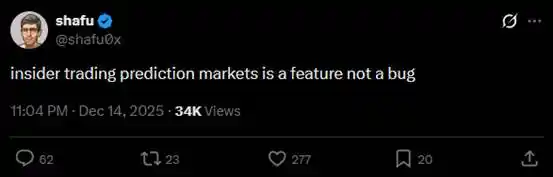
Players who hold this view believe that as long as the information leaked through insider trading has 'overall positive externality,' it is justified. They also believe that prediction markets cannot do without these insiders because without them, the accuracy of event predictions in prediction markets would drop significantly, leaving only those without accurate information to bet against each other.

This view has some merit, but I think prediction market platforms themselves would resist such positioning because, in the long run, it would harm retail trust. The entire market would essentially change from a platform encouraging individual research and insight, aggregating collective wisdom, into a one-sided 'slaughter' by insiders, which is not conducive to the development of liquidity. If prediction markets were like this, it would be better to rename them 'information bounty platforms.'
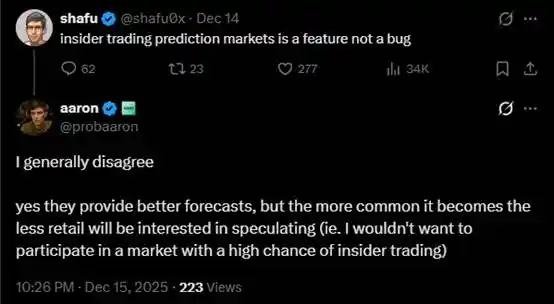
Overall, I believe that platforms like Polymarket, built on-chain, with transparent movements and anonymity, fulfill our expectations of decentralization—anyone can freely send signals through prediction markets without worrying about anything, only needing to be responsible for their own bets. The harsh reality is that there are too many wealth transfers caused by information asymmetry in the world, and those that occur in prediction markets or stock markets might be the ones we feel most keenly.

As for whether prediction markets themselves should maintain a relatively fairer environment for retail investors and whether they need to sustain a more acceptable positioning for the public for sustainable development, that is a question they should consider.

Conclusion

There are actually many interesting questions, such as whether there will be a prediction market in the future that can challenge Kalshi and Polymarket? If prediction market compliance continues to advance worldwide, will each country and region have its own leader (because these markets can do better localization and provide prediction events more friendly to users in their respective countries and regions), etc.

Prediction markets are not exactly new, but the compliance of prediction markets is a very new, very avant-garde bold attempt. I believe that over time, the various questions mentioned in this article will have interesting answers that we cannot anticipate.


Criptomoedas em alta

Perguntas relacionadas

QWhy did prediction markets take nearly 40 years to experience a major breakout in 2025?

APrediction markets saw explosive growth in 2025 due to key regulatory advancements, such as CFTC approvals allowing platforms like Polymarket and Kalshi to operate legally in the U.S., expanded distribution channels, increased institutional investment, richer event diversity including sports and crypto, and improved product experiences aided by AI tools.

QHow does the U.S. government distinguish prediction markets from traditional gambling?

AThe U.S. government treats prediction markets as legal commodity derivatives rather than gambling because of their 'positive externalities,' such as improving information efficiency and aiding decision-making. Unlike traditional gambling, prediction markets use peer-to-peer betting without a house setting odds, reducing manipulation risks, and they operate under specific regulatory frameworks like the Commodity Exchange Act.

QWhat role did regulatory changes play in the growth of prediction markets in 2025?

ARegulatory changes were crucial: the CFTC approved platforms like Polymarket as designated contract markets, allowing nationwide distribution in all 50 states. This legitimacy attracted institutional investors, facilitated major funding rounds, expanded event types like sports and crypto predictions, and enhanced public trust through media and tech integrations.

QAre prediction markets considered a haven for insider trading, and how is this viewed?

ASome argue that insider trading on prediction markets like Polymarket can be beneficial because it leads to more accurate information disclosure and positive externalities. However, platforms generally resist this perception, as it could undermine散户 trust and liquidity, turning the market into an 'information bounty' system rather than a fair collective intelligence platform.

QWhat are the main factors that contributed to the user and volume growth of prediction markets in 2025?

AKey factors include regulatory approvals expanding access, integration with major platforms like Robinhood and Coinbase, a wider range of预测事件 such as sports and elections, increased institutional funding improving liquidity and product quality, and AI-driven tools enhancing user experience and market efficiency.

Leituras Relacionadas

In Jinjiang, Fujian, a Storage Super Unicorn Lies Quiet

In Fujian's Jinjiang, a city known for sportswear, lies a quiet semiconductor giant: Fujian Jinhua Integrated Circuit Co. (JHICC). Once a promising domestic DRAM manufacturer alongside Yangtze Memory and ChangXin Memory Technologies (CXMT), its journey was derailed in 2018 when the U.S. placed it on an Entity List and filed criminal charges for alleged trade secret theft. This halted production for years. A turning point came in February 2024 when a U.S. federal court found JHICC not guilty. However, it had lost crucial time. While CXMT soared to become a top-valued A-share company in 2024, JHICC, with an estimated valuation of 80 billion RMB, was just restarting. Its current output is primarily customized DDR4 chips, not the advanced DDR5/HBM demanded for AI, but it still benefits from the broader memory chip upcycle. JHICC's story is tied to Chen Zhengkun, a veteran engineer who left Micron to lead the venture. Founded in 2016 with state-backed funding, JHICC partnered with Taiwan's UMC to develop DRAM technology. Rapid progress was cut short by the U.S. actions, which Micron initiated, partly due to its heavy reliance on the Chinese market. Post-sanctions, Chen's team worked to rebuild the production line with reduced reliance on U.S. technology. According to its records, JHICC achieved small-scale production and revenue growth under immense pressure. It now focuses on the stable "niche" DRAM market (e.g., TVs, routers) with a monthly capacity of ~40,000 wafers, aiming for 60,000 by 2026. It holds over 1,000 patents but remains on the Entity List. For Jinjiang, investing in JHICC was a bold industrial leap. The local government provided unwavering financial and logistical support during the crisis, helping the company survive. JHICC has become the anchor for a growing local semiconductor cluster. Though its scale lags behind domestic peers, JHICC's persistence symbolizes a hard-won foothold in a global market long dominated by Samsung, SK Hynix, and Micron. Having missed one boom, it seeks a place in the new AI-driven memory supercycle.

marsbitHá 33m

In Jinjiang, Fujian, a Storage Super Unicorn Lies Quiet

marsbitHá 33m

Must-Watch Events Next Week|CLARITY Act Could Face Senate Vote; SpaceX, Circle to Report Earnings (8.3-8.9)

**Summary: Key Events and Developments to Watch (August 3-9)** The upcoming week is marked by significant financial disclosures, key legislative deadlines, and notable product updates. **Major Financial Events:** Several companies are scheduled to release their Q2 2026 earnings. American Bitcoin (ABTC) will report on August 3, followed by SpaceX and Hut 8 Mining Corp. on August 4, and Circle on August 5. Notably, a significant portion of SpaceX shares (up to 12% of total shares) will be unlocked on August 6 following their earnings release. **Key Legislative Deadline:** The U.S. Senate faces an August 7 deadline to secure 60 votes for the CLARITY Act, a bipartisan bill aiming to establish a federal regulatory framework for cryptocurrencies. The Senate may hold a full vote on the bill during the week. **Economic Data:** The U.S. July Non-Farm Payrolls report will be released on August 7, providing crucial labor market data. **Technology & Product Updates:** * **Shutdowns:** DeFi portfolio tracker Zapper and wallet app Ctrl Wallet will cease operations on August 3. * **Upgrades:** LayerZero will deprecate its v1 relayers on August 3. XRP Ledger's new version 3.3.0, featuring five new functions, is expected next week. * **AI:** Elon Musk announced that the advanced Grok 4.6 AI model is set for release around August 7. * **Bitcoin:** The BIP-110 forced signaling for a potential Bitcoin network change is scheduled to begin around August 8. **Other Notable Events:** Chinese robotics firm Unitree Tech has set its preliminary price inquiry for its IPO for August 5. South Korean exchange Upbit will delist AQT and AERGO tokens on August 3.

marsbitHá 2h

Must-Watch Events Next Week|CLARITY Act Could Face Senate Vote; SpaceX, Circle to Report Earnings (8.3-8.9)

marsbitHá 2h

Trading

Spot

Artigos em Destaque

Como comprar O

Bem-vindo à HTX.com!Tornámos a compra de O1 exchange (O) simples e conveniente.Segue o nosso guia passo a passo para iniciar a tua jornada no mundo das criptos.Passo 1: cria a tua conta HTXUtiliza o teu e-mail ou número de telefone para te inscreveres numa conta gratuita na HTX.Desfruta de um processo de inscrição sem complicações e desbloqueia todas as funcionalidades.Obter a minha contaPasso 2: vai para Comprar Cripto e escolhe o teu método de pagamentoCartão de crédito/débito: usa o teu visa ou mastercard para comprar O1 exchange (O) instantaneamente.Saldo: usa os fundos da tua conta HTX para transacionar sem problemas.Terceiros: adicionamos métodos de pagamento populares, como Google Pay e Apple Pay, para aumentar a conveniência.P2P: transaciona diretamente com outros utilizadores na HTX.Mercado de balcão (OTC): oferecemos serviços personalizados e taxas de câmbio competitivas para os traders.Passo 3: armazena teu O1 exchange (O)Depois de comprar o teu O1 exchange (O), armazena-o na tua conta HTX.Alternativamente, podes enviá-lo para outro lugar através de transferência blockchain ou usá-lo para transacionar outras criptomoedas.Passo 4: transaciona O1 exchange (O)Transaciona facilmente O1 exchange (O) no mercado à vista da HTX.Acede simplesmente à tua conta, seleciona o teu par de trading, executa as tuas transações e monitoriza em tempo real.Oferecemos uma experiência de fácil utilização tanto para principiantes como para traders experientes.

459 Visualizações TotaisPublicado em {updateTime}Atualizado em 2026.06.29

Como comprar O

Como comprar PROS

Bem-vindo à HTX.com!Tornámos a compra de Pharos (PROS) simples e conveniente.Segue o nosso guia passo a passo para iniciar a tua jornada no mundo das criptos.Passo 1: cria a tua conta HTXUtiliza o teu e-mail ou número de telefone para te inscreveres numa conta gratuita na HTX.Desfruta de um processo de inscrição sem complicações e desbloqueia todas as funcionalidades.Obter a minha contaPasso 2: vai para Comprar Cripto e escolhe o teu método de pagamentoCartão de crédito/débito: usa o teu visa ou mastercard para comprar Pharos (PROS) instantaneamente.Saldo: usa os fundos da tua conta HTX para transacionar sem problemas.Terceiros: adicionamos métodos de pagamento populares, como Google Pay e Apple Pay, para aumentar a conveniência.P2P: transaciona diretamente com outros utilizadores na HTX.Mercado de balcão (OTC): oferecemos serviços personalizados e taxas de câmbio competitivas para os traders.Passo 3: armazena teu Pharos (PROS)Depois de comprar o teu Pharos (PROS), armazena-o na tua conta HTX.Alternativamente, podes enviá-lo para outro lugar através de transferência blockchain ou usá-lo para transacionar outras criptomoedas.Passo 4: transaciona Pharos (PROS)Transaciona facilmente Pharos (PROS) no mercado à vista da HTX.Acede simplesmente à tua conta, seleciona o teu par de trading, executa as tuas transações e monitoriza em tempo real.Oferecemos uma experiência de fácil utilização tanto para principiantes como para traders experientes.

483 Visualizações TotaisPublicado em {updateTime}Atualizado em 2026.06.29

Como comprar PROS

O que é VERONA

I. Introdução ao Projeto VERONA é uma blockchain construída para todos, em todo o lado, através da abstração da cadeia. Utilizando a sua camada de Abstração Generalizada, a VERONA distingue-se por integrar funcionalidades complexas de blockchain, como contas, assinaturas e interoperabilidade, diretamente ao nível do protocolo. Esta abordagem permite a interação com aplicações de blockchain sem a necessidade de compreender as tecnologias subjacentes.1) Informação Básica Nome: VERONA (VERONA)III. Links Relacionados Link do site oficial: https://xion.burnt.com/ Whitepaper: https://xion.burnt.com/whitepaper.pdf Exploradores: https://explorer.burnt.com/ Mídias Sociais: https://x.com/burnt_xion Nota: A introdução ao projeto provém dos materiais publicados ou fornecidos pela equipa oficial do projeto, que é apenas para referência e não constitui aconselhamento de investimento. A HTX não se responsabiliza por quaisquer perdas diretas ou indiretas resultantes.

1.2k Visualizações TotaisPublicado em {updateTime}Atualizado em 2026.06.22

O que é VERONA

Discussões

Bem-vindo à Comunidade HTX. Aqui, pode manter-se informado sobre os mais recentes desenvolvimentos da plataforma e obter acesso a análises profissionais de mercado. As opiniões dos utilizadores sobre o preço de A (A) são apresentadas abaixo.

活动图片













