Why Are We So Persistent in That 'Laborious and Unrewarding' Data Cleaning?

marsbitPublicado em 2026-01-24Última atualização em 2026-01-24

Resumo

In the article "Why Are We So Committed to 'Labor-Intensive and Unrewarding' Data Cleaning?", the RootData team reflects on their second bounty event, which focused on enhancing data transparency in Web3. The event involving over 140 participants resulted in 1,220 submissions, with 564 valid data points approved—a 46.2% acceptance rate. Key improvements included identifying key team members from projects like MOMO.FUN and Subhub (often not publicly listed), correcting inaccuracies in token unlock details and TGE timelines, and updating outdated information such as misattributed founders and deprecated social accounts. The author emphasizes that ensuring data transparency—though challenging—is critical for protecting investors' "right to know." In Web3, where misinformation is common (e.g., inconsistent token unlock data across platforms), RootData aims to serve as a reliable source of validated information. The team notes that core team changes around TGE events often signal project risks, yet such details are frequently overlooked. To uphold transparency, RootData publishes monthly reports on false fundraising claims, conducts in-depth analyses (e.g., exchange listing reports), and cross-verifies data rigorously—even declining unverified submissions. They also engage with industry leaders like Binance to align on data accuracy goals. The long-term vision is to transform isolated data points into structured, actionable transparency reports that support informed investmen...

Author: @BlockCookies

Hello everyone, I am the Data Activity Lead at RootData.

The second round of RootData's Bounty Activity has been successfully concluded. While sharing this review, rather than just cold numbers, I'd like to discuss: Why is promoting 'data transparency' in Web3 extremely challenging, yet something that must be done?

First, here are the data for this round's activity: Over 140 unique users participated, providing 1220 pieces of feedback, ultimately resulting in 564 validated data points, with an average approval rate of 46.2%.
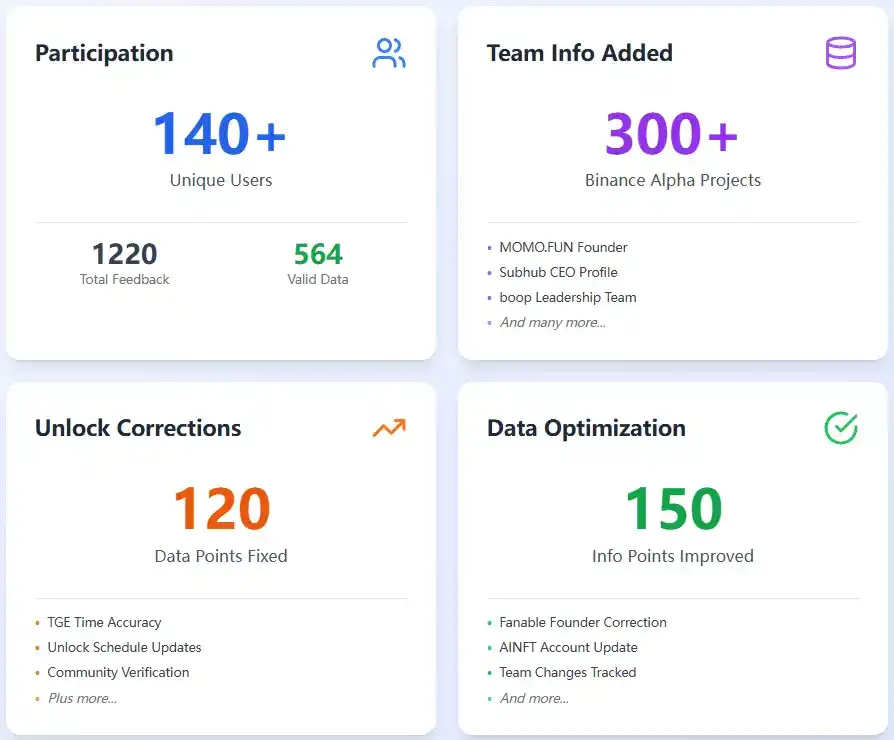
Overview of Round 2 Bounty Activity Data

This activity helped RootData supplement nearly 300+ 'People Behind the Alpha,' such as executives and leads from MOMO.FUN, Subhub, boop, etc. These individuals often do not list their positions in their X bios or LinkedIn but may appear at events or be active in communities.

Additionally, we corrected about 120 token unlock information points. Some had inaccurate TGE times, while some had unlock rules not disclosed promptly; these issues were all optimized through the community's efforts.

Furthermore, we conducted in-depth optimization on 150 existing data points. For instance, we found that the founder of Fanable was mistakenly recorded as a non-Web3 individual with the same name, and its Managing Director Sergio had already left; the AINFT project had long changed its Twitter account...

Why are we pushing for transparency in the Web3 space? This data might seem mundane, and RootData itself is an expert in aggregating off-chain data, so why spend our own funds and mobilize the community for such 'grunt work'?

Honestly, when my boss @yubopan1 assigned me this task, I hesitated too. But one thing he said struck a chord: "From the ICO era to the FTX incident, the biggest tragedy for users is the lack of fair 'investment知情权 (right to know).' As crypto moves towards compliance, data platforms must be at the forefront, acting as that mirror."

As the data lead, I deeply feel his judgment is correct: Relying on a single source is insufficient for accuracy. Data未经多方验证 is不足以让 RootData become a platform trusted by investors.

Take token unlock data alone; it's very 'fragmented': the same project might have 5 different versions across 5 mainstream unlock platforms.

As is well known, Binance Listing requires submitting at least 3 team members. RootData has cataloged over 18,000 industry figures. How many update their resumes urgently before TGE, and how many 'quietly leave' after securing funding?

This round revealed: Significant projects experience frequent core team changes around TGE. For investors, this is often a 'barometer' of the project's direction. If no one verifies and discloses this, it gets lost in the daily information overload.

To ensure 'transparency' isn't just a slogan, our current implemented solutions include:

  • Monthly disclosures of false funding intelligence.
  • Regular in-depth research, like the recently published 《Exchange Listing Decision Report》.
  • Increasing the frequency of LinkedIn profile动态抓取 and verification.

Moreover, we insist on rigorous review standards. In this round, a user provided detailed information on the River development team, but the source was merely a post by a third-party account on Binance Square. Despite the detailed content, due to the lack of official endorsement or multi-source cross-verification, we still chose not to approve it.

This round focused on 'Binance Alpha,' and we also attempted communication with the Binance team. We don't aim to target any specific exchange; on the contrary, we hope to stand together with industry giants.

We once reached out to the Binance team to confirm some key dimensions, and the response was very positive: "If there's any information regarding Alpha that needs confirmation, feel free to communicate anytime."

Single-point data correction is just the beginning. In the future, RootData will connect 'discrete data points' into 'logically rigorous transparency reports,'甚至 transforming them into practical investment strategies.

Transparency is a持久战 (long-term battle) and an inevitable path for Web3 to go mainstream. We need more 'data hunters' to join us in揭开迷雾 (lifting the fog). Everyone is welcome to leave comments and discuss.


Perguntas relacionadas

QWhy does RootData insist on the laborious task of data cleaning in Web3 space?

ARootData believes that ensuring data transparency is crucial for providing fair 'investment知情权' (right to know) to users, especially after events like the ICO era and FTX incident. They aim to be a reliable platform by verifying data through multiple sources, as unverified data cannot be trusted.

QWhat were the key outcomes of RootData's second bounty event?

AThe event had over 140 independent participants who provided 1,220 feedback entries, resulting in 564 validated data points with an average approval rate of 46.2%. It helped add 300+ 'Alpha behind the people' and corrected about 120 token unlock details.

QWhat challenges exist in maintaining data accuracy for Web3 projects, according to the article?

AData accuracy is highly fragmented; for example, token unlock information for the same project can vary across five mainstream platforms. Additionally, core team members often change frequently around TGE, which is a critical signal for investors but easily overlooked without verification.

QHow does RootData ensure the reliability of the data it collects?

ARootData employs rigorous verification methods, including cross-referencing multiple sources and rejecting data without official backing. They also publish monthly reports on false funding information, conduct deep research like exchange listing reports, and increase frequency of LinkedIn profile checks.

QWhat is RootData's long-term goal regarding data transparency?

ARootData aims to transform discrete data points into logically coherent transparency reports and eventually into practical investment strategies. They seek to collaborate with industry leaders like Binance and encourage more 'data hunters' to join in demystifying Web3 information.

Leituras Relacionadas

As Consensus Accelerates, What Are Young Investors Betting On?

Title: As Consensus Forms Faster, What Are Young Investors Betting On? In the rapid evolution of tech investment, a new generation of young investors is navigating a landscape where AI, robotics, commercial aerospace, and quantum computing are advancing simultaneously. Traditional investment logic based on financial models is giving way to a need for deep technical understanding and the ability to act before industry consensus forms. An analysis of trends from the "WAIC FUTURE TECH" list of young investment leaders reveals key shifts in focus. The first major trend is the movement of AI from the digital screen into the physical world. Investment is shifting from large language models and chatbots towards embodied AI, robotics, AI hardware, and edge computing. While demonstrations generate excitement, the real challenge lies in achieving scalable, reliable, and cost-effective delivery in complex real-world environments like factories and logistics. Success depends not just on algorithms but on the integration of sensors, actuators, and control systems. Second, the competitive focus for large models is moving beyond raw capability toward building an "intelligence flywheel." The goal is to create self-reinforcing systems where user interaction generates data, improving the model, which in turn enhances the user experience and attracts more engagement. Companies that successfully embed AI into workflows to create these closed-loop systems can build lasting value that isn't easily erased by the next model upgrade. Third, facing a potential bottleneck in high-quality human-generated data, investors are looking at new underlying technologies. Reinforcement learning and self-play, as demonstrated by AlphaGo Zero, offer paths for AI to generate its own experience. Scientific foundation models, which aim to build general AI capabilities for fields like life sciences and materials discovery, represent a non-consensus direction that could unlock new frontiers of knowledge and data. Finally, in deep-tech areas like quantum computing, commercial aerospace, and space-based infrastructure, patient capital is essential. These fields have long, uncertain development and validation cycles involving complex engineering, supply chains, and regulations. Investment here requires a long-term view, focusing on foundational team capabilities and the eventual emergence of market demand, even if commercial returns are distant. Collectively, these trends illustrate how young investors are adapting to a new era. They are learning to make earlier, technically-informed judgments, balance hype with real-world viability, and provide the patient capital needed to build the deep-tech foundations of the future.

marsbitHá 5m

As Consensus Accelerates, What Are Young Investors Betting On?

marsbitHá 5m

Can Japan Buy Growth with AI? Will the Bond Market Believe It?

Japan's cabinet has introduced the 2026 Basic Policy on Economic and Fiscal Management and Reform, shifting its primary fiscal target. The new framework moves away from the traditional annual primary balance goal and instead prioritizes a stable reduction of the debt-to-GDP ratio. This change is tied to a strategy of increased "responsible proactive fiscal" spending, aiming to boost long-term growth through investments in strategic sectors like AI, semiconductors, energy, and robotics. The government estimates total public and private investment in 62 key technologies could exceed 370 trillion yen by 2040. The market reaction has been mixed and cautious. While equity markets may respond to policy signals, bond markets are focused on fiscal credibility. Concerns center on whether the weakening of the clear primary balance anchor could lead to looser fiscal discipline. If investors doubt that these strategic investments will generate sufficient productivity gains, tax revenue, and nominal growth to outpace rising interest costs, they may demand higher yields on Japanese Government Bonds (JGBs). Recent volatility in the yen and JGB yields, with the 10-year yield briefly reaching 2.9%, reflects this skepticism. The success of this new framework hinges on two factors: whether Japan can achieve a nominal growth rate consistently higher than its long-term interest rates, and whether future budgets demonstrate disciplined control over bond issuance. The government's narrative is that strategic investment is essential to break Japan's cycle of low growth, aging, and labor shortages. However, the bond market will continuously assess the credibility of this plan, pricing the risk that it may represent fiscal expansion rather than a viable growth strategy.

marsbitHá 42m

Can Japan Buy Growth with AI? Will the Bond Market Believe It?

marsbitHá 42m

Misjudged A-Shares: Resilience, Expectations, and Confidence

China's A-share market recently faced selling pressure, especially in tech sectors, initially triggered by a global tech sell-off that began in South Korea. However, the article argues this is a case of "mistaken injury" and highlights the market's underlying resilience. This resilience stems from three main pillars: **1) Tech Sector Fundamentals:** Unlike Korea's market dominated by a few memory chip stocks, China's tech sector is diversified across computing, communications, electronics, and semiconductors, supported by dual narratives of global AI supply chains and domestic substitution. Core areas like optical modules and fiber optics continue to show strong earnings growth. **2) "National Team" Support:** State-backed institutions and large corporations have made significant market purchases and announced buybacks, providing liquidity and signaling confidence. This is seen as a stabilizing policy signal, often associated with market bottoms. **3) Broader Market Pillars:** Other major sectors are showing endogenous recovery momentum. Consumer stocks benefit from stabilizing CPI and signs of sector recovery (e.g., liquor price hikes). Cyclical sectors like aluminum have high earnings, potential price increases due to tight supply, and low valuations. The financial sector offers stable dividends and low valuations. The conclusion is that the sell-off was driven by external contagion, not a collapse in fundamentals. With strong policy support and recovering momentum across key sectors, the A-share market possesses the toughness to regain stability.

marsbitHá 1h

Misjudged A-Shares: Resilience, Expectations, and Confidence

marsbitHá 1h

Trading

Spot
活动图片




