Why Aave’s $42B risk model faces its first real test after Chaos Labs’ exit

ambcryptoPublicado em 2026-04-07Última atualização em 2026-04-07

Resumo

Risk management is central to DeFi protocol performance, especially during volatile periods. Aave, with $42.34B in TVL and $16.55B in loans, relies on continuous risk model adjustments rather than fixed settings. External teams like Chaos Labs have historically updated liquidation thresholds, borrow limits, and collateral rules in response to market conditions. Chaos Labs’ recent exit signals strain in Aave’s risk framework as the protocol scales. Their departure reflects deeper misalignments in risk management strategy and comes despite their critical role in overseeing Aave’s growth from $5.2B to over $26B in TVL. The exit also highlights operational and financial challenges, as the engagement remained unprofitable even with a proposed $5M budget. Aave now faces its first major test in risk continuity. Responsibility shifts to internal teams and other providers like LlamaRisk, but questions remain about response speed and coordination—especially as Aave introduces greater complexity with V4. While systems are currently stable, any delay in adjustments could allow risks to accumulate. Market confidence may now depend less on past performance and more on how effectively Aave manages this transition.

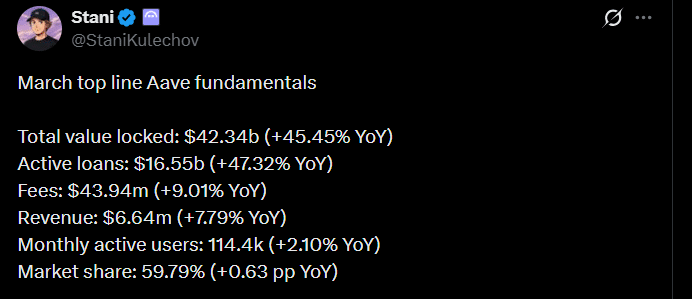
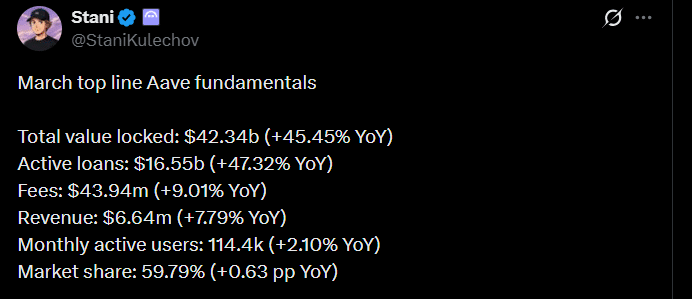
Risk management in DeFi now plays a central role in how protocols perform, especially during volatile periods. As Q1 2026 ended, Aave [AAVE] managed about $42.34 billion in TVL and $16.55 billion in loans; it relies on continuous adjustments rather than fixed settings.

Source: Stani Kulechov on X

External teams like Chaos Labs update liquidation thresholds, borrow limits, and collateral rules as conditions change.

As these updates happen more often, the system responds faster to market stress. This improves stability and user confidence, although it also means protocols depend more on external risk models as complexity increases.

Chaos Labs exit signals strain in Aave’s risk model

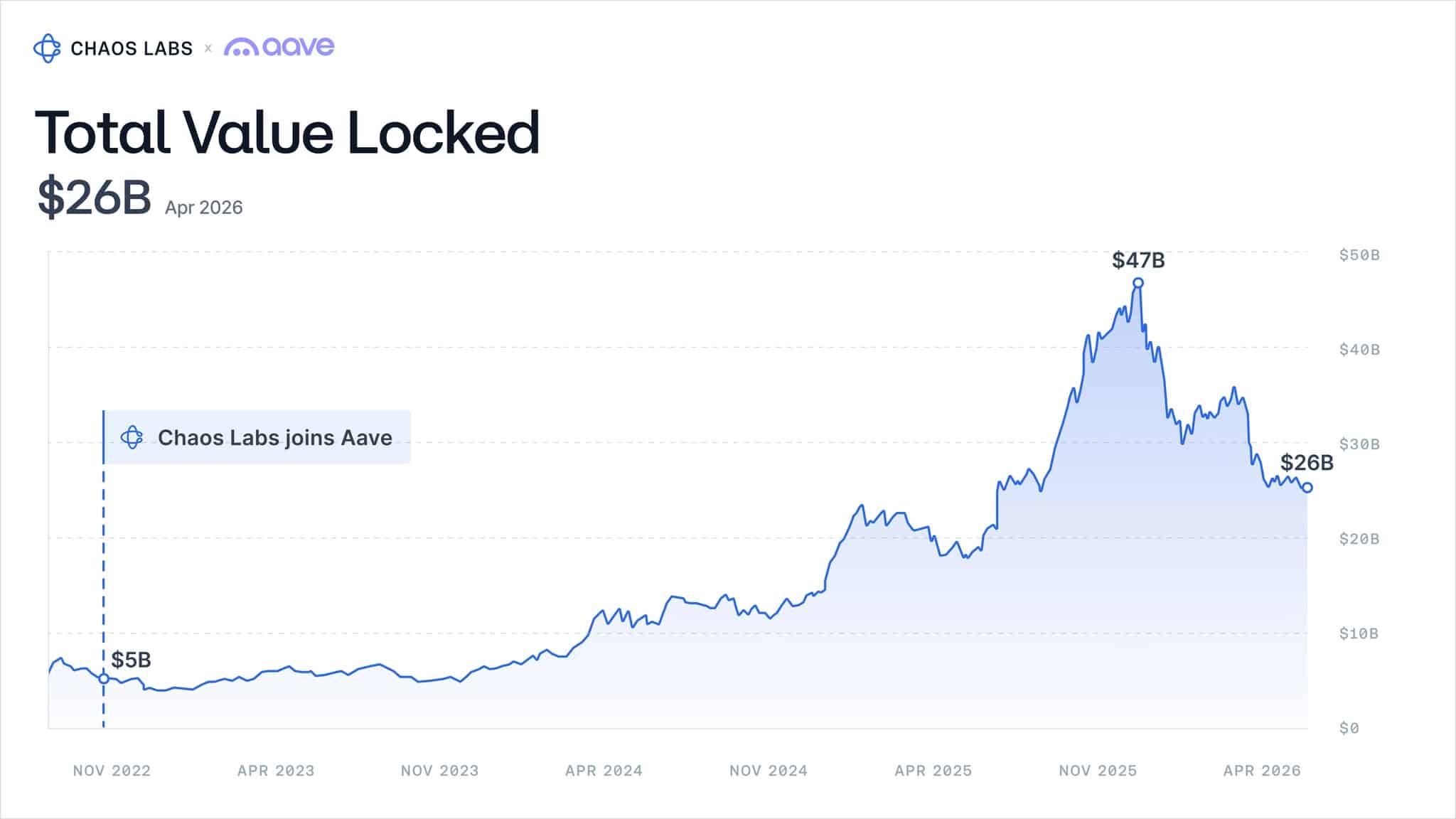
Chaos Labs’ exit signals more than a contributor change; it reflects growing strain in how Aave manages risk as it scales. For three years, Chaos Labs priced every loan while Aave’s TVL expanded from $5.2 billion to over $26 billion, processing $2.5 trillion in deposits and more than $2 billion in liquidations, according to Chaos Labs report.

Source: Governance. Aave.com

Yet, the exit was driven by deeper misalignment on how risk should be handled going forward. As core contributors left, workload and operational risk increased, while Aave V4 introduced greater complexity on an unfamiliar structure.

Stani Kulechov, founder and Aave’s CEO, applauded them in a post stating, “We also want to thank the entire Chaos Labs team for their contributions over the years, as they have helped bring the protocol we built into its current level of maturity.”

Consequently, the engagement remained loss-making despite a proposed $5 million budget. This shift suggests that as protocols grow, maintaining high-quality risk oversight becomes harder, which could affect long-term stability if demand outpaces control.

Aave’s risk continuity now faces its first real test

Aave now enters a critical transition as it absorbs the exit of a key risk contributor, shifting focus from performance to continuity.

With Chaos Labs gone, responsibility shifts to internal teams and providers like LlamaRisk, raising questions about response speed. Stani noted that “LlamaRisk already serves as a risk contributor to the Aave DAO and has deep familiarity with the protocol’s architecture and parameters. We support LlamaRisk increasing their budget to accommodate this additional workload and expanding their team as needed. “

As Aave expands toward V4, risk complexity increases, which places more pressure on coordination.

In the short term, systems remain stable; however, any slowdown in adjustments could allow risks to build gradually. This shift suggests that market confidence may now depend less on past performance and more on how effectively this transition is managed.


Final Summary

  • Aave stability relied on continuous risk updates, but Chaos Labs’ exit raises questions about maintaining the same responsiveness.
  • Aave now enters a transition where slower adjustments could increase risk, shifting focus from past performance to execution.

Perguntas relacionadas

QWhat was the total value locked (TVL) and loan amount managed by Aave as Q1 2026 ended?

AAave managed about $42.34 billion in TVL and $16.55 billion in loans as Q1 2026 ended.

QWhy did Chaos Labs exit from its role in Aave's risk management?

AChaos Labs' exit was driven by deeper misalignment on how risk should be handled going forward, increased workload and operational risk as core contributors left, and the introduction of greater complexity with Aave V4 on an unfamiliar structure. The engagement also remained loss-making despite a proposed $5 million budget.

QWhat are the potential risks for Aave following Chaos Labs' departure?

AFollowing Chaos Labs' exit, potential risks include slower response speeds in risk adjustments, which could allow risks to build gradually. There is also increased pressure on coordination as Aave expands toward V4, and market confidence may now depend more on how effectively the transition is managed rather than past performance.

QWho is taking over the risk management responsibilities for Aave after Chaos Labs' exit?

AResponsibility shifts to internal teams and providers like LlamaRisk, which already serves as a risk contributor to the Aave DAO and has deep familiarity with the protocol's architecture and parameters.

QHow did Aave's TVL grow during Chaos Labs' three-year contribution?

ADuring Chaos Labs' three-year contribution, Aave's TVL expanded from $5.2 billion to over $26 billion.

Leituras Relacionadas

Who Decides the Rules of Bitcoin? BIP-110 Ignites Governance Debate

Bitcoin's governance is once again at the center of a heated debate, this time ignited by BIP-110, the "Reduced Data Temporary Softfork." This proposal aims to curb non-monetary data (like inscriptions and Runes) by introducing seven new consensus-layer restrictions over a year, such as limiting new output scripts to 34 bytes and restoring the OP_RETURN cap to 83 bytes. The controversy stems from BIP-110's fundamental shift: it moves the battle against "spam" from node relay and miner policies to the consensus layer, rendering currently valid transactions invalid. Supporters, arguing that default policy governance has failed (highlighted by Bitcoin Core v30's relaxation of OP_RETURN limits), see this as necessary to protect node resources and Bitcoin's monetary focus. Opponents, led by figures like Michael Saylor and Adam Back, warn it dangerously centralizes governance. Saylor listed 110 reasons against it, criticizing its low 55% miner activation threshold and potential for chain splits. Back emphasized Bitcoin's "permissionless" ethos, arguing no single group should impose value judgments via consensus rules. Further complicating matters, technical critiques suggest BIP-110 may be technically circumventable, and a "BlockSlop" vulnerability in its upgrade path poses a consensus risk. The debate has drawn in diverse stakeholders: miners (with pools like Ocean signaling support and Foundry polling clients), node operators (like Bitcoin Knots), and new players like corporate treasury holder MicroStrategy (Saylor), whose market influence adds a novel dimension. Ultimately, BIP-110 acts as a governance stress test, exposing the unresolved question: who decides Bitcoin's rules? It pits the authority of miners, node operators, developers, and capital holders against each other, with each side claiming to defend Bitcoin's core principles of neutrality and security.

marsbitHá 5m

Who Decides the Rules of Bitcoin? BIP-110 Ignites Governance Debate

marsbitHá 5m

Who Decides Bitcoin's Rules? BIP-110 Ignites Governance Debate

Title: Who Decides Bitcoin's Rules? BIP-110 Ignites Governance Debate A new technical proposal, BIP-110 (Reduced Data Temporary Softfork), has sparked a fundamental governance debate within the Bitcoin community. It aims to impose new consensus rules for one year to limit non-financial data (like inscriptions and Runes) on-chain, moving beyond simple node and miner policy filters to invalidate currently valid transactions. Supporters argue that default policies have failed due to workarounds, necessitating consensus-layer changes to protect Bitcoin's core monetary function from data spam. Critics, including Michael Saylor and Adam Back, contend this dangerously centralizes judgment, undermines permissionlessness, and sets a risky governance precedent. They advocate for market-based solutions like fees or Layer 2s instead. The debate exposes deeper tensions: miners are divided on activation; node operators assert their sovereignty; Bitcoin Core developers influence defaults without direct accountability; and large corporate holders like MicroStrategy now wield narrative influence. Technically, BIP-110 may not fully block data and carries a disclosed consensus bug risk. Ultimately, BIP-110 acts as a stress test, forcing the community to confront the unresolved question: who legitimately decides what Bitcoin is and how it evolves, amidst competing claims from miners, nodes, developers, and capital holders.

链捕手Há 17m

Who Decides Bitcoin's Rules? BIP-110 Ignites Governance Debate

链捕手Há 17m

Zcash's New Node Zakura Goes Live: Privacy Payments Can Reach 50,000 TPS, Aiming to Rival Visa and Mastercard

Zcash, a privacy-focused cryptocurrency, has launched a new full node software called Zakura version 1.0.0. Developed by Zcash co-founder Sean Bowe and Dev Ojha, with private ZEC donations, its goal is to enable Zcash to process over 50,000 transactions per second (TPS)—matching the scale of Visa and Mastercard—while maintaining full transaction privacy and verifiability. This addresses a key bottleneck, as Zcash currently handles only about 1 private transaction per second. Zakura is a fork of the Zcash Foundation's Zebra node. It features chain pruning and snapshots, reducing disk usage and allowing new nodes to sync in under two minutes. It also offers compatibility with the legacy `zcashd` client interface. The scalability challenge stems from the large data size of privacy proofs. Bowe's Tachyon project aims to use recursive proofs to reduce consensus-layer data needs from ~500 MB/s to ~100 MB/s. For wallet scalability, Valar Group is researching Private Information Retrieval (PIR) tech to allow wallets to fetch their data privately. Zakura supports fast block propagation and the upcoming "Ironwood" network upgrade (NU6.3), scheduled for activation around July 28th. Ironwood was created to contain a critical inflation bug discovered in the Orchard shielded pool in May 2024. The fix uses "turnstiles" to trap any counterfeit ZEC created during the vulnerability period within the shielded pool, preventing it from entering circulation and restoring supply integrity.

marsbitHá 32m

Zcash's New Node Zakura Goes Live: Privacy Payments Can Reach 50,000 TPS, Aiming to Rival Visa and Mastercard

marsbitHá 32m

Replicating the "DeepSeek Moment"? Wall Street Unanimously Says: Kimi K3 Instead Strengthens Computing Power Demand

Title: Wall Street Sees Kimi K3 as a Catalyst for Compute Demand, Not a "DeepSeek Moment 2.0" Summary: Following the release of Moonshot AI's powerful open-source model Kimi K3, initial market reaction mirrored the "DeepSeek moment" that sparked a sell-off in compute stocks earlier in 2025, fearing reduced demand for AI infrastructure. However, major Wall Street banks including UBS, Nomura, BofA, and Citi argue the opposite: K3 will accelerate, not weaken, demand for compute, memory, storage, and networking. Their analysis centers on K3's specifications—2.8 trillion parameters, 1M token context, and MoE architecture—which represent a "scale" story rather than a pure "efficiency" one like DeepSeek R1. These features increase pressure on inference, memory (especially KV cache), and storage. Analysts invoke Jevons Paradox: as high-quality models become more affordable (K3 is cheaper than top closed models but not the cheapest), usage and token volumes expand, ultimately increasing total compute consumption. The reports highlight that competition will force leading US AI labs (OpenAI, Anthropic, Google) to invest more in training and iteration to maintain their edge. Furthermore, the rise of capable open-source models like K3 is expanding the global AI developer ecosystem, with Chinese models now accounting for over 45% of developer traffic. Key beneficiaries identified across the AI infrastructure chain include memory/storage players (e.g., Micron, Samsung), compute leaders (Nvidia, TSMC), networking suppliers (due to "super-node" cluster needs for deploying K3), and cloud platforms (e.g., Alibaba) that host diverse model ecosystems. The consensus is that stronger open-source models are an entry point for the next wave of infrastructure demand diffusion, provided workload growth outpaces efficiency gains.

链捕手Há 35m
Replicating the "DeepSeek Moment"? Wall Street Unanimously Says: Kimi K3 Instead Strengthens Computing Power Demand

链捕手Há 35m

Trading

Spot
活动图片