Whoever Defines Token Holds the Minting Power in the AI Era

比推Publicado em 2026-03-23Última atualização em 2026-03-23

Resumo

The article discusses the intense debate in China over the Chinese translation of "Token," a fundamental unit in AI and computing. Previously an obscure technical term, Token has become economically significant as it is now used in cloud service billing, AI model revenue metrics, and national AI industry statistics. With China's daily Token consumption soaring, the naming contest has attracted various stakeholders. Proposals include "智元" (intelligence unit), promoted by an AI media company for brand alignment; "模元" (model unit), emphasizing model ownership; and "符元" (symbol unit), a technically accurate but less popular term. The academic translation "词元" (word unit), established in 2021, is now overlooked due to Token's newfound economic value. The author argues that naming Token is not merely a linguistic issue but a struggle for narrative control and economic influence, akin to minting currency in the AI era. The piece highlights that whoever defines Token shapes the industry's future direction and financial flows.

Author: Kuli, Shenchao TechFlow

Original Title: Token Doesn't Need a Chinese Name, But the Business Behind It Does


Recently, you may have noticed something: people have started discussing what Token should be called.

Professor Yang Bin from Tsinghua University published an article titled "It's Already Urgent to Determine the Chinese Translation for Token"; on Zhihu, related translation questions have garnered 250,000 views, with comment sections buzzing with ideas.

Over the past two to three years, the domestic AI circle has been using the term Token directly without any issue. Why the sudden need for a Chinese name?

The immediate reason might be that, after this year's Spring Festival, the general public learned for the first time that Tokens cost money.

OpenClaw turned AI from chatting to working, with tasks burning through hundreds of thousands of Tokens, and bills skyrocketing; various cloud providers have also announced price increases, with Token as the billing unit.

At the same time, Token has begun appearing in places it never did before.

At the GTC conference, NVIDIA CEO Jensen Huang mentioned that in Silicon Valley, people are already asking in interviews, "How many Tokens does this job offer?" He suggested incorporating Tokens into engineers' compensation;

OpenAI founder Sam Altman took it even further, suggesting that Tokens will replace universal basic income, with everyone receiving computing power instead of money.

Data from the National Data Bureau shows that China's daily Token consumption surged from 100 billion in early 2024 to over 40 trillion by September 2025, reaching 180 trillion this February. At the beginning of the year, the People's Daily published an article titled "A Casual Talk on Ciyuan (词元)" to explain the term to readers.
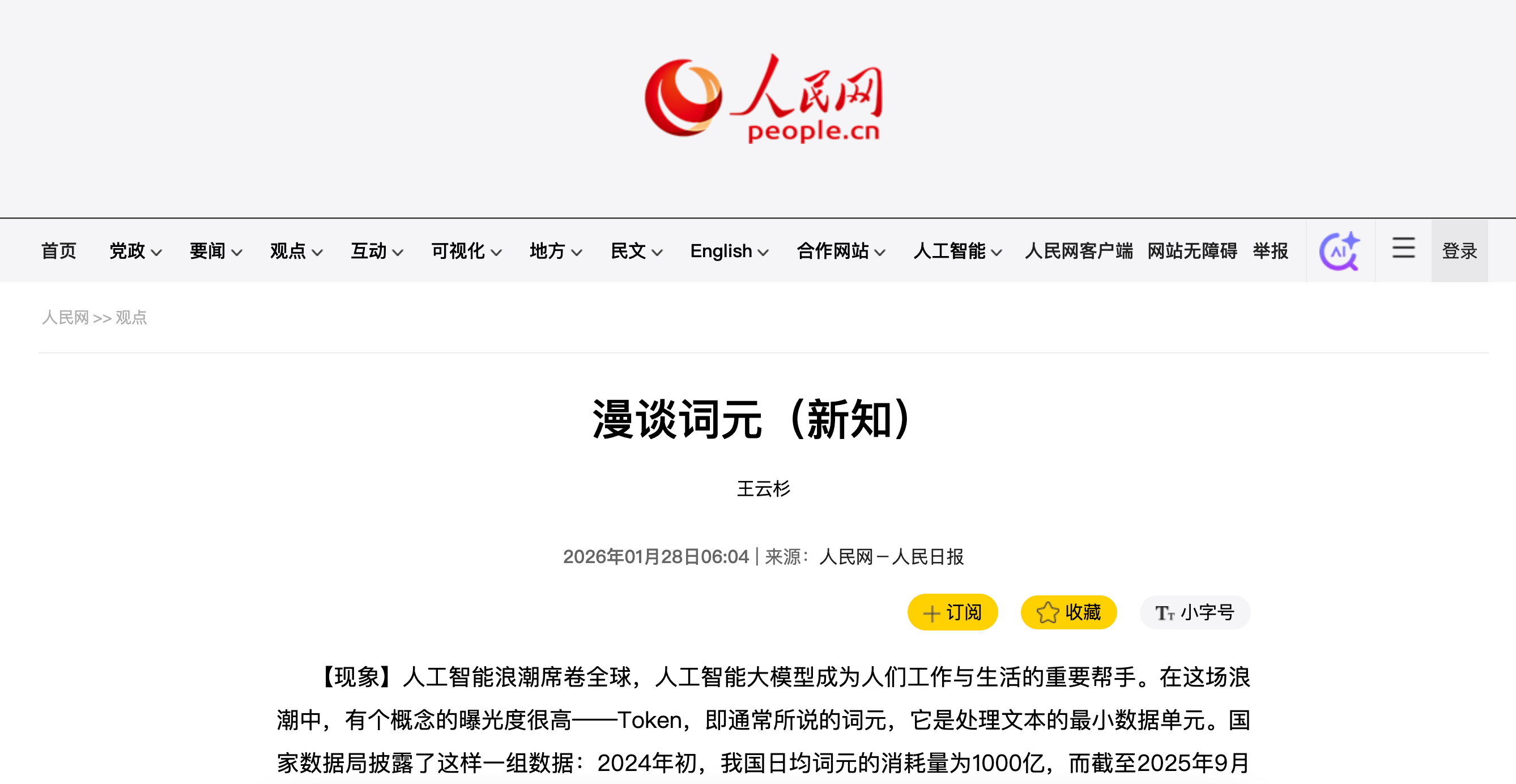
Once a technical term enters cloud service bills, compensation packages, and official statistics, it can no longer remain in English.

The question is, what to call it?

If this were merely a translation issue, there would already be an answer. In 2021, the domestic academic community settled on a name for Token: 词元 (Ciyuan).

But no one paid attention because, back then, Token was just an internal term within technical circles.

Now, it's different.

The word Token itself is a universal container. People in the crypto world call it 代币 (daibi, token), those in security call it 令牌 (lingpai, token), and those in AI call it 词元 (ciyuan, lexeme). The same English word, depending on which direction the Chinese translation leans, determines whose territory it belongs to.

Thus, a battle over naming Token has begun.

Business Needs Discourse Power

How a word is translated is usually a matter for linguists. But this time, almost no linguists are involved in the naming.

The most prominent name currently is "智元" (Zhiyuan).

It's being pushed most vigorously by an AI media outlet called "新智元" (Xin Zhiyuan). If Token's Chinese name becomes "智元", this company's brand name would coincide with the industry's fundamental term, meaning every article discussing Token would provide free advertising for them.

Their own promotional article ends candidly: "We suggest translating Token as the industry's new consensus: 智元 (Zhiyuan), leaving the '新' (Xin, new) for us."

According to the same article, Baichuan Intelligent founder Wang Xiaochuan commented: "Calling it 智元 is quite good."

As a maker of large models, it's certainly good for him if Token is called 智元. Each operation of the model would then produce not just a billing unit, but a "basic unit of intelligence."

Selling Token is selling traffic; selling 智元 is selling intelligence—a completely different valuation story.

Professor Yang Bin from Tsinghua University proposed "模元" (Moyuan), with "模" (mo) corresponding to model. Whoever owns the large model holds the production rights to "模元". Leaning the term towards models directs pricing power to the model companies.

Some advocate for "符元" (Fuyuan), returning to the most fundamental definition in computer science—Token is simply a symbol processing unit, unrelated to intelligence or models.

Technically the purest, but the proposer is an independent technical writer without corporate backing or capital push, rendering this proposal almost inaudible in the discussion.

Which direction the name leans, the industry narrative moves in that direction, and money flows accordingly.

A distant example: the day Facebook renamed itself Meta, "metaverse" transformed from a sci-fi concept into a valuation story for a company. A recent example: China consumes 180 trillion Tokens daily, ranking first globally, but what to call this term, how to define it, and who defines it remain undecided...

The world's largest consumer of Tokens hasn't even decided what to call what it consumes.

However, this term actually already had a Chinese name.

In 2021, Professor Qiu Xipeng from Fudan University's School of Computer Science translated Token as "词元" (Ciyuan). The academic community accepted it and wrote it into textbooks. No one discussed it then because Token wasn't valuable at the time.

Now, Token is valuable.

It's the billing unit for cloud services, the revenue source for large model companies, and a core metric for measuring the scale of the AI industry at the national level. So the media arrived, the big shots arrived, the professors arrived, each bringing their preferred name and the rationale behind it.

Translation was never the issue. The issue is when this term started becoming valuable.
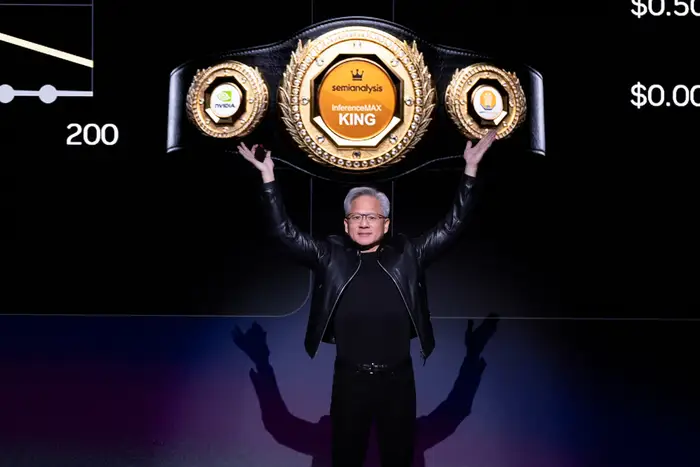
Jensen Huang didn't participate in the Chinese naming discussion at GTC. He did something simpler: held up a championship belt inscribed with "Token King" and declared that data centers are Token factories.

Whoever produces Tokens defines Tokens. He doesn't care about the name.

Token, Land Grabbing, and Minting

Therefore, the part truly worth serious thought isn't which translation is better.

After the term "calorie" was established, the entire food industry's pricing, labeling, and regulatory systems were built around it. After the definition of "流量" (liuliang, data traffic) was established in China's telecom industry, operators billed, competed, and designed packages based on it—the entire business model revolved around these two words for over a decade.

Token is now on the same path.

It's already the billing unit for cloud services, the revenue metric for large model companies, and a core indicator for measuring the AI industry at the national level. The VC circle is even discussing whether investment funds can be disbursed directly in Tokens.

Once a word becomes a measure of money, naming it is no longer translation—it's minting currency.

Call it "智元" (Zhiyuan), and the minting power goes to the AI narrative; whoever tells the story of intelligence benefits. Call it "模元" (Moyuan), and the minting power goes to the model companies; whoever has large models prints money. Call it "符元" (Fuyuan), and the minting power returns to the technology itself, but technology doesn't speak for itself.

The academic community's 2021 term "词元" (Ciyuan) was ignored not because the translation was poor, but because this "currency" wasn't valuable then.

Now it's valuable, and everyone wants to carve their name on it.


Twitter:https://twitter.com/BitpushNewsCN

Bitpush TG Discussion Group:https://t.me/BitPushCommunity

Bitpush TG Subscription: https://t.me/bitpush

Original link:https://www.bitpush.news/articles/7622494

Perguntas relacionadas

QWhy has there been a recent push to give Token a Chinese name, according to the article?

ABecause Token has become a unit of billing for cloud services, part of compensation packages, and a core metric for national AI industry statistics, making it necessary to have a standardized Chinese term as it enters everyday economic and official use.

QWhat are some of the proposed Chinese translations for 'Token' mentioned in the article, and who supports them?

A'智元' (Zhi Yuan) is promoted by the AI media '新智元' and supported by Wang Xiaochuan of Baichuan AI; '模元' (Mo Yuan) was proposed by Professor Yang Bin of Tsinghua University; '符元' (Fu Yuan) was suggested by an independent technical writer but has little traction.

QHow does the article compare the naming of 'Token' to historical examples like 'calories' or '流量' (data流量)?

AThe article compares it to how 'calories' defined the food industry's pricing and labeling system, and how '流量' (data流量) became the central unit for telecom billing and business models, indicating that naming Token is like establishing a new monetary standard for the AI economy.

QWhat does the article suggest is the real significance behind the debate over Token's Chinese name?

AThe debate is not about translation accuracy but about 'minting currency'—whoever defines the term gains narrative control and economic influence, shaping where money flows in the AI industry, whether toward AI intelligence stories, model companies, or pure technology.

QWhat was the academic translation for Token proposed in 2021, and why did it gain little attention at the time?

AIn 2021, Professor Qiu Xipeng of Fudan University translated Token as '词元' (Ci Yuan), which was accepted in academia and textbooks. It gained little attention because Token was not yet valuable as an economic unit at that time.

Leituras Relacionadas

Dialogue with Morgan Stanley Executive: Wall Street Isn't Rejecting Bitcoin, It's Just Waiting for the Right Time

In a podcast interview, Amy Oldenburg, Head of Digital Asset Strategy at Morgan Stanley, discusses Wall Street's evolving stance on Bitcoin, explaining the bank's measured approach and the road ahead. Oldenburg, with 26 years at Morgan Stanley, traces her perspective to witnessing transformative tech cycles and her experience in emerging markets, where she observed the need for alternative financial systems like mobile money (e.g., M-Pesa). This background informs her view of Bitcoin's value proposition. She clarifies that Morgan Stanley is "client-driven." Regulatory hurdles, particularly as a bank holding company under Federal Reserve oversight, initially slowed their entry. While the firm couldn't act as quickly as independent asset managers, persistent client demand and a changing regulatory environment led to offerings like their low-fee Bitcoin ETP (MSBT). They are now gradually rolling out spot Bitcoin trading on their E*Trade platform. Regarding advisor adoption, Oldenburg cites a "lack of education" as the primary barrier. Morgan Stanley recommends a 0-2% allocation for more conservative portfolios and 2-4% for aggressive ones, but price volatility and confusion about its place in asset allocation persist. She notes competition for investor attention from AI and commodities. Addressing Bitcoin's price stagnation despite institutional buying, Oldenburg points to a confluence of factors: competing investment narratives (AI, quantum computing) and the complex financial landscape. She suggests a catalyst for Bitcoin as a neutral reserve asset might require a "slow-burn crisis" that exposes fragility in traditional systems. For wider bank adoption, including holding Bitcoin on balance sheets, she identifies the need for regulatory clarity to reduce punitive capital treatment and for the asset to be usable as collateral within financial ecosystems. Looking ahead, Oldenburg predicts steady, moderate adoption growth through 2030 rather than an explosive "J-curve." She emphasizes the importance of differentiating Bitcoin from other crypto assets and expresses concern that the core cypherpunk ethos of self-custody is being diluted as traditional finance enters the space. She concludes that the digital asset field remains in its early stages with significant innovation, like AI agents and micropayments, still to come.

marsbitHá 20m

Dialogue with Morgan Stanley Executive: Wall Street Isn't Rejecting Bitcoin, It's Just Waiting for the Right Time

marsbitHá 20m

10% Position Limit Proposed: UK Retail Authorized Funds to Gain Indirect Exposure to Crypto Assets

The UK Financial Conduct Authority (FCA) is consulting on a proposal (CP26/17) that would allow retail funds, including UCITS and most Non-UCITS Retail Schemes (NURS), to invest up to 10% of their total assets in cryptoasset exchange-traded notes (crypto ETNs). This would enable indirect exposure to cryptoassets for mainstream investors through regulated funds. The rule maintains the existing prohibition on funds holding underlying cryptocurrencies like Bitcoin or Ethereum directly. The proposal introduces a strict 10% cap, positioning crypto ETNs as a potential satellite holding within diversified portfolios. Funds must ensure these investments align with their stated objectives and risk profiles. Notably, the cap does not apply to Qualified Investor Schemes (QIS) for professional clients, while Long-Term Asset Funds (LTAFs) would be prohibited from holding crypto ETNs. This move builds on the FCA's 2025 decision to permit retail trading of crypto ETNs on UK regulated exchanges. However, significant compliance burdens fall on fund managers, who must conduct thorough due diligence, assess liquidity, and provide clear risk disclosures to investors. The FCA emphasizes that even a small allocation can significantly impact a fund's risk profile. The policy's practical impact remains uncertain. Widespread adoption depends on whether asset managers deem the potential benefits worth the operational costs, disclosure requirements, and reputational risks. The consultation is open for feedback until July 13, 2026. Ultimately, the proposal represents a cautious, incremental step toward integrating cryptoassets into the regulated fund landscape, rather than a broad opening.

Foresight NewsHá 48m

10% Position Limit Proposed: UK Retail Authorized Funds to Gain Indirect Exposure to Crypto Assets

Foresight NewsHá 48m

Public Version of Mythos Officially Launched: Analyzing the Advantages and Limitations of AI Smart Contract Auditing

Publicly available Mythos, Anthropic's AI model, has officially launched, demonstrating both significant potential and limitations in smart contract security auditing. The article analyzes its capabilities through real-world cases. AI excels in identifying subtle, low-level vulnerabilities through pattern recognition and large-scale code screening. A key example is detecting a storage slot collision between a custom rewards mapping and a third-party library's ReentrancyGuard, a vulnerability easily missed in manual audits. In the recent Zcash incident, AI also rapidly discovered a critical soundness bug that had remained hidden for years. However, AI currently struggles with complex, interconnected scenarios. When tested on the Curve LlamaLend sDOLA exploit, which involved manipulating prices across multiple protocols (Curve pools, lending markets) to trigger liquidations, Fable 5 failed to identify the core cross-protocol attack vector. These scenarios require a deep understanding of DeFi economic models and multi-contract interactions. In conclusion, while AI tools like Mythos significantly boost efficiency in finding standardized, syntactic vulnerabilities, they cannot yet replace expert analysis for complex, business-logic, and cross-protocol attacks. An effective audit workflow combines AI's speed for initial screening with human expertise for in-depth, holistic analysis.

marsbitHá 53m

Public Version of Mythos Officially Launched: Analyzing the Advantages and Limitations of AI Smart Contract Auditing

marsbitHá 53m

Trade.xyz's Rebase Refusal Sparks Controversy, On-Chain Pre-IPO Market Faces Major Pricing Test

The debate surrounding Trade.xyz's refusal to adjust its SPCX (SpaceX pre-IPO) perpetual contract pricing amid updated share count revelations highlights a key challenge for on-chain pre-IPO markets. While several centralized exchanges (CEXs) paused and repriced their contracts after SpaceX's filing showed a ~10% increase in total shares, Trade.xyz maintained its market-driven pricing logic, which tracks expected per-share price sentiment rather than fundamental valuation metrics like market cap. This discrepancy triggered cross-platform arbitrage and caused leveraged long positions on Trade.xyz to suffer significant losses, as the platform's HIP-3 architecture lacks a native "Rebase" mechanism to neutrally adjust all user positions following such corporate actions. The incident underscores the difficulty for decentralized perpetual exchanges (Perp DEXs) to implement Rebase—a process CEXs handle by centrally pausing markets and adjusting ledger data. On-chain, this requires complex smart contract modifications, increasing gas costs, complexity, and potential attack surfaces. While some DEXs have managed similar adjustments, Trade.xyz's current design does not natively support it, though the team is reportedly exploring solutions for future events like stock splits. Ultimately, the controversy serves as a critical case study for the nascent on-chain pre-IPO sector, raising questions about price discovery reliability, transparent rule disclosure, and the readiness of DeFi infrastructures to handle traditional corporate actions as real-world assets (RWAs) gain traction.

marsbitHá 1h

Trade.xyz's Rebase Refusal Sparks Controversy, On-Chain Pre-IPO Market Faces Major Pricing Test

marsbitHá 1h

Trading

Spot
Futuros

Artigos em Destaque

Como comprar ERA

Bem-vindo à HTX.com!Tornámos a compra de Caldera (ERA) simples e conveniente.Segue o nosso guia passo a passo para iniciar a tua jornada no mundo das criptos.Passo 1: cria a tua conta HTXUtiliza o teu e-mail ou número de telefone para te inscreveres numa conta gratuita na HTX.Desfruta de um processo de inscrição sem complicações e desbloqueia todas as funcionalidades.Obter a minha contaPasso 2: vai para Comprar Cripto e escolhe o teu método de pagamentoCartão de crédito/débito: usa o teu visa ou mastercard para comprar Caldera (ERA) instantaneamente.Saldo: usa os fundos da tua conta HTX para transacionar sem problemas.Terceiros: adicionamos métodos de pagamento populares, como Google Pay e Apple Pay, para aumentar a conveniência.P2P: transaciona diretamente com outros utilizadores na HTX.Mercado de balcão (OTC): oferecemos serviços personalizados e taxas de câmbio competitivas para os traders.Passo 3: armazena teu Caldera (ERA)Depois de comprar o teu Caldera (ERA), armazena-o na tua conta HTX.Alternativamente, podes enviá-lo para outro lugar através de transferência blockchain ou usá-lo para transacionar outras criptomoedas.Passo 4: transaciona Caldera (ERA)Transaciona facilmente Caldera (ERA) no mercado à vista da HTX.Acede simplesmente à tua conta, seleciona o teu par de trading, executa as tuas transações e monitoriza em tempo real.Oferecemos uma experiência de fácil utilização tanto para principiantes como para traders experientes.

483 Visualizações TotaisPublicado em {updateTime}Atualizado em 2026.06.02

Como comprar ERA

Discussões

Bem-vindo à Comunidade HTX. Aqui, pode manter-se informado sobre os mais recentes desenvolvimentos da plataforma e obter acesso a análises profissionais de mercado. As opiniões dos utilizadores sobre o preço de ERA (ERA) são apresentadas abaixo.

活动图片













