Who Will Make Money in the Age of Agents?

marsbitPublicado em 2026-05-27Última atualização em 2026-05-27

Resumo

In the Agents era of blockchain, traditional value capture theories face challenges. The "Fat Protocol" theory, dominant since 2016, suggested protocols capture most value as their tokens are essential for network use. However, the proliferation of interchangeable L1s, L2s, and modular layers has eroded protocol scarcity and pricing power. Conversely, the "Fat App" theory posits that applications capturing user relationships (like wallets and exchanges) become the primary value layer by controlling distribution and transaction flows. This aligns with the current "Great Repricing" cycle. Agents disrupt this logic. As software users, they lack brand loyalty, prioritize cost and efficiency, and switch between platforms seamlessly. This undermines the front-end UX moats that "Fat Apps" rely on. The article explores several potential futures: 1. **Headless Applications:** Current leading apps could strip their front-ends and become backend API infrastructure for Agents, preserving their role. 2. **Protocol Resurgence:** If integration becomes trivial, Agents might bypass aggregators and interact directly with protocols, reviving "Fat Protocol" dynamics. 3. **Pricing Power Collapse:** Agents' rational, frictionless routing could commoditize the entire stack, compressing margins toward cost and leaving little profit for intermediaries. 4. **Unprecedented Activity:** Agents may enable new, high-frequency, machine-to-machine economic activities, expanding the total value pie ev...

Author: Jonah Burian

Compiled by: Jiahuan, ChainCatcher

Many speculate that the next billion users of blockchain will be Agents. But few ask the further question: In that world, who will make money?

Every previous theory of value capture in the crypto space assumes the user is human. The "Fat Protocols" theory posits that protocols are best at monetizing human users.

The "Fat Apps" theory I explored with my colleagues in "How to Capture Value" and "The Great Repricing" argues that the application layer can do better. But Agents change the nature of the user, and existing theories will break down accordingly.

The Fat Protocols Theory

In 2016, @jmonegro proposed "Fat Protocols." For nearly a decade, it has been the dominant value capture theory in crypto.

The core idea: In the traditional internet, value accumulates at the application layer (@Google, @facebook), while the underlying protocols (TCP/IP, HTTP) capture almost no value. The crypto world will completely reverse this. Blockchains have open, shared data, so applications will become commoditized.

And because using the network requires consuming the protocol's token, the token will capture the speculative value generated by usage growth as it appreciates. Each application's success drives demand for the token. The underlying protocol will grow faster than any application built on top of it.
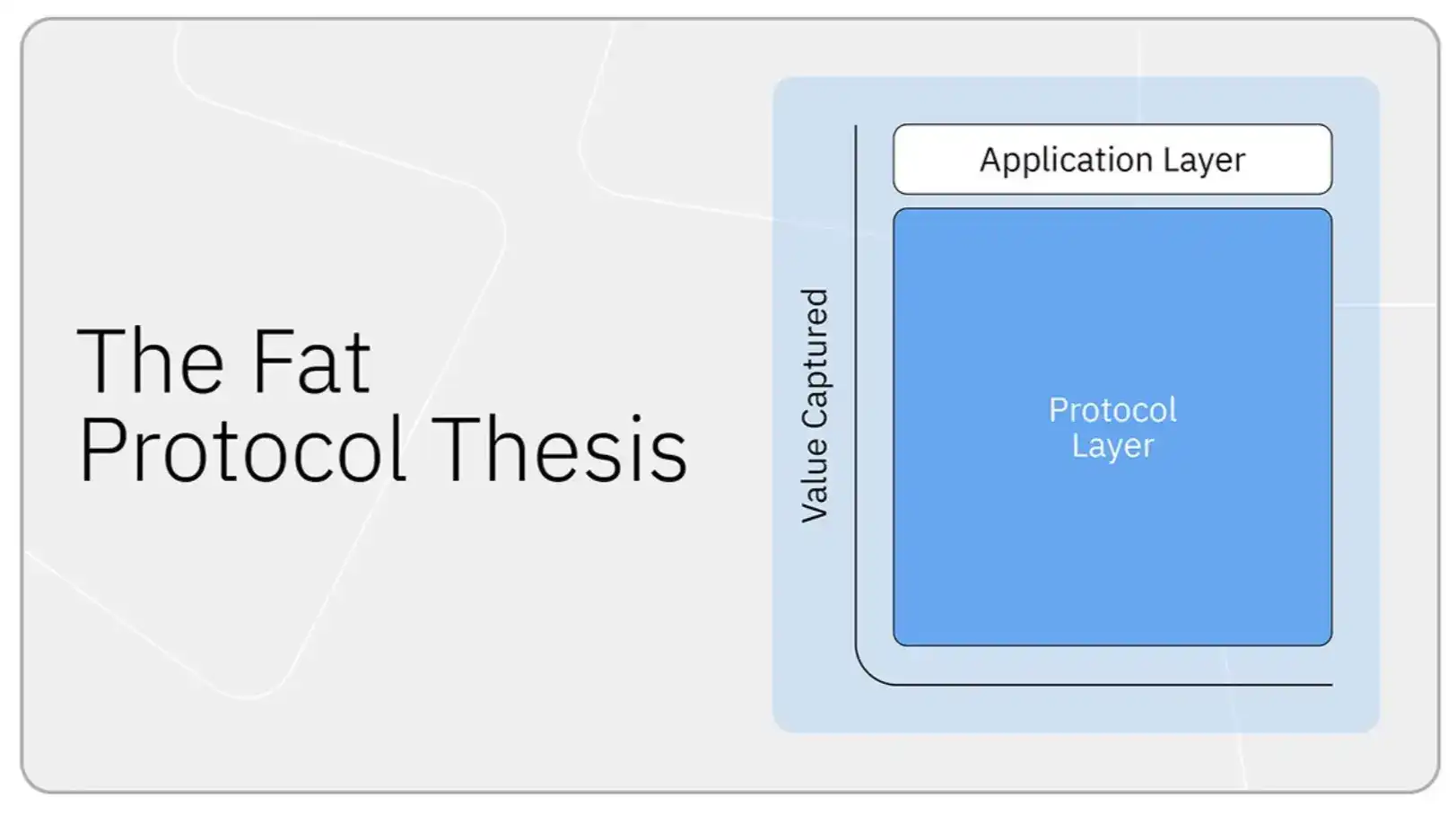
For years, this seemed correct. Bitcoin and Ethereum's values far surpassed any companies built on them.

This model works perfectly when the protocol itself is scarce, costly to build, and difficult to replace. Bitcoin and Ethereum in 2017 were indeed very scarce; there weren't dozens of general-purpose L1s competing for the same workloads.

Block space was sufficiently constrained that holding the underlying asset felt like holding a piece of every application that needed it.

Today, reliable alternatives exist at every layer of the infrastructure stack: multiple high-throughput L1s, dozens of L2s, and modular settlement and data availability (DA) layers competing fiercely on price. Block space has gone from constrained to abundant.

As cross-chain bridges and aggregators make the underlying chain nearly invisible to users, user switching costs collapse. Infrastructure becomes interchangeable, and interchangeable commodities compete on price. The result is that protocol pricing power dies along with scarcity.

The Fat Apps Theory

By 2026, the entities capturing most of the economic benefits are applications, not protocols: e.g., @phantom, @coinbase, @Polymarket, @Pumpfun.

In my view, the reason is that the most valuable asset in crypto is the user relationship.

If you control the user interface and transaction flow, you control distribution, and can profit from almost any on-chain product users touch: swaps, lending, staking, minting, and fiat on/off ramps. This is probably why funds are so obsessed with neobanks.
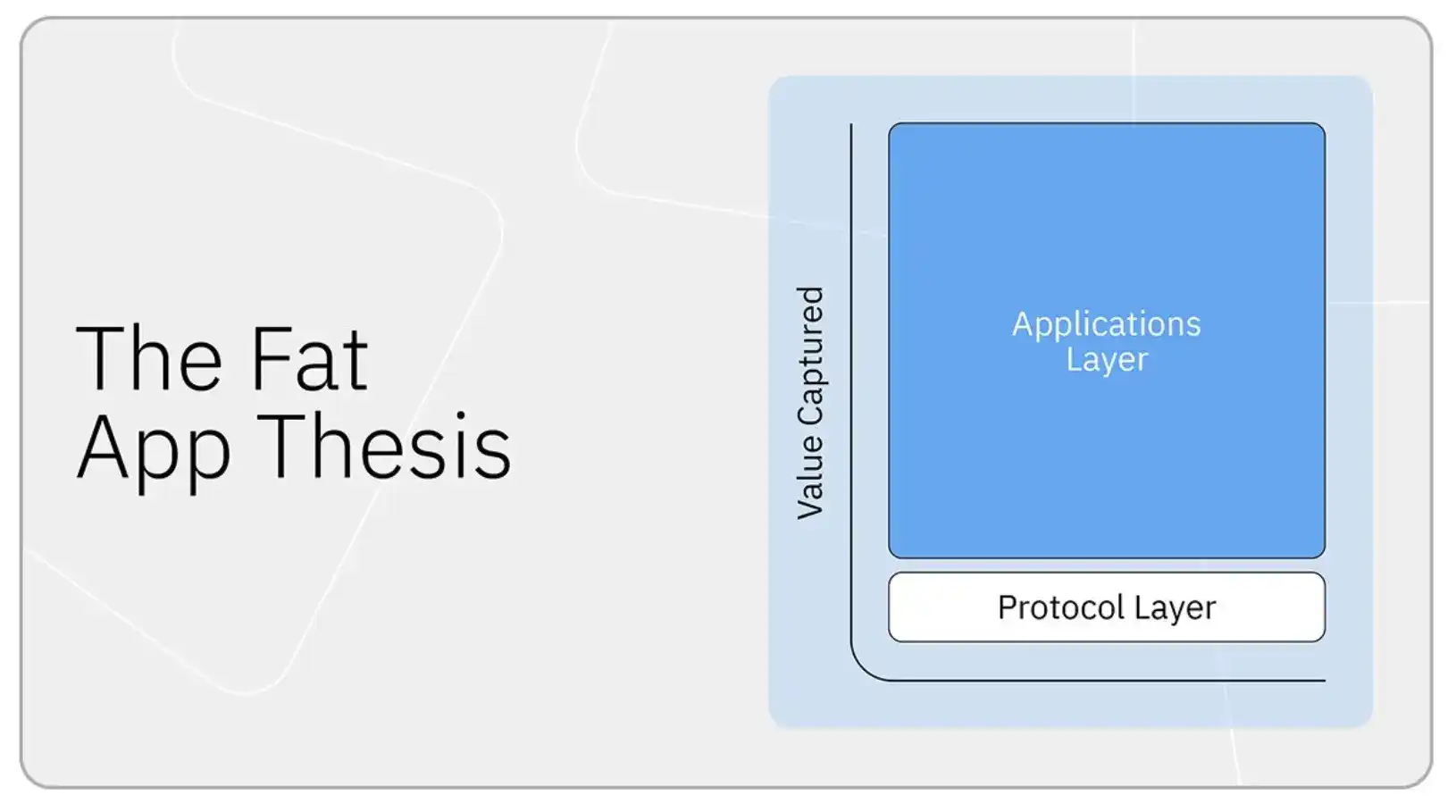
Applications also push infrastructure into pure price wars, forcing infrastructure margins down to marginal cost. I documented this dynamic in "How to Capture Value." The same dynamic is playing out in the stablecoin space, which I've discussed elsewhere.

Asset prices are reflecting this theory. Spencer and I called this shift "The Great Repricing": in this cycle, value is starting to accrue to the layer that owns the user.

Why Agents Break This Logic

The Fat Apps theory assumes users are humans who value UX, brand, and convenience. But Agents don't care about any of that. They call APIs directly, have no brand loyalty, and switch between platforms at zero cost.

When the user becomes software, owning the user relationship is no longer an unbreakable moat. The entire front-end moat upon which the Fat Apps theory relies is failing.

So, who captures value in the age of Agents?
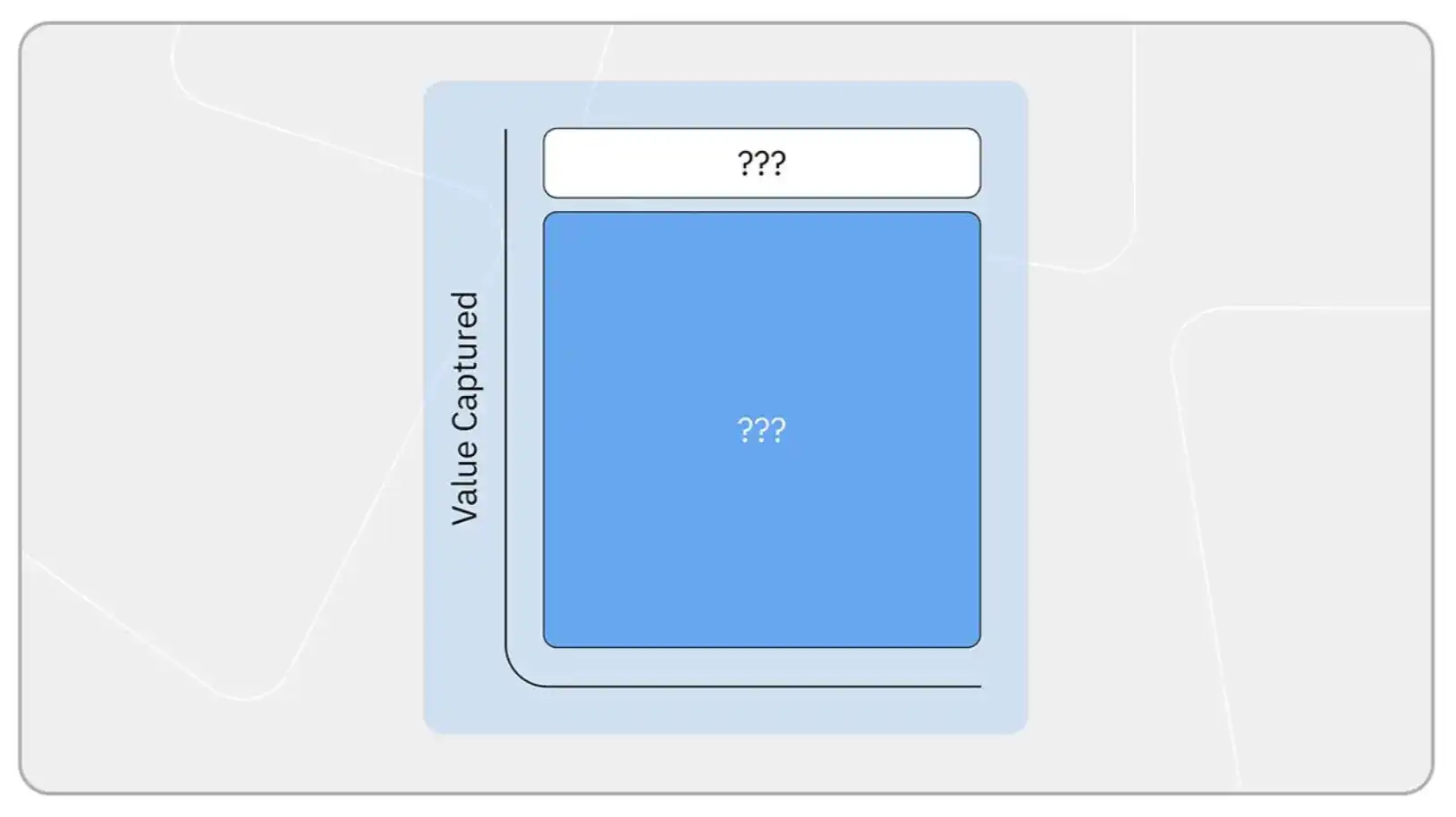
Applications Go "Headless"

In one version of the future, winners at the application layer remain winners by shedding their front-end interface, i.e., going "headless."

Wallets and aggregators have already done the hardest work: integrations with dozens of protocols, routing logic, authentication, and fiat on/off-ramp infrastructure.

The logical next step is to open this tech stack as an API for Agents, letting Agents route through them—just as humans route through @phantom or @JupiterExchange today.

In this world, the Fat Apps theory survives. It just loses its front end. The companies that won in the human era transform into pure back-end infrastructure for Agents. We already see traditional SaaS companies like Salesforce moving in this direction.

The Resurgence of Protocols

In another version, Agents completely skip the middle layer.

If integration becomes easy enough (well-documented APIs, standardized RPCs, predictable execution semantics), Agents have no real reason to pay an aggregator to do something they can do themselves. Aggregators' advantages in the human era were UX and handling routing complexity.

But Agents don't need UX, and routing is an engineering problem that Agents are increasingly good at solving.

If the world evolves this way, the Fat Protocols theory gets a second life.

Pricing Power Collapses Across the Stack

Perhaps Agents will apply commoditization pressure everywhere. They are perfectly rational, frictionlessly routing to the cheapest venue every single time with zero loyalty.

Applications lose the ability to charge a UX premium from humans. Aggregators and infrastructure lose pricing power because there is no longer human inertia protecting them from price wars.

In this scenario, no one in the tech stack captures much profit. Margins across the supply chain are forced down to marginal cost. The residual value accrues to the owners of the Agents, or to the end-users the Agents serve.

Crypto becomes a utility, and it's hard to make big money in utilities.

Agents Create Unprecedented Activity

The simple take on this is: Agents are doing everything humans do, just faster and at greater scale. Even if margins are compressed, the overall pie grows.

I think there's a more interesting version.

Agents enable activities that were previously infeasible: e.g., continuously rebalancing a portfolio for less than a penny in execution costs, machine-to-machine commerce between Agents, and entirely new markets that exist only because pricing and transaction speeds far outpace what humans can follow.

Current on-chain activity data doesn't reflect this because we assume a human must be involved.

If this is the change Agents bring, then the question shifts from "how is the existing pie divided" to "how much new economic activity pours on-chain, and which layers are ready to serve it."

A Yet-Unnamed Business Model

Every cycle, we try to guess where value will flow, and tend to think existing business models will extend into the future. This assumption usually causes us to miss the new models that haven't yet emerged.

When the internet was new, no one foresaw the attention economy. The idea that "slicing up user attention and auctioning it to advertisers would become the dominant business model, and a single company could capture a significant share of global ad spend" was alien. It only seems inevitable in hindsight.

AI looks like one of the biggest technological disruptions in decades. In an Agent-dominated world, some value capture might flow to business models no one is talking about today. And the entities capturing that value might not be the ones the market is currently focused on.

What to Watch

The most likely outcome is not one system completely replacing the other. For a long time, humans and Agents will coexist as crypto users, with entirely different maps of value capture.

As long as humans interact on-chain, the Fat Apps theory still applies: consumers willing to pay for UX, brand, and convenience will continue to pay a premium to the applications that own that relationship. And the layers involved in Agent transactions will be governed by a separate set of theories, whichever of the above scenarios becomes reality.

For builders, I think the question worth iterating on the Agent side is: What actually makes an Agent come back to you instead of routing directly to the next cheapest alternative? UX probably isn't the answer. Liquidity, latency, settlement guarantees might be.


Perguntas relacionadas

QAccording to the article, what was the dominant value capture theory in crypto for the past decade, and what was its core argument?

AThe dominant value capture theory was the 'Fat Protocols' theory. Its core argument was that in the crypto world, value accrues to the underlying blockchain protocols (like Bitcoin and Ethereum) rather than the applications built on top. This is because protocols become more valuable as they are used (demand for their token increases), while applications become commoditized due to open, shared data.

QWhat is the 'Fat App' theory, and why is it currently challenging the 'Fat Protocols' theory?

AThe 'Fat App' theory argues that value is increasingly captured at the application layer. It posits that the most valuable asset in crypto is the user relationship. Entities that control the user interface and transaction flow (like wallets and exchanges) control distribution and can monetize various on-chain products. It challenges 'Fat Protocols' because infrastructure has become commoditized with many alternatives, eroding protocol pricing power.

QWhy does the author believe AI Agents will disrupt the current 'Fat App' value capture model?

AThe 'Fat App' model assumes users are humans who value UX, brand, and convenience. AI Agents do not care about these aspects; they interact via APIs with zero brand loyalty and can switch between platforms at near-zero cost. Therefore, the front-end moat (user relationship) that 'Fat Apps' rely on becomes ineffective when the 'user' is software.

QThe article outlines several possible scenarios for value capture in an Agents-dominated world. Name two of them.

ATwo possible scenarios are: 1) Successful applications become 'headless,' pivoting to serve as backend infrastructure APIs for Agents, keeping the 'Fat App' theory alive but without the front-end. 2) Agents bypass middlemen entirely and interact directly with protocols if integration is simple enough, potentially revitalizing the 'Fat Protocols' theory.

QWhat does the author suggest builders in the Agents economy should focus on, instead of user experience (UX)?

AThe author suggests builders should focus on what would make an Agent choose their service repeatedly over a cheaper alternative. Potential answers include factors like superior liquidity, lower latency, or stronger settlement guarantees, rather than traditional UX elements that appeal to humans.

Leituras Relacionadas

Are Rising U.S. Stocks Getting More Dangerous? Goldman Sachs: Downside Protection Mechanisms Have Almost Failed

The US stock market rally is showing signs of becoming increasingly precarious as key downside protection mechanisms fail, according to Goldman Sachs. Derivatives strategist Brian Garrett notes that the S&P 500 options volatility skew has plunged to an 18-month low, indicating the market now prices an 8% probability for both a 10% drop and a 10% rise—a sign of "skew failure." Concurrently, Goldman's Panic Index hit a two-year low, reflecting minimal demand for tail-risk hedging. This complacency emerges amid a relentless market surge, with the S&P 500 setting new records frequently in 2024. Garrett highlights three major concerns: extreme concentration in the top ten stocks (40% of index weight), heavy reliance on AI-themed performance, and a price pattern eerily similar to the 1998-1999 period. Despite pervasive media pessimism, this fear is absent in options pricing. Downside hedge costs are historically low. Goldman suggests tactical trades: buying RSP outperformance options versus the SPX for a broadening rally, purchasing VIX calls for protection, and going long on Bitcoin ETF volatility. Hedge funds have been net buyers for two weeks, with sector rotation into financials and out of industrials. Notably, the global single-stock leveraged/ inverse ETF AUM has doubled to over $60 billion in two months, underscoring growing speculative activity.

marsbitHá 25m

Are Rising U.S. Stocks Getting More Dangerous? Goldman Sachs: Downside Protection Mechanisms Have Almost Failed

marsbitHá 25m

DAT Failure? Listed Companies Betting on HYPE Floating Profit of $12.5 Billion

Several public companies that adopted a "HYPE Treasury" strategy—holding significant reserves of the HYPE token from the Hyperliquid ecosystem—have achieved substantial paper gains, collectively exceeding $1.25 billion. This contrasts with the reported struggles of MicroStrategy's flagship BTC treasury strategy. The article profiles three such HYPE-focused treasury companies: 1. **Hyperliquid Strategies Inc. (PURR):** The largest holder, with approximately 22.3 million HYPE tokens valued at ~$1.636 billion, resulting in an unrealized gain of ~$1.22 billion. It has fully transitioned from a biotech firm to a dedicated crypto treasury, adding staking and validator operations to enhance returns. 2. **Hyperion DeFi (HYPD):** Holds around 2 million HYPE tokens (~$147 million value) with a gain of ~$49.4 million. It is deeply integrated into the Hyperliquid ecosystem, running a major validator node and building DeFi products for additional yield. 3. **Lion Group Holding (LGHL):** A smaller holder with ~194,000 HYPE tokens (~$14.14 million value), maintaining a long-term commitment to the token. The success of these HYPE treasuries is attributed not only to the token's significant price appreciation but also to active on-chain participation through staking, validation, and ecosystem integrations, creating a compounding "flywheel" effect. The article posits that while MicroStrategy's BTC strategy faces challenges, HYPE treasuries may offer a more sustainable model through deeper protocol engagement, with potential for further growth if HYPE's price rises as predicted by some analysts.

marsbitHá 45m

DAT Failure? Listed Companies Betting on HYPE Floating Profit of $12.5 Billion

marsbitHá 45m

DAT Failing? Listed Companies Betting on HYPE Have Floating Profits of $12.5 Billion

Facing a potential need to sell Bitcoin to pay dividends amid a $12.5B quarterly net loss, the crypto treasury strategy pioneered by Strategy appears strained. In contrast, public companies that adopted a similar strategy by betting on the HYPE token are seeing massive gains, with collective unrealized profits exceeding $1.25 billion. Three key HYPE treasury companies are highlighted: 1. **Hyperliquid Strategies Inc. (PURR):** The largest holder, with approximately 22.3 million HYPE tokens valued at ~$1.636 billion, resulting in ~$1.22 billion in unrealized gains. It has fully transitioned from a biotech firm to a native crypto treasury, focusing on staking and ecosystem participation via validator operations. 2. **Hyperion DeFi (HYPD):** Holds about 2 million HYPE tokens (~$147M value) with ~$49.4M in gains. It is deeply integrated into the Hyperliquid ecosystem, running a top validator node and building DeFi products to generate additional yield. 3. **Lion Group Holding (LGHL):** A smaller player holding ~193,775 HYPE tokens (~$14.14M value), maintaining a long-term holding strategy alongside other crypto assets. The article argues that HYPE treasuries have an advantage over Bitcoin-based ones like Strategy's. Their success stems not just from price appreciation but from active on-chain participation—staking, earning validator rewards, and engaging with ecosystem protocols—creating a compounding "flywheel" effect. With Hyperliquid dominating the on-chain perpetuals market and HYPE's tokenomics encouraging buys and burns, these treasuries are positioned to benefit further if HYPE's price rises as some predict. While the original Bitcoin treasury strategy isn't declared a failure, the current narrative highlights the outsized success of early movers into the HYPE ecosystem.

Odaily星球日报Há 49m

DAT Failing? Listed Companies Betting on HYPE Have Floating Profits of $12.5 Billion

Odaily星球日报Há 49m

Comics Illustration: Helping You Understand China's New Regulations on Outbound Investment

Summary: Understanding China's New Regulations on Overseas Investment The State Council has announced new regulations on overseas investment, effective July 1, 2026. The core message is not a prohibition on international investment, but a call for both companies and individuals to operate with strong regulatory awareness. Here are the key points: 1. **Scope is Broad:** The rules apply not only to companies but also to other organizations and individual residents. 2. **Definition of Investment is Wide:** It encompasses not just capital transfers but also asset contributions, obtaining equity or rights, financing, providing guarantees, and direct or indirect acquisition of rights related to overseas entities or assets. 3. **Companies Must Plan Comprehensively:** Beyond simple ownership charts, firms need clear plans covering the investing entity, required approvals or filings, fund transfer paths, and compliance with technology, data, and security reviews. 4. **Individuals Should Prioritize Compliance:** Before focusing on returns, individuals must first assess their eligibility, understand legal channels for capital outflow, know what they are acquiring, and identify responsible parties in case of issues. 5. **Penalties are Significant:** Violations can result in fines and potentially restrictions on future overseas investment activities. In essence, overseas investment remains possible, but it must be approached with regulatory compliance as a fundamental priority, not solely based on commercial opportunity. *Note: This is a general informational summary and does not constitute legal advice or investment recommendations.*

marsbitHá 1h

Comics Illustration: Helping You Understand China's New Regulations on Outbound Investment

marsbitHá 1h

Trading

Spot
Futuros
活动图片




