Who is the 'Only Alternative' to SpaceX, Valued at Trillions?

marsbitPublicado em 2026-05-08Última atualização em 2026-05-08

Resumo

Rocket Lab (RKLB), considered by many as the "only alternative" to SpaceX, reported strong Q1 2026 results with revenue of $200.3M, beating expectations. Its stock has surged 240% over the past year. The company is seen as replicating SpaceX's proven path. Its small-lift Electron rocket is the world's only frequently and reliably launched vehicle in its class and has demonstrated reusability through ocean recovery. The key to its future growth, however, is the upcoming medium-lift Neutron rocket, designed to compete directly with SpaceX's Falcon 9. Neutron features innovative designs like the fixed, reusable "HungryHippo" payload fairing, aiming for greater efficiency. Like SpaceX with Starlink, Rocket Lab operates a dual business model of "Launch + Space Systems," with satellite components already generating nearly 70% of its revenue. While SpaceX's valuation is estimated at $1.75-$2 trillion, Rocket Lab's market cap is around $45 billion. This gap represents both the reality of SpaceX's dominance and the significant upside potential investors see in Rocket Lab if Neutron succeeds. The major risk is that Neutron's first flight, currently scheduled for late 2026, could face delays or failures—a common challenge in aerospace. Its success is critical for validating Rocket Lab's ambition to become the world's second provider of reusable medium-lift launch capability.

Author|Azuma(@azuma_eth)
After the U.S. stock market closed on May 8th, commercial aerospace company Rocket Lab (RKLB) announced a much better-than-expected Q1 2026 earnings report.

The financial report data showed that Rocket Lab's Q1 revenue reached $200.3 million, a significant year-on-year increase of 63.5%, higher than the expected $189 million; the Q2 revenue guidance was raised to $225-240 million, far exceeding analysts' expectations of $205 million. Although the operating loss of $56 million shows the company is still in a "cash-burning" mode, the adjusted gross margin has climbed to 43% (only 33.4% in the same period last year), indicating that the company's unit economics are significantly improving while scaling up — in simple terms, it's "burning money" more efficiently.

Boosted by the positive earnings report, RKLB rose nearly 7% after hours, and has gained a whopping 240% over the past year.

As SpaceX's century-level IPO approaches, commercial aerospace has become another hot theme in the U.S. stock market, with capital beginning to assign internet-level valuation imagination to the business of "building rockets." In this frenzy, apart from SpaceX, whose valuation is pointing to $1.75-2 trillion with significant pre-market premium, Rocket Lab, positioned as "the pure commercial aerospace stock most similar to SpaceX," has also become an alternative option in the eyes of many investors.

The 'Only Alternative' to SpaceX?

The reason Rocket Lab is seen as the current "only alternative" to SpaceX is that it is perfectly replicating the successful path already proven by SpaceX — first achieving commercial closure and reusable technology with a small rocket, then using a larger rocket to optimize costs and capture the core market.

Electron: The Dominant Player in the Small Rocket Segment

In the business of building rockets, PPT presentations are everywhere, but companies that can reliably launch rockets are few and far between. Currently, Rocket Lab's "Electron" is the world's only small launch vehicle achieving frequent and reliable commercial operation, and it is also the second most frequently launched rocket in the U.S., second only to SpaceX's "Falcon 9."

The "maturity" of Electron is reflected not only in its dozens of launch records and extremely high success rate but also in the implementation of its recovery technology. Rocket Lab has successfully retrieved the first-stage booster from the ocean multiple times and has even reused engines in subsequent launches. This mastery of engineering "reusability" technology is precisely the trump card weapon that allowed SpaceX to dominate the commercial aerospace market.

Neutron: The Falcon 9 Chaser

If the small rocket is Rocket Lab's entry ticket, then the medium-to-large rocket "Neutron" currently under development is the main engine for its charge towards a hundred-billion-dollar market cap.

Neutron is not simply a scaled-up version of Electron; it was designed from the outset with a strong "target" — to chase Falcon 9. Falcon 9 is currently the only commercially reusable medium-to-large rocket on the market, and SpaceX holds an absolute monopoly in this field.
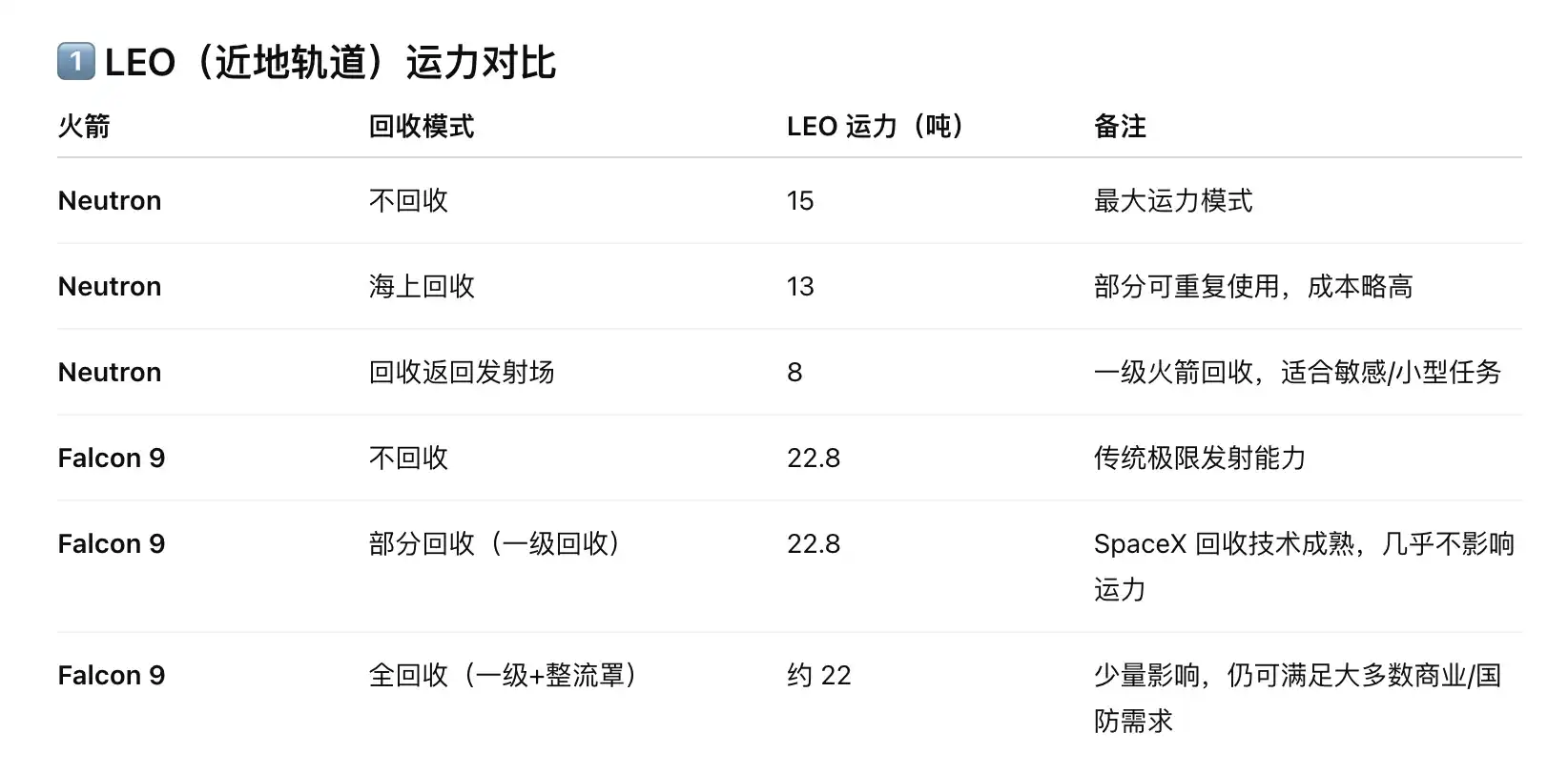
The biggest significance of Neutron's emergence is that it is expected to become the world's only second option that can compete with Falcon 9, although its designed payload capacity (approx. 8-15 tons) is still slightly inferior to Falcon 9. However, in engineering logic, it attempts to achieve a curved overtaking of its predecessor through "late-mover advantages" — with unique designs like the HungryHippo fairing and Archimedes engine, Neutron aims to surpass Falcon 9 in efficiency regarding fairing recovery and engine reusability.
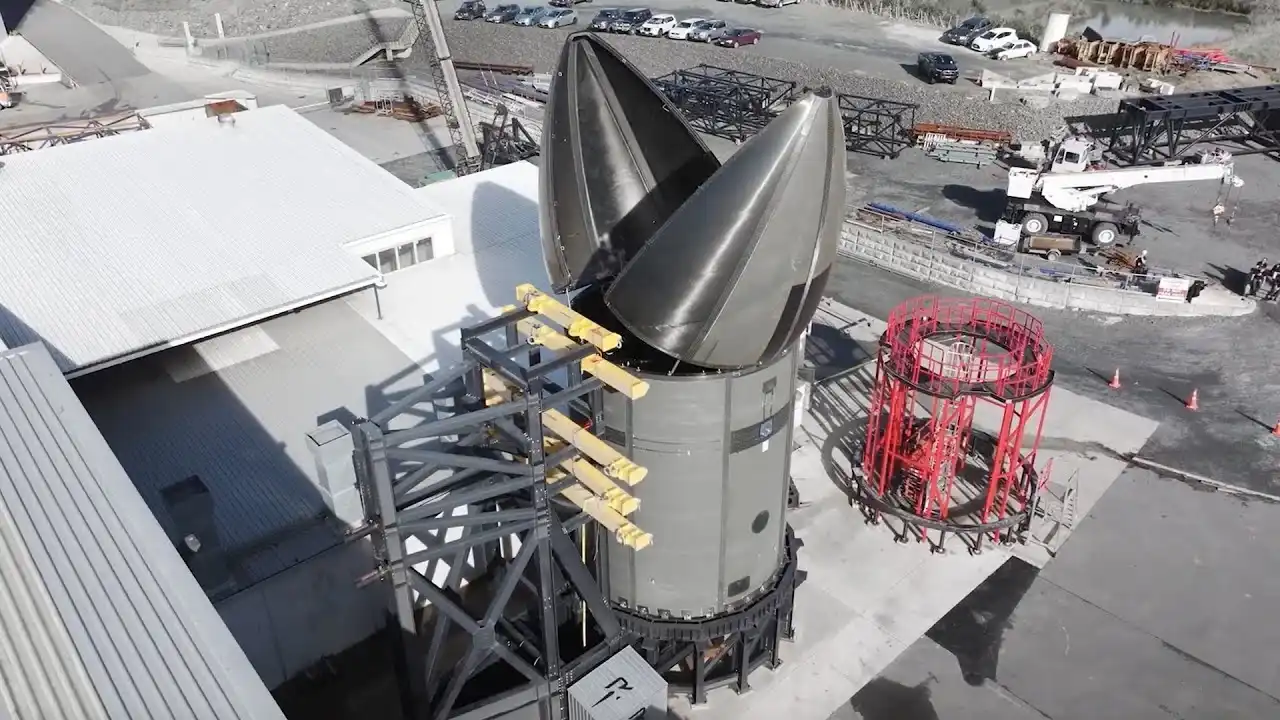
  • Odaily Note: HungryHippo is Neutron's most significant design highlight. Unlike SpaceX, which needs to retrieve millions of dollars worth of fairing debris from the sea after each launch, Neutron's fairing adopts a fixed, non-separating design connected to the first-stage booster. When releasing the second stage, it opens like a "hippopotamus mouth," closes after deployment, and lands with the first stage for recovery. This means the fairing avoids the complex process of at-sea recovery and post-landing reassembly; it's ready for refueling immediately after landing.

Judging from the disclosed testing progress, Rocket Lab is rapidly narrowing the generational gap with SpaceX in medium-to-large launch capabilities.

"Building Rockets" plus "Building Satellites": Replicating SpaceX's Ecological Loop

Just as SpaceX has Starlink, Rocket Lab is also building its own "launch + manufacturing" dual-drive ecosystem. Rocket Lab's "Space Systems" business (covering satellite platforms, laser communication, solar arrays, etc.) currently accounts for nearly 70% of its total revenue. This means that even during Neutron's R&D phase, Rocket Lab can still generate substantial revenue by selling satellite components.

This kind of "full industry chain" business model is almost unique to Rocket Lab in the public market, before SpaceX's own potential listing.

Huge Valuation Gap: A Reflection of Reality and an Investment Opportunity

Currently, SpaceX's private market valuation is as high as $1.75 to $2 trillion, while Rocket Lab's market cap has just surpassed $45 billion. The huge valuation gap objectively reflects the real-world status difference between the two companies, but this is precisely where investors see the most attractive "odds."

In the current global commercial aerospace field, the only company that can stably achieve frequent launches, reusability, high payload capacity, and low costs is SpaceX. Falcon 9's cost advantage has reached a level that makes most competitors despair, and this advantage is gradually forming a terrifying positive spiral — the cheaper, the more launches; the more launches, the more data; the more data, the faster the upgrades; the faster the upgrades, the cheaper it gets... This moat built by scale, data, and pace has left countless latecomers in awe.

But Rocket Lab's opportunity lies in the fact that, currently, Neutron appears to be the most promising reusable medium-to-large rocket to catch up with Falcon 9's pace. "The only choice after SpaceX" — this single label alone is compelling enough. Once Neutron successfully completes its maiden flight, Rocket Lab's valuation logic will completely shift from "a small rocket company" to "the world's second platform company with medium-to-large reusable rocket capability," poised to capture a large number of commercial contracts from SpaceX's hands. Therefore, the current market enthusiasm for Rocket Lab is largely a bet on the success probability of Neutron.

At this point in 2026, with SpaceX having broken through the trillion-dollar valuation ceiling, Rocket Lab, with a market cap of only about 2.5% of SpaceX's, clearly has more room for upside imagination.

Biggest Risk: "Neutron" Hasn't Flown Yet...

But there's still one big suspense — Can Neutron actually fly on schedule?

According to the latest disclosure, Neutron's maiden flight is scheduled for the end of 2026. However, looking back at history, no new rocket launch has ever proceeded without delays. The aerospace industry has a harsh reality — a PPT rocket ≠ a real rocket.

Historically, many rockets never flew; many rockets blew up on their first flight; and many rockets failed in their cost-control designs. Neutron has yet to make its first flight. If Neutron's R&D progress encounters setbacks or its maiden flight is delayed, the current market cap will face severe pressure tests, and even the best story will be hard to continue telling.


Perguntas relacionadas

QWhy is Rocket Lab considered the 'only alternative' to SpaceX in the commercial space sector?

ARocket Lab is seen as the primary alternative to SpaceX because it is replicating SpaceX's proven path to success. It established a viable commercial business with its small Electron rocket and reusability technology, and is now developing the Neutron medium-lift rocket to compete with SpaceX's Falcon 9. Additionally, Rocket Lab operates a dual business model of 'launch + manufacturing' similar to SpaceX's Starlink ecosystem.

QWhat was the market reaction to Rocket Lab's Q1 2026 earnings report?

AFollowing its Q1 2026 earnings report, Rocket Lab's stock (RKLB) rose nearly 7% in after-hours trading. The report showed revenue of $200.3 million, a 63.5% year-over-year increase, surpassing expectations of $189 million, and provided strong Q2 guidance.

QWhat is the key design feature of Rocket Lab's Neutron rocket that aims to surpass the Falcon 9's efficiency?

AA key efficiency feature of the Neutron rocket is its 'HungryHippo' fairing. Unlike SpaceX's fairings which separate and require sea recovery, Neutron's fairing is fixed and non-separating. It opens to release the second stage and then closes, allowing it to be recovered intact with the first stage, eliminating complex recovery and refurbishment processes.

QWhat is the primary risk currently facing Rocket Lab's growth story?

AThe primary risk for Rocket Lab is the development and first launch of its Neutron rocket. Scheduled for late 2026, any significant delays, technical failures, or cost overruns in Neutron's development could severely impact the company's valuation and growth narrative, as much of its future potential is tied to this vehicle.

QHow does Rocket Lab's current valuation compare to SpaceX's, and what opportunity does this present for investors?

ASpaceX's valuation is estimated at $1.75 to $2 trillion, while Rocket Lab's market capitalization is just over $45 billion. This massive gap reflects their current market positions but presents a significant opportunity for investors. If Rocket Lab's Neutron rocket succeeds, the company's valuation could be re-rated from a small-launch provider to the world's second platform with medium-lift reusable rocket capability, offering substantial upside potential.

Leituras Relacionadas

The Foundation of SpaceX's Trillion-Dollar Valuation: Who is Dividing Up Musk's Annual Tens of Billions in Capital Expenditure?

SpaceX's trillion-dollar valuation is built on its three core businesses: Starlink (profitable, 60% of revenue), rockets (driving down launch costs), and AI (a major investment area). This creates a financial cycle: Starlink funds rocket development, which enables low-cost launches for AI hardware, generating future revenue. This cycle fuels annual capital expenditures of tens of billions, flowing to a vast supply chain. Suppliers are categorized by their replaceability. The first group includes irreplaceable players like NVIDIA (GPU/CUDA ecosystem), Eutelsat (critical radio spectrum), Filtronic (specialized amplifiers), Materion (strategic beryllium), and STMicroelectronics (antenna chips). The second group consists of hard-to-replace suppliers due to high switching costs, such as Honeywell (flight control), Carpenter Technology (specialty alloys), Hexcel (carbon fiber), Broadcom (data exchange), and Linde (industrial gases). The third group comprises high-volume, cost-critical suppliers for mass-produced items like Starlink terminals. Key names include Wistron NeWeb (primary manufacturer) and several A-share companies like Shenzhen Sunway (connectors), Pies New Materials (forgings), Western Superconducting (alloys), and Yingliu (castings). Other niche players include Trimble (timing), Astronics (power distribution), and CTS (thermal management). The article argues that investing in these suppliers, rather than SpaceX stock directly, offers an alternative opportunity. The rationale is threefold: procurement is just beginning to scale, SpaceX's IPO brings new transparency to its supply chain, and the situation mirrors early stages of past "super terminal" ecosystems like Apple or Tesla. While risks exist (commodity cycles, geopolitical factors, technology shifts), the core thesis is that SpaceX's massive, ongoing procurement will translate into reliable revenue for its key suppliers, regardless of its own stock price volatility.

marsbitHá 27m

The Foundation of SpaceX's Trillion-Dollar Valuation: Who is Dividing Up Musk's Annual Tens of Billions in Capital Expenditure?

marsbitHá 27m

SpaceX's Trillion-Dollar Valuation Base: Who's Sharing in Musk's Annual Tens of Billions in Capital Expenditure?

**Title: The Foundation of SpaceX's Trillion-Dollar Valuation: Who Benefits from Musk's Annual $100 Billion Capital Expenditure?** This article argues that investors seeking to benefit from SpaceX's growth might find greater opportunities in its supply chain rather than directly investing in the company itself, drawing parallels to historical successes with Apple, Tesla, and NVIDIA suppliers. **SpaceX's Business Model & Cash Flow:** SpaceX generates revenue from three main areas: 1. **Starlink:** Its profitable core, earning $11.3B in 2023 (60% of revenue), funding other ventures. 2. **Rockets (Falcon/Starship):** Requires $3B+ in annual R&D but achieves the world's lowest launch costs. 3. **AI:** Currently unprofitable (-$6B+ in 2023), investing heavily in ground-based supercomputers (220,000 GPUs) and future orbital data centers. The cycle is: Starlink profits → fund cheaper rockets → low-cost launches deploy AI hardware → AI compute rentals generate future revenue. This cycle drives annual procurement spending of tens of billions of dollars. **The Supply Chain Beneficiaries:** Suppliers are categorized by their replaceability: **1. Nearly Irreplaceable (High Barriers to Entry):** * **NVIDIA:** Powers the Colossus supercomputer; its CUDA ecosystem creates immense switching costs. * **Eutelsat (SATS):** Controls critical radio spectrum for satellite communications; holds a ~3% stake in SpaceX. * **Filtronic (FTC):** Supplies millimeter-wave signal amplifiers for Starlink satellites; SpaceX constitutes 83% of its revenue. * **Materion (MTRN):** Global leader in beryllium production, a strategic material used in Starship structures. * **STMicroelectronics (STM):** Supplies phased-array antenna chips for Starlink satellites. **2. Replaceable, but Switching Cost is Prohibitively High:** * **Honeywell (HON):** Provides flight control and inertial navigation systems with decades of certification. * **Carpenter Technology (CRS):** Manufactures ultra-pure specialty steel alloys for Raptor engines. * **Hexcel (HXL):** Supplies custom carbon fiber composites developed over a decade with SpaceX. * **Broadcom (AVGO):** Manages high-speed data switching. * **Linde Group:** Supplies industrial gases (liquid oxygen/nitrogen) from facilities built near SpaceX launch sites. **3. High-Volume, Cost-Critical Manufacturing:** Focuses on mass-producing components like Starlink user terminals (target: 30 million units). * **Key Players:** Wistron NeWeb (6285, primary terminal manufacturer), several Chinese A-share companies (e.g., Sunway Communication, PAX New Materials, Western Metal Materials, Yingliu Co.), and smaller US firms like Trimble (TRMB, timing systems). **Why Now?** Three factors make the supply chain opportunity timely: 1. **Volume Ramp-Up:** SpaceX plans 100 launches in 2026, aims for 30 million Starlink terminals, and will deploy AI data centers, meaning procurement will accelerate. 2. **Increased Transparency:** The IPO provides public financial data, allowing investors to track supplier order growth. 3. **Historical Precedent:** The current phase is likened to Tesla's early mass-production stage (circa 2018), suggesting a long growth runway for suppliers. **Conclusion:** The article posits that while investing in SpaceX stock is betting on Elon Musk's ambitious vision at a high valuation, investing in its established suppliers is a bet on the tangible, recurring revenue from its massive procurement budget, which is largely decoupled from day-to-day stock price volatility.

链捕手Há 31m

SpaceX's Trillion-Dollar Valuation Base: Who's Sharing in Musk's Annual Tens of Billions in Capital Expenditure?

链捕手Há 31m

The U.S. Government Blocked the Anthropic Model. It Wasn't About 'Jailbreaking' at All.

Last Friday, the U.S. Commerce Department issued an enforcement letter that forced Anthropic to take its two most advanced AI models, Fable 5 and Mythos 5, offline. The stated reason was unspecified national security concerns, initially linked to potential "jailbreaks" of the models' safeguards. However, new details suggest the action stemmed more from a deteriorating relationship between the Trump administration and Anthropic, rather than a genuine technical threat. According to reports, the government cited a little-known export control regulation, compelling Anthropic to block access for all non-U.S. persons, including its own international employees. The company complied, shutting down the models without a court order or specific technical details from the government. Cybersecurity expert Katie Moussouris revealed she was privately shown a research paper detailing a potential safeguard bypass in Fable 5. She argued the described method was minor and did not warrant an export ban, stating that attempts to "fix" it would only weaken the model's defensive capabilities. Moussouris and other experts have since called for the order to be revoked, warning it dangerously removes advanced cybersecurity tools from U.S. defenders. Analysts like Justin Hendrix suggest the move appears retaliatory and sets a dangerous precedent, signaling that the U.S. government can unilaterally shut down a tech company's products. The incident has raised concerns about the reliability of American AI and the potential for political interference in the tech industry, serving as a warning to the broader sector.

marsbitHá 34m

The U.S. Government Blocked the Anthropic Model. It Wasn't About 'Jailbreaking' at All.

marsbitHá 34m

Ray Dalio: AI Bull Market Continues to Soar, Should Investors Go All In or Cash Out and Leave the Field?

In his latest notes, Ray Dalio addresses a critical question for investors amid the AI-driven stock market surge: how should one allocate assets during a transformative technological revolution? Dalio emphasizes that technological advancement does not automatically make related stocks attractive. Historical tech cycles—marked by excitement, crowding, volatility, and eventual shakeouts—show that even long-term winners like Microsoft and Apple experienced severe drawdowns. Today's AI sector faces similar uncertainties: overinvestment, intensifying competition, geopolitical tensions (e.g., Taiwan's chip supply), tax policy shifts, anti-AI sentiment, and potential disruption from future technologies like quantum computing. Dalio's core argument focuses on the highly concentrated market structure, where a few tech giants dominate major indices. He warns investors against unknowingly holding concentrated, correlated exposures. Instead of chasing a handful of AI leaders, he advocates for a robust, diversified portfolio of 15 or more high-quality, uncorrelated investments, risk-balanced to match an investor's volatility tolerance. Mathematically, such diversification significantly improves the risk-return ratio—for example, holding 15 uncorrelated assets can boost the ratio by over four times compared to a single concentrated bet. Dalio cautions that future equity returns appear low, with his bubble indicator suggesting real returns could be negative over the next 5-10 years. He stresses that knowing what you don't know is as important as knowing what you do. In an environment of high uncertainty and concentration, avoiding large, concentrated bets on AI stocks is prudent. The optimal strategy is disciplined diversification—the "holy grail" of investing—to navigate this technologically driven cycle with lower risk and comparable or better returns.

marsbitHá 38m

Ray Dalio: AI Bull Market Continues to Soar, Should Investors Go All In or Cash Out and Leave the Field?

marsbitHá 38m

Trading

Spot
Futuros
活动图片