Author: Sanqing, Foresight News
On July 1, the U.S. Office of Government Ethics (OGE) released President Trump's 2025 annual financial disclosure report (OGE Form 278e), his first annual filing since his second term, spanning 927 pages. The OGE is a federal agency within the executive branch established by the Ethics in Government Act of 1978. It oversees the conduct of over 4 million federal officials and employees, preventing conflicts of interest, with annual financial disclosures being a core regulatory tool. Foresight News has tallied all identifiable cryptocurrency holdings and cash flow items from the original disclosure, with the total accountable income amounting to approximately $1.427 billion.
This report was released against the backdrop of a downturn in the crypto market—Bitcoin prices have fallen over 50% from last autumn's all-time high, putting widespread pressure on the industry. The President's personal crypto wealth expanded against the trend, forming a stark contrast with the industry's overall contraction. Vice President Vance's (JD Vance) concurrently disclosed personal assets also included, for the first time, a Bitcoin holding, with a disclosed value range of $250,000 to $500,000.
The Crypto Ledger in the Disclosure
Trump's crypto assets are scattered across four related entities, with each holding and cash flow recorded down to the single digit in the original report. All details below are from the original OGE Form 278e.
CIC Digital LLC (the operating entity for the memecoin business, 100% held by the "Donald J. Trump Revocable Trust"): The books show holdings include a USDC cold wallet valued between $5 million and $25 million, an Ethereum cold wallet valued between $5 million and $25 million, and a Bitcoin cold wallet valued at over $50 million. In 2025, this entity received $635,068,835 in royalties through the "Celebration Coins" token licensing agreement, $493,846 through a sub-licensing agreement with JBCZ Group LLC, $510,808 from Ethereum staking rewards, and $45,932 in USDC cold wallet interest, totaling approximately $636 million.
DT Marks Defi LLC (formerly DT Tower II LLC, holds a 38.25% stake in WLF Holdco LLC, the controlling entity of World Liberty Financial, with the Trump family collectively holding 30%): The books show holdings include an Ethereum cold wallet valued at over $50 million, a Bitcoin cold wallet valued at over $50 million, and multi-currency cold wallets including Chainlink (LINK) valued between $500,000 and $1 million, Aave (AAVE) valued between $1 million and $5 million, among others.
In 2025, this entity received a net gain of $65,625,000 from the sale of WLF Holdco equity and received cash and various token proceeds from World Liberty Financial's token sales: the Ethereum wallet received $150,606,931, the USDC wallet received $56,036,445, USD cash received $42,250,000, the Bitcoin wallet received $33,462,160, and long-tail tokens like LINK, AAVE, ENA, MOVE, ONDO collectively received $8,204,785, with an additional $1,821,628 from Ethereum staking rewards and $6,995 in USDC interest. This entity's total annual income reached approximately $594 million.
DTTM Operations LLC: Directly holds 15.75 billion World Liberty Financial governance tokens, recorded under the Ethereum wallet item, with a disclosed value range of "over $50 million".
DT Marks SC LLC: Holds a 38.25% stake in Stablecoin Holdco LLC, receiving $196,875,000 in dividends in 2025. Investors in this stablecoin company include Abu Dhabi's Sheikh Tahnoon bin Zayed Al Nahyan.
Beyond directly held tokens and tokenized income, Trump also holds Coinbase (COIN) Class A shares through multiple personal investment accounts, with purchase frequency noticeably higher than sales in 2025, with a single highest purchase amount reaching the $250,000 to $500,000 range; he also holds shares in Coreweave, a Bitcoin miner transitioning into an AI company.
He also holds shares in other crypto-involved enterprises like CME, Block Inc., Intercontinental Exchange (parent company of NYSE), Robinhood, Strategy, and Bitcoin miner CleanSpark. Among these, the Robinhood holding is the largest, reaching the $250,000 to $500,000 range in a single account.
Additionally, associated with Trump is an NFT income under First Lady Melania's name. Her MKT World LLC, through a licensing agreement with Designers Manager selling NFTs and other collectibles, had a net income of $6,011,259 in 2025; this income is registered under "Part 5: Spouse's Assets" on the disclosure form, separate from the crypto assets held by Trump himself.
In contrast, Vance's disclosure is much simpler. His personal asset list includes only one crypto holding—a Coinbase account holding Bitcoin, with a disclosed value range of $250,000 to $500,000, generating no other crypto-related income for the year.
Issuers Reap Profits in All Conditions, Retail Investors Bear the Losses Alone
Trump's crypto wealth does not come from passive holding but from his direct position as an issuer. CIC Digital LLC is both the licensor of the memecoin and the direct recipient of royalties; DT Marks Defi LLC is both a shareholder in World Liberty Financial's controlling entity and the direct beneficiary of token sale cash flows.
He is not "investing" in cryptocurrency; he is "issuing" cryptocurrency.
This issuer-position revenue model bears almost no downside risk. The Trump-named token was issued on the Solana blockchain just days before his January 2025 inauguration, once surging to around $74 before falling continuously, currently trading around $1.68.
According to data cited by the X platform account MeidasTouch, approximately 764,000 wallet addresses have incurred losses on this token. Trump himself, from royalty income alone, received $635 million.
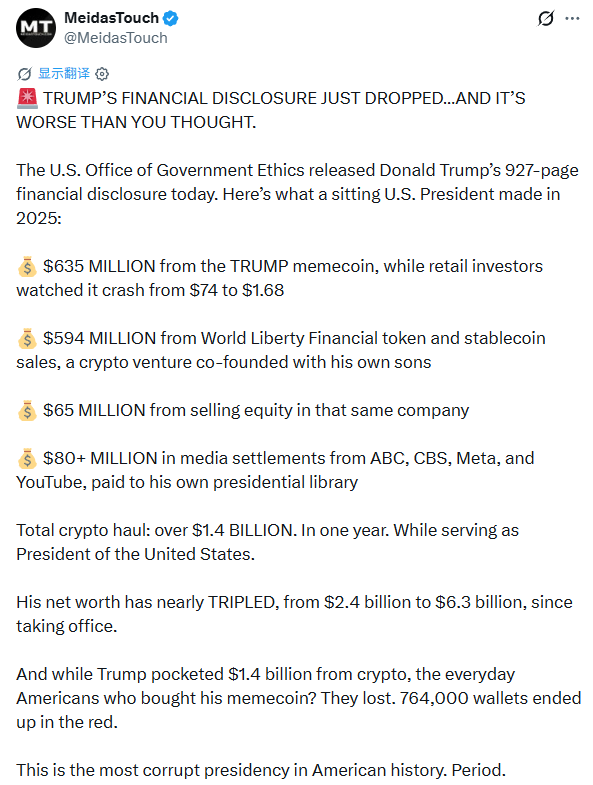
MeidasTouch called it "the most corrupt presidential term in American history," a statement carrying strong political bias, but it points to a real issue. When the issuer's income comes from the trading activity itself rather than the project's long-term value, retail investors are naturally at a disadvantage.
Regulator and Beneficiary as One
The timing of this disclosure coincides with a critical phase of negotiations in the Senate for the most important legislative process in the U.S. crypto industry, the "CLARITY Act." This bill aims to clarify the standards for determining the security status of assets like Bitcoin and Ethereum, but the ethics provision prohibiting the President, Vice President, members of Congress, and their families from holding or benefiting from crypto businesses has yet to be resolved in the negotiations.
Democratic lawmakers have been pushing to include this clause in the final text, citing the issues exposed by this disclosure. Incumbent high-ranking officials should not simultaneously be the biggest beneficiaries of the industry they regulate.
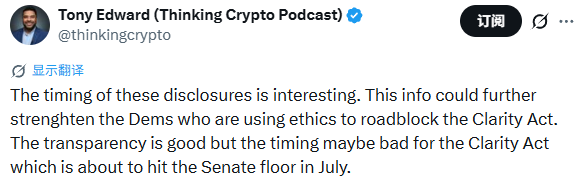
According to comments by Thinking Crypto podcast host Tony Edward on X, the timing of this disclosure's release is "rather delicate," potentially further strengthening the Democrats' leverage to block the bill's progress on ethical grounds; organizations like Transparency International have also consistently criticized the bill for lacking conflict-of-interest provisions.
In contrast, Vance's disclosed $250,000 to $500,000 Bitcoin holding is closer to the level of an ordinary high-net-worth individual investor. The controversy illustrates that the core issue is not "whether officials can hold crypto assets," but "whether the President's family directly operates, issues, and extracts fees from the entities under regulation."
Whether the "CLARITY Act" can incorporate conflict-of-interest provisions within the remaining window will directly determine whether the model of "regulator and beneficiary as one" is merely a unique case of the Trump administration or will become the norm for the long-term coexistence of the crypto industry and power structures in the future.