White House Pushes for Fast Crypto Deal as Senate Window Narrows and $1B Liquidations Rock Markets

bitcoinistPublicado em 2026-01-22Última atualização em 2026-01-22

Resumo

The White House is urging U.S. lawmakers to quickly pass crypto market structure legislation as the Senate faces challenges in securing bipartisan support. Patrick Witt, a key advisor, warns that delays could lead to harsher future policies and that legislation is inevitable. The push comes amid political pressure from upcoming midterm elections, which could further complicate legislative efforts. Meanwhile, crypto markets experienced significant turmoil with over $1 billion in liquidations, primarily from long positions in Bitcoin and Ethereum, amid falling prices and tightening global liquidity.

The White House is urging U.S. lawmakers to move quickly on legislation to reform the crypto market structure as political timelines tighten and digital asset markets face renewed volatility.

With the Senate struggling to secure bipartisan support and more than $1 billion in recent crypto liquidations, officials say the window for passing a workable regulatory framework may be closing.

Patrick Witt, executive director of the President’s Council of Advisors for Digital Assets, has warned that expecting the crypto industry to operate without clear rules is unrealistic. He argues that some form of legislation is “inevitable” and that delays could leave the sector exposed to harsher policies in the future.
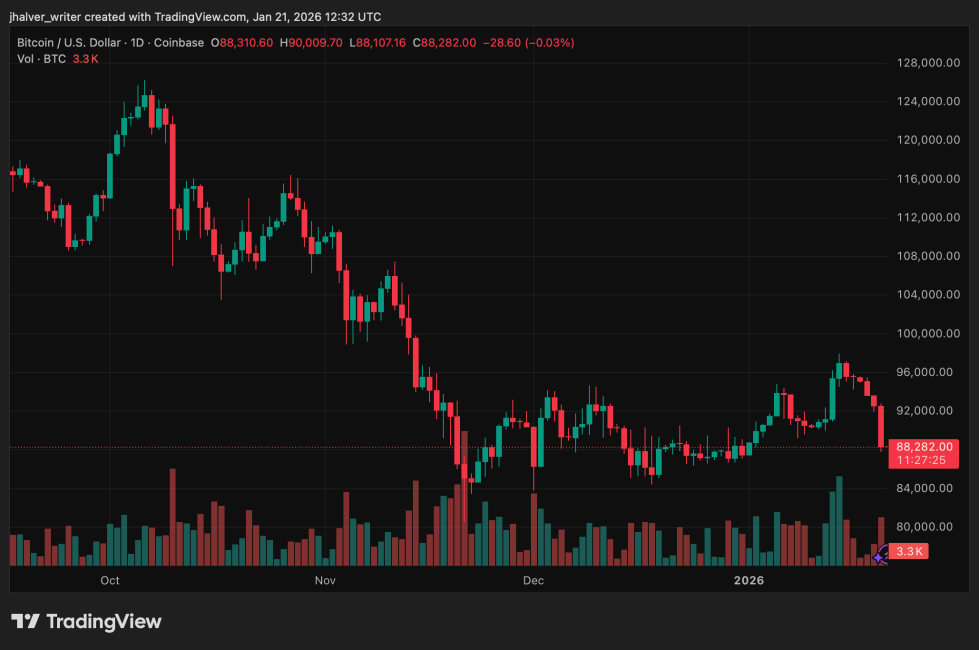
BTC's price trends to the downside on the daily chart. Source: BTCUSD on Tradingview

White House Presses for Action on Crypto Rules

The proposed Senate bill would define how the Securities and Exchange Commission (SEC) and the Commodity Futures Trading Commission (CFTC) oversee crypto markets, including stablecoins and decentralized finance protocols. However, disagreements over key provisions have slowed progress.

Both the Senate Banking and Agriculture Committees recently postponed markups as lawmakers worked to resolve disputes and gather enough support to advance the bill. Witt has been blunt in his message to the industry: accept compromise now or risk facing a less favorable outcome later.

He criticized Coinbase CEO Brian Armstrong for withdrawing support for the current version of the bill, after Armstrong said the company would “rather have no bill than a bad bill.”

Midterm Elections Add Pressure

The push for speed is also tied to the November U.S. midterm elections, which could reshape Congress. All House seats and 35 Senate seats are up for grabs, and polling and prediction markets suggest Democrats have a strong chance of flipping the House.

A divided Congress would likely slow or stall crypto legislation altogether. Witt has cautioned that the political alignment needed to pass a market structure bill may not be in place after the elections, making the coming months critical for any deal.

$1B Liquidations Highlight Market Stress

The policy debate comes as markets reel from a sharp deleveraging event. Today, more than 182,000 traders were liquidated in a single day, with total losses of over $1.08 billion. Most of the damage came from long positions in Bitcoin and Ethereum, as falling prices triggered cascading margin calls across major exchanges.

Bitcoin alone saw over $427 million in long liquidations, while Ethereum accounted for roughly $374 million. Technical indicators show many altcoins trading with RSI levels below 50, suggesting continued selling pressure.

Rising Japanese bond yields and renewed global risk-off sentiment have also tightened liquidity, prompting investors to shift away from volatile assets like crypto. Although Bitcoin later stabilized near $90,000, analysts say the recent rebound looks more like a pause after forced selling than a clear return to bullish momentum.

Cover image from ChatGPT, BTCUSD chart on Tradingview

Criptomoedas em alta

Perguntas relacionadas

QWhy is the White House urging lawmakers to move quickly on crypto legislation?

AThe White House is pushing for speed due to tightening political timelines from the upcoming midterm elections and renewed market volatility, warning that the window for passing a workable regulatory framework may be closing.

QWhat is the main obstacle to passing the crypto market structure bill in the Senate?

AThe main obstacle is a lack of bipartisan support, with disagreements over key provisions causing postponed markups in committees as lawmakers work to resolve disputes.

QHow did Patrick Witt of the President’s Council respond to Coinbase CEO Brian Armstrong's stance on the bill?

APatrick Witt criticized Brian Armstrong for withdrawing support, after the Coinbase CEO said the company would 'rather have no bill than a bad bill.' Witt argued that accepting a compromise now is better than risking a less favorable outcome later.

QWhat event caused over $1 billion in crypto liquidations and which assets were most affected?

AA sharp deleveraging event caused over $1.08 billion in liquidations, with the majority of losses coming from long positions in Bitcoin ($427M) and Ethereum ($374M) as falling prices triggered margin calls.

QHow could the November midterm elections impact the future of crypto legislation?

AThe elections could reshape Congress, and if Democrats flip the House as predicted, it would likely result in a divided Congress that could slow or stall crypto legislation altogether, making the current political alignment critical for any deal.

Leituras Relacionadas

Annual Salary of Millions Competing for Electricians, Meta Rushes to Open Its Own Technical School

The AI boom is facing an unexpected bottleneck: a severe shortage of skilled construction workers and electricians. As tech giants like Meta, OpenAI, and Alphabet race to build massive data centers—such as OpenAI's $16 billion "Stargate" project—they are hitting a critical labor wall. The U.S. needs an estimated 130,000 more electricians, 240,000 construction workers, and 150,000 supervisors by 2030 for AI infrastructure alone, but tens of thousands of electrician jobs go unfilled each year. While AI companies offer high premiums, with electricians earning up to $280,000 annually, worker scarcity still causes massive losses—delays on a single project can cost $14.2 million per month. The complexity of building AI data centers, which require immense power (equivalent to powering hundreds of thousands of homes), sophisticated electrical systems, and advanced liquid cooling solutions, demands highly skilled technicians who are in short supply. To combat this, companies are investing heavily in training. Meta has committed $115 million to a free training school offering tuition, housing, and stipends, targeting 5,000 new workers. OpenAI is partnering with unions to secure skilled labor. These efforts are paying off, with a significant rise in Gen Z interest in trade schools over college. However, the power demands are staggering. AI data centers are driving a rapid surge in electricity consumption, projected to account for up to 12% of U.S. power use by 2028 and raising costs for consumers. Furthermore, the construction boom is project-based, leading to a potential future glut of trained workers once building peaks, which could depress wages industry-wide. The race for AI supremacy now depends as much on skilled hands as on advanced chips.

marsbitHá 7m

Annual Salary of Millions Competing for Electricians, Meta Rushes to Open Its Own Technical School

marsbitHá 7m

OpenAI No Longer Sells Its Most Expensive Model for Profit

OpenAI is shifting its business strategy away from promoting its most expensive, flagship models for every task. Recent price cuts—80% for GPT-5.6 Luna and 20% for Terra—signal a deeper change: the company now actively advises users that many tasks don't require the most powerful model. Instead, OpenAI recommends a tiered approach: use the high-end GPT-5.6 Sol for complex planning and analysis, then delegate execution to cheaper models like Luna. This mirrors moves by Anthropic, which recently launched Claude Opus 5 at half the price of its top model, Fable 5. Both companies are de-emphasizing flagship models as primary revenue drivers, using them instead for brand prestige and technological showcases. The industry is entering a "mass-market" phase, similar to automotive, where high-volume, cost-effective models handle daily operations and drive scale. OpenAI's price reductions are partly enabled by AI models themselves optimizing underlying code and infrastructure, creating a self-reinforcing cycle of efficiency gains and cost reduction. Competition is shifting from "who is smartest" to "who offers the best value." The goal is no longer selling individual models but fostering widespread API adoption and ecosystem lock-in. By making AI calls cheap and ubiquitous, companies like OpenAI aim to become the indispensable, utility-like infrastructure powering automated workflows—the "water and electricity" of software, quietly embedded everywhere.

marsbitHá 7m

OpenAI No Longer Sells Its Most Expensive Model for Profit

marsbitHá 7m

Will the Fed Definitely Raise Interest Rates in September? How Will Crypto and U.S. Stocks Withstand the Pressure?

The market's expectation for a September Fed rate hike surged dramatically in early August, jumping from under 50% to over 80% within a week. This shift followed a contentious July FOMC meeting, where a 9-3 vote to hold rates revealed growing dissent from hawkish members advocating for an immediate hike to combat persistent inflation. The primary catalyst for this repricing is rising oil prices, driven by renewed geopolitical tensions around the Strait of Hormuz, which threaten global supply. Energy costs directly influence inflation metrics, making the upcoming July CPI report (due August 12th) a critical data point. If it shows inflation reaccelerating, the probability of a September hike will solidify. For Bitcoin and crypto assets, this is typically bearish news. Bitcoin continues to behave as a high-beta, liquidity-sensitive risk asset. A rate hike raises the opportunity cost of holding non-yielding assets and could drive capital toward money markets, pressuring crypto prices in the short term. However, historical patterns suggest that if a hike is perceived as the end of a tightening cycle rather than the start, any negative price impact may be brief. U.S. stocks, particularly crypto-linked equities like Coinbase and growth-oriented tech stocks, are also vulnerable. Higher rates increase discount rates in valuation models, putting pressure on high-multiple companies. This coincides with a pivotal tech earnings season where investor focus has shifted from massive AI capital expenditure to tangible revenue and cash flow generation. Companies with negative cash flow and weak growth narratives could face heightened volatility if borrowing costs rise in September. In summary, a September Fed hike has evolved into a mainstream market scenario. Key factors to watch are oil prices, the July CPI report, and Fed communications, which will determine the final decision and its impact on volatile crypto and equity markets.

marsbitHá 18m

Will the Fed Definitely Raise Interest Rates in September? How Will Crypto and U.S. Stocks Withstand the Pressure?

marsbitHá 18m

Trading

Spot

Artigos em Destaque

Como comprar HOUSE

Bem-vindo à HTX.com!Tornámos a compra de Housecoin (HOUSE) simples e conveniente.Segue o nosso guia passo a passo para iniciar a tua jornada no mundo das criptos.Passo 1: cria a tua conta HTXUtiliza o teu e-mail ou número de telefone para te inscreveres numa conta gratuita na HTX.Desfruta de um processo de inscrição sem complicações e desbloqueia todas as funcionalidades.Obter a minha contaPasso 2: vai para Comprar Cripto e escolhe o teu método de pagamentoCartão de crédito/débito: usa o teu visa ou mastercard para comprar Housecoin (HOUSE) instantaneamente.Saldo: usa os fundos da tua conta HTX para transacionar sem problemas.Terceiros: adicionamos métodos de pagamento populares, como Google Pay e Apple Pay, para aumentar a conveniência.P2P: transaciona diretamente com outros utilizadores na HTX.Mercado de balcão (OTC): oferecemos serviços personalizados e taxas de câmbio competitivas para os traders.Passo 3: armazena teu Housecoin (HOUSE)Depois de comprar o teu Housecoin (HOUSE), armazena-o na tua conta HTX.Alternativamente, podes enviá-lo para outro lugar através de transferência blockchain ou usá-lo para transacionar outras criptomoedas.Passo 4: transaciona Housecoin (HOUSE)Transaciona facilmente Housecoin (HOUSE) no mercado à vista da HTX.Acede simplesmente à tua conta, seleciona o teu par de trading, executa as tuas transações e monitoriza em tempo real.Oferecemos uma experiência de fácil utilização tanto para principiantes como para traders experientes.

443 Visualizações TotaisPublicado em {updateTime}Atualizado em 2026.06.02

Como comprar HOUSE

Discussões

Bem-vindo à Comunidade HTX. Aqui, pode manter-se informado sobre os mais recentes desenvolvimentos da plataforma e obter acesso a análises profissionais de mercado. As opiniões dos utilizadores sobre o preço de HOUSE (HOUSE) são apresentadas abaixo.

活动图片













