White House Crypto Advisor Fires Back At Bank CEOs In Stablecoin Rewards Clash

bitcoinistPublicado em 2026-05-11Última atualização em 2026-05-11

Resumo

As a key crypto market structure bill nears a markup, the White House's top crypto advisor has criticized bank CEOs for reigniting a debate over stablecoin rewards. This follows a letter from American Bankers Association CEO Rob Nichols urging bank executives to pressure lawmakers to revise the CLARITY Act, claiming its current language inadequately prevents crypto firms from offering "interest-like rewards" on payment stablecoins, which could risk bank deposits and financial stability. The bill prohibits interest-equivalent payments but allows rewards for specific activities like staking. Patrick Witt, a White House digital assets advisor, rebuked the banking CEOs for refusing to attend White House mediation meetings on this issue, which has delayed the bill for months. While Senate sources suggest the banking lobby's push is weak and the committee is focused on other bill aspects, the debate could resurface when the legislation reaches the full Senate.

As the highly anticipated markup of the crypto market structure bill approaches, the White House’s top crypto advisor has slammed the banking industry’s CEOs amid efforts to reopen the stablecoin rewards debate.

ABA CEO Urges Banks To Block Stablecoin Rewards

On Sunday, the American Bankers Association (ABA)’s CEO, Rob Nichols, sent a letter urging bank executives to push lawmakers to revisit the language on the crypto market structure bill, known as the CLARITY Act, ahead of its Thursday markup.

Nichols affirmed that he was “reaching out to make every bank leader in this country aware of an urgent advocacy fight that requires your immediate engagement,” adding that he wants Congress to establish digital asset rules and responsible guardrails for the crypto industry.
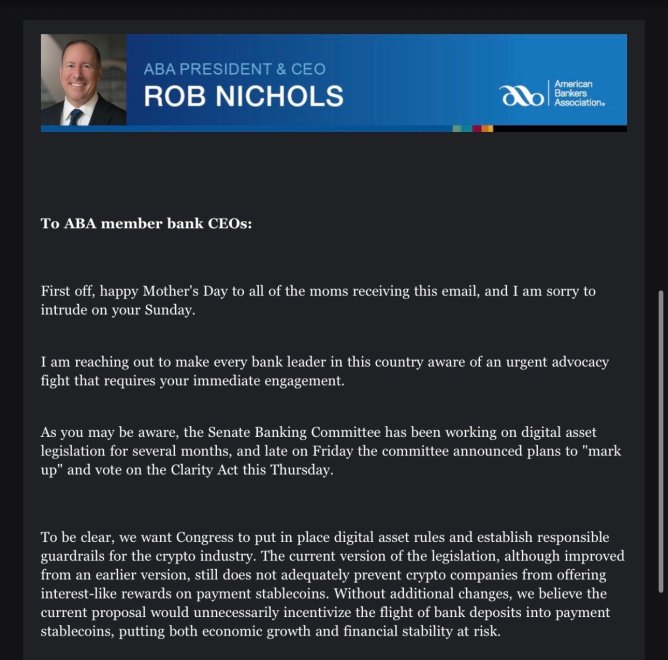
Nichols letter to bank executives. Source: Brendan Pedersen on X

However, he considers that the latest version of the bill “still does not adequately prevent crypto companies from offering interest-like rewards on payment stablecoins,” which would “unnecessarily incentivize the flight of bank deposits into payment stablecoins, putting both economic growth and financial stability at risk.”

“We believe the committee members may not be fully aware of the risks to the economy posed by the stablecoin loophole. Your immediate engagement can make a difference,” Nichols’ letter read.

For context, the latest version of the CLARITY Act prohibits any activity “economically or functionally equivalent to the payment of interest or yield on an interest-bearing bank deposit” on payment stablecoins.

Nonetheless, the text allows for payment of rewards tied to bona fide activities, including staking, transaction activity, or liquidity provision, aiming to promote a “buy and user” approach.

Last Friday, US banking trade groups, including ABA, sent a letter asking senators to amend the stablecoin yield compromise ahead of the markup, arguing that the language on the current version of the legislation still leaves room for rewards programs that could effectively replicate yield.

White House Crypto Advisor Slams CEOs For Skipping Yield Talks

Patrick Witt, executive director of the US President’s Council of Advisors on Digital Assets, fired back at Nichols and other banking industry CEOs for their recent push to revisit the Senate Banking Committee’s compromise on Stablecoin yield and rewards.

In an X post, Witt reacted to the recent letters, affirming that he had specifically requested that Nichols and other bank trade CEOs attend the White House’s meetings to mediate the stablecoin yield dispute, but that they refused.

As reported by Bitcoinist, the White House held multiple meetings to resolve the disagreement between the crypto and banking industries, which has delayed a vote on the legislation for four months.

Some reports at the time noted that no individual bank representatives attended the February meeting, but that the sector was represented through trade associations, including ABA, the Banking Policy Institute (BPI), and the Independent Community Bankers of America (ICBA).

“I guess the White House was beneath them?” the crypto advisor wrote on Monday. “In their defense, I wouldn’t want to have to defend their position in public either.”

Meanwhile, Senate sources have told journalist Eleanor Terret that the banking trade group effort was “pretty milquetoast,” adding that Committee members have already shifted their focus to wrapping up other outstanding issues in the bill, such as ethics language, which may complicate the sector’s efforts to reopen the debate.

“Still, the issue could resurface once the legislation reaches the Senate floor, where the banking groups may try to win over senators not on the Banking Committee,” Terret pointed out.
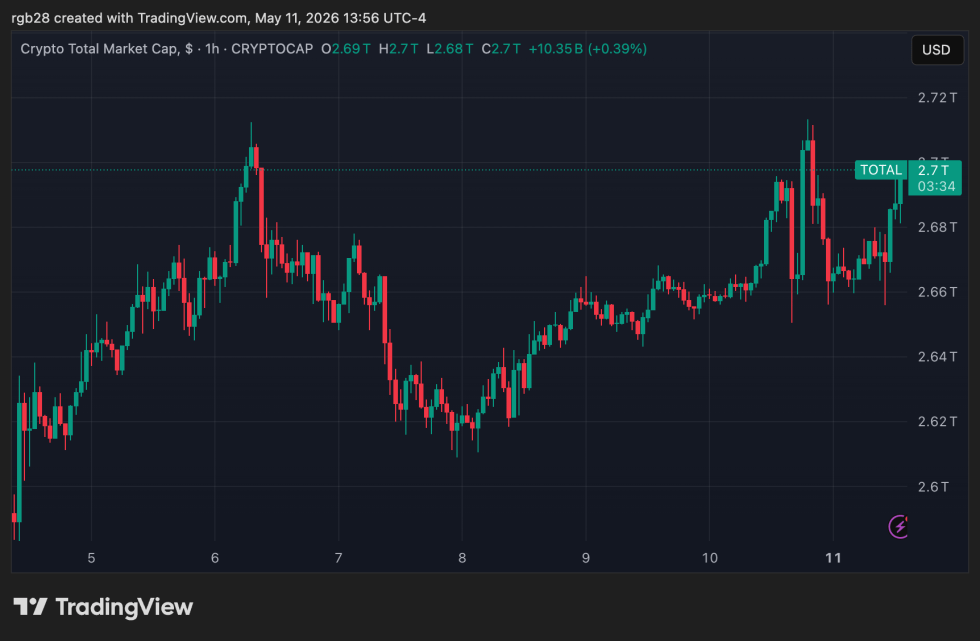
The total crypto market capitalization is at $2.7 trillion in the one-week chart. Source: TOTAL on TradingView


Perguntas relacionadas

QWhat is the main concern raised by ABA CEO Rob Nichols regarding the latest version of the CLARITY Act?

ARob Nichols's main concern is that the latest version of the bill does not adequately prevent crypto companies from offering interest-like rewards on payment stablecoins. He argues this could incentivize the flight of bank deposits into stablecoins, putting economic growth and financial stability at risk.

QHow did Patrick Witt, the White House crypto advisor, respond to the banking industry CEOs' efforts to revisit the stablecoin yield compromise?

APatrick Witt criticized the banking industry CEOs, noting that he had specifically requested they attend White House meetings to mediate the stablecoin yield dispute, but they refused. He suggested they avoided defending their position in public.

QWhat does the current text of the CLARITY Act allow regarding rewards on payment stablecoins?

AThe current text of the CLARITY Act prohibits activities economically equivalent to paying interest on bank deposits for payment stablecoins. However, it allows for rewards tied to bona fide activities such as staking, transaction activity, or liquidity provision.

QAccording to the article, what has delayed a vote on the crypto market structure legislation?

AA vote on the legislation has been delayed for four months due to the disagreement between the crypto and banking industries over the issue of stablecoin yields and rewards.

QWhat is the perspective of Senate sources, as reported by journalist Eleanor Terret, on the banking trade groups' latest effort?

ASenate sources described the banking trade group's effort as 'pretty milquetoast.' They added that Committee members have shifted focus to other outstanding issues in the bill, such as ethics language, which may complicate efforts to reopen the stablecoin debate.

Leituras Relacionadas

Ten-Thousand-Word Analysis: From $10 to $290, MRVL Wins the Entire AI Era by 'Not Making GPUs'

Marvell Technology's stock price surged from under $10 in 2016 to a record $290 in June 2026, fueled not by making GPUs, but by dominating AI infrastructure connectivity. This analysis argues the market misvalues MRVL as merely a smaller Broadcom in custom AI chips, overlooking its true, unique position. Marvell's core strength lies in enabling high-speed data flow for AI clusters through three interconnected businesses. First, it holds a commanding ~70% market share in high-speed optical DSPs (essential for data center light modules), a deep-moat business with accelerating growth. Second, its custom AI chip design business serves hyperscalers like AWS, Microsoft, and Google, with a significant revenue pipeline despite lower margins. Third, stable cash flows come from Ethernet switch chips and enterprise storage controllers. Together, they form a full-stack "AI data movement" platform. CEO Matt Murphy's transformative leadership since 2016, involving strategic divestments, key acquisitions (like Inphi for optical DSPs), and securing long-term agreements with major cloud providers, repositioned the company. A pivotal $2 billion strategic investment from NVIDIA in 2026 underscored Marvell's critical role in the AI ecosystem, particularly through collaborations like NVLink Fusion. While Marvell faces risks—including client concentration (losing the Amazon Trainium3 design), lower-margin business mix, competitive threats, insider selling, and complex supply chains—its fundamentals remain strong. The optical interconnect moat is widening with the acquisition of Celestial AI (photonics fabric), and financial metrics show accelerating revenue growth and operating leverage. With a PEG ratio suggesting undervaluation relative to its growth, the thesis is that the market undervalues Marvell's monopolistic position in AI "plumbing" while overemphasizing its competitive custom chip segment. The story transcends investing, symbolizing how in any complex system—from the internet to AI—the value of "connection" ultimately surpasses that of individual "nodes."

marsbitHá 15m

Ten-Thousand-Word Analysis: From $10 to $290, MRVL Wins the Entire AI Era by 'Not Making GPUs'

marsbitHá 15m

AI Relay Stations Spark Heated Debate on Zhihu: Behind Cheap Tokens, What Are Users Really Worried About?

A discussion on Zhihu about "AI relay stations" shifted the niche developer topic of "cheap tokens" into broader user awareness. Users moved beyond simply questioning the legitimacy of these services to focus on practical concerns: Where do cheap tokens truly come from? Is the model being accessed the real one? Can relay stations see prompts, code, and API keys? For occasional users, are the risks worth it? The core debate centered less on price and more on trust. A primary worry is model authenticity—the risk of "model swapping," where users paying for a premium model might be routed to a cheaper one, creating an information asymmetry. Others argued that cost comparisons matter; while cheaper than official pay-as-you-go APIs, relay stations may not be the lowest-cost option versus subscriptions, domestic models, or free tiers, making user needs assessment crucial. Speculation about token sources ranged from legitimate bulk discounts to gray-area methods like account sharing or exploiting regional pricing. This opacity makes risk assessment difficult for users. Data security emerged as a critical concern, especially for enterprise use. When processing sensitive information like code, contracts, or client data, the inability to verify a relay station's data handling, retention, or access policies poses significant compliance and confidentiality risks. The evolving consensus suggests relay stations can be used cautiously for low-sensitivity, disposable tasks (e.g., summarizing public info, simple translation). However, they should not be the default for sensitive, professional, or production workflows involving proprietary data, Agents, or automated systems. Recommendations include avoiding large prepayments, not relying on a single service, using test prompts to monitor quality, anonymizing data where possible, and keeping official channels as backups. Ultimately, the discussion framed tokens not just as a billing unit but as a measure of real cost encompassing price, model integrity, data security, and service stability. The popularity of relay stations highlights user demand for affordable access, but the debate underscores a key trade-off: the savings from cheap tokens may come at the price of trust, transparency, and control over one's data and AI experience.

marsbitHá 45m

AI Relay Stations Spark Heated Debate on Zhihu: Behind Cheap Tokens, What Are Users Really Worried About?

marsbitHá 45m

In-Depth Research Report on TradFi: The Convergence Wave of Crypto and Traditional Finance

In 2026, the crypto industry is undergoing a profound infrastructure-level transformation—TradFi assets are migrating on-chain at an unprecedented pace. According to CoinGecko's Q1 2026 report, the total value locked (TVL) of tokenized real-world assets (RWA) has surpassed $31 billion, a nearly 4x increase from $7.8 billion at the beginning of 2025, with the sector’s aggregate market capitalization reaching $19.3 billion. Among these, the market cap of tokenized stocks surged from $2 million to $486 million, with Q1 spot trading volume reaching $15.1 billion—a single quarter already surpassing the entire second half of 2025. RWA perpetual contract Q1 trading volume reached a staggering $524.8 billion, far exceeding the $313 billion for all of 2025. Meanwhile, BlackRock's BUIDL fund has reached $2.3 billion in scale and has filed for two new tokenized funds, signaling that the world's largest asset manager's tokenization strategy is evolving from pilot to product suite expansion. HTX, as a core participant in the crypto exchange sector, officially launched TradFi perpetual futures products including NVDA, AAPL, MSFT, META, and SPY in 2026, enabling crypto users to gain 24/7 trading access to core U.S. equities. Boston Consulting Group predicts that global tokenized asset scale could reach $16 trillion by 2030, while McKinsey offers a conservative estimate of approximately $2 trillion. The on-chain migration of TradFi assets is no longer a "future narrative" but a structural transformation unfolding in real time, as crypto exchanges evolve from single crypto asset trading platforms toward "multi-asset-class trading infrastructure."

HTX LearnHá 47m

In-Depth Research Report on TradFi: The Convergence Wave of Crypto and Traditional Finance

HTX LearnHá 47m

Trading

Spot
Futuros

Artigos em Destaque

Como comprar HOUSE

Bem-vindo à HTX.com!Tornámos a compra de Housecoin (HOUSE) simples e conveniente.Segue o nosso guia passo a passo para iniciar a tua jornada no mundo das criptos.Passo 1: cria a tua conta HTXUtiliza o teu e-mail ou número de telefone para te inscreveres numa conta gratuita na HTX.Desfruta de um processo de inscrição sem complicações e desbloqueia todas as funcionalidades.Obter a minha contaPasso 2: vai para Comprar Cripto e escolhe o teu método de pagamentoCartão de crédito/débito: usa o teu visa ou mastercard para comprar Housecoin (HOUSE) instantaneamente.Saldo: usa os fundos da tua conta HTX para transacionar sem problemas.Terceiros: adicionamos métodos de pagamento populares, como Google Pay e Apple Pay, para aumentar a conveniência.P2P: transaciona diretamente com outros utilizadores na HTX.Mercado de balcão (OTC): oferecemos serviços personalizados e taxas de câmbio competitivas para os traders.Passo 3: armazena teu Housecoin (HOUSE)Depois de comprar o teu Housecoin (HOUSE), armazena-o na tua conta HTX.Alternativamente, podes enviá-lo para outro lugar através de transferência blockchain ou usá-lo para transacionar outras criptomoedas.Passo 4: transaciona Housecoin (HOUSE)Transaciona facilmente Housecoin (HOUSE) no mercado à vista da HTX.Acede simplesmente à tua conta, seleciona o teu par de trading, executa as tuas transações e monitoriza em tempo real.Oferecemos uma experiência de fácil utilização tanto para principiantes como para traders experientes.

284 Visualizações TotaisPublicado em {updateTime}Atualizado em 2026.06.02

Como comprar HOUSE

Discussões

Bem-vindo à Comunidade HTX. Aqui, pode manter-se informado sobre os mais recentes desenvolvimentos da plataforma e obter acesso a análises profissionais de mercado. As opiniões dos utilizadores sobre o preço de HOUSE (HOUSE) são apresentadas abaixo.

活动图片












