When Will Solana Price Surge To $360? Analyst Shares Possible Timeline

bitcoinistPublicado em 2026-04-01Última atualização em 2026-04-01

Resumo

Crypto analyst Celal Kucuker has presented a technical analysis suggesting Solana (SOL) could eventually surge to $360, a 333% increase from its current price of around $83. His forecast, however, anticipates significant short-term volatility, including a potential sharp crash to new lows near $50.42 to complete a bearish Double Bottom pattern. Kucuker's chart analysis indicates SOL may first rally to approximately $111.32 before plunging to the $50 support level. From that low, a breakout from a long-term descending channel could propel the price toward the $360 target, potentially by late 2026 or 2027. Key resistance levels on the path are identified at $130 and $260. When questioned on the fundamental thesis, the analyst pointed to broader crypto market dynamics, suggesting that momentum from meme coin rallies often catalyzes upward movement across the market, which could drive Solana to new all-time highs.

A crypto analyst has issued a new Solana price forecast, outlining several potential target levels for the current cycle. In the short term, the analyst expects significant volatility and the possibility of a sharp price crash to new lows. Despite this, his ultimate projection suggests that SOL could surge toward $360, representing a roughly 333% increase from its price of about $83 at the time of writing.

When The Solana Price Could Hit $360

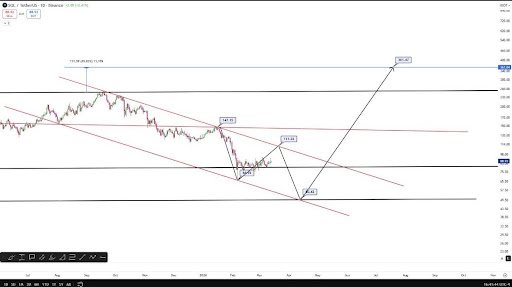
A detailed technical analysis shared by market expert Celal Kucuker on X has sparked renewed optimism around Solana’s price outlook. The analyst shared a chart showing the SOL price around $88 at the time. He also outlined a clear roadmap that points to a potential final surge near $360 for the cryptocurrency.

The chart reveals a dominant bearish channel defined by several parallel red descending trendlines that shaped Solana’s price action from late 2025 through early 2026. These lines have repeatedly capped rallies and guided SOL’s downtrend, while also respecting the critical resistance point around $147.15.

Following the cryptocurrency’s rally to $147, it recorded a massive price crash to $66.92, marking the first floor of its Double Bottom pattern, as shown on the chart. Based on the trajectory of black lines within the descending parallel channel, Kucuker expects Solana to rally again to $111.32 in the near term, representing a roughly 66% increase from the previous bottom.
Source: Chart from Celal Kucuker on X

Once this happens, SOL is projected to plunge even deeper toward $50.42, officially completing its bearish Double Bottom pattern. Kucuker has highlighted this area as a solid support zone. From this pivotal low, the analyst drew a black, upward-sloping line that cleanly slices through the entire bearish descending channel.

This line points directly to the $361.47 bullish target. Kucuker’s timing for this projection suggests that Solana could skyrocket to this level by 2027. However, the chart shows somewhere around the third quarter of 2026. Notably, such a move would deliver a staggering 616% gain from the projected $50.42 support level.

Additional targets in the chart analysis further reinforce Kucuker’s bullish outlook. The analyst drew multiple horizontal lines on the chart to mark key resistance zones that may influence price movement. The first red line points to $130 as an immediate resistance level, which comes into play once the price surpasses the initial target of $111.32. Beyond this, the next black line identifies $260 as the next major resistance level that, if broken, could confirm Solana’s projected price rally above $360.

The Thesis Behind The Bull Rally

A crypto community member has challenged Kucuker’s bullish forecast for Solana, questioning why he posted price targets and charts without explaining the underlying thesis. They asked the analyst to explain which macroeconomic factors could push the SOL price above $360 and which could drive it down to the $50 support level.

In response, Kucuker pointed to broader market dynamics, noting that price rallies often start with meme coins, which typically generate momentum across the market. He noted that Solana will likely benefit from this upward movement, potentially propelling it to new all-time highs.

SOL trading at $82 on the 1D chart | Source: SOLUSDT on Tradingview.com

Perguntas relacionadas

QWhat is the analyst's ultimate price target for Solana in this cycle, and what percentage increase does that represent from the current price?

AThe analyst's ultimate price target for Solana is $360, which represents a roughly 333% increase from its price of about $83 at the time of writing.

QAccording to the technical analysis, what is the projected low point that would form the Double Bottom pattern before the surge?

AThe analysis projects that Solana will plunge to a low of $50.42 to officially complete its bearish Double Bottom pattern.

QWhat are the two key resistance levels identified in the chart that Solana must break through on its way to the $360 target?

AThe two key resistance levels identified are $130 as an immediate resistance and $260 as the next major resistance level.

QWhat broader market dynamic did the analyst cite as a potential catalyst for Solana's price rally?

AThe analyst cited that price rallies often start with meme coins, which generate momentum across the market, and Solana will likely benefit from this upward movement.

QBy what timeframe does the analyst suggest Solana could potentially reach the $360 price target?

AThe analyst's timing suggests Solana could reach the $360 target by 2027, with the chart indicating it could happen around the third quarter of 2026.

Leituras Relacionadas

Circle CEO's Seoul Visit: No Korean Won Stablecoin Issuance, But Met All Major Korean Banks

Circle CEO Jeremy Allaire's recent activities in Seoul indicate a strategic shift for the company, moving away from issuing a Korean won-backed stablecoin and instead focusing on embedding itself as a key infrastructure provider within Korea’s financial and crypto ecosystem. Despite Korea accounting for nearly 30% of global crypto trading volume—with a market characterized by high retail participation and altcoin dominance—Circle has chosen not to compete for the role of stablecoin issuer. Instead, Allaire met with major Korean banks (including Shinhan, KB, and Woori), financial groups, leading exchanges (Upbit, Bithumb, Coinone), and tech firms like Kakao. This approach reflects a broader industry transition: the core of stablecoin competition is shifting from issuance rights to systemic positioning. With Korean regulators still debating whether banks or tech companies should issue stablecoins, Circle is avoiding regulatory uncertainty by strengthening its role as a service and technology partner. The company is deepening integration with trading platforms, building connections, and promoting stablecoin infrastructure. This positions Circle to benefit regardless of which entity eventually issues a won stablecoin. Allaire also noted the potential for a Chinese yuan stablecoin in the next 3–5 years, underscoring a regional trend of stablecoins becoming more regulated and integrated with traditional finance. Ultimately, Circle’s strategy highlights that future influence in the stablecoin market will belong not necessarily to the issuers, but to the foundational infrastructure layers that enable cross-system transactions.

marsbitHá 2m

Circle CEO's Seoul Visit: No Korean Won Stablecoin Issuance, But Met All Major Korean Banks

marsbitHá 2m

SpaceX Ties Up with Cursor: A High-Stakes AI Gambit of 'Lock First, Acquire Later'

SpaceX has secured an option to acquire AI programming company Cursor for $60 billion, with an alternative clause requiring a $10 billion collaboration fee if the acquisition does not proceed. This structure is not merely a potential acquisition but a strategic move to control core access points in the AI era. The deal is designed as a flexible, dual-path arrangement, allowing SpaceX to either fully acquire Cursor or maintain a binding partnership through high-cost collaboration. This "option-style" approach minimizes immediate regulatory and integration risks while ensuring long-term alignment between the two companies. At its core, the transaction exchanges critical AI-era resources: SpaceX provides its Colossus supercomputing cluster—one of the world’s most powerful AI training infrastructures—while Cursor contributes its AI-native developer environment and strong product adoption. This synergy connects compute power, models, and application layers, forming a closed-loop AI capability stack. Cursor, founded in 2022, has achieved rapid growth with over $1 billion in annual revenue and widespread enterprise adoption. Its value lies in transforming software development through AI agents capable of coding, debugging, and system design—positioning it as a gateway to future software production. For SpaceX, this move is part of a broader strategy to evolve from a aerospace company into an AI infrastructure empire, integrating xAI, supercomputing, and chip manufacturing. Controlling Cursor fills a gap in its developer tooling layer, strengthening its AI narrative ahead of a potential IPO. The deal reflects a shift in AI competition from model superiority to ecosystem and entry-point control. With programming tools as a key battleground, securing developer loyalty becomes crucial for dominating the software production landscape. Risks include questions around Cursor’s valuation, technical integration challenges, and potential regulatory scrutiny. Nevertheless, the deal underscores a strategic bet: controlling both compute and software development access may redefine power dynamics in the AI-driven future.

marsbitHá 42m

SpaceX Ties Up with Cursor: A High-Stakes AI Gambit of 'Lock First, Acquire Later'

marsbitHá 42m

Trading

Spot
Futuros
活动图片