When Top Crypto VCs Are Shrinking Across the Board, Why Has This Firm Grown by 150%?

marsbitPublicado em 2026-04-20Última atualização em 2026-04-20

Resumo

In a declining crypto market where top venture capital firms like Paradigm, Pantera, a16z crypto, and Multicoin saw significant reductions in assets under management (AUM), Haun Ventures stood out with a 150% growth, increasing its AUM from $1 billion to $2.5 billion by 2025. Founded by Katie Haun, a former federal prosecutor and a16z crypto veteran, the firm combines regulatory insight with investment discipline. Initially investing heavily in NFTs during the 2022 hype, Haun Ventures quickly pivoted as the bubble burst, adopting a cautious approach with only six investments over the following 18 months. The firm balanced its portfolio between digital tokens and traditional equity, allocating about 30% to liquid tokens like Bitcoin and Ethereum, which contributed significantly to returns as Bitcoin’s price surged. By 2024, Haun Ventures shifted focus to B2B solutions in payments and developer infrastructure, leading over 56% of its investment rounds—the highest rate among top VCs. This strategy paid off with several high-multiple exits via acquisitions, such as Bridge (acquired at $1.1 billion from a $200 million valuation) and BVNK (acquired at $1.8 billion from a $750 million valuation). The firm’s success is attributed to its regulatory foresight, adaptive strategy, high-conviction lead investments, and emphasis on real-world utility and exit efficiency—making it a standout performer during the crypto downturn.

Author: Gu Yu, ChainCatcher

As the crypto market overall declines, the assets under management (AUM) of almost all crypto VC firms are shrinking with it, and the industry is entering a brutal clearing cycle. But against this backdrop, a crypto venture capital fund established less than five years ago has become a clear exception, charting an independent growth trajectory amidst widespread contraction.

According to a batch of undisclosed financial disclosure documents from U.S. SEC obtained by a Fortune reporter last week, data shows that the AUM of leading firms like Paradigm, Pantera, a16z crypto, and Multicoin shrank across the board in 2025, with Multicoin's AUM shrinking by more than half.

The only one that grew against the trend was Haun Ventures, a venture capital fund established just four years ago. Its AUM grew from an initial $1 billion逐年 (year by year) to $2.5 billion in 2025.
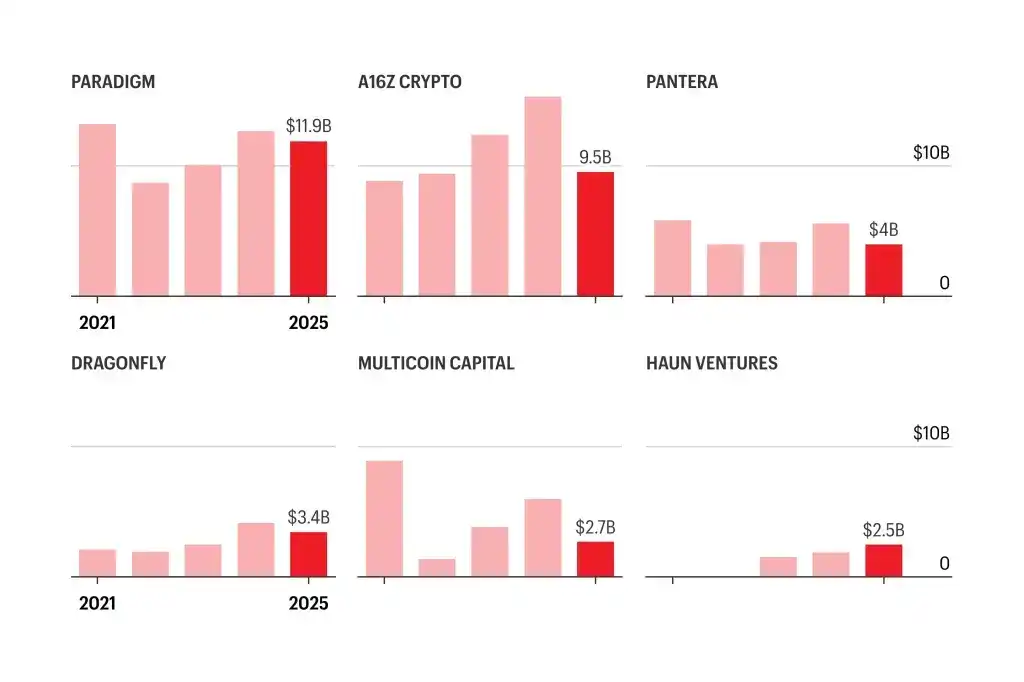
In the bleak crypto market, this is by no means just luck. Last year, market news indicated that Haun Ventures was close to completing a new round of fundraising for a $1 billion fund. All of this reflects that Haun Ventures and its founder Katie Haun's unique investment strategy has passed the test of the market and LPs, propelling them into the ranks of top VCs.

Distinct Founder Style and Background

The difference of Haun Ventures was foreshadowed from the very start.

Founder Katie Haun is not a typical crypto investor. She was a long-serving federal prosecutor in the U.S., working on financial crime investigations for over a decade, and created the U.S. government's first cryptocurrency task force. In 2018, she became a16z's first female general partner and co-led the firm's cryptocurrency fund. She also joined the Coinbase board, thus combining policy vision, institutional resources, and practical experience.

This experience means her understanding of the crypto industry does not stem purely from "technological potential" or "market size," but rather from compliance boundaries, systemic risks, and institutional embedding capabilities. The influence of this background is not obvious, but it is profound enough.

It is worth noting that Haun Ventures is one of only two crypto funds named after their founder, reflecting the fund's distinct founder-driven style. The other VC named after its founder is a16z.

In its early days, Haun Ventures was not flawless and also stepped into pitfalls during market frenzies. Looking back at its investment record, Haun Ventures once focused heavily on NFT as a key investment area, investing in at least 4 NFT projects including Opensea, Autograph, ZORA, and Highlight in the first half of 2022 alone.

However, as the bubble for NFTs and similar concepts burst quickly, Haun Ventures demonstrated a strong ability to correct mistakes and iterate. From the second half of 2022 onwards, it rapidly contracted its efforts, significantly decreasing its investment frequency, responding to the market downturn with extreme prudence.

According to RootData, in the 18 months spanning the second half of 2022 and the entirety of 2023, Haun Ventures publicly disclosed participation in only 6 funding rounds, averaging one investment every three months.

As of June 2023, Haun Ventures partner Rosenblum stated in an interview that the firm's investments were almost evenly split between digital tokens and traditional equity, and that it had already deployed about 30% of its capital into roughly twenty-plus projects, including publicly traded, liquid tokens. These tokens included well-known cryptocurrencies like Bitcoin and Ethereum, as well as smaller market cap tokens related to projects.

At that time, Bitcoin's price hovered for a long time in the $15,000-$30,000 range, before subsequently rising to a high of $126,000 in 2025. This also brought Haun Ventures very substantial investment returns, largely offsetting the investment losses in areas like NFTs and becoming a crucial foundation for its growth in scale.

Key Shift

Starting in 2024, Haun Ventures' investment strategy began to show a clear shift, with its focus turning towards B2B solution companies in areas like payments and developer platforms.

At the time, these directions were not particularly 'sexy.' They lacked explosive growth narratives and were difficult to generate market hype in a short time, yet they恰好 (exactly) hit the key node of the industry's transition from speculation to utility.

In that year, Haun Ventures invested in nearly ten B2B companies, including the stablecoin payment platform Bridge, crypto-native infrastructure platform Conduit, crypto protocol economic security solution Chaos Labs, Solana development platform Helius, and crypto payment platform BVNK.

In terms of investment style, Haun Ventures particularly favors leading investment rounds. According to RootData statistics, among its publicly disclosed participation in 39 funding rounds, it led the round 22 times, with a lead investment rate exceeding 56%, ranking first among top-tier VCs. This demonstrates that Haun Ventures has an unusual level of conviction in its portfolio, willing to support high-potential early-stage projects with substantial capital.

Looking back now, payments have become the sector with the highest valuation premiums and the clearest exit paths in the crypto space. Haun Ventures' early布局 (layout/positioning), combined with its consistent lead investment style, has yielded very considerable exit returns.
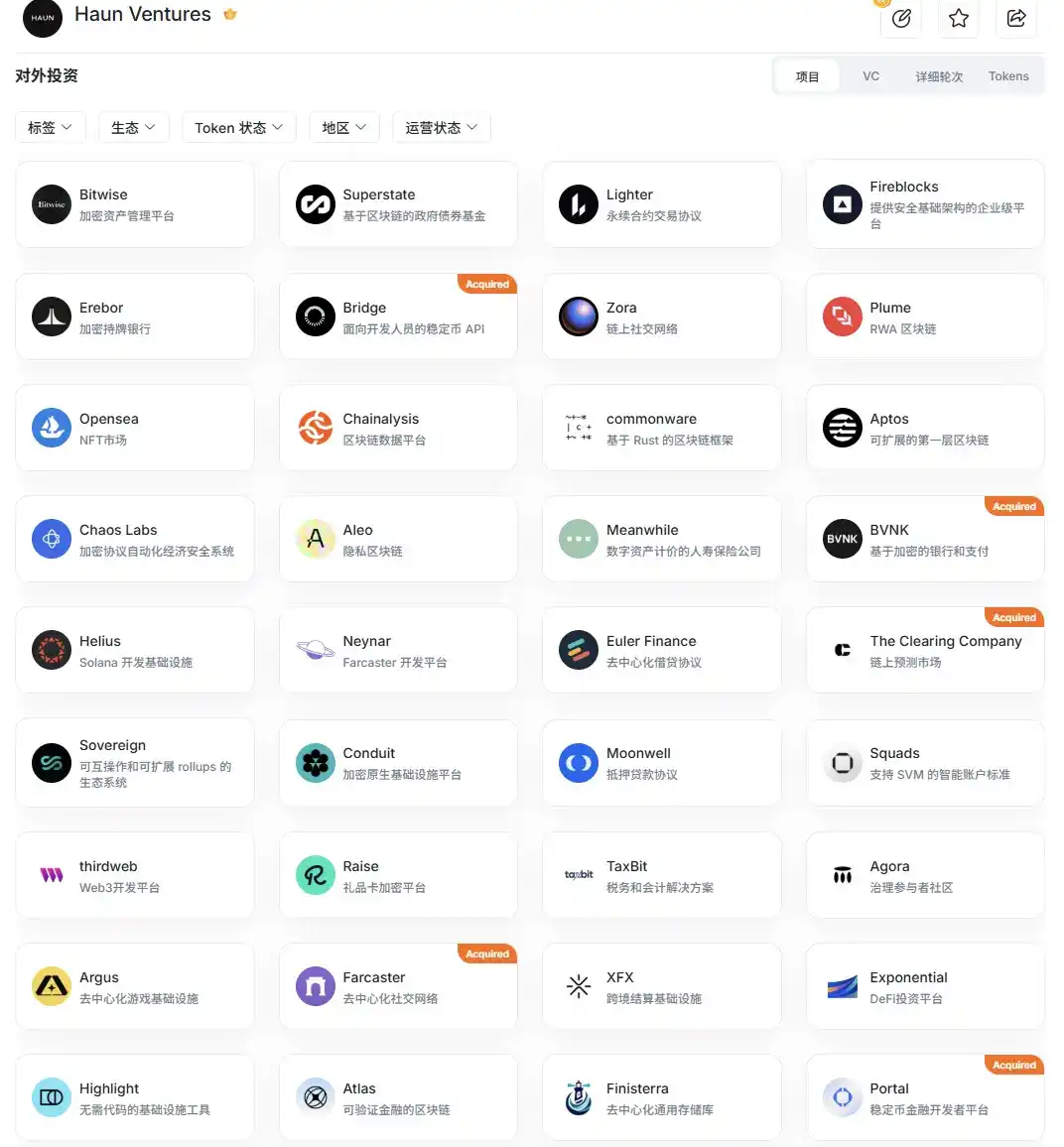
Since October 2024, over 5 of Haun Ventures' portfolio companies have been acquired, with several payment companies achieving high-multiple returns. For example, Haun Ventures once led an investment in the stablecoin development platform Bridge at a $200 million valuation, and it was eventually acquired for a valuation exceeding $1.1 billion. Haun Ventures also led an investment in the crypto payment platform BVNK at a $750 million valuation, which was eventually acquired for a valuation exceeding $1.8 billion.

In an environment where crypto asset exit channels are increasingly narrow and secondary market liquidity is highly concentrated towards the top, Haun Ventures has proven the viability of another path: investing via equity in companies that solve real payment pain points and possess compatibility with traditional finance, achieving high-multiple exits through acquisitions, which is more capital-efficient than holding a pile of highly illiquid tokens.

From chasing the hot trend of NFTs, to a balanced allocation of tokens and equity, and then to focusing on B2B payments and infrastructure, the evolution path of Haun Ventures is precisely an epitome of crypto VCs shifting from speculation-oriented to value-oriented. Katie Haun's compliance experience, the fund's rapid error-correction ability, prudent investment pace, high lead-investment ratio heavy allocation strategy, combined with precise grasp of real-world applications and exit paths, together build a moat for weathering cycles.

As industry泡沫 (bubbles) recede, institutions that expanded依靠 (relying on) narratives and leverage are shrinking one after another. Haun Ventures, with compliance and stability as its foundation, has become the most certain winner in the crypto winter, also pointing out the survival and growth logic for the next phase of the entire VC industry.


Perguntas relacionadas

QAccording to the article, which crypto VC firm was the only one to experience growth in AUM during the market downturn, and what was its growth?

AHaun Ventures was the only crypto VC firm to experience growth. Its assets under management (AUM) grew from an initial $1 billion to $2.5 billion in 2025, representing a 150% increase.

QWhat unique background does Katie Haun, the founder of Haun Ventures, have that differentiates her from typical crypto investors?

AKatie Haun is a former U.S. federal prosecutor who worked on financial crime investigations for over a decade and created the U.S. government's first cryptocurrency task force. She later became a16z's first female general partner, co-leading their crypto fund, and served on the board of Coinbase.

QHow did Haun Ventures' investment strategy change after the NFT market bubble burst in 2022?

AAfter the NFT bubble burst, Haun Ventures significantly reduced its investment frequency, becoming extremely cautious. It shifted its focus from consumer-facing NFTs to a more balanced portfolio, splitting investments almost evenly between digital tokens and traditional equity, and later pivoting to B2B solutions like payment and developer platforms.

QWhat is a key characteristic of Haun Ventures' investment style in terms of its participation in funding rounds?

AA key characteristic is its high lead-investment rate. Haun Ventures led over 56% of the funding rounds it participated in, which is the highest rate among top-tier VCs, demonstrating strong conviction and a willingness to commit significant capital to early-stage projects.

QWhat type of companies did Haun Ventures focus on starting in 2024, and how did this strategy lead to successful exits?

AStarting in 2024, Haun Ventures focused on B2B solutions, particularly payment and developer infrastructure companies. This strategy led to successful high-multiple exits through acquisitions. For example, its portfolio company Bridge was acquired for over $1.1 billion after a lead investment at a $200 million valuation, and BVNK was acquired for over $1.8 billion after a lead investment at a $750 million valuation.

Leituras Relacionadas

Apple Also Has to Pay Rent Now

Apple Pays Rent Too: The Two-Way Flow of "Traffic Tax" and "AI Capability Rent" Between Tech Giants For over two decades, Google has paid Apple an estimated $20 billion annually to remain the default search engine on Safari, a "traffic tax" for a critical user entry point. However, in 2026, the direction of this cash flow partially reversed. Apple agreed to pay Google roughly $1 billion per year to license its Gemini AI models, as Apple's own models reportedly struggled with complex tasks. This creates a unique dynamic: Apple acts as the "landlord" in the established search ecosystem, collecting rent from Google for access. Simultaneously, in the emerging AI arena, Apple becomes the "tenant," paying Google for access to cutting-edge AI capabilities it cannot currently match internally. While Apple claims its new models are "distilled" from Gemini outputs and contain "not a drop" of Google's original code, core dependencies remain. Its knowledge base is refined using Gemini's outputs, and its most powerful cloud model runs on Google's infrastructure. Apple has structured the deal as non-exclusive, allowing it to theoretically switch AI suppliers—a hedge against over-reliance. The future hinges on whether advanced AI models become a commodity (cheap and abundant) or remain a concentrated, scarce resource (expensive and controlled by few). Apple is betting on the former, leveraging its massive device ecosystem to be a powerful, choosy customer. If the latter proves true, its bargaining power could erode. This power dynamic is extending to developers. Apple, Google, and WeChat are all pushing for apps to expose their core functions as standardized "actions" or "intents" that their respective AI assistants (Siri, Gemini, WeChat AI) can directly call. The new scarce resource is no longer just app store visibility, but "being selected by the AI." The currency of "rent" has changed from a 30% revenue share to ceding control over how users interact with an app's functions.

marsbitHá 1h

Apple Also Has to Pay Rent Now

marsbitHá 1h

Missed the SpaceX IPO? WEEX's "First Trade Protection" Lets You Experience US Stock Trading Risk-Free.

With the excitement around SpaceX's recent public listing reigniting interest in the US stock market, Chinese investors face significant challenges accessing compliant and convenient trading channels following regulatory actions against major online brokers. This article explores the available options, highlighting their risks and limitations. Traditional paths for US stock investments remain problematic. Qualified Domestic Institutional Investor (QDII) and Listed Open-Ended Fund (LOF) products, while compliant, suffer from high fees, significant purchase premiums, and a very limited selection of assets. Small, unregulated offshore brokers pose substantial risks, including potential insolvency. While secure, VIP accounts at banks in Hong Kong or Singapore require high minimum deposits (often 1-2 million RMB) and in-person visits, placing them out of reach for most retail investors. The article positions cryptocurrency exchanges, specifically their TradFi (traditional finance on-chain) offerings, as a compelling alternative. Platforms like WEEX are noted for providing access to a wide range of US stocks and ETFs, including SpaceX (SPCXON), through tokenized assets. This method offers advantages such as a single account for both crypto and traditional assets, USDT-based settlement avoiding fiat complexities, flexible leverage, and robust risk management. To attract users, WEEX is promoting a "First Trade Guarantee" campaign. Running from June 15 to July 8 (UTC+8), it features a $30,000 prize pool. Users who trade $500 worth of US stock contracts can qualify for a guarantee on their first eligible trade: 100% loss coverage up to $30 or a 20% bonus on profits up to $30. The campaign is presented as a low-risk opportunity for both crypto natives and traditional investors to experience US stock trading.

marsbitHá 1h

Missed the SpaceX IPO? WEEX's "First Trade Protection" Lets You Experience US Stock Trading Risk-Free.

marsbitHá 1h

How Difficult is Chip Making? A Division Error Costs 475 Million Dollars

How Hard Is It to Make a Chip? A Division Error Cost $475 Million Chip expert Shi Kan, a researcher at the Chinese Academy of Sciences and a popular tech creator, explains the immense challenges of chip development. Chips are foundational to modern technology, but their creation is extraordinarily difficult. The journey from sand to a functional chip involves complex design and manufacturing, but a critical bottleneck is verification—ensuring the design works flawlessly before costly production. A single, undetected bug can have catastrophic consequences, as illustrated by the infamous 1994 Intel Pentium FDIV bug. A flaw in the floating-point division unit forced a recall costing $475 million. Unlike software, chips cannot be easily patched after manufacture, making "first-time success" paramount. However, industry surveys show only 24% of chip projects achieve this; over three-quarters require at least one costly re-spin due to design flaws. Verification has thus become the dominant phase, consuming up to 70% of the design cycle. The core challenge is a "verification impossible triangle" between high performance, good debuggability, and low cost. Exhaustively verifying a modern CPU core could take 15,000 years with software simulation, or 30 years with advanced hardware emulation—timeframes utterly impractical for development. Despite being essential, verification is often seen as unglamorous "dirty work," receiving less academic attention than fields like AI. Shi and his team are tackling this by developing an agile verification research framework called ENCORE, based on FPGA technology, to improve verification efficiency and debug capability. Beyond research, Shi engages in public science communication through long-form video content, aiming to demystify chip technology, AI, and computer science. He argues for the value of pursuing "hard and long-term" endeavors, whether in the meticulous world of chip verification or in creating substantive educational content, believing such sustained effort is likely the right path forward.

marsbitHá 1h

How Difficult is Chip Making? A Division Error Costs 475 Million Dollars

marsbitHá 1h

Trading

Spot
Futuros
活动图片