When Tokens Cost More Than People, 'AI Narrative' Runs Into Trouble

marsbitPublicado em 2026-05-29Última atualização em 2026-05-29

Resumo

Title: When Tokens Cost More Than People, the "AI Narrative" Hits Trouble The economic sustainability of corporate AI adoption is under scrutiny as token consumption soars while measurable business value remains elusive. Major companies like Uber and Microsoft report struggling to justify rising AI costs, with executives coining terms like "tokenmaxxing" to describe wasteful usage. Data reveals a stark picture: for every dollar spent on AI tokens, only 18 cents translates to user-facing value, with the rest consumed by bug fixes, rework, and friction. The debate splits into bullish and bearish camps. Bulls, like Goldman Sachs analysts, see current inefficiencies as growing pains, predicting a 24-fold increase in token demand by 2030 and a shift towards healthier metrics like "cost per effective action." They point to indicators of real productivity gains and argue current tech valuations are not in bubble territory. Bears, however, highlight an unsustainable model where value is heavily concentrated in semiconductor companies like Nvidia, funded by cloud giants taking on massive debt. Studies show 95% of firms investing in generative AI see zero return. A deeper concern is the circular financial structure between cloud providers (hyperscalers) and AI labs like OpenAI and Anthropic. Billions in cloud service commitments are tied to these labs, which are partly funded by the hyperscalers' own investment. This creates a loop where cloud revenue depends on labs securing contin...

Author: Bao Yilong

Source: Wall Street News

The justification for corporate AI spending is facing a severe test, as Token consumption continues to climb, yet quantifiable commercial value remains elusive.

On May 22, Uber's Chief Operating Officer Andrew Macdonald, whose company is valued at over $200 billion, stated publicly on a podcast that the link between the growth in token consumption and substantial product improvement "doesn't exist yet."

Macdonald pointed out that companies are finding it increasingly difficult to rationalize the continuously rising AI expenditures. He even coined a term for the wasteful phenomenon within engineering teams: "tokenmaxxing."

Earlier in mid-May, Microsoft began cutting internal Claude Code licenses, citing token bills as "unsustainable."
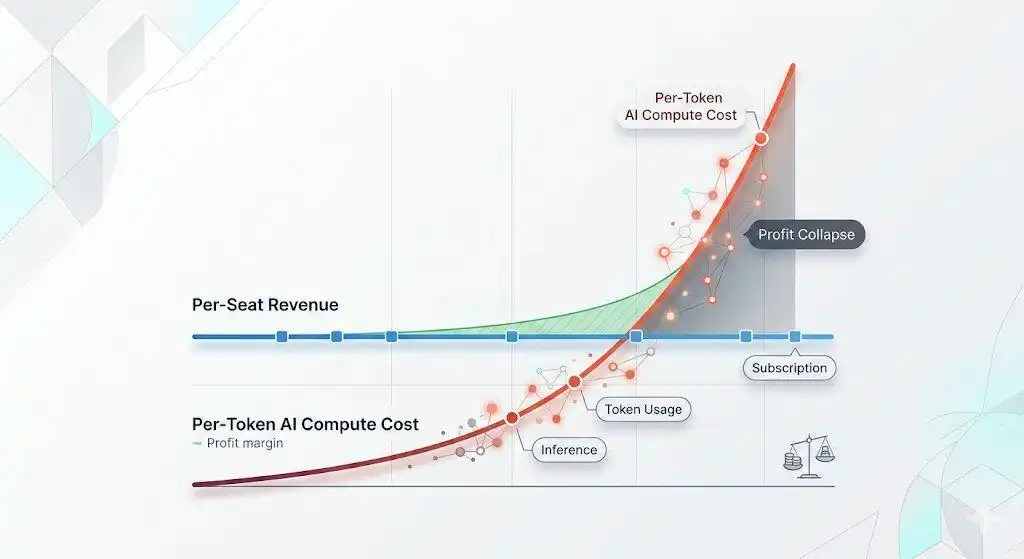
The combination of these two events forces the market to confront a previously overlooked variable. Token economics, specifically the unit economics of token consumption at enterprise scale, has evolved from a peripheral issue to the central load-bearing pillar of the entire AI investment thesis.

Five Data Points, Painting a New Picture

Since April, multiple data points have emerged successively, collectively sketching an alarming picture.

In April this year, Uber's Chief Technology Officer publicly stated that the company had burned through its annual Claude Code budget in just four months.

Among 5,000 engineers, monthly usage rates ranged from 84% to 95%, with individual monthly bills varying from $150 to $2,000. The CTO himself reportedly consumed $1,200 worth of tokens during a two-hour internal demonstration.

Macdonald described being "speechless" upon hearing this number.

Regarding Microsoft, according to a report in The Verge's Tom Warren's Notepad newsletter, Claude Code quickly became popular among Microsoft's internal engineering teams. However, the token-based billing model made scaled spending unsustainable, prompting Microsoft to proceed with cutting related licenses.

GitHub announced that starting June 1, all Copilot plans would shift from a fixed subscription model to usage-based billing.

The official discussion thread garnered nearly 900 downvotes, as users calculated that a single AI programming session typically consumes $30 to $40, meaning a $10 monthly subscription could be exhausted in a single use.

Developer productivity platform Entelligence.AI aggregated data from 2,444 companies and found:

  • For every $1 spent on AI token costs, only 18 cents generated actual value reaching users.
  • 44 cents were used to fix bugs introduced by the AI itself; 27 cents went to rework; 11 cents were consumed by review friction.

According to Bloomberg's Silicon Data LLM Token Expenditure Index, token prices have risen about 65% since the end of February this year, and US AI software prices have increased by 20% to 37% cumulatively over the past year.

Bull vs. Bear Debate: One Fact, Two Interpretations

The same data points to starkly different conclusions under different analytical frameworks.

The bullish view argues that the current chaos is merely the growing pains of a successful transformation.

According to Goldman Sachs' Jim Schneider in early May, by 2030, agentic AI will drive a 24-fold increase in token consumption, reaching approximately 120 sextillion tokens per month. The gross margins of hyperscale cloud providers and model vendors will turn positive within the next 3 to 12 months.

Goldman's Rich Privorotsky believes that Q1 2026 might have been the peak for "token maximization" as a KPI. The industry is shifting from pursuing consumption volume to the healthier metric of "cost per effective action."

JP Morgan's economic research also found a jump in new and updated Python packages on PyPI in early 2026, a trend not seen when ChatGPT launched in 2022, indicating that real productivity gains are occurring.

Furthermore, the Magnificent 7 currently trades at about 20 times forward earnings, far below the 52 times at the peak of the 2000 tech bubble, 67 times for Japan in 1989, and 34 times during the "Nifty Fifty" era. By historical bubble standards, this does not constitute a bubble.

The bearish view was most systematically articulated by Goldman Sachs semiconductor analyst Jim Covello in an April report.

He pointed out that almost all value in the AI supply chain flows to semiconductor companies, a phenomenon unprecedented and unsustainable in history. Chip companies should benefit when their customers benefit, but in this cycle, their prosperity comes at the expense of consumption across the entire upstream industry chain.

Nvidia's net profit has grown about 20-fold since ChatGPT's launch; major hyperscale cloud providers have burned through their operating cash flow and are turning to debt—data center-related debt issuance in 2025 was approximately $182 billion, doubling from 2024.

MIT Nanda research shows 95% of enterprises investing in generative AI see zero return. This decoupling may persist for a while, but cannot last forever.

Concerns of the Circular Financing Structure

This discussion touches on a more complex level: the financial loop between hyperscale cloud providers and AI labs.

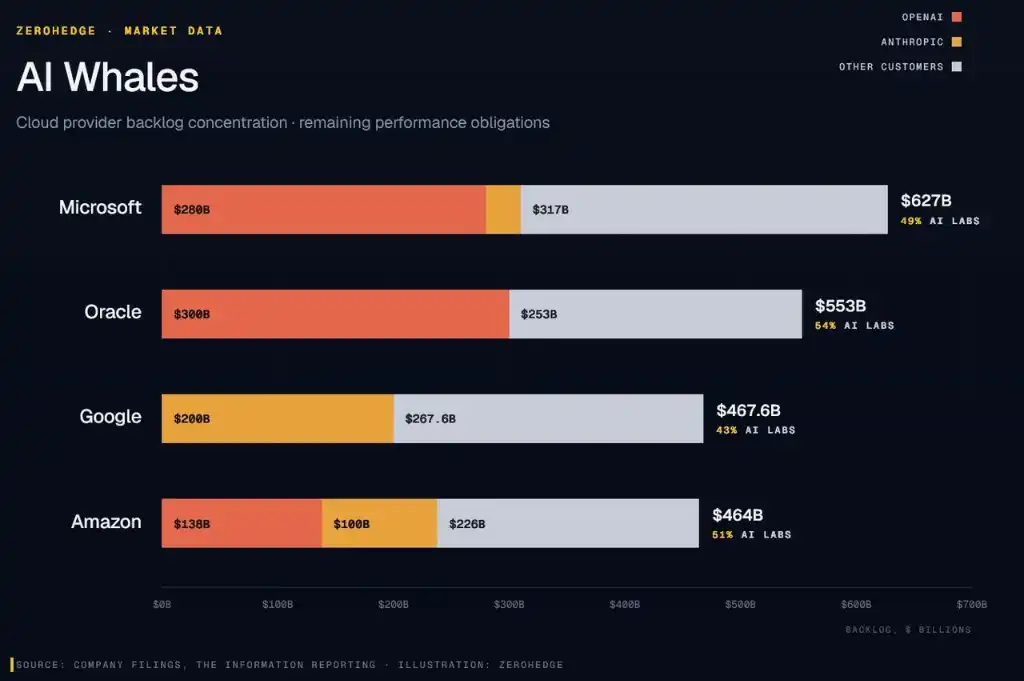
According to corporate disclosure documents compiled by The Information, OpenAI and Anthropic account for more than half of the approximately $2 trillion in future cloud service commitments from Microsoft, Oracle, Google, and Amazon. Specifically:

  • Of Microsoft's $627 billion cloud service backlog, $280 billion is tied to OpenAI;
  • Of Oracle's $553 billion pipeline business, 54% (approx. $300 billion) is committed by OpenAI;
  • Of Google's $467.6 billion, Anthropic accounts for 43% (approx. $200 billion);
  • Amazon's corresponding exposure also reaches 51% of its $464 billion backlog.
This financing structure is inherently circular. Microsoft's $13 billion investment in OpenAI was largely delivered in the form of Azure credits, which OpenAI used to purchase Azure compute. Microsoft then booked this as cloud revenue.

The same hyperscale cloud providers are both equity investors in the AI labs and service providers collecting compute bills.

This structure is also reflected in profit data. Alphabet reported a record Q1 profit of $62.6 billion, of which about $28.7 billion, nearly half, came from the paper appreciation of its Anthropic stake.

Amazon's Q1 profit of $30.3 billion included $16.8 billion in pre-tax unrealized gains from Anthropic, while its free cash flow plummeted 95% to $1.2 billion due to data center capital expenditures of $44.2 billion in the same period.
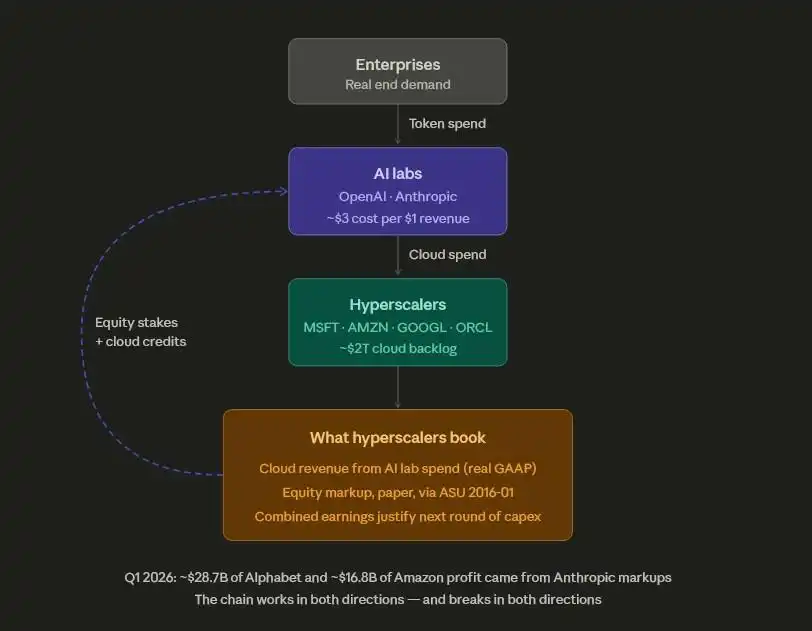
The sustainability of this system depends on AI labs' continued ability to secure external financing to fulfill cloud computing commitments, which in turn relies on enterprise customers' continued willingness to pay rising token bills.

It is reported that Anthropic currently incurs costs of $3 for every $1 of revenue. Once the pace of financing slows, the credibility of cloud revenue projections will decline, and the valuation multiples of hyperscale cloud vendors will also face re-evaluation pressure.

This chain transmits in both directions and will break in both directions.

This Isn't 1999, But the Problem is Real

The current situation does not constitute a typical bubble setup.

From a valuation multiple perspective, the Tech 7 currently trades at about 20 times forward price-to-earnings, far below the 52 times at the peak of the 2000 tech bubble, 67 times for the Japanese market in 1989, or the 34 times during the "Nifty Fifty" era.

AI technology itself is real. For heavy user groups, data on productivity gains is verifiable. OpenAI has an annualized revenue of about $20 billion, Anthropic about $4.3 billion; these two labs are not going to disappear.

Today, token cost (compute expense) has become the key determinant of AI success or failure. Six months ago, people weren't even discussing this topic.

Back then, people only cared about "whether the technology works." Now the answer is clear: in the eyes of specific jobs and specific people, the technology indeed works.

But a new question arises: Can the money saved by downstream companies using AI be transmitted upward in time to outrun the valuation window the capital market has left for AI labs and cloud giants?

Those bullish on AI believe that as long as the technology continues to mature, corporate ROI (Return on Investment) will turn positive within 1 to 1.5 years.

The bearish believe more executives will follow Macdonald's lead, publicly complaining about low AI ROI and starting to cut budgets.

Both scenarios are playing out; the outcome is undecided. The only certainty is that the old lie—"as long as token consumption is rising, it means the AI transformation is successful"—has been shattered.

High token consumption does not equal commercial value; this bubble must eventually be squeezed out. The bill for AI has come due, but who will ultimately pay for it? That remains an unknown for now.


Perguntas relacionadas

QAccording to the article, what is the major problem that enterprise AI spending is currently facing?

AThe major problem is that token consumption is rapidly increasing, but quantifiable business value is hard to find. The article states that 'the line between the growth of token consumption and substantive product improvement... does not yet exist.' Executives are finding it difficult to justify the escalating costs.

QWhat key finding did the developer platform Entelligence.AI discover regarding the value generated from AI token spending?

AEntelligence.AI found that for every dollar spent on AI token fees, only 18 cents generated tangible value that reached end-users. The rest was consumed by other costs: 44 cents for fixing AI-introduced bugs, 27 cents for rework, and 11 cents for review friction.

QWhat is the critical concern regarding the financial structure between hyperscale cloud providers and AI labs, as described in the article?

AThe concern is a potentially unsustainable, cyclical financing structure. Hyperscale cloud providers (like Microsoft, Amazon) are both equity investors in and service providers for AI labs (like OpenAI, Anthropic). The labs use cloud credits from the investments to purchase cloud compute, which the providers book as revenue. This structure depends on continuous external funding for the labs, which itself relies on enterprise clients' willingness to pay rising token bills.

QBased on the bull argument presented, what metric is the AI industry supposedly shifting towards from 'tokenmaxxing'?

AAccording to the bull argument, the industry is shifting from focusing on 'tokenmaxxing' (maximizing token consumption as a KPI) towards a healthier metric: the 'cost per effective action' or the return on investment (ROI) of AI deployments.

QWhat does the article conclude is the 'new question' now that the technical capability of AI is proven for specific tasks?

AThe new question is: 'Can the money saved by downstream companies using AI be transmitted upwards quickly enough to outpace the valuation window that capital markets have left for AI labs and cloud giants?' In other words, can the business value and cost savings materialize fast enough to justify the high costs and valuations before investor patience runs out?

Leituras Relacionadas

Deconstructing the U.S. Stock Quantum Computing Sector: IonQ, Rigetti, D-Wave, Which of These Concept Stocks is Worth Betting On?

**Title:** Analyzing the US Quantum Computing Race: IonQ, Rigetti, D-Wave – Which Concept Stock is Worth Betting On? **Summary:** The podcast discusses the resurgence of quantum computing as a national priority for both the US and China, driven by its potential to break current encryption, revolutionize drug discovery, finance, and logistics. The core challenge is commercializing the technology, which is hampered by high error rates in quantum bits (qubits). Quantum error correction, requiring thousands of physical qubits per reliable logical qubit, is key but years away. The analysis compares three main publicly traded US quantum computing firms: * **IonQ (Ion Trap):** Considered the most financially stable with the fastest commercial progress (2025 revenue: $130M, +202%) and high-quality clients. Its valuation is very high, pricing in significant future growth. * **Rigetti (Superconducting):** Seen as the highest-risk, highest-potential-reward bet. It has the smallest revenue but recently launched a 108-qubit system. Its valuation multiples are extreme, making it highly sensitive to news. * **D-Wave (Quantum Annealing):** Has the most unique positioning with real-world enterprise clients today (e.g., Mastercard, Volkswagen) solving optimization problems. Its recent acquisition moves it into general-purpose quantum computing ("dual-platform"), adding execution risk. Major tech giants like Google, IBM, and Microsoft are also heavily invested, pursuing various technical approaches. Nvidia is positioning itself as the essential bridge between classical and quantum computing. The investment phase is likened to AI in 2018-2020: promising underlying technology with accelerating breakthroughs but a commercial inflection point still 3-7 years away, suggesting potential for a market correction ("bubble washout"). For investors, suggested approaches include gaining exposure through tech giants with quantum divisions (e.g., Google, IBM) or using niche ETFs like WQTM for pure-play quantum exposure, rather than direct stock picks in the highly volatile pure-play companies at this early stage.

marsbitHá 9m

Deconstructing the U.S. Stock Quantum Computing Sector: IonQ, Rigetti, D-Wave, Which of These Concept Stocks is Worth Betting On?

marsbitHá 9m

From Parallel Finance to Mainstream Finance: The On-Chain Securities Era Ushers in a Historic Window

From Parallel Finance to Mainstream: The Dawn of On-Chain Securities For over a decade, the crypto industry has operated as a parallel financial system with its own currencies, markets, and assets—from Bitcoin and ICOs to DeFi, NFTs, and memecoins. Despite building a robust internal ecosystem, a wall has separated it from the traditional financial world. That barrier is now crumbling. The industry's first act was one of internal evolution: ICOs streamlined fundraising, DeFi recreated financial services on-chain, and layer-2 networks competed for scalability—all within the crypto bubble. While innovative, this cycle remained closed, with capital and users circulating internally, leading to volatile boom-bust cycles. Even Bitcoin ETFs, while attracting Wall Street capital, merely provided a channel to buy crypto assets without bridging the systems. The next, larger narrative is Real-World Assets (RWA) moving on-chain. This involves tokenizing stocks, bonds, funds, and future cash flows. Blockchain can compress the complex traditional processes of trading, settlement, clearing, and custody into a seamless, automated network operating in seconds. This shift is creating a new financial gateway: the native crypto securities broker. This entity will combine functions of an exchange, broker, bank, and custodian into a unified global financial operating system. Consequently, the next major battleground won't be the "public chain wars" focused on speed and cost, but the competition to build the financial infrastructure capable of hosting high-quality, liquid real-world assets. Access to global equities, index funds, or stakes in companies like SpaceX could erase the boundary between crypto and traditional finance, unlocking a market orders of magnitude larger than crypto's current valuation. In summary, after years of creating a separate financial world, crypto's next decade will be defined by its integration into the existing global financial system, marking the true beginning of its largest growth story.

marsbitHá 30m

From Parallel Finance to Mainstream Finance: The On-Chain Securities Era Ushers in a Historic Window

marsbitHá 30m

Wang Chuan: When the Neighbor Old Wang Made 30x on Memory Stocks, How to Avoid Anxiety (Part Six) - The Trap of Commoditized Goods

Wang Chuan: When the Neighbor Lao Wang Made 30x on Storage Stocks, How to Stay Anxiety-Free (Part 6) - The Trap of Commoditized Goods. This essay uses historical and current examples to analyze the cyclical and high-risk nature of the data storage industry. It begins with the 1990s rise and dramatic fall of Iomega, whose stock soared over 160x in 18 months before collapsing 97% from its peak, illustrating the fleeting success of storage "meme stocks." The core problem is that storage products, like DRAM and flash memory, are highly commoditized. This leads to extreme volatility: prices have plummeted over 80% multiple times, and company stocks often crash 95% or go bankrupt. The industry's dynamic is defined by "elastic demand facing heavy-asset, long-cycle, rigid supply." When demand spikes and supply is fixed, prices skyrocket, as seen recently with AI-driven demand for High Bandwidth Memory (HBM). Companies like Sandisk and Micron have reported massive revenue and gross margin jumps (e.g., Sandisk's gross margin rising from 22.5% to 78.3%) despite minimal increases in production volume. However, these high margins are self-defeating. They incentivize massive new capacity investments (hundreds of billions planned from 2026), with supply expected to surge by late 2027. Once new supply meets demand, prices and profits will crash, potentially leading to a scenario where "selling more results in earning less." The article debunks the safety of long-term supply agreements, comparing them to fragile non-aggression pacts easily broken when market conditions shift. It warns that when an industry is highly profitable but trades at low P/E ratios, the risk is greatest, as plummeting prices quickly erase those earnings. Multiple asymmetric risks loom, including economic recession, reduced AI spending, faster-than-expected capacity expansion (especially from Chinese firms), and technological innovations that reduce memory requirements. In conclusion, the storage sector is a cyclical trap where periods of euphoric profits are often precursors to devastating downturns, luring unprepared investors into a "wealth incinerator."

marsbitHá 40m

Wang Chuan: When the Neighbor Old Wang Made 30x on Memory Stocks, How to Avoid Anxiety (Part Six) - The Trap of Commoditized Goods

marsbitHá 40m

Wang Chuan: When the neighbor Lao Wang earned thirty times from investing in memory storage stocks, how can you still avoid anxiety (6) - The trap of homogeneous products

The article, "Wang Chuan: How to Remain Unanxious After Neighbor Lao Wang's Thirty-Fold Gain on Storage Stocks (Part 6) - The Trap of Commoditized Goods," analyzes the cyclical and perilous nature of the data storage industry through historical and current case studies. It begins with the example of Iomega, whose Zip drives led to a stock surge of over 160x in the mid-1990s before collapsing over 97% from its peak due to competition from cheaper CD-R technology. This pattern is characteristic of storage, where products like DRAM are highly commoditized, leading to extreme price volatility. The sector has seen prices crash over 80% multiple times, with companies often facing bankruptcy. The core dynamic is "elastic demand facing heavy-asset, long-cycle, rigid supply." High prices attract new capacity, but the long lead time means supply eventually overshoots, causing sharp price corrections. The current AI-driven boom, exemplified by surging demand for High-Bandwidth Memory (HBM), has led to skyrocketing prices and profit margins for companies like SanDisk and Micron, despite relatively flat production volumes. However, the author warns this high-margin environment is self-defeating. The high profits are already triggering massive new capacity investments (hundreds of billions starting 2026), with supply expected to ramp up by late 2027. When supply catches up, total revenue and profits may fall even as more units are sold. Long-term supply agreements offer little protection, as buyers can find ways to renegotiate if market prices drop, similar to fragile political treaties. Key risks include economic downturns, cuts in AI spending, faster-than-expected capacity expansion (especially from Chinese firms), and innovations in chip/algorithm design that reduce memory needs. A critical trap is that at the cycle's peak, storage stocks often appear cheap with low P/E ratios, luring value investors just before an impending downturn where profits evaporate. The conclusion cautions that for commoditized goods like storage, high margins inevitably destroy themselves, and the current asymmetry favors downside risk over further upside. The neighbor's dream of easy wealth from storage stocks is portrayed as a precarious illusion.

链捕手Há 57m

Wang Chuan: When the neighbor Lao Wang earned thirty times from investing in memory storage stocks, how can you still avoid anxiety (6) - The trap of homogeneous products

链捕手Há 57m

Trading

Spot
Futuros

Artigos em Destaque

Como comprar PEOPLE

Bem-vindo à HTX.com!Tornámos a compra de ConstitutionDAO (PEOPLE) simples e conveniente.Segue o nosso guia passo a passo para iniciar a tua jornada no mundo das criptos.Passo 1: cria a tua conta HTXUtiliza o teu e-mail ou número de telefone para te inscreveres numa conta gratuita na HTX.Desfruta de um processo de inscrição sem complicações e desbloqueia todas as funcionalidades.Obter a minha contaPasso 2: vai para Comprar Cripto e escolhe o teu método de pagamentoCartão de crédito/débito: usa o teu visa ou mastercard para comprar ConstitutionDAO (PEOPLE) instantaneamente.Saldo: usa os fundos da tua conta HTX para transacionar sem problemas.Terceiros: adicionamos métodos de pagamento populares, como Google Pay e Apple Pay, para aumentar a conveniência.P2P: transaciona diretamente com outros utilizadores na HTX.Mercado de balcão (OTC): oferecemos serviços personalizados e taxas de câmbio competitivas para os traders.Passo 3: armazena teu ConstitutionDAO (PEOPLE)Depois de comprar o teu ConstitutionDAO (PEOPLE), armazena-o na tua conta HTX.Alternativamente, podes enviá-lo para outro lugar através de transferência blockchain ou usá-lo para transacionar outras criptomoedas.Passo 4: transaciona ConstitutionDAO (PEOPLE)Transaciona facilmente ConstitutionDAO (PEOPLE) no mercado à vista da HTX.Acede simplesmente à tua conta, seleciona o teu par de trading, executa as tuas transações e monitoriza em tempo real.Oferecemos uma experiência de fácil utilização tanto para principiantes como para traders experientes.

487 Visualizações TotaisPublicado em {updateTime}Atualizado em 2025.03.21

Como comprar PEOPLE

Discussões

Bem-vindo à Comunidade HTX. Aqui, pode manter-se informado sobre os mais recentes desenvolvimentos da plataforma e obter acesso a análises profissionais de mercado. As opiniões dos utilizadores sobre o preço de PEOPLE (PEOPLE) são apresentadas abaixo.

活动图片












