When Tokens Cost More Than People, 'AI Narrative' Runs Into Trouble

marsbitPublicado em 2026-05-29Última atualização em 2026-05-29

Resumo

Title: When Tokens Cost More Than People, the "AI Narrative" Hits Trouble The economic sustainability of corporate AI adoption is under scrutiny as token consumption soars while measurable business value remains elusive. Major companies like Uber and Microsoft report struggling to justify rising AI costs, with executives coining terms like "tokenmaxxing" to describe wasteful usage. Data reveals a stark picture: for every dollar spent on AI tokens, only 18 cents translates to user-facing value, with the rest consumed by bug fixes, rework, and friction. The debate splits into bullish and bearish camps. Bulls, like Goldman Sachs analysts, see current inefficiencies as growing pains, predicting a 24-fold increase in token demand by 2030 and a shift towards healthier metrics like "cost per effective action." They point to indicators of real productivity gains and argue current tech valuations are not in bubble territory. Bears, however, highlight an unsustainable model where value is heavily concentrated in semiconductor companies like Nvidia, funded by cloud giants taking on massive debt. Studies show 95% of firms investing in generative AI see zero return. A deeper concern is the circular financial structure between cloud providers (hyperscalers) and AI labs like OpenAI and Anthropic. Billions in cloud service commitments are tied to these labs, which are partly funded by the hyperscalers' own investment. This creates a loop where cloud revenue depends on labs securing contin...

Author: Bao Yilong

Source: Wall Street News

The justification for corporate AI spending is facing a severe test, as Token consumption continues to climb, yet quantifiable commercial value remains elusive.

On May 22, Uber's Chief Operating Officer Andrew Macdonald, whose company is valued at over $200 billion, stated publicly on a podcast that the link between the growth in token consumption and substantial product improvement "doesn't exist yet."

Macdonald pointed out that companies are finding it increasingly difficult to rationalize the continuously rising AI expenditures. He even coined a term for the wasteful phenomenon within engineering teams: "tokenmaxxing."

Earlier in mid-May, Microsoft began cutting internal Claude Code licenses, citing token bills as "unsustainable."
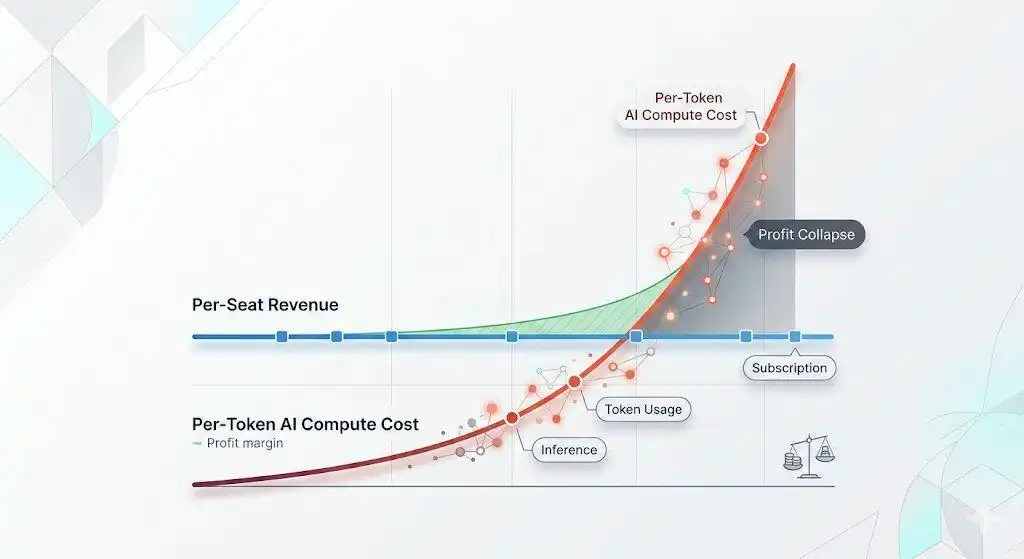
The combination of these two events forces the market to confront a previously overlooked variable. Token economics, specifically the unit economics of token consumption at enterprise scale, has evolved from a peripheral issue to the central load-bearing pillar of the entire AI investment thesis.

Five Data Points, Painting a New Picture

Since April, multiple data points have emerged successively, collectively sketching an alarming picture.

In April this year, Uber's Chief Technology Officer publicly stated that the company had burned through its annual Claude Code budget in just four months.

Among 5,000 engineers, monthly usage rates ranged from 84% to 95%, with individual monthly bills varying from $150 to $2,000. The CTO himself reportedly consumed $1,200 worth of tokens during a two-hour internal demonstration.

Macdonald described being "speechless" upon hearing this number.

Regarding Microsoft, according to a report in The Verge's Tom Warren's Notepad newsletter, Claude Code quickly became popular among Microsoft's internal engineering teams. However, the token-based billing model made scaled spending unsustainable, prompting Microsoft to proceed with cutting related licenses.

GitHub announced that starting June 1, all Copilot plans would shift from a fixed subscription model to usage-based billing.

The official discussion thread garnered nearly 900 downvotes, as users calculated that a single AI programming session typically consumes $30 to $40, meaning a $10 monthly subscription could be exhausted in a single use.

Developer productivity platform Entelligence.AI aggregated data from 2,444 companies and found:

  • For every $1 spent on AI token costs, only 18 cents generated actual value reaching users.
  • 44 cents were used to fix bugs introduced by the AI itself; 27 cents went to rework; 11 cents were consumed by review friction.

According to Bloomberg's Silicon Data LLM Token Expenditure Index, token prices have risen about 65% since the end of February this year, and US AI software prices have increased by 20% to 37% cumulatively over the past year.

Bull vs. Bear Debate: One Fact, Two Interpretations

The same data points to starkly different conclusions under different analytical frameworks.

The bullish view argues that the current chaos is merely the growing pains of a successful transformation.

According to Goldman Sachs' Jim Schneider in early May, by 2030, agentic AI will drive a 24-fold increase in token consumption, reaching approximately 120 sextillion tokens per month. The gross margins of hyperscale cloud providers and model vendors will turn positive within the next 3 to 12 months.

Goldman's Rich Privorotsky believes that Q1 2026 might have been the peak for "token maximization" as a KPI. The industry is shifting from pursuing consumption volume to the healthier metric of "cost per effective action."

JP Morgan's economic research also found a jump in new and updated Python packages on PyPI in early 2026, a trend not seen when ChatGPT launched in 2022, indicating that real productivity gains are occurring.

Furthermore, the Magnificent 7 currently trades at about 20 times forward earnings, far below the 52 times at the peak of the 2000 tech bubble, 67 times for Japan in 1989, and 34 times during the "Nifty Fifty" era. By historical bubble standards, this does not constitute a bubble.

The bearish view was most systematically articulated by Goldman Sachs semiconductor analyst Jim Covello in an April report.

He pointed out that almost all value in the AI supply chain flows to semiconductor companies, a phenomenon unprecedented and unsustainable in history. Chip companies should benefit when their customers benefit, but in this cycle, their prosperity comes at the expense of consumption across the entire upstream industry chain.

Nvidia's net profit has grown about 20-fold since ChatGPT's launch; major hyperscale cloud providers have burned through their operating cash flow and are turning to debt—data center-related debt issuance in 2025 was approximately $182 billion, doubling from 2024.

MIT Nanda research shows 95% of enterprises investing in generative AI see zero return. This decoupling may persist for a while, but cannot last forever.

Concerns of the Circular Financing Structure

This discussion touches on a more complex level: the financial loop between hyperscale cloud providers and AI labs.

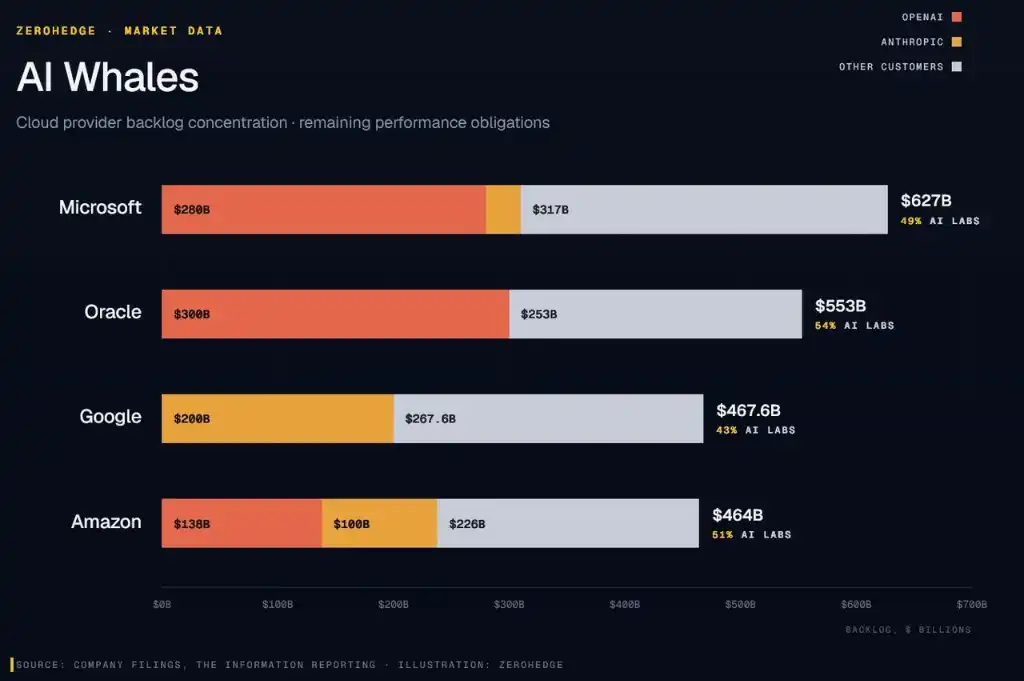
According to corporate disclosure documents compiled by The Information, OpenAI and Anthropic account for more than half of the approximately $2 trillion in future cloud service commitments from Microsoft, Oracle, Google, and Amazon. Specifically:

  • Of Microsoft's $627 billion cloud service backlog, $280 billion is tied to OpenAI;
  • Of Oracle's $553 billion pipeline business, 54% (approx. $300 billion) is committed by OpenAI;
  • Of Google's $467.6 billion, Anthropic accounts for 43% (approx. $200 billion);
  • Amazon's corresponding exposure also reaches 51% of its $464 billion backlog.
This financing structure is inherently circular. Microsoft's $13 billion investment in OpenAI was largely delivered in the form of Azure credits, which OpenAI used to purchase Azure compute. Microsoft then booked this as cloud revenue.

The same hyperscale cloud providers are both equity investors in the AI labs and service providers collecting compute bills.

This structure is also reflected in profit data. Alphabet reported a record Q1 profit of $62.6 billion, of which about $28.7 billion, nearly half, came from the paper appreciation of its Anthropic stake.

Amazon's Q1 profit of $30.3 billion included $16.8 billion in pre-tax unrealized gains from Anthropic, while its free cash flow plummeted 95% to $1.2 billion due to data center capital expenditures of $44.2 billion in the same period.
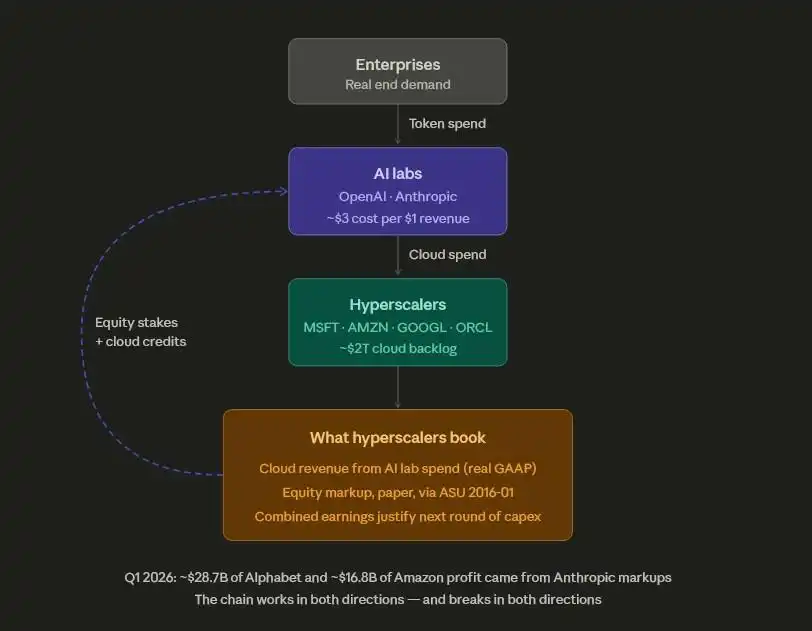
The sustainability of this system depends on AI labs' continued ability to secure external financing to fulfill cloud computing commitments, which in turn relies on enterprise customers' continued willingness to pay rising token bills.

It is reported that Anthropic currently incurs costs of $3 for every $1 of revenue. Once the pace of financing slows, the credibility of cloud revenue projections will decline, and the valuation multiples of hyperscale cloud vendors will also face re-evaluation pressure.

This chain transmits in both directions and will break in both directions.

This Isn't 1999, But the Problem is Real

The current situation does not constitute a typical bubble setup.

From a valuation multiple perspective, the Tech 7 currently trades at about 20 times forward price-to-earnings, far below the 52 times at the peak of the 2000 tech bubble, 67 times for the Japanese market in 1989, or the 34 times during the "Nifty Fifty" era.

AI technology itself is real. For heavy user groups, data on productivity gains is verifiable. OpenAI has an annualized revenue of about $20 billion, Anthropic about $4.3 billion; these two labs are not going to disappear.

Today, token cost (compute expense) has become the key determinant of AI success or failure. Six months ago, people weren't even discussing this topic.

Back then, people only cared about "whether the technology works." Now the answer is clear: in the eyes of specific jobs and specific people, the technology indeed works.

But a new question arises: Can the money saved by downstream companies using AI be transmitted upward in time to outrun the valuation window the capital market has left for AI labs and cloud giants?

Those bullish on AI believe that as long as the technology continues to mature, corporate ROI (Return on Investment) will turn positive within 1 to 1.5 years.

The bearish believe more executives will follow Macdonald's lead, publicly complaining about low AI ROI and starting to cut budgets.

Both scenarios are playing out; the outcome is undecided. The only certainty is that the old lie—"as long as token consumption is rising, it means the AI transformation is successful"—has been shattered.

High token consumption does not equal commercial value; this bubble must eventually be squeezed out. The bill for AI has come due, but who will ultimately pay for it? That remains an unknown for now.


Perguntas relacionadas

QAccording to the article, what is the major problem that enterprise AI spending is currently facing?

AThe major problem is that token consumption is rapidly increasing, but quantifiable business value is hard to find. The article states that 'the line between the growth of token consumption and substantive product improvement... does not yet exist.' Executives are finding it difficult to justify the escalating costs.

QWhat key finding did the developer platform Entelligence.AI discover regarding the value generated from AI token spending?

AEntelligence.AI found that for every dollar spent on AI token fees, only 18 cents generated tangible value that reached end-users. The rest was consumed by other costs: 44 cents for fixing AI-introduced bugs, 27 cents for rework, and 11 cents for review friction.

QWhat is the critical concern regarding the financial structure between hyperscale cloud providers and AI labs, as described in the article?

AThe concern is a potentially unsustainable, cyclical financing structure. Hyperscale cloud providers (like Microsoft, Amazon) are both equity investors in and service providers for AI labs (like OpenAI, Anthropic). The labs use cloud credits from the investments to purchase cloud compute, which the providers book as revenue. This structure depends on continuous external funding for the labs, which itself relies on enterprise clients' willingness to pay rising token bills.

QBased on the bull argument presented, what metric is the AI industry supposedly shifting towards from 'tokenmaxxing'?

AAccording to the bull argument, the industry is shifting from focusing on 'tokenmaxxing' (maximizing token consumption as a KPI) towards a healthier metric: the 'cost per effective action' or the return on investment (ROI) of AI deployments.

QWhat does the article conclude is the 'new question' now that the technical capability of AI is proven for specific tasks?

AThe new question is: 'Can the money saved by downstream companies using AI be transmitted upwards quickly enough to outpace the valuation window that capital markets have left for AI labs and cloud giants?' In other words, can the business value and cost savings materialize fast enough to justify the high costs and valuations before investor patience runs out?

Leituras Relacionadas

AI PC Battle: Bet on the Toll Booth, Not the Camp

**Title:** The AI PC Battle: Don't Bet on Sides, Bet on the Tollbooth **Summary:** The AI PC competition is moving beyond simple "x86 vs. Arm" narratives. The core investment thesis should focus on identifying which players can sustain margins, cash flow, and pricing power throughout the upgrade cycle, rather than backing a particular architecture. The opportunity is analyzed in three layers: 1. **The Advanced Foundry Tollbooth:** TSMC is positioned to collect "tolls" regardless of which chip designer wins, due to its dominant ~70% share in advanced semiconductor manufacturing, which is essential for high-end AI PC chips. 2. **Compute & Platform Spillover:** AMD represents an offensive in the x86 CPU+GPU space, while NVIDIA leverages its GPU and CUDA software stack dominance. Both benefit from the demand for increased local AI compute. 3. **Architecture Diffusion & Turnaround Plays:** ARM and Intel offer potential for significant upside (elasticity), but investments here require stricter discipline due to higher execution risks and competitive challenges. The industry is transitioning from concept to shipment validation. While short-term forecasts for AI PC adoption have been revised down slightly due to tariffs and procurement delays, the long-term trend towards AI becoming a standard PC feature remains intact. The key driver for upgrade cycles will be whether compelling enterprise applications (e.g., privacy-sensitive computing, low-latency inference) emerge beyond consumer-focused features like meeting summarization. Investment strategy should prioritize companies with platform-level advantages and recurring revenue streams. TSMC offers high certainty as the foundational tollbooth. AMD presents a strong offensive play within the established ecosystem. ARM and Intel are higher-risk, higher-potential-reward turnaround bets. The report cautions against chasing short-term hype and emphasizes a disciplined, long-term approach focused on buying ecosystem strength and cash-flow certainty after market enthusiasm subsides. **Key Risks:** Underwhelming AI PC applications slowing upgrade cycles; slow improvement in Windows on Arm compatibility; macro/tariff impacts on PC demand; potential advanced node supply-demand mismatches affecting TSMC; high overall AI sector valuations making stocks vulnerable to a risk-off shift in markets.

marsbitHá 11m

AI PC Battle: Bet on the Toll Booth, Not the Camp

marsbitHá 11m

Ten-Thousand-Word Analysis: From $10 to $290, MRVL Wins the Entire AI Era by 'Not Making GPUs'

Marvell Technology's stock price surged from under $10 in 2016 to a record $290 in June 2026, fueled not by making GPUs, but by dominating AI infrastructure connectivity. This analysis argues the market misvalues MRVL as merely a smaller Broadcom in custom AI chips, overlooking its true, unique position. Marvell's core strength lies in enabling high-speed data flow for AI clusters through three interconnected businesses. First, it holds a commanding ~70% market share in high-speed optical DSPs (essential for data center light modules), a deep-moat business with accelerating growth. Second, its custom AI chip design business serves hyperscalers like AWS, Microsoft, and Google, with a significant revenue pipeline despite lower margins. Third, stable cash flows come from Ethernet switch chips and enterprise storage controllers. Together, they form a full-stack "AI data movement" platform. CEO Matt Murphy's transformative leadership since 2016, involving strategic divestments, key acquisitions (like Inphi for optical DSPs), and securing long-term agreements with major cloud providers, repositioned the company. A pivotal $2 billion strategic investment from NVIDIA in 2026 underscored Marvell's critical role in the AI ecosystem, particularly through collaborations like NVLink Fusion. While Marvell faces risks—including client concentration (losing the Amazon Trainium3 design), lower-margin business mix, competitive threats, insider selling, and complex supply chains—its fundamentals remain strong. The optical interconnect moat is widening with the acquisition of Celestial AI (photonics fabric), and financial metrics show accelerating revenue growth and operating leverage. With a PEG ratio suggesting undervaluation relative to its growth, the thesis is that the market undervalues Marvell's monopolistic position in AI "plumbing" while overemphasizing its competitive custom chip segment. The story transcends investing, symbolizing how in any complex system—from the internet to AI—the value of "connection" ultimately surpasses that of individual "nodes."

marsbitHá 41m

Ten-Thousand-Word Analysis: From $10 to $290, MRVL Wins the Entire AI Era by 'Not Making GPUs'

marsbitHá 41m

AI Relay Stations Spark Heated Debate on Zhihu: Behind Cheap Tokens, What Are Users Really Worried About?

A discussion on Zhihu about "AI relay stations" shifted the niche developer topic of "cheap tokens" into broader user awareness. Users moved beyond simply questioning the legitimacy of these services to focus on practical concerns: Where do cheap tokens truly come from? Is the model being accessed the real one? Can relay stations see prompts, code, and API keys? For occasional users, are the risks worth it? The core debate centered less on price and more on trust. A primary worry is model authenticity—the risk of "model swapping," where users paying for a premium model might be routed to a cheaper one, creating an information asymmetry. Others argued that cost comparisons matter; while cheaper than official pay-as-you-go APIs, relay stations may not be the lowest-cost option versus subscriptions, domestic models, or free tiers, making user needs assessment crucial. Speculation about token sources ranged from legitimate bulk discounts to gray-area methods like account sharing or exploiting regional pricing. This opacity makes risk assessment difficult for users. Data security emerged as a critical concern, especially for enterprise use. When processing sensitive information like code, contracts, or client data, the inability to verify a relay station's data handling, retention, or access policies poses significant compliance and confidentiality risks. The evolving consensus suggests relay stations can be used cautiously for low-sensitivity, disposable tasks (e.g., summarizing public info, simple translation). However, they should not be the default for sensitive, professional, or production workflows involving proprietary data, Agents, or automated systems. Recommendations include avoiding large prepayments, not relying on a single service, using test prompts to monitor quality, anonymizing data where possible, and keeping official channels as backups. Ultimately, the discussion framed tokens not just as a billing unit but as a measure of real cost encompassing price, model integrity, data security, and service stability. The popularity of relay stations highlights user demand for affordable access, but the debate underscores a key trade-off: the savings from cheap tokens may come at the price of trust, transparency, and control over one's data and AI experience.

marsbitHá 1h

AI Relay Stations Spark Heated Debate on Zhihu: Behind Cheap Tokens, What Are Users Really Worried About?

marsbitHá 1h

In-Depth Research Report on TradFi: The Convergence Wave of Crypto and Traditional Finance

In 2026, the crypto industry is undergoing a profound infrastructure-level transformation—TradFi assets are migrating on-chain at an unprecedented pace. According to CoinGecko's Q1 2026 report, the total value locked (TVL) of tokenized real-world assets (RWA) has surpassed $31 billion, a nearly 4x increase from $7.8 billion at the beginning of 2025, with the sector’s aggregate market capitalization reaching $19.3 billion. Among these, the market cap of tokenized stocks surged from $2 million to $486 million, with Q1 spot trading volume reaching $15.1 billion—a single quarter already surpassing the entire second half of 2025. RWA perpetual contract Q1 trading volume reached a staggering $524.8 billion, far exceeding the $313 billion for all of 2025. Meanwhile, BlackRock's BUIDL fund has reached $2.3 billion in scale and has filed for two new tokenized funds, signaling that the world's largest asset manager's tokenization strategy is evolving from pilot to product suite expansion. HTX, as a core participant in the crypto exchange sector, officially launched TradFi perpetual futures products including NVDA, AAPL, MSFT, META, and SPY in 2026, enabling crypto users to gain 24/7 trading access to core U.S. equities. Boston Consulting Group predicts that global tokenized asset scale could reach $16 trillion by 2030, while McKinsey offers a conservative estimate of approximately $2 trillion. The on-chain migration of TradFi assets is no longer a "future narrative" but a structural transformation unfolding in real time, as crypto exchanges evolve from single crypto asset trading platforms toward "multi-asset-class trading infrastructure."

HTX LearnHá 1h

In-Depth Research Report on TradFi: The Convergence Wave of Crypto and Traditional Finance

HTX LearnHá 1h

Trading

Spot
Futuros

Artigos em Destaque

Como comprar PEOPLE

Bem-vindo à HTX.com!Tornámos a compra de ConstitutionDAO (PEOPLE) simples e conveniente.Segue o nosso guia passo a passo para iniciar a tua jornada no mundo das criptos.Passo 1: cria a tua conta HTXUtiliza o teu e-mail ou número de telefone para te inscreveres numa conta gratuita na HTX.Desfruta de um processo de inscrição sem complicações e desbloqueia todas as funcionalidades.Obter a minha contaPasso 2: vai para Comprar Cripto e escolhe o teu método de pagamentoCartão de crédito/débito: usa o teu visa ou mastercard para comprar ConstitutionDAO (PEOPLE) instantaneamente.Saldo: usa os fundos da tua conta HTX para transacionar sem problemas.Terceiros: adicionamos métodos de pagamento populares, como Google Pay e Apple Pay, para aumentar a conveniência.P2P: transaciona diretamente com outros utilizadores na HTX.Mercado de balcão (OTC): oferecemos serviços personalizados e taxas de câmbio competitivas para os traders.Passo 3: armazena teu ConstitutionDAO (PEOPLE)Depois de comprar o teu ConstitutionDAO (PEOPLE), armazena-o na tua conta HTX.Alternativamente, podes enviá-lo para outro lugar através de transferência blockchain ou usá-lo para transacionar outras criptomoedas.Passo 4: transaciona ConstitutionDAO (PEOPLE)Transaciona facilmente ConstitutionDAO (PEOPLE) no mercado à vista da HTX.Acede simplesmente à tua conta, seleciona o teu par de trading, executa as tuas transações e monitoriza em tempo real.Oferecemos uma experiência de fácil utilização tanto para principiantes como para traders experientes.

488 Visualizações TotaisPublicado em {updateTime}Atualizado em 2026.06.02

Como comprar PEOPLE

Discussões

Bem-vindo à Comunidade HTX. Aqui, pode manter-se informado sobre os mais recentes desenvolvimentos da plataforma e obter acesso a análises profissionais de mercado. As opiniões dos utilizadores sobre o preço de PEOPLE (PEOPLE) são apresentadas abaixo.

活动图片












