When the Spreads Reach 50%: The Rise of Pre-Market Crypto-Stock Arbitrage

比推Publicado em 2026-03-16Última atualização em 2026-03-16

Resumo

In the context of the crypto bear market, a new arbitrage opportunity is gaining traction: pre-IPO stock tokenization trading across different platforms. The article highlights significant price discrepancies—sometimes exceeding 50%—for high-profile companies like Kalshi, Polymarket, and SpaceX (xAI) on platforms such as PreStocks, Jarsy, and Tessera. These gaps, driven by varying trading mechanisms and liquidity conditions, reveal a strong market demand for a unified platform that bridges traditional and crypto pre-market trading. The piece argues that building such an intermediary could capitalize on these arbitrage opportunities, especially with a wave of major IPOs expected in 2026, while generating revenue through trading fees and liquidity provision.

Author: Wenser, Odaily Planet Daily

Editor: Hao Fangzhou

Original Title: Spreads Exceeding 50%, The Pre-Market Crypto-Stock Arbitrage Market to Become a New Business in the Crypto Bear Market


Not long ago, Mysten Labs CEO evan.sui shared his views on the "bear market." He mentioned that he does not agree with the so-called "the bear market is great, keep building" argument. In fact, the bear market is not "great"; packaging it as good for everyone overlooks the real costs (such as discouraging builders and users). Many retail investors and excellent teams will face cash flow breaks and have to exit, ultimately harming the long-term development of the crypto industry.

However, data evidence is inconsistent with this view. A report released by Lattice VC in October 2024 showed that at that time, over 80% of crypto startups that announced seed round financing during the 2022 bear market were still building. In other words, if project parties can ensure relative stability in personnel and funds, the bear market is indeed more conducive to project construction and development. As for the reasons, perhaps it's because project parties focus more on product development and experience optimization during a bear market; or perhaps the bear market trains project parties in various abilities to survive. In short, being in a crypto bear market, project parties determined to start a business might instead find a way out of desperation and carve their own path of development.

In view of this, we will explore the potential employment tracks and project directions in this cycle through a series of articles titled "Crypto Bear Market Startup Guide." If crypto projects are born and grow rapidly in the future as a result, Odaily Planet Daily also welcomes project parties to discuss cooperation.

Today, let's first talk about the hottest potential entrepreneurial direction at the moment besides prediction markets—the pre-market price difference market for crypto and stocks.

The Real Demand of the Pre-Market Crypto-Stock Market: Platform Differentiation and Liquidity Bridge

As an intermediate bridge connecting the crypto market and the traditional financial market, crypto-stock trading platforms have not only received high attention and active participation from crypto project parties, but global leading securities platforms including Nasdaq and the New York Stock Exchange have also ventured into it, aiming to capture the incremental market while further activating liquidity in the traditional financial market.

Furthermore, not only have listed cryptocurrency concept stocks undergone tokenization and on-chain contract transformation, but many hot concept stocks that have not yet IPOed have also been highly sought after by both the crypto market and the traditional financial market, thus giving rise to several pre-market stock tokenization trading platforms.

Considering that the capital market is about to welcome a wave of US listings this year, including OpenAI, Anthropic, SpaceX (xAI), Kalshi, Polymarket, OKX, Kraken, and a series of AI model companies, commercial aerospace companies, prediction market platforms, and crypto exchanges, 2026 is undoubtedly a "big year for IPOs."

Against the backdrop of the crypto market falling intermittently with occasional rebounds and the stock market rising everywhere节节攀升, the heat of the pre-market stock trading market further corroborates the above view—there is strong demand for pre-market trading of hot concept stocks in both the crypto market and the traditional financial market.

This is the main reason for the emergence of pre-market stock trading platforms such as PreStocks, Jarsy, and Tessera. Additionally, compared to pre-market stock trading markets in the traditional financial market such as Hiive and Nasdaq Private Market, the trading methods, purchase quotas, and entry barriers of the crypto pre-market trading market are more flexible, and the premiums are relatively higher, so many users participate enthusiastically.

But just as the same token can have different degrees of price differences on different exchanges, before the pre-market stock market temporarily introduces a mechanism similar to an oracle, whatever the reason, we can clearly see that the pricing of the same underlying stock on the different platforms mentioned above has certain price differences.

Based on the above information, we can make a judgment—the crypto market still lacks one or more "bridge platforms between pre-market stock trading markets."

This is probably a necessary step to push stock tokenization and pre-market stock tokenization further forward—a unified comprehensive platform covering pre-market trading in both traditional financial markets and crypto markets.

Below, we will take the 2 leading prediction market platforms Kalshi and Polymarket, which are recently seeking $20 billion in financing, and SpaceX (xAI), valued at $1.25 trillion, as examples to discuss the feasibility and real demand of this "entrepreneurial direction."

Comparing Pre-Market Spreads of PreStocks, Jarsy, Tessera 3 Major Platforms: Maximum Spread Rate Exceeds 50%, Price Difference Up to Nearly $150

Kalshi Pre-Market Spread: Up to $148, Spread Rate About 37%

Taking the Kalshi pre-market trading market as an example, its prices on different platforms are as follows—

PreStocks platform, the pre-market price of the stock token is about $397; (Compared to the $369 we mentioned one month ago in the article "Kalshi Trading Volume Continues to Break New Highs, What is a Reasonable Pre-Market Stock Price?" (https://www.odaily.news/zh-CN/post/5209330), it has increased by nearly $30, a increase of 7.6%)
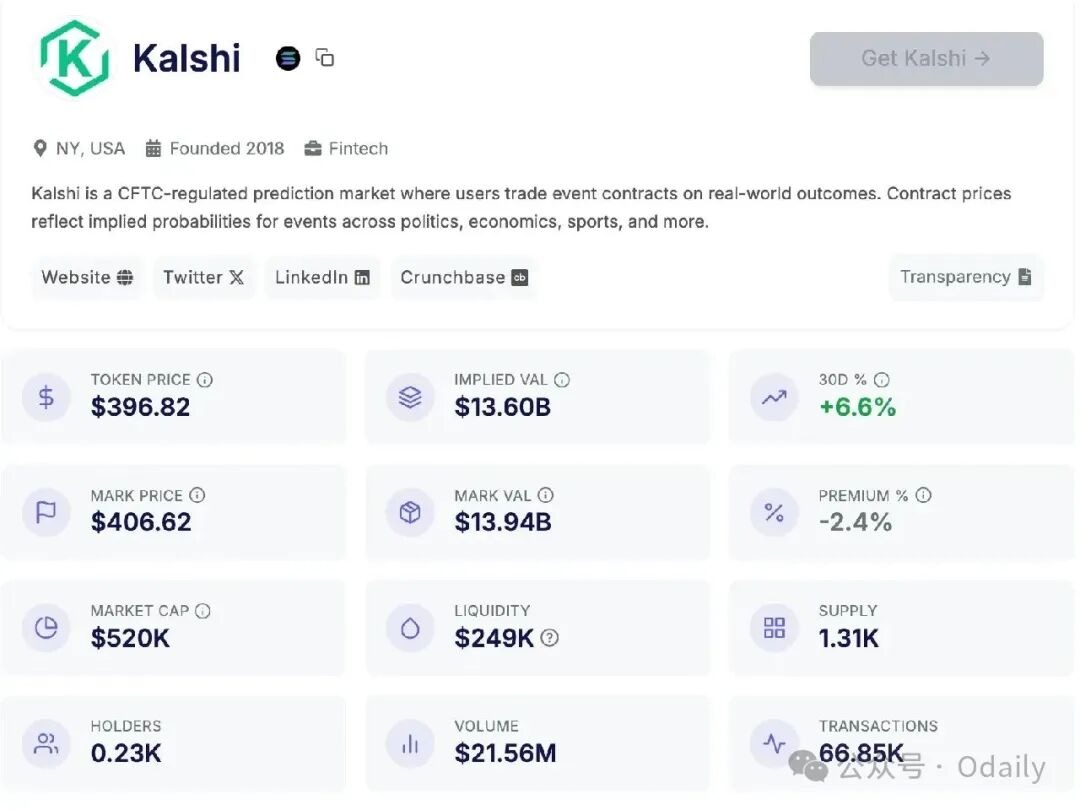
Jarsy platform, the pre-market stock price is quoted at about $545. (Compared to the $504 we mentioned one month ago in the article "Kalshi Trading Volume Continues to Break New Highs, What is a Reasonable Pre-Market Stock Price?" (https://www.odaily.news/zh-CN/post/5209330), it has increased by over $40, a increase of 8.1%)

In other words, the pre-market stock price of Kalshi has a spread of up to $148 between the two major trading platforms (Odaily Planet Daily Note: Considering that the two platforms adopt an order book trading mechanism and an on-chain liquidity token trading mechanism respectively, we are only making an abstract comparison here, temporarily not involving specific asset delivery forms, the same below). If calculated based on the $360 price of the traditional financial market pre-market trading platform Hiive, the pre-market spread is even as high as $185.

Polymarket Pre-Market Spread: Up to $94, Spread Rate Over 50%

Taking the Polymarket pre-market trading market as an example, its prices on different platforms are as follows—

PreStocks platform, the pre-market price of the stock token is about $186 (Odaily Planet Daily Note: up 23% in the past 30 days);
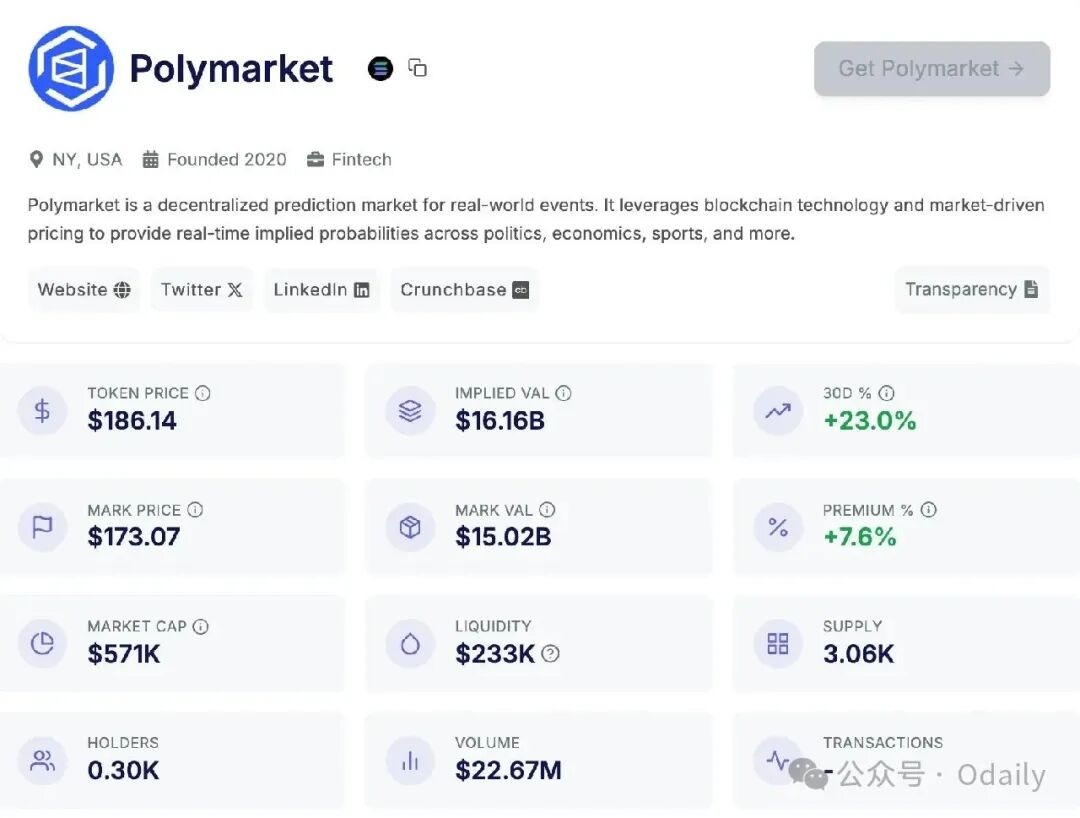
Jarsy platform, the pre-market stock price is quoted at about $280.

In other words, the pre-market stock price of Polymarket has a spread of about $94 between the 2 major platforms, with a spread rate of about 50.5%.

SpaceX(xAI) Pre-Market Spread: About $75, Spread Rate 12.7%

Taking SpaceX(xAI) as an example, its prices on different platforms are as follows—

PreStocks platform, the pre-market price of the stock token is about $666 (Odaily Planet Daily Note: up 4.1% in the past 30 days);
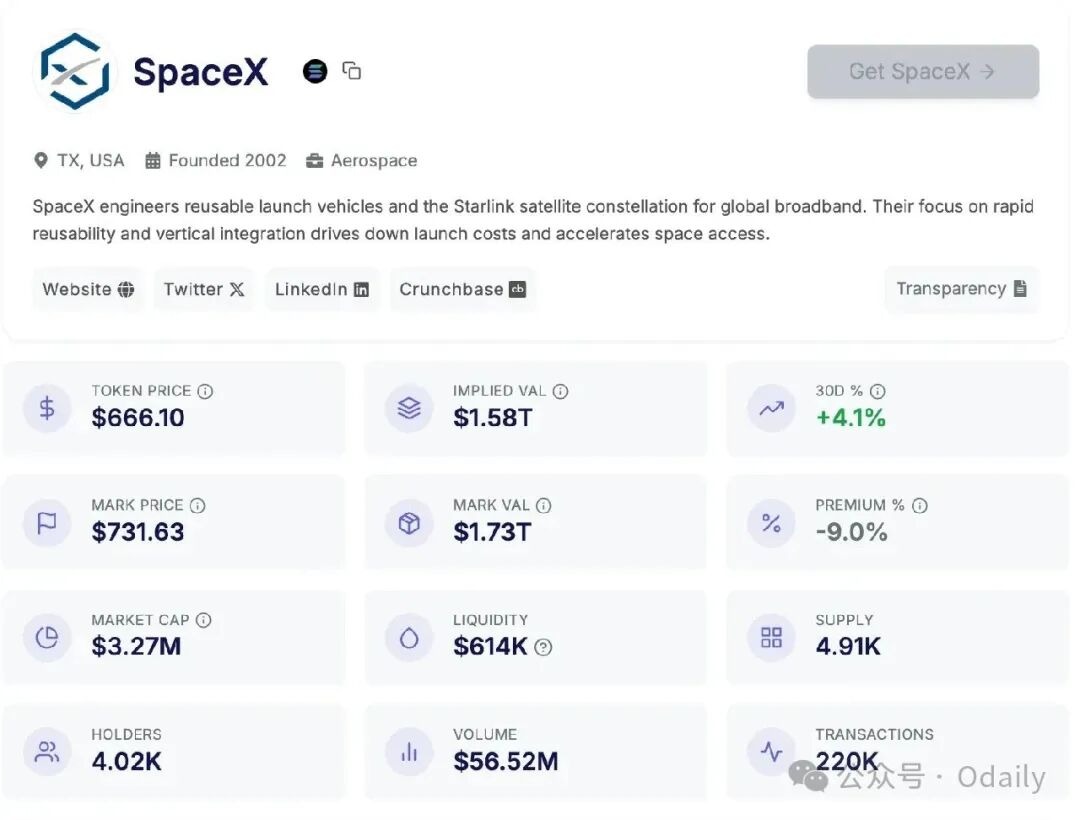
Tessera platform, the pre-market price of the stock token is temporarily reported at about $591 (Odaily Planet Daily Note: up about 14.5% in the past 30 days).
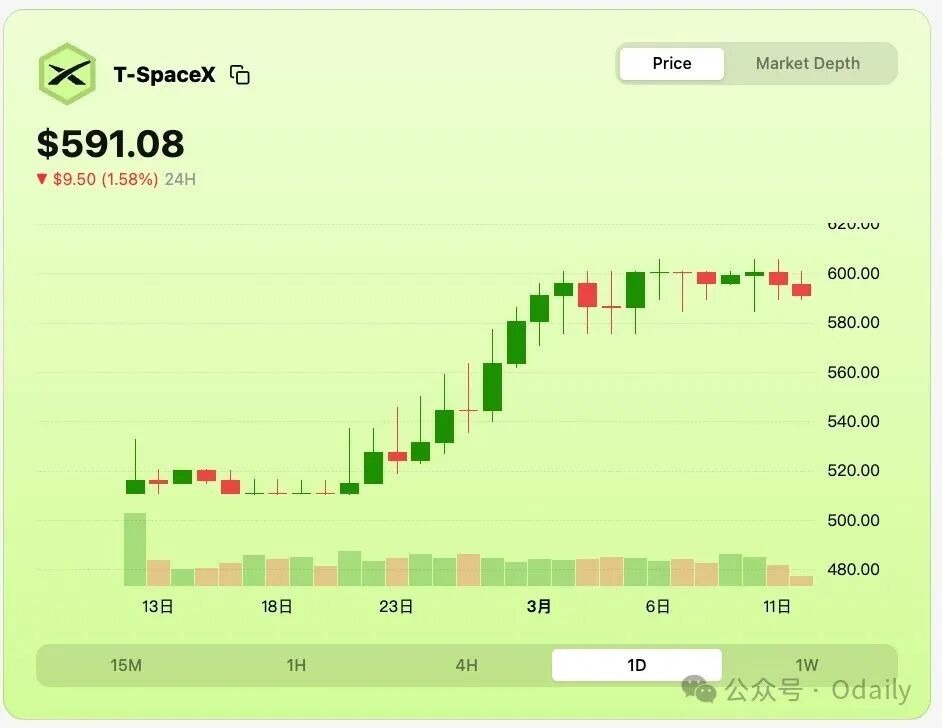
In other words, the pre-market stock price of SpaceX has a spread of about $75 between the 2 major platforms, with a spread rate of about 12.7%.

In summary, based on existing pre-market trading platforms, it might be possible to build a crypto-stock pre-market spread market to meet the trading demand and speculation demand of the market after having sufficient pre-market tokens or pre-market equity capital.

Of course, considering that the current market liquidity remains within the million-dollar level, the main business model of this platform may lie in transaction fees or LP fees, as well as the realization of price differences from the platform's own investment quotas.


Twitter:https://twitter.com/BitpushNewsCN

Bitpush TG Communication Group:https://t.me/BitPushCommunity

Bitpush TG Subscription: https://t.me/bitpush

Original link:https://www.bitpush.news/articles/7619997

Perguntas relacionadas

QWhat is the main topic of the article regarding the crypto bear market?

AThe article discusses the emergence of a new potential business opportunity in the crypto bear market: the pre-market price arbitrage market for tokenized stocks, where significant price differences (spreads) exist across different trading platforms.

QWhich companies are mentioned as examples to illustrate the price differences in the pre-market stock trading platforms?

AThe article mentions Kalshi, Polymarket, and SpaceX (xAI) as examples to illustrate the price differences on platforms like PreStocks, Jarsy, and Tessera.

QWhat was the largest price difference (spread) mentioned for Polymarket's pre-market stock, and what was the spread rate?

AFor Polymarket, the largest price difference mentioned was $94, with a spread rate of approximately 50.5%.

QAccording to the article, what is the proposed solution to address the price differences across various pre-market trading platforms?

AThe article suggests building a bridge platform or a unified comprehensive platform that connects pre-market trading in both traditional financial markets and crypto markets to arbitrage the price differences.

QWhat reason does the article give for the emergence of platforms like PreStocks, Jarsy, and Tessera?

AThese platforms emerged due to the high demand from both crypto and traditional financial markets for pre-market trading of hot concept stocks, especially with the upcoming IPO boom in 2026 involving companies like OpenAI, Anthropic, SpaceX, and others.

Leituras Relacionadas

TechFlow Intelligence: Trump-Linked Companies Transfer $12 Million in Assets Before China Visit, 'The Big Short' Protagonist Warns of Stock Market Bubble Again

The article reports multiple developments across tech, crypto, and finance. In AI, Mozilla used AI for large-scale code review, Google confirmed hackers used AI to find zero-day exploits, and OpenAI deployed GPT-5.5 to find errors in math benchmarks. A court ruled Anthropic's scanning and destroying books for AI training as fair use, while its Claude platform launched on AWS. Google's new video model 'Omni' was leaked. In crypto/Web3, Trump-linked companies transferred $12M in crypto assets before a China visit. BlackRock chose Ethereum for tokenized funds, and a hacker stole $174k via a malicious NFT that tricked an AI. Jack Dorsey's first tweet NFT plummeted from $2.9M to under $5. In chips/hardware, TSMC approved an additional $20B for its Arizona plant. Apple's Tim Cook and Elon Musk will accompany Trump to China, while Nvidia's Jensen Huang is notably absent. For markets, Michael Burry warned of parabolic stock rises and suggested near-total sell-offs, with online discussions comparing current sentiment to the 1999 bubble. Other notes include WTI oil surpassing $100, a 20% price hike for Beijing-Shanghai high-speed rail, and new products like Unitree's $26.9k humanoid robot. The underlying theme suggests AI is becoming infrastructure, creating pressure on old systems while a new order is not yet ready, leaving investors anxious.

marsbitHá 13m

TechFlow Intelligence: Trump-Linked Companies Transfer $12 Million in Assets Before China Visit, 'The Big Short' Protagonist Warns of Stock Market Bubble Again

marsbitHá 13m

2026 New Policy Interpretation: The "Mutual Pursuit" of Intelligent Agents and AI Terminals, and the Three Major Value Reconstructions in the AIoT Industry

In May 2026, China's national ministries released two pivotal policy documents that jointly establish a strategic "dual-track" framework for the AIoT industry. The "Intelligent Agent Standardized Application and Innovation Development Implementation Opinions" defines the "soul"—positioning intelligent agents as core AI products. The "Artificial Intelligence Terminal Intelligence Grading" national standard defines the "body"—establishing a four-tier capability ladder (L1 to L4) for AI hardware. This synchronized policy approach is globally unique, moving beyond market-led (US) or risk-focused (EU) models. It frames AIoT as a new type of "intelligent infrastructure," comparable to electricity or the internet in historical significance. The core analysis identifies a value evolution from IoT 1.0 (connection) to AIoT 4.0 (collaboration, represented by the forward-looking L4 level). This "L4" signifies a paradigm shift: from users operating tools to delegating tasks to agent-like devices ("Intelligent Action of All Things"). The article outlines three strategic paths for companies: becoming Standard Definers, Scenario Integrators (focusing on 19 specified application areas), or Infrastructure Builders. A critical 18-24 month window is identified for strategic positioning. A "Four Levers" strategy is proposed: leveraging Standards (L-level certification), leveraging Scenarios (deep vertical focus), leveraging Open Source (for cost reduction and ecosystem influence), and leveraging Momentum (engaging in global protocol ecosystems). In conclusion, these policies are a starting gun for a decade-long industrial transformation, shifting the industry narrative from "Intelligent Connection of All Things" to "Intelligent Action of All Things," with companies needing to choose their赛道and execution strategy decisively.

marsbitHá 1h

2026 New Policy Interpretation: The "Mutual Pursuit" of Intelligent Agents and AI Terminals, and the Three Major Value Reconstructions in the AIoT Industry

marsbitHá 1h

Splashing Out 27 Billion Yuan, OpenAI Establishes New Company to Accelerate AI Deployment

On May 11th, OpenAI announced the formation of a new company, "OpenAI Deployment Company," with an initial investment of over $4 billion (approximately 27.2 billion RMB). This venture aims to help businesses build and deploy AI solutions. OpenAI is also acquiring the AI consulting firm Toromo to rapidly scale the deployment company's capabilities. This new entity, majority-owned by OpenAI, brings together 19 investment, consulting, and system integration partners, led by TPG with co-lead founding partners including Advent International, Bain Capital, and Brookfield. OpenAI's Chief Revenue Officer, Denise Dresser, stated that while AI is becoming increasingly capable, the current challenge lies in integrating these systems into core business infrastructure and workflows. The deployment company is designed to bridge this gap and translate AI capabilities into operational impact. This move comes as OpenAI emphasizes the next competitive phase will depend on the efficiency of deploying AI in real business scenarios. The company reports over 1 million businesses already use its products and APIs. OpenAI is significantly increasing its investments in computing power, with co-founder Greg Brockman stating the company expects to spend $50 billion on compute this year, a dramatic increase from $3 million in 2017. The announcement follows OpenAI's recent completion of a record $122 billion funding round in late March, led by Amazon, Nvidia, and SoftBank, valuing the company at $852 billion post-money. Major strategic investors committed $110 billion as a base for this round. Concurrently, OpenAI is advancing its core model development. It has shifted focus from its Sora video generator to developing advanced robotics and AI models that interact with the physical world. It has also begun allowing select users access to a new model specialized in identifying software vulnerabilities and is reportedly preparing to launch an enhanced image generation model in the coming weeks. According to reports citing founder Sam Altman, OpenAI is considering an IPO as early as 2027, with a potential valuation around $1 trillion.

marsbitHá 1h

Splashing Out 27 Billion Yuan, OpenAI Establishes New Company to Accelerate AI Deployment

marsbitHá 1h

Trading

Spot
Futuros
活动图片





