When the 'Bitcoin Bible' Prophecy Meets Soaring Silver: Is the Old Theory Still Valid?

比推Publicado em 2026-01-28Última atualização em 2026-01-28

Resumo

A book published in 2018, "The Bitcoin Standard," argued that Bitcoin is a harder form of money than gold and that silver cannot serve as a reliable store of value due to its high supply elasticity—meaning production can quickly ramp up when prices rise, causing bubbles to burst, as seen in the Hunt brothers' case in the 1980s. However, eight years later, silver has surged to a record $117 per ounce, driven by structural shifts. Unlike past speculative bubbles, today’s rally is fueled by industrial demand: over 60% of silver use now comes from sectors like solar panels, electric vehicles, and AI hardware. Supply has not kept pace; mining output has declined since 2016, and inventories are shrinking. New factors, such as China’s export restrictions on refined silver, have further tightened markets. Bitcoin maximalists cite the book to defend their stance, arguing silver’s rise is temporary and that Bitcoin’s fixed supply makes it superior long-term. But current silver dynamics challenge earlier assumptions, highlighting a clash between old theories and new realities. As silver continues its rally, Bitcoin proponents await a narrative reversal.

Author: David, Shenchao TechFlow

Original Title: An 8-Year-Old Book About Bitcoin Is 'Predicting' a Silver Crash?


In 2020, MicroStrategy founder Michael Saylor read a book and decided to buy $425 million worth of Bitcoin.

This book is called "The Bitcoin Standard," published in 2018, translated into 39 languages, sold over a million copies, and is revered by Bitcoin enthusiasts as the "Bible."
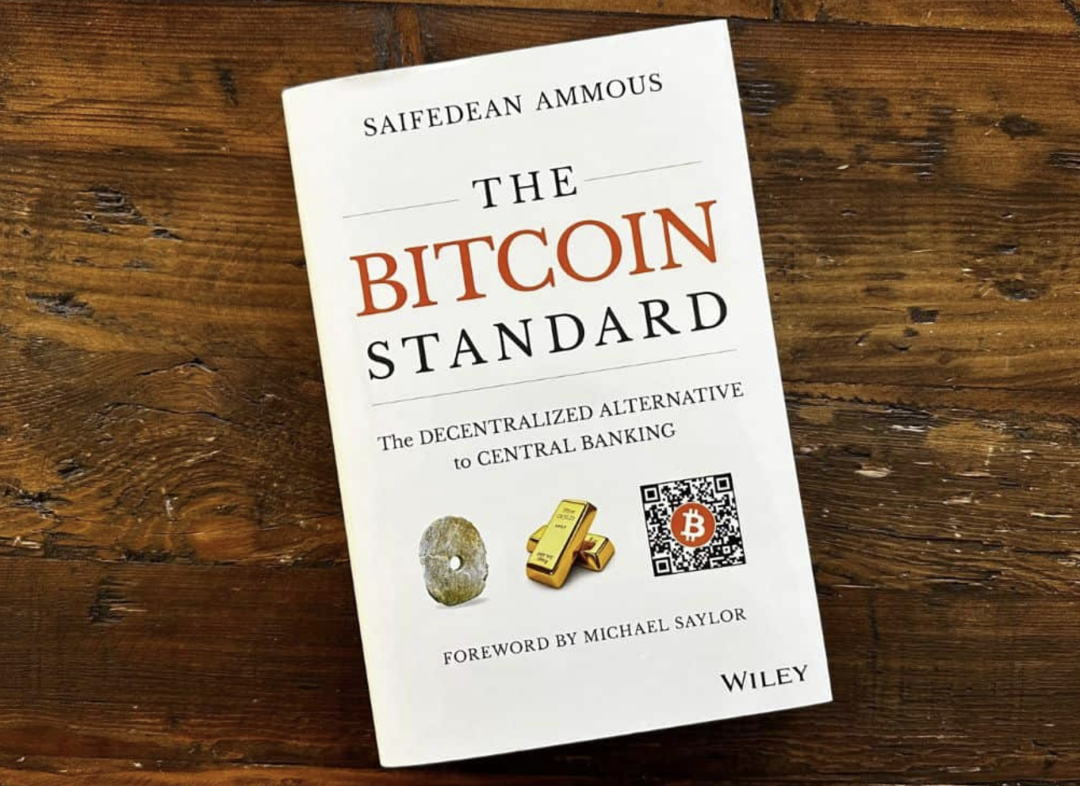
Author Saifedean Ammous, a Columbia University economics PhD, has one core argument:

Bitcoin is a "harder" form of hard currency than gold.

Meanwhile, on the book's promotional page, Michael Saylor's endorsement reads:

"This book is a work of genius. After reading it, I decided to buy $425 million worth of Bitcoin. It has had the greatest impact on MicroStrategy's way of thinking, leading us to shift our balance sheet to a Bitcoin standard."

But there is one chapter in this book that isn't about Bitcoin. It's about why silver cannot become a hard currency.

Eight years later, silver has just surged to a historic high of $117 per ounce, the investment frenzy in precious metals continues, and even Hyperliquid and a number of CEXs have begun listing precious metal contracts in various forms.

Often at times like these, there are always those who act as whistleblowers or defectors to warn of risks, especially in an environment where everything is rising except Bitcoin.

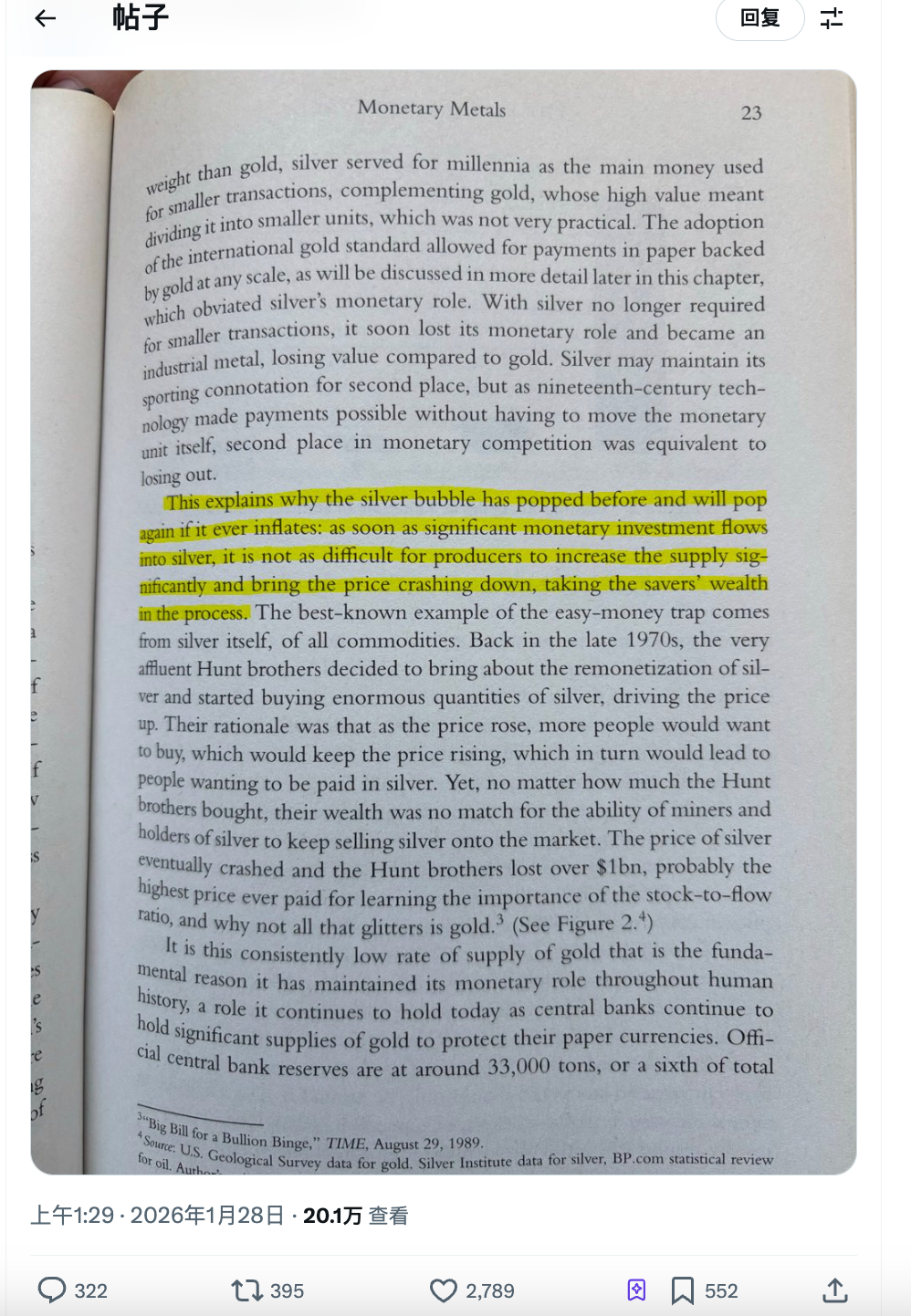
For example, a widely circulated post on Crypto Twitter today is someone quoting from this book, sharing a screenshot of page 23 with a highlighted paragraph that reads:

Every silver bubble has burst, and the next one will be no exception.
The History of Silver Speculation

Before you rush to criticize, let's look at what this core argument actually is.

The core argument in this book is called stock-to-flow. OG BTC enthusiasts have probably heard of this theory.

Translated into plain language: For something to become a "hard currency," the key is how difficult it is to increase its production.

Gold is hard to mine. Global above-ground gold stocks are about 200,000 tons, with annual new production of less than 3,500 tons. Even if the gold price doubles, miners can't suddenly dig out twice as much gold. This is called "supply rigidity."

Bitcoin is even more extreme. The total supply is capped at 21 million coins, halving every four years, and no one can change the code. This is scarcity created by algorithm.

What about silver?

The gist of that highlighted passage is: Silver bubbles have burst before and will burst again. Because once large amounts of money flow into silver, miners can easily increase supply, driving the price down, and evaporating the wealth of savers.

The author also gives an example: the Hunt brothers.

In the late 1970s, Texas oil tycoons the Hunt brothers decided to hoard silver, attempting to corner the market. They bought billions of dollars worth of silver and futures contracts, driving the price from $6 to $50, setting a then-historic high for silver.

And then? Miners疯狂出货白银 (frantically sold silver), exchanges raised margin requirements, and the silver price crashed. The Hunt brothers lost over $1 billion and eventually went bankrupt.

Therefore, the author's conclusion is:

Silver's supply elasticity is too high,注定不可能成为价值储存工具 (doomed to be unable to become a store of value). Every time someone tries to hoard it as "hard currency," the market will teach them a lesson with increased production.

When this logic was written in 2018, silver was $15 an ounce. Nobody cared.

Is This Silver Rally Different?

For the above logic about silver to hold true, there is a premise: if the silver price rises, supply can keep up.

However, data from the last 25 years tells a different story.

Global silver mine production peaked in 2016 at approximately 900 million ounces. By 2025, this number had dropped to 835 million ounces. The price increased 7-fold, but production反而缩了 7% (instead shrank by 7%).

Why doesn't the "price rise leads to production increase" logic work?

One structural reason is that about 75% of silver is produced as a by-product of copper, zinc, and lead mining. Miners' production decisions depend on the prices of these base metals, not on silver. Even if the silver price doubles, if the copper price doesn't rise, mines won't open more.

Another reason might be time. The cycle from exploration to production for a new mine project is 8 to 12 years. Even if work starts immediately, no new supply will be seen before 2030.

The result is five consecutive years of supply deficit. According to Silver Institute data, from 2021 to 2025, the global cumulative silver deficit is close to 820 million ounces, almost equivalent to a full year's global mine production.
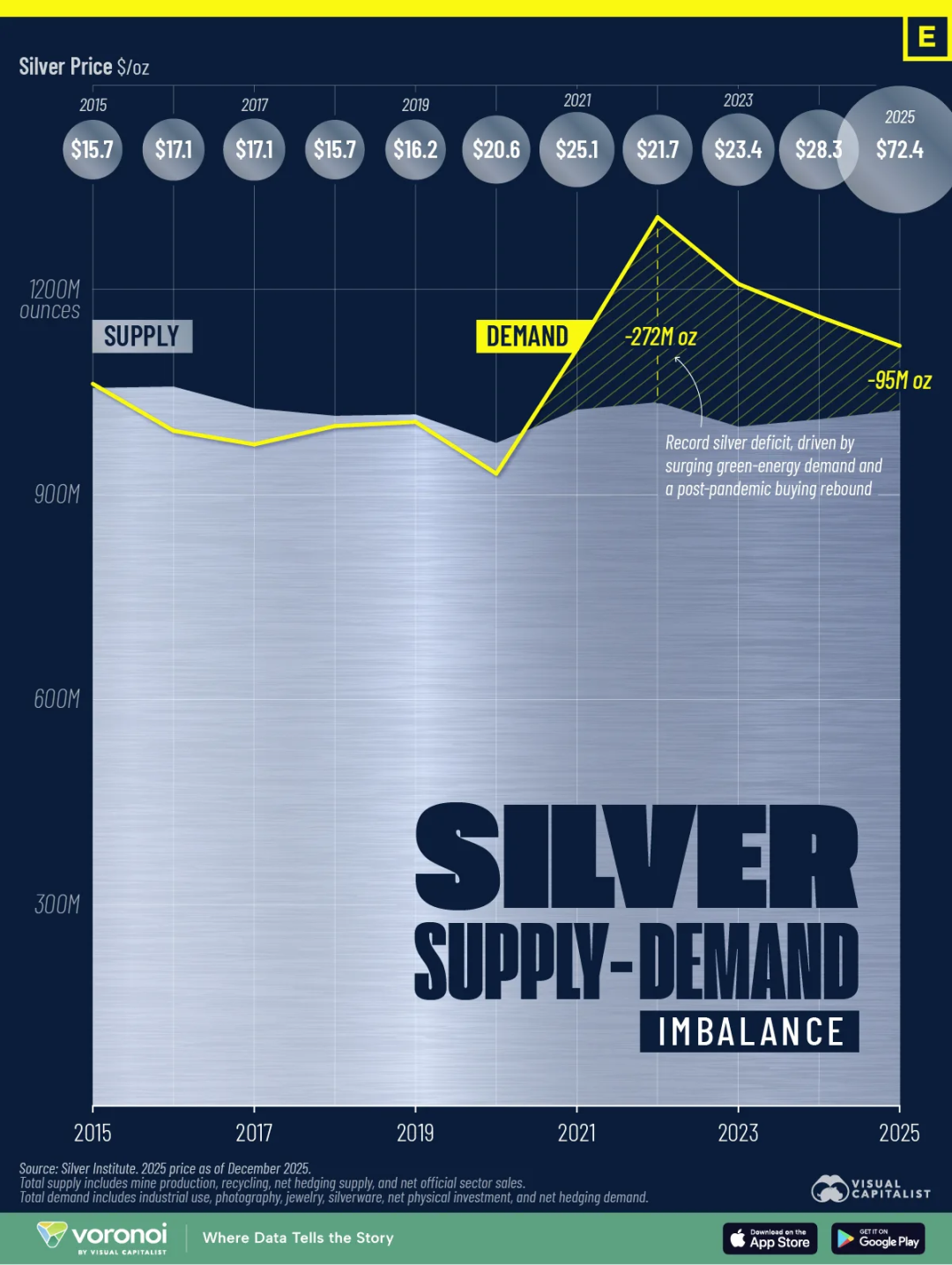
Meanwhile, silver inventories are also bottoming out. The London Bullion Market Association's deliverable silver inventory has dropped to only 155 million ounces. The silver lease rate has surged from the normal 0.3%-0.5% to 8%, meaning someone is willing to pay an 8% annualized cost just to secure physical silver.

There's also a new variable. Starting January 1, 2026, China implemented export restrictions on refined silver, with only state-owned large factories with an annual production capacity of over 80 tons able to obtain export licenses. Small and medium-sized exporters are directly shut out.

In the era of the Hunt brothers, miners and holders could use increased production and selling to smash the price.

This time, the supply side might be running out of bullets.

Speculation, but also Rigid Demand

When the Hunt brothers hoarded silver, silver was a monetary speculation. Buyers thought: the price will rise, hoard it and wait to sell.

The driving force behind the 2025 silver rally is completely different.

First, look at some data. According to the World Silver Survey 2025 report, industrial demand for silver reached 680.5 million ounces in 2024, a historical high. This number accounts for over 60% of total global demand.
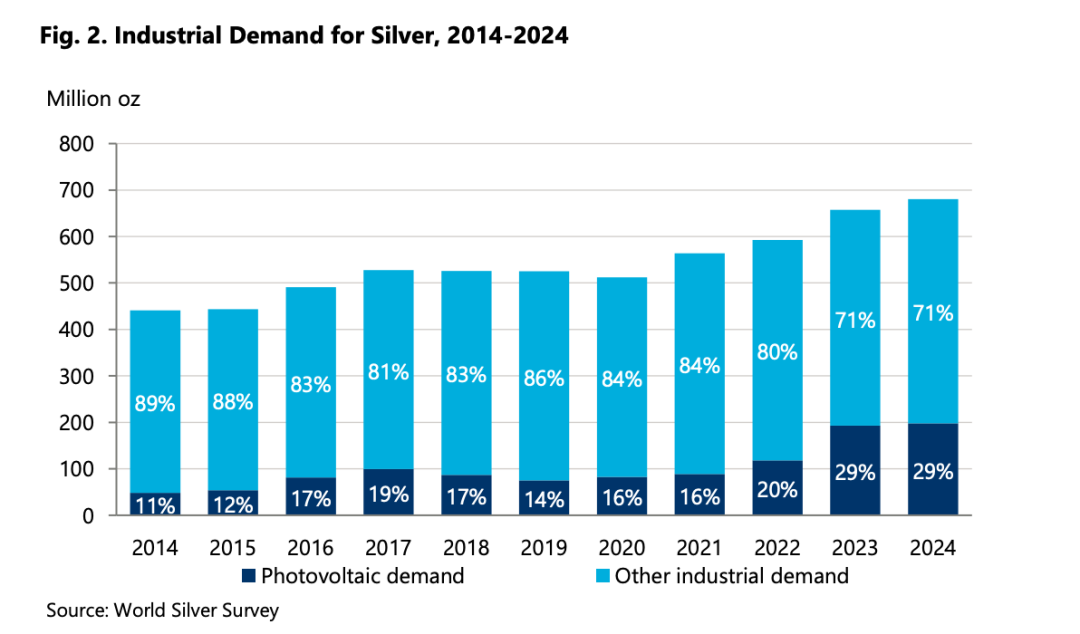
What is industrial demand buying?

Photovoltaics (PV). Every solar panel requires silver paste for its conductive layer. The International Energy Agency predicts global PV installed capacity will quadruple by 2030. The PV industry is already the single largest industrial buyer of silver.

Electric Vehicles (EVs). A traditional internal combustion engine vehicle uses about 15-28 grams of silver. An electric vehicle uses 25-50 grams, with high-end models using even more. Battery management systems, motor controllers, charging interfaces—silver is needed everywhere.

AI and Data Centers. Servers, chip packaging, high-frequency connectors—silver's conductivity and thermal conductivity are irreplaceable. This demand began accelerating in 2024, and the Silver Institute specifically listed "AI-related applications" in its report.

In 2025, the U.S. Department of the Interior listed silver on its "Critical Minerals" list. The last time this list was updated, lithium and rare earths were added.

Of course, sustained high silver prices will bring about a "silver thrifting" effect, such as some PV manufacturers already reducing the amount of silver paste per panel. But the Silver Institute's prediction is that even considering thrifting, industrial demand will remain near record levels for the next 1-2 years.

This is essentially rigid demand, a variable that Saifedean might not have foreseen when writing "The Bitcoin Standard."

A Book Can Also Provide Psychological Comfort

Bitcoin's "digital gold" narrative has recently been muted in the face of actual gold and silver.

The market has dubbed this year the "Debasement Trade": a weakening dollar, rising inflation expectations, geopolitical tensions, funds flowing into hard assets for safety. But this wave of safe-haven money chose gold and silver, not Bitcoin.

For Bitcoin maximalists, this requires an explanation.

Hence, the aforementioned book becomes a kind of classical reference for an answer and a defense of their position: silver is rising now because it's a bubble, wait for it to crash, then you'll know who was right.

This is more like a narrative self-rescue.

When the asset you hold underperforms the market for a whole year, you need a framework to explain "why I'm still right."

Short-term price doesn't matter, long-term logic does. Silver's logic is wrong, Bitcoin's logic is right, so Bitcoin must outperform, it's just a matter of time.

Is this logic consistent? Yes. Can it be falsified? Difficult.

Because you can always say "not enough time has passed."

The problem is, the real world doesn't wait. Brothers holding Bitcoin and altcoins, still坚守加密圈 (holding fast to the crypto circle), are really anxious.

A Bitcoin theory written 8 years ago cannot automatically cover the reality of not rising 8 years later.

Silver is still soaring, and we sincerely wish Bitcoin good luck.


Twitter:https://twitter.com/BitpushNewsCN

Bitpush TG Discussion Group:https://t.me/BitPushCommunity

Bitpush TG Subscription: https://t.me/bitpush

Original link:https://www.bitpush.news/articles/7606661

Criptomoedas em alta

Perguntas relacionadas

QWhat is the core argument of 'The Bitcoin Standard' regarding Bitcoin and gold?

AThe core argument of 'The Bitcoin Standard' is that Bitcoin is a harder form of 'hard currency' than gold, based on its superior stock-to-flow ratio and algorithmic scarcity.

QAccording to the book, why is silver not considered a reliable store of value?

AThe book argues that silver is not a reliable store of value because its supply is highly elastic; when prices rise, miners can easily increase production, leading to price crashes and loss of wealth for savers.

QWhat historical example does the author use to illustrate the risk of silver speculation?

AThe author uses the example of the Hunt brothers in the late 1970s, who attempted to corner the silver market but ultimately went bankrupt after miners increased supply and exchanges raised margin requirements, causing prices to collapse.

QHow has the supply dynamics of silver changed since the book was written, challenging its original thesis?

ASince the book was written, silver production has declined despite rising prices, due to structural factors like silver being a byproduct of other metals and long lead times for new mines, resulting in a sustained supply deficit.

QWhat new industrial demands are driving silver's current price surge, according to the article?

ACurrent industrial demands driving silver's price surge include its use in photovoltaic solar panels, electric vehicles, and AI/data center applications, which account for over 60% of global demand and create rigid, non-speculative needs.

Leituras Relacionadas

Must-Watch Events Next Week|CLARITY Act Could Face Senate Vote; SpaceX, Circle to Report Earnings (8.3-8.9)

**Summary: Key Events and Developments to Watch (August 3-9)** The upcoming week is marked by significant financial disclosures, key legislative deadlines, and notable product updates. **Major Financial Events:** Several companies are scheduled to release their Q2 2026 earnings. American Bitcoin (ABTC) will report on August 3, followed by SpaceX and Hut 8 Mining Corp. on August 4, and Circle on August 5. Notably, a significant portion of SpaceX shares (up to 12% of total shares) will be unlocked on August 6 following their earnings release. **Key Legislative Deadline:** The U.S. Senate faces an August 7 deadline to secure 60 votes for the CLARITY Act, a bipartisan bill aiming to establish a federal regulatory framework for cryptocurrencies. The Senate may hold a full vote on the bill during the week. **Economic Data:** The U.S. July Non-Farm Payrolls report will be released on August 7, providing crucial labor market data. **Technology & Product Updates:** * **Shutdowns:** DeFi portfolio tracker Zapper and wallet app Ctrl Wallet will cease operations on August 3. * **Upgrades:** LayerZero will deprecate its v1 relayers on August 3. XRP Ledger's new version 3.3.0, featuring five new functions, is expected next week. * **AI:** Elon Musk announced that the advanced Grok 4.6 AI model is set for release around August 7. * **Bitcoin:** The BIP-110 forced signaling for a potential Bitcoin network change is scheduled to begin around August 8. **Other Notable Events:** Chinese robotics firm Unitree Tech has set its preliminary price inquiry for its IPO for August 5. South Korean exchange Upbit will delist AQT and AERGO tokens on August 3.

marsbitHá 53m

Must-Watch Events Next Week|CLARITY Act Could Face Senate Vote; SpaceX, Circle to Report Earnings (8.3-8.9)

marsbitHá 53m

Stocks Are Plummeting More Sharply Than Cryptocurrencies. Where Has the Money Gone?

Stock Markets Plunge Deeper Than Cryptocurrencies: Where Did the Money Go? In late July, Seoul's Kospi index triggered circuit breakers for two consecutive days, plummeting over 40% from its June high. The collapse was led by heavyweight stocks like SK Hynix, whose record profits still disappointed investors, and devastating leveraged ETFs, with one major product losing over 83% of its value. This signaled a global, forced deleveraging targeting the most crowded trades. Interestingly, while stocks exhibited extreme volatility akin to crypto markets, Bitcoin rose nearly 15% in July after a prior steep drop. Analysis shows the money fleeing equities did not flow into Bitcoin. Instead, Bitcoin had already absorbed its sell-off in May-June, when U.S. spot Bitcoin ETFs saw historic outflows. The true safe-haven beneficiary was gold, whose price rose over 20% year-on-year, highlighting a decoupling between Bitcoin and gold as "digital gold." The sell-off was a targeted unwinding of leveraged positions in tech and semiconductors, accelerated by broker-dealer risk management and shifts in the AI narrative, including new competition from Chinese memory chipmakers. The retreat path was clear: from high-valuation tech stocks to cash and U.S. Treasuries, then to gold. For Bitcoin to attract sustained institutional inflows, conditions like eased global liquidity pressure, a "soft-landing" Fed rate cut, and U.S. regulatory clarity via legislation like the stalled CLARITY Act are needed. Currently, Bitcoin is not a safe haven but an already-cleared asset. Its low correlation with tech stocks, however, makes it a potential diversification play for institutional portfolios once the storm passes. The money isn't here yet, but the positioning is underway.

marsbitHá 53m

Stocks Are Plummeting More Sharply Than Cryptocurrencies. Where Has the Money Gone?

marsbitHá 53m

In Conversation with Ray Dalio: We Are Currently in an AI Bubble, with 1% of My Portfolio in Bitcoin

Ray Dalio, founder of Bridgewater Associates, warns in an interview that the current AI boom shows classic bubble characteristics, which could lead to significant economic downturns as seen in past cycles like 1929 or 2000. He explains that speculative enthusiasm, fueled by debt and overvaluation, often precedes a crash when rising rates or taxation force asset sales, causing widespread losses and recession. Dalio also outlines his "Big Cycle" theory, describing an approximate 80-year pattern where widening wealth gaps, massive government deficits, and shifting geopolitical power (like China's rise) create internal conflict and global instability. He emphasizes that we are in a late-cycle, transitional phase where traditional powers like the US and UK face decline. For personal wealth protection, Dalio advises diversification beyond cash into assets like stocks, bonds, real estate, and particularly gold, which he prefers over Bitcoin. While he holds about 1% of his portfolio in Bitcoin as a non-printable hard asset, he views gold as more secure from technological or governmental threats. Regarding AI's impact, Dalio believes it will disproportionately benefit capital owners, worsening inequality by replacing both physical and cognitive labor. He suggests that human intuition and emotional intelligence, combined with AI, will be key for future workers. On taxation, Dalio argues that wealth taxes are impractical and risk triggering asset sell-offs, reducing productive investment. He points to the UK as a cautionary example of debt, low productivity, and political strife. Geopolitically, Dalio foresees a more regionalized world, with the US showing weakness in prolonged conflicts like with Iran, akin to past imperial declines. The ideal outcome, he suggests, is coexisting powerful blocs (e.g., Americas, China-Asia Pacific) without major war.

marsbitHá 4h

In Conversation with Ray Dalio: We Are Currently in an AI Bubble, with 1% of My Portfolio in Bitcoin

marsbitHá 4h

Daily 7.2 Trillion KRW: Foreign Capital's Record Net Buying on Friday! Wall Street Says Headwinds for Korean Stock Fund Flows Have Subsided

South Korean stock market sees a dramatic shift in fund flows. On July 31, foreign investors made a record net purchase of approximately KRW 7.2 trillion in KOSPI stocks, marking a fundamental reversal from the persistent large-scale net outflows seen in previous months. This contributed to a significant narrowing of foreign net selling in July to KRW 9.8 trillion, down sharply from KRW 48.4 trillion in June and KRW 44.5 trillion in May. Simultaneously, domestic institutional pressure eased. South Korean pension funds and asset managers turned to a net buying position in July, purchasing KRW 1.0 trillion worth of KOSPI shares, contrasting with net sales in May and June. Market volatility is expected to be dampened by new financial regulations. Effective July 31, the Financial Services Commission tightened access for retail investors to single-stock leveraged ETFs by raising the minimum cash deposit requirement. Trading volumes for these products subsequently dropped to about 50% of their monthly average. Citigroup Research maintains its year-end KOSPI target of 10,000 points. The firm cites several supportive factors: the substantial easing of headwinds from capital outflows, a robust fundamental outlook for the semiconductor sector, historically low market valuations, strong economic fundamentals, and the potential for policy support from financial authorities if needed.

marsbitHá 4h

Daily 7.2 Trillion KRW: Foreign Capital's Record Net Buying on Friday! Wall Street Says Headwinds for Korean Stock Fund Flows Have Subsided

marsbitHá 4h

Trading

Spot

Artigos em Destaque

O que é BITCOIN

Compreender o HarryPotterObamaSonic10Inu (ERC-20) e a Sua Posição no Espaço Cripto Nos últimos anos, o mercado de criptomoedas assistiu a um aumento na popularidade das moedas meme, cativando não apenas os traders, mas também aqueles que procuram envolvimento comunitário e valor de entretenimento. Entre estes tokens únicos está o HarryPotterObamaSonic10Inu (ERC-20), um projeto intrigante que mistura referências culturais no tecido das criptomoedas. Este artigo explora os principais aspetos do HarryPotterObamaSonic10Inu, examinando os seus mecanismos, a sua ética orientada pela comunidade e o seu envolvimento com o vasto panorama cripto. O que é o HarryPotterObamaSonic10Inu (ERC-20)? Como o nome sugere, o HarryPotterObamaSonic10Inu é uma moeda meme construída na blockchain Ethereum, classificada sob o padrão ERC-20. Ao contrário das criptomoedas tradicionais, que podem enfatizar a utilidade prática ou o potencial de investimento, este token prospera no valor de entretenimento e na força da sua comunidade. O projeto visa promover um ambiente onde utilizadores envolvidos possam reunir-se, partilhar ideias e participar em atividades inspiradas por diversos fenómenos culturais. Uma característica notável do HarryPotterObamaSonic10Inu é a zero taxa sobre transações. Este elemento atraente visa encorajar a negociação e o envolvimento da comunidade, isento de encargos adicionais que podem desencorajar os traders de pequena escala. A oferta total da moeda está fixada em mil milhões de tokens, uma cifra que marca a sua intenção de manter uma circulação substancial dentro da comunidade. Criador do HarryPotterObamaSonic10Inu (ERC-20) As origens do HarryPotterObamaSonic10Inu estão um pouco envoltas em mistério; os detalhes sobre o criador permanecem desconhecidos. O desenvolvimento deste token carece de uma equipa identificável ou de um plano explícito, o que não é raro no setor das moedas meme. Em vez disso, o projeto surgiu de forma orgânica, com o seu progresso a depender fortemente do entusiasmo e da participação da sua comunidade. Investidores do HarryPotterObamaSonic10Inu (ERC-20) No que diz respeito a investimentos externos e apoios, o HarryPotterObamaSonic10Inu também permanece ambíguo. O token não lista quaisquer fundações de investimento conhecidas ou apoio organizacional significativo. Em vez disso, o “sangue vital” do projeto é a sua comunidade de base, que informa o seu crescimento e sustentabilidade através da ação coletiva e do envolvimento no espaço cripto. Como Funciona o HarryPotterObamaSonic10Inu (ERC-20)? Como uma moeda meme, o HarryPotterObamaSonic10Inu opera principalmente fora dos quadros tradicionais que muitas vezes governam o valor dos ativos. Existem vários aspetos distintivos que definem como o projeto funciona: Transações Sem Taxas: Sem taxas sobre transações, os utilizadores podem comprar e vender o token livremente, sem a preocupação de custos ocultos. Envolvimento da Comunidade: O projeto prospera na interação da comunidade, aproveitando plataformas de redes sociais para criar entusiasmo e facilitar a participação. Discussões, partilha de conteúdo e envolvimento são elementos cruciais que ajudam a expandir o seu alcance e a fomentar a lealdade entre os apoiantes. Sem Utilidade Prática: Deve ser notado que o HarryPotterObamaSonic10Inu não oferece utilidade concreta dentro do ecossistema financeiro. Em vez disso, é classificado como um token principalmente para entretenimento e atividades comunitárias. Referência Cultural: O token incorpora de forma inteligente elementos da cultura popular para atrair interesse, conectando-se tanto com entusiastas de memes como com seguidores de criptomoedas. HarryPotterObamaSonic10Inu exemplifica como as moedas meme operam de forma diferente de projetos de criptomoedas mais tradicionais, entrando no mercado como construções sociais inovadoras em vez de ativos utilitários. Linha do Tempo do HarryPotterObamaSonic10Inu (ERC-20) A história do HarryPotterObamaSonic10Inu é marcada por vários marcos notáveis: Criação: O token surgiu de um meme viral, capturando a imaginação de muitos entusiastas de criptomoedas. Datas específicas de criação não estão disponíveis, sublinhando a sua ascensão orgânica. Listagem em Exchanges: O HarryPotterObamaSonic10Inu conseguiu entrar em várias exchanges, permitindo um acesso e negociação mais fáceis pela comunidade. Iniciativas de Envolvimento da Comunidade: Atividades contínuas direcionadas a melhorar a interação comunitária, incluindo concursos, campanhas em redes sociais e geração de conteúdo por fãs e defensores. Planos de Expansão Futura: O roteiro do projeto inclui o lançamento de uma coleção de NFTs, mercadorias e um site de eCommerce relacionado aos seus temas culturais, envolvendo ainda mais a comunidade e tentando adicionar mais dimensões ao seu ecossistema. Pontos-Chave sobre o HarryPotterObamaSonic10Inu (ERC-20) Natureza Orientada pela Comunidade: O projeto prioriza a contribuição coletiva e a criatividade, assegurando que o envolvimento dos utilizadores está na vanguarda do seu desenvolvimento. Classificação como Moeda Meme: Representa o epítome da criptomoeda baseada em entretenimento, destacando-se dos veículos de investimento tradicionais. Sem Afiliação Direta com o Bitcoin: Apesar da semelhança no nome do ticker, o HarryPotterObamaSonic10Inu é distinto e não tem qualquer relação com o Bitcoin ou outras criptomoedas estabelecidas. Foco na Colaboração: O HarryPotterObamaSonic10Inu é projetado para criar um espaço de colaboração e partilha de histórias entre os seus detentores, proporcionando uma via para a criatividade e o fortalecimento da comunidade. Perspectivas Futuras: A ambição de expandir além da sua premissa inicial para NFTs e mercadorias delineia um caminho para o projeto potencialmente entrar em avenidas mais mainstream dentro da cultura digital. À medida que as moedas meme continuam a capturar a imaginação da comunidade cripto, HarryPotterObamaSonic10Inu (ERC-20) destaca-se devido aos seus laços culturais e abordagem centrada na comunidade. Embora possa não se encaixar no molde típico de um token orientado para utilidade, a sua essência reside na alegria e camaradagem fomentadas entre os seus apoiantes, destacando a natureza em evolução das criptomoedas em uma era cada vez mais digital. À medida que o projeto continua a desenvolver-se, será importante observar como as dinâmicas comunitárias influenciam a sua trajetória no panorama em constante mudança da tecnologia blockchain.

2.0k Visualizações TotaisPublicado em {updateTime}Atualizado em 2024.12.03

O que é BITCOIN

Como comprar BTC

Bem-vindo à HTX.com!Tornámos a compra de Bitcoin (BTC) simples e conveniente.Segue o nosso guia passo a passo para iniciar a tua jornada no mundo das criptos.Passo 1: cria a tua conta HTXUtiliza o teu e-mail ou número de telefone para te inscreveres numa conta gratuita na HTX.Desfruta de um processo de inscrição sem complicações e desbloqueia todas as funcionalidades.Obter a minha contaPasso 2: vai para Comprar Cripto e escolhe o teu método de pagamentoCartão de crédito/débito: usa o teu visa ou mastercard para comprar Bitcoin (BTC) instantaneamente.Saldo: usa os fundos da tua conta HTX para transacionar sem problemas.Terceiros: adicionamos métodos de pagamento populares, como Google Pay e Apple Pay, para aumentar a conveniência.P2P: transaciona diretamente com outros utilizadores na HTX.Mercado de balcão (OTC): oferecemos serviços personalizados e taxas de câmbio competitivas para os traders.Passo 3: armazena teu Bitcoin (BTC)Depois de comprar o teu Bitcoin (BTC), armazena-o na tua conta HTX.Alternativamente, podes enviá-lo para outro lugar através de transferência blockchain ou usá-lo para transacionar outras criptomoedas.Passo 4: transaciona Bitcoin (BTC)Transaciona facilmente Bitcoin (BTC) no mercado à vista da HTX.Acede simplesmente à tua conta, seleciona o teu par de trading, executa as tuas transações e monitoriza em tempo real.Oferecemos uma experiência de fácil utilização tanto para principiantes como para traders experientes.

4.5k Visualizações TotaisPublicado em {updateTime}Atualizado em 2026.06.02

Como comprar BTC

O que é $BITCOIN

OURO DIGITAL ($BITCOIN): Uma Análise Abrangente Introdução ao OURO DIGITAL ($BITCOIN) OURO DIGITAL ($BITCOIN) é um projeto baseado em blockchain que opera na rede Solana, com o objetivo de combinar as características dos metais preciosos tradicionais com a inovação das tecnologias descentralizadas. Embora partilhe um nome com o Bitcoin, frequentemente referido como “ouro digital” devido à sua percepção como uma reserva de valor, o OURO DIGITAL é um token separado projetado para criar um ecossistema único dentro da paisagem Web3. O seu objetivo é posicionar-se como um ativo digital alternativo viável, embora os detalhes sobre as suas aplicações e funcionalidades ainda estejam em desenvolvimento. O que é o OURO DIGITAL ($BITCOIN)? OURO DIGITAL ($BITCOIN) é um token de criptomoeda explicitamente projetado para uso na blockchain Solana. Em contraste com o Bitcoin, que fornece um papel amplamente reconhecido como armazenamento de valor, este token parece focar em aplicações e características mais amplas. Aspectos notáveis incluem: Infraestrutura Blockchain: O token é construído na blockchain Solana, conhecida pela sua capacidade de lidar com transações de alta velocidade e baixo custo. Dinâmicas de Oferta: O OURO DIGITAL tem um fornecimento máximo limitado a 100 quatrilhões de tokens (100P $BITCOIN), embora os detalhes sobre o seu fornecimento circulante ainda não tenham sido divulgados. Utilidade: Embora as funcionalidades precisas não estejam explicitamente delineadas, existem indicações de que o token poderia ser utilizado para várias aplicações, potencialmente envolvendo aplicações descentralizadas (dApps) ou estratégias de tokenização de ativos. Quem é o Criador do OURO DIGITAL ($BITCOIN)? Neste momento, a identidade dos criadores e da equipa de desenvolvimento por trás do OURO DIGITAL ($BITCOIN) permanece desconhecida. Esta situação é típica entre muitos projetos inovadores no espaço da blockchain, particularmente aqueles alinhados com finanças descentralizadas e fenómenos de moedas meme. Embora tal anonimato possa fomentar uma cultura orientada pela comunidade, intensifica as preocupações sobre governança e responsabilidade. Quem são os Investidores do OURO DIGITAL ($BITCOIN)? As informações disponíveis indicam que o OURO DIGITAL ($BITCOIN) não tem apoiantes institucionais conhecidos ou investimentos proeminentes de capital de risco. O projeto parece operar num modelo peer-to-peer focado no apoio e adoção da comunidade, em vez de rotas de financiamento tradicionais. A sua atividade e liquidez estão principalmente situadas em exchanges descentralizadas (DEXs), como a PumpSwap, em vez de plataformas de negociação centralizadas estabelecidas, destacando ainda mais a sua abordagem de base. Como Funciona o OURO DIGITAL ($BITCOIN) A mecânica operacional do OURO DIGITAL ($BITCOIN) pode ser elaborada com base no seu design de blockchain e nas características da rede: Mecanismo de Consenso: Ao aproveitar o exclusivo proof-of-history (PoH) da Solana combinado com um modelo de proof-of-stake (PoS), o projeto assegura uma validação eficiente das transações, contribuindo para o alto desempenho da rede. Tokenomics: Embora mecanismos deflacionários específicos não tenham sido extensivamente detalhados, o vasto fornecimento máximo de tokens implica que pode atender a microtransações ou casos de uso de nicho que ainda estão por definir. Interoperabilidade: Existe o potencial para integração com o ecossistema mais amplo da Solana, incluindo várias plataformas de finanças descentralizadas (DeFi). No entanto, os detalhes sobre integrações específicas permanecem não especificados. Cronologia de Eventos Chave Aqui está uma cronologia que destaca marcos significativos relacionados ao OURO DIGITAL ($BITCOIN): 2023: O lançamento inicial do token ocorre na blockchain Solana, marcado pelo seu endereço de contrato. 2024: O OURO DIGITAL ganha visibilidade ao tornar-se disponível para negociação em exchanges descentralizadas como a PumpSwap, permitindo que os utilizadores o negociem contra SOL. 2025: O projeto testemunha atividade de negociação esporádica e potencial interesse em envolvimentos liderados pela comunidade, embora não tenham sido documentadas parcerias ou avanços técnicos notáveis até ao momento. Análise Crítica Forças Escalabilidade: A infraestrutura subjacente da Solana suporta altos volumes de transações, o que pode aumentar a utilidade do $BITCOIN em vários cenários de transação. Acessibilidade: O potencial preço de negociação baixo por token pode atrair investidores de retalho, facilitando uma participação mais ampla devido a oportunidades de propriedade fracionada. Riscos Falta de Transparência: A ausência de apoiantes, desenvolvedores ou um processo de auditoria publicamente conhecidos pode gerar ceticismo em relação à sustentabilidade e confiabilidade do projeto. Volatilidade do Mercado: A atividade de negociação depende fortemente do comportamento especulativo, o que pode resultar em volatilidade significativa dos preços e incerteza para os investidores. Conclusão O OURO DIGITAL ($BITCOIN) surge como um projeto intrigante, mas ambíguo, dentro do ecossistema em rápida evolução da Solana. Embora tente aproveitar a narrativa do “ouro digital”, a sua divergência do papel estabelecido do Bitcoin como reserva de valor sublinha a necessidade de uma diferenciação mais clara da sua utilidade pretendida e estrutura de governança. A aceitação e adoção futuras dependerão provavelmente da abordagem da atual opacidade e da definição mais explícita das suas estratégias operacionais e económicas. Nota: Este relatório abrange informações sintetizadas disponíveis até outubro de 2023, e desenvolvimentos podem ter ocorrido além do período de pesquisa.

242 Visualizações TotaisPublicado em {updateTime}Atualizado em 2025.05.13

O que é $BITCOIN

Discussões

Bem-vindo à Comunidade HTX. Aqui, pode manter-se informado sobre os mais recentes desenvolvimentos da plataforma e obter acesso a análises profissionais de mercado. As opiniões dos utilizadores sobre o preço de BTC (BTC) são apresentadas abaixo.

活动图片














