When Migration Becomes the Norm: Why 'Your Own EVM Chain' Is Becoming Standard

marsbitPublicado em 2026-02-05Última atualização em 2026-02-05

Resumo

In the past year, the industry's real "voting" has shifted from governance forums to deployment scripts, migration plans, and budgets. Projects are choosing ecosystems through action, not words—migrating mainnets, prioritizing tool stacks, and betting on networks with stronger market effects. A prime example is Noble, a leading stablecoin infrastructure in Cosmos, which moved to its own EVM L1, signaling that the main battleground for stablecoins and app distribution remains in EVM ecosystem due to its mature developer tools, wallet/dApp ecosystem, and concentrated liquidity. The trend toward "having your own EVM chain" is becoming standard. While EVM offers clear advantages in assets, integrations, and tools, generic chains come with constraints like fee volatility, congestion, and shared sequencing. Application chains/rollups allow teams to internalize these constraints—tailoring block times, execution models, and infrastructure to their business needs, and aligning transaction revenue with growth incentives. Rollup-as-a-Service (RaaS) platforms like Caldera are reducing the high costs and complexity of building and maintaining chains, turning "chain-as-a-product" into a replicable strategy. They focus not just on deployment but also on solving interoperability challenges—e.g., via Caldera's Metalayer, which standardizes cross-chain bridging and integration to reduce friction for users and developers. As migration to EVM continues, the focus shifts from "which chain to c...

Over the past year, the most genuine "voting" in the crypto industry has increasingly occurred not in governance forums, but in deployment scripts, migration plans, and budget sheets. Project teams no longer express their stance through slogans; instead, they choose ecosystems through actions: where to migrate their mainnet, which toolstack to prioritize for the next phase of product adaptation, and which network effect-stronger market to bet their liquidity and partnerships on.

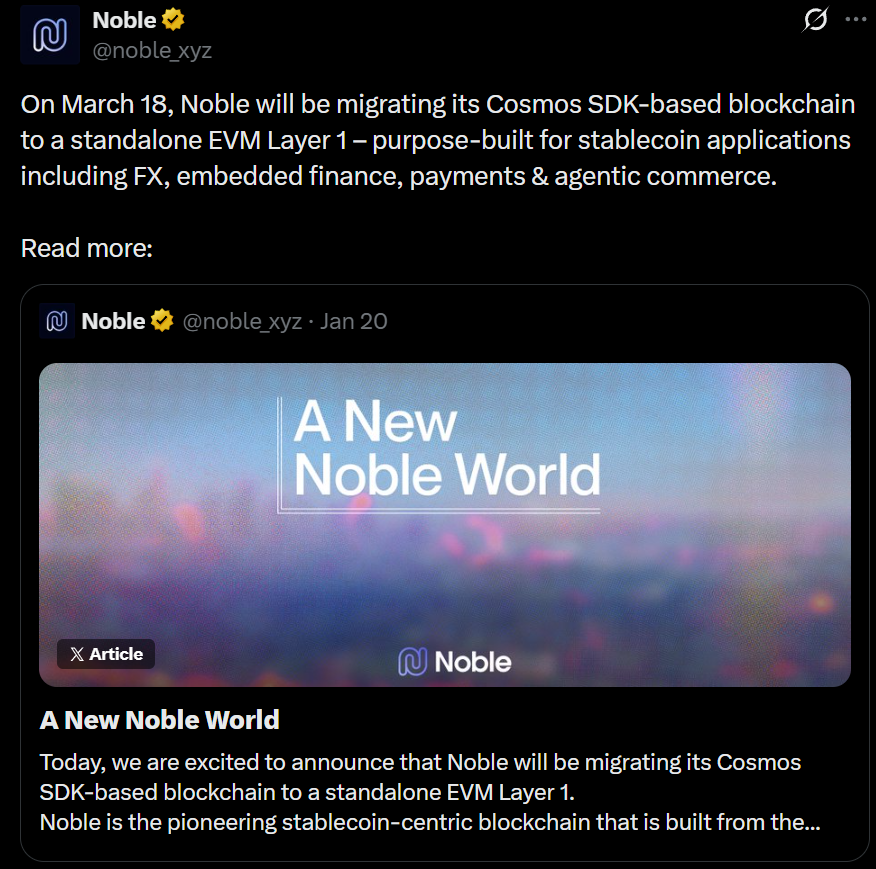
Noble's pivot is a typical case. As one of the most successful stablecoin infrastructures in the Cosmos ecosystem, it once handled the issuance and cross-chain distribution of native USDC and connected numerous chains and stablecoin settlement scenarios via IBC. But when it announced its migration to an independent EVM L1 and deeply tied its stablecoin products and network value capture mechanisms, the signal was clear enough: the main battlefield for stablecoins, settlement, and application distribution remains in EVM. Stablecoin market share is highly concentrated in EVM, and developer tools and wallet/dApp ecosystems are more mature. But this doesn't mean that "going EVM" equals "squeezing into some general-purpose chain" and everything is settled. On the contrary, while more and more teams are moving towards EVM, they are beginning to redefine a question: are we choosing a chain, or are we choosing a growth method?
Why Will 'Your Own EVM Chain' Become More Common?

First, the advantages of EVM remain clear: larger stablecoin and asset volume, more comprehensive integration targets, and more mature developer tools. This determines that many applications ultimately still want to complete their growth and distribution within EVM. But on the other hand, on general-purpose chains, applications often have to accept a series of exogenous constraints: fee volatility, congestion, shared sequencing environment, unified upgrade schedules, and the resulting uncontrollable user experience. The appeal of appchains/rollups lies in "internalizing" these constraints—teams can choose block times, execution models, RPC, and infrastructure configurations more suitable for their business characteristics, and more tightly bind transaction revenue and incentive design to their own network and product growth.

In other words, the industry is shifting from "choosing a chain and adapting to it" to "choosing an architecture and shaping it." When the cost of this path is significantly reduced, "having your own EVM chain" becomes more like a replicable product strategy rather than a high-stakes gamble.

Rollup as a Service Is Turning 'Building Your Own Chain' from a Heavy Asset into a Standard Move

What hinders the adoption of the appchain model is not "unclear value," but "construction and operation are too expensive." From chain setup, security, operation, monitoring, to cross-chain, bridging, message passing, and user onboarding paths, each item implies high human and time costs. For most teams, even if they recognize "chain as a product," they might be deterred by engineering complexity. This is also the background against which Rollup as a Service (RaaS) comes to the forefront: it productizes deployment, hosting, maintenance, and part of the security engineering, allowing teams to focus their energy back on the application itself—functionality, ecosystem partnerships, growth, and commercialization.

Taking Caldera as an example, its core narrative and roadmap are quite typical: early on, it lowered the barrier to rollup deployment to a more affordable level through its Rollup Engine; and after the number of rollups grew rapidly, it further focused on "how to smooth out fragmentation." Caldera calls this layer the Metalayer: hoping to equip new chains with more complete interconnection capabilities from the start, including fast bridging, aggregation, and developer SDKs, reducing the integration and time costs teams would otherwise spend separately connecting with multiple suppliers. Behind this is a very realistic judgment: the real bottleneck of the appchain model is not "whether a chain can be built," but "does having your own chain impact user experience?" If user onboarding, cross-chain, and interaction paths are smooth enough, the sovereignty and controllable experience of appchains/rollups become more attractive; conversely, interoperability and liquidity fragmentation will offset the benefits of "lower gas fees and higher performance."

After the Distribution Logic Changes, 'Interconnection' Becomes Growth Infrastructure

When the barrier to "building your own chain" is lowered by RaaS, a new problem becomes more prominent: chains can be created more easily, but users and funds may not come in more easily. For most applications, the real growth loss often occurs before use—how many steps for onboarding, how long to wait for cross-chain, whether fees are transparent, what to do if it fails. Funds are scattered across Ethereum mainnet, various L2s, exchanges, and other ecosystems; user entry points also come from wallets, aggregators, centralized channels, or dApp jumps. In this distribution landscape, cross-chain and onboarding paths are essentially part of the conversion funnel; the greater the friction, the more likely new users are consumed "before reaching the product."

Precisely because interconnection begins to affect conversion and retention, the competitive focus of RaaS is shifting from "can you launch a chain with one click" to "can you prevent the chain from becoming an island." Some infrastructure teams are also extending their focus from deployment capabilities to the productization of the interconnection layer: taking Caldera as an example, in addition to providing rollup deployment and operation capabilities, it has also made interconnection one of its core directions by launching Metalayer, hoping to preemptively and standardize the integration of cross-chain, bridging, and related toolchains as much as possible, so that new chains are equipped with smoother asset entry and cross-network flow paths from the start, rather than patching them up sporadically after launch. For project teams, this means fewer vendor assemblies, shorter integration cycles, and more controllable user experiences; for users, it means fewer "multiple-choice questions" and less operational friction. Only after interconnection friction decreases can the sovereignty and controllable experience of appchains/rollups not be offset by cross-chain complexity, making it easier to replicate success on a larger scale.

The Next Generation Standard Is Not 'Where to Migrate To,' but 'Taking Growth into Your Own Hands'

As more and more projects move closer to EVM, the industry's decision-making focus is also changing: from "which chain to choose to side with" to "choosing a more effective growth and delivery method." EVM's advantages as a distribution market still hold, but if a business remains on a general-purpose chain long-term, key experiences become more dependent on the external environment: fee volatility caused by congestion, queuing and failure rates due to shared execution, and upgrade and parameter constraints under unified schedules. In the early stages, these uncertainties are acceptable; once entering the scaling phase, they directly impact conversion and commercialization, making growth more like "depending on market conditions."

The reason why "your own EVM chain/rollup" is increasingly becoming a standard is not that all project teams want to do infrastructure, but because it makes growth variables more controllable: fees and performance are more stable, confirmation and execution environments are more tailored to the business, upgrade schedules can follow the product, and it's easier to form a closed loop between chain-layer revenue, incentives, resource investment, and product operation. More importantly, RaaS lowers the cost of building and operating chains, and interconnection layers like Metalayer reduce cross-chain and integration friction, making "having your own execution environment" no longer equal to "sacrificing distribution and liquidity." When these two types of costs decrease simultaneously, owning an EVM chain/rollup transforms from a customized option for a few leading projects into a replicable standard solution for more applications in the scaling phase.


Perguntas relacionadas

QWhat is the main reason why projects are choosing to build their own EVM chains or rollups?

AThe main reason is to gain greater control over their growth and user experience. On a shared, general-purpose chain, projects are subject to external constraints like fee volatility, network congestion, and a shared upgrade schedule. By having their own EVM-compatible chain or rollup, they can tailor the execution environment to their specific business needs, stabilize fees and performance, and create a closed loop between chain-level revenue, incentives, and product growth.

QWhat role does Rollup as a Service (RaaS) play in the trend of 'owning your own EVM chain'?

ARollup as a Service (RaaS) is a key enabler by significantly lowering the barriers to entry. It productizes the complex processes of chain deployment, hosting, maintenance, and security engineering. This allows development teams to focus their resources on the application itself—such as functionality, ecosystem partnerships, and growth—rather than the heavy lifting of building and operating the underlying infrastructure, making 'owning your own chain' a more standard and accessible strategy.

QAccording to the article, what is the new bottleneck for application-specific chains/rollups after deployment becomes easier?

AThe new bottleneck is not the ability to create a chain, but ensuring it is not an isolated island. The major challenge is facilitating smooth user and capital inflow. Friction in processes like cross-chain bridging, asset onboarding, and user interaction paths can create a significant conversion funnel, potentially losing new users before they even reach the application. Therefore, seamless interoperability has become a critical growth infrastructure.

QHow does the article describe the shift in the industry's decision-making focus?

AThe industry's decision-making focus is shifting from 'choosing which chain to align with' to 'choosing a more effective method for growth and product delivery.' It's less about picking a side in an ecosystem and more about selecting an architectural strategy—like an app-specific rollup—that allows a project to shape its own environment and control the key variables that affect its growth and user experience.

QWhat is the purpose of an 'interoperability layer' or 'Metalayer' as mentioned in the context of RaaS providers like Caldera?

AThe purpose of an interoperability layer or 'Metalayer' is to reduce the friction of cross-chain interactions and integration from the very beginning. It provides standardized tools for bridging, aggregation, and developer SDKs, allowing a new chain to launch with pre-built, smooth pathways for assets to enter and flow across networks. This minimizes the need for projects to assemble solutions from multiple vendors post-launch, reduces integration time, and provides a more controlled and frictionless user experience.

Leituras Relacionadas

Korean Youth, Making a 'Last Stand' in an Epic Bull Market

South Korea is experiencing an unprecedented stock market boom in the first half of 2026, with the KOSPI index doubling in six months, driven primarily by tech giants Samsung Electronics and SK Hynix. This "epic bull run," tied to the semiconductor cycle, has sparked a nationwide frenzy for stock trading. The country, with a population of just over 50 million, now has over 105 million securities accounts. The article, from the perspective of a Chinese national living in Seoul, explores how this speculative fever reflects deeper societal anxieties among Korean youth. Facing stagnant wages, high costs of living, housing pressures, and rigid social stratification, many young people see the volatile market as a "last chance" to alter their predetermined life trajectories and escape financial precarity. Stories include a young office worker investing her meager savings, a couple delaying marriage due to financial pressures, and a seasoned trader navigating exclusive social circles where market information is currency. However, the boom also exposes and exacerbates existing inequalities. While some achieve windfalls, others face devastating losses, with borrowing to invest reaching record highs. The narrative contrasts the illusion of equal opportunity with the harsh reality that the ability to absorb risk is unevenly distributed. Ultimately, the market frenzy is portrayed not as a solution, but as a symptom of a generation's struggle against a system offering limited upward mobility, where daily life is a precarious balance of bills, debts, and societal expectations.

marsbitHá 14m

Korean Youth, Making a 'Last Stand' in an Epic Bull Market

marsbitHá 14m

Young South Koreans, Making a 'Last-Ditch Effort' in an Epic Bull Market

This article explores how an unprecedented stock market boom in South Korea during the first half of 2026, driven by the semiconductor industry, is transforming the lives of ordinary people, particularly the youth. The KOSPI index doubled in six months, fueled by giants Samsung and SK Hynix, leading to a frenzy of retail investing. With over 105 million stock accounts in a population of just over 50 million, a sense of "FOMO" (fear of missing out) is pervasive. Through the perspective of Li Yuning, a Chinese woman living in Seoul, the piece follows several young Koreans who see the market as a last chance to escape stifling economic pressures, high housing costs, and narrow social mobility. Individuals like Minji, a low-paid office worker, and Junho, saving for marriage, invest their limited savings, while experienced traders like Suhu navigate exclusive social circles. The narrative reveals that this speculative fever stems less from greed and more from deep-seated anxiety about being left behind in a society with growing wealth inequality and rigid class structures. However, the boom also exposes stark social divides. It exacerbates wealth gaps, as those with family support or existing capital fare better. The pressure to succeed is immense, with stories of devastating losses leading to personal tragedy. Ultimately, the article suggests the牛市 acts as a pressure valve and a temporary illusion of opportunity in a system where traditional paths to advancement seem increasingly closed, leaving young people to gamble on the market as a final, desperate bid for a better future.

链捕手Há 20m

Young South Koreans, Making a 'Last-Ditch Effort' in an Epic Bull Market

链捕手Há 20m

Doubao Charges More than GPT, While DeepSeek Slashes Prices Dramatically: Who Will Win?

The article discusses the divergent pricing strategies of two major Chinese AI companies. In May, Doubao (by ByteDance) began testing fees, with its professional tier priced higher than ChatGPT Plus. Meanwhile, DeepSeek permanently cut prices for its V4-Pro API to a quarter of the original, setting new global lows. Doubao, with high user traffic from ByteDance apps like TikTok, leads in monthly active users but faces massive compute costs from its free model. Its move to a freemium model targets heavy users, aiming to balance scale and monetization amid substantial investments. DeepSeek's price cut is attributed to architectural innovations that slash inference costs, adaptation to domestic hardware reducing dependency, and engineering optimizations. It focuses on the enterprise (B2B) market, aiming to become a leading model base. Both companies are currently unprofitable. The article contrasts their approaches with Anthropic, which is profitable by primarily serving enterprises with high-value use cases like coding and agents. It argues that sustainable AI business models require integrating AI into real workflows to deliver tangible ROI, rather than just offering chat services. DeepSeek's recent $7 billion funding round, including investments from Tencent, is noted to bolster its B2B position. The ultimate winner will be the player that successfully transforms AI into measurable returns, whether through consumer productivity ecosystems or enterprise platforms.

marsbitHá 29m

Doubao Charges More than GPT, While DeepSeek Slashes Prices Dramatically: Who Will Win?

marsbitHá 29m

Promised Year of Crypto IPOs? Only One Went Public in Six Months, Down 70%

The much-anticipated wave of crypto IPOs in 2026 has failed to materialize, with market conditions worsening dramatically. While SpaceX prepares for the largest IPO in history, raising $75 billion at a $1.75 trillion valuation, the crypto sector faces a frozen pipeline. The sole crypto IPO success this year, BitGo, serves as a cautionary tale. After launching on the NYSE in January at $18, its stock has plummeted approximately 70%. Other major contenders have stalled or delayed. Kraken, which secretly filed in late 2025, has put its plans on ice, seeing its valuation drop 33% to $13.3 billion. Consensys has postponed its filing until autumn at the earliest, and Bitpanda is poised to miss its self-imposed H1 deadline for a Frankfurt listing. This widespread retreat is driven by a severe liquidity crunch. Bitcoin has fallen below $60,000, with capital being diverted to AI stocks and the massive SpaceX offering. The poor performance of earlier crypto listings like Gemini and the stagnant price of Coinbase further dampen investor appetite. A key underlying pressure is the impending US midterm elections in November, which could alter the currently favorable regulatory landscape. Companies had hoped to go public during this window of policy certainty, but challenging market dynamics have overridden those plans. The transparency that comes with being a public company is now seen as a potential liability rather than a benefit in a down market. The industry's fate now hinges on a few critical watchpoints: whether Kraken restarts its process in H2, if Consensys files in the fall, and if SpaceX's debut can revitalize market liquidity. Otherwise, the promised "crypto IPO year" will likely be pushed beyond the election.

marsbitHá 44m

Promised Year of Crypto IPOs? Only One Went Public in Six Months, Down 70%

marsbitHá 44m

Trading

Spot
Futuros
活动图片