When Is The Next FOMC Meeting And What Are The Expectations For Crypto?

bitcoinistPublicado em 2026-04-25Última atualização em 2026-04-25

Resumo

The next FOMC meeting is scheduled for April 29, 2026, and is expected to result in no change to the current interest rate of 3.5-3.75%. According to the FedWatch Tool, there is a 99.5% probability rates will remain unchanged, a 0.5% chance of a hike, and a 0% chance of a cut. Consequently, the crypto market is anticipated to see little to no significant movement following the announcement. Historically, FOMC decisions heavily influence crypto: hawkish stances (rate hikes) often cause market declines, while dovish stances (rate cuts) typically trigger rallies. A neutral decision, like the one expected, usually allows the market to continue its existing trend without major disruption.

The Federal Open Market Committee (FOMC) meets a total of eight times a year, where members of the committee review economic and financial conditions in the US, and this usually has serious implications for the crypto market. With the end of each meeting comes an announcement where the Fed chair reveals what the interest rates will be before the next meeting.

Depending on how the Fed is viewing the data, either dovish or hawkish, it could lead to either a rise in interest rates or a decline in interest rates. Sometimes, the interest rates are kept the same, and this does not usually move the financial markets much.

In the case where the Fed is hawkish, the result of the FOMC meetings usually comes with an increase in interest rates. Such conditions are usually not ideal for investors, leading to a more cautious stance. In such a case, the financial markets usually see a crash, and the crypto market often follows the same trajectory as a result.

A dovish stance, otherwise known as a bullish stance, is usually when the Fed drops interest rates. Depending on how much of a drop in basis points this is, it can be very bullish for the crypto market, as they often respond with a rally. In times like these, the crypto market also follows and is usually green as the euphoria fills the market.

This is because lower interest rates encourage crypto investments as investors are more likely to take on risk due to the low rates. Then, on the other side of this is the neutral state, where the Fed leaves interest rates the same, and the markets often maintain whatever trajectory they were on before the announcement.

When Is The Next FOMC Meeting, And Could It Affect Crypto Negatively?

According to the CME Group website, the next FOMC meeting is scheduled in a week, on April 29, 2026. As always, the meeting will last two days, followed by a press conference. These meetings are already scheduled months in advance, so they come as no surprise to the market.

One interesting thing, though, is the speculation leading up to the day of the meeting. As the FedWatch Tool shows, the expectations are that there will actually be no change in the current interest rates. For context, the current interest rate is sitting at 3.5-3.75%.
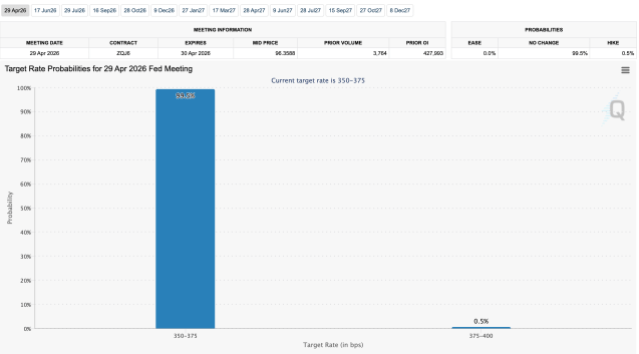
Source: FedWatch

The tool shows a 99.5% chance that the Fed will not change rates, which follows the current sentiment in the market. It shows a 0% chance that interest rates will reduce, and only a 0.5% chance that there will be a hike in the interest rates. If this plays out, then it is likely that the crypto market will not see any significant change as a result of the FOMC meeting being concluded.

Crypto market cap sitting at $2.57 billion | Source: Total Market Cap from Tradingview.com

Perguntas relacionadas

QWhen is the next FOMC meeting scheduled to take place?

AThe next FOMC meeting is scheduled for April 29, 2026.

QWhat is the current interest rate range, according to the article?

AThe current interest rate is sitting at 3.5-3.75%.

QWhat is the market expectation for the interest rate decision at the upcoming FOMC meeting?

AThere is a 99.5% chance that the Fed will not change the interest rates, with a 0% chance of a reduction and a 0.5% chance of a hike.

QHow does a dovish stance from the Fed typically affect the crypto market?

AA dovish stance, where the Fed drops interest rates, is usually bullish for the crypto market, often causing it to respond with a rally as lower rates encourage risk-on investments.

QWhat is the total crypto market cap mentioned in the article?

AThe total crypto market cap is sitting at $2.57 billion.

Leituras Relacionadas

Will the Next Crypto Bull Run Start with On-Chain Trading of SpaceX?

This article presents a scenario-based forecast for the crypto industry from 2026 to 2029, arguing that the next major cycle will be driven not by technological narratives but by legal access to real-world assets. The author predicts that by mid-2026, pre-IPO perpetual contracts for top private companies like SpaceX, OpenAI, and Anthropic on platforms like Hyperliquid will become the primary gateway for accessing quality assets, as most crypto-native tokens fail to capture real value. The much-hyped AI x Crypto intersection largely fails except for prediction markets, which thrive on betting on AI model supremacy. By 2027, public blockchain foundations are forced to choose between catering to retail speculation or building compliant infrastructure for institutions, with many opting for the latter. Growth in stablecoins and tokenized private credit/equity hits a "triple ceiling" due to regulatory and political uncertainty rather than market demand. The pivotal shift is forecast for 2028. A major liquidation event in pre-IPO perpetuals exposes the structural flaw of synthetic markets lacking a real underlying asset anchor. In response, regulatory changes finally allow the public solicitation of private securities resales to verified accredited investors. This creates a legitimate secondary market for real company equity, which then becomes the core asset class of the new bull market, relegating synthetic perps to a niche role. By 2029, the industry becomes "boring" but foundational. Tokens without claims on real cash flows or assets cease trading. Stablecoin growth is steady but politically capped. Crypto infrastructure fades from view as it gets absorbed into traditional finance backends. The article's central thesis is that the key bottleneck for crypto's next phase is legal and regulatory channels for real asset ownership, not technology.

marsbitHá 1h

Will the Next Crypto Bull Run Start with On-Chain Trading of SpaceX?

marsbitHá 1h

The Value Distribution of Stablecoins

**Summary: The Value Distribution of Stablecoins** The article argues that stablecoins are evolving from mere trading tools into broader channels for dollar access. It divides the stablecoin ecosystem into four layers to analyze how value is distributed: 1. **Issuance Layer:** Mints stablecoins, holds reserve assets, and captures the spread between reserve yield and user costs (e.g., Tether, Circle). This layer currently earns the largest profit margin. 2. **Infrastructure Layer:** Connects stablecoins to the traditional financial system, handling fiat on/off-ramps, banking integration, compliance (KYC/AML), and asset management (e.g., Bridge, BVNK). This is the "unglamorous" but critical work, building the essential bridges between crypto and real-world finance. 3. **Acquiring/Distribution Layer:** Integrates stablecoins into merchant systems, manages payment flows, and provides enterprise financial software (e.g., Stripe, Coinbase). They act as the access point for businesses. 4. **Application Layer:** The end-users and businesses that ultimately use stablecoins for payments, settlements, or as a store of value. They benefit from convenience but have little pricing power. The core thesis is that while the issuance layer currently dominates profits, the often-overlooked **infrastructure layer holds significant long-term potential**. The real challenge and barrier to mass adoption is not the on-chain transfer of stablecoins (which is simple), but the complex "last mile" integration into existing business workflows, banking systems, and regulatory frameworks across different countries. Companies in this layer are currently in a "land grab" phase, investing heavily to build networks, secure bank partnerships, and establish compliance pathways. While their position is currently pressured by the profitable issuers above and distribution platforms below, the article suggests that if stablecoins become a default financial rail for businesses, the infrastructure providers who have done the hard work of integration will ultimately gain strong pricing power and become entrenched, essential players.

marsbitHá 8h

The Value Distribution of Stablecoins

marsbitHá 8h

The Value Distribution of Stablecoins

The Value Distribution of Stablecoins The article argues that stablecoins are evolving from a mere trading tool into a broad "dollar channel." It analyzes the industry's value chain through four layers: 1. **Issuance Layer (e.g., Tether, Circle):** The top layer that mints stablecoins, holds reserve assets, and captures the thickest interest rate spread. 2. **Infrastructure Layer (e.g., Bridge, BVNK):** Connects stablecoins to the traditional financial system, handling critical but complex "dirty work" like fiat on/off-ramps, banking integration, compliance (KYC/AML), and cross-border settlement. 3. **Acquiring/Distribution Layer (e.g., Stripe, Coinbase):** Embeds stablecoins into merchant systems, manages payment flows, and integrates with enterprise software. 4. **Application Layer:** End-users and businesses that ultimately use stablecoins for payments, settlement, or storing value. The author posits that while the issuance layer currently captures the most profit, the most overlooked and potentially critical layer is infrastructure. The core challenge for stablecoin adoption isn't the on-chain transfer (which is simple), but bridging the gap between blockchain and the real-world financial system. This involves solving practical problems for businesses: fiat conversion, reconciliation, tax handling, and user onboarding. Infrastructure companies are currently in a difficult "land-grab" phase—building networks, securing banking relationships, and achieving compliance country-by-country. They face pressure from both the profitable issuance layer above and distribution platforms below. However, the author suggests this layer is building a crucial moat. Once stablecoins become a default business rail, the infrastructure players who have done the hard work of integration may gain significant, durable value and pricing power.

链捕手Há 8h

The Value Distribution of Stablecoins

链捕手Há 8h

Trading

Spot
Futuros
活动图片