When Even the Shovel Sellers Borrow to Buy Shovels: The US Stock AI Sector Evaporates Trillions in a Week, as the Market Begins Pricing AI's 'Bill'

marsbitPublicado em 2026-06-11Última atualização em 2026-06-11

Resumo

Last week saw a sharp sell-off in the US AI sector, erasing trillions in market value despite companies reporting record financials. Key events included Alphabet's massive equity raise despite having over $1.2 trillion in cash, Broadcom's stock plummeting after its quarterly report, a 4% Nasdaq drop, and Oracle's stock falling even after posting record revenue and backlog. The market's focus shifted from stellar income statements to cash flow and balance sheets, questioning the massive and increasingly leveraged capital expenditures required to fund the AI infrastructure race. Analysts point out that while growth is strong, profitability and the visibility of AI monetization are now under scrutiny. The financing chain stretches from cash-rich giants like Alphabet raising debt and equity, to chipmakers like Broadcom facing margin pressure, to cloud providers like Oracle with negative free cash flow funding via debt, and finally to unprofitable AI labs like OpenAI and Anthropic—who are the ultimate customers for much of this infrastructure. The market is beginning to price the risk of this concentrated, leveraged bill coming due, with the upcoming SpaceX IPO serving as the next test for this financing ecosystem.

Author: Ada, Deep Tide TechFlow

Over the past week, the US stock AI sector presented a strange picture, with records being broken one after another and stocks being sold off one after another.

On June 1, Alphabet, sitting on hundreds of billions in cash, announced one of the largest equity financings in history; On June 3 after market close, Broadcom delivered its best-ever quarterly report, only for its stock to crash the next day; On June 5, the Nasdaq plunged 4% in a single day, with the semiconductor sector shedding roughly $1 trillion in market value in one session; On June 10 after market close, Oracle reported record revenue and backlog, yet its stock still fell; On June 11, the pricing moment arrived for what is set to be the largest SpaceX IPO in history. The financial numbers themselves are not the issue; the problem is the way these numbers are being achieved: more and more money is being borrowed into this AI infrastructure race through increasingly complex means. When the market began tallying up this bill, even record-breaking numbers couldn't save stock prices.

The Same Script: Record First, Then Get Sold Off

Broadcom went first. According to its earnings report and multiple media outlets, for its fiscal Q2 ended May 3, Broadcom's revenue reached $22.219 billion, up 48% year-over-year; AI chip revenue was $10.8 billion, surging 143% year-over-year; and earnings per share exceeded Wall Street expectations. But the market focused solely on one gap: the company's AI chip revenue guidance for the next quarter is $16 billion, below analyst expectations, and CEO Hock Tan did not raise the full-year AI revenue target, mentioning that Google might diversify its chip supply chain. Nonetheless, Broadcom's stock plummeted about 15% the next day, erasing nearly $280 billion in market value in a single day, making it one of the largest single-day market cap losses in Wall Street history.

Oracle's turn came a week later. According to its earnings report and CNBC, for its fiscal Q4 ended May 31, Oracle's revenue was $19.2 billion, up 21% year-over-year; cloud infrastructure revenue was $5.8 billion, up 93% year-over-year; adjusted EPS was $2.11, beating analyst expectations of $1.95. The backlog was even more staggering: Remaining Performance Obligations (RPO) reached $638 billion, skyrocketing 363% year-over-year, far exceeding analyst expectations of $595.7 billion. Yet the stock also didn't find favor, dropping about 9% in after-hours trading.

Sandwiched between these two earnings reports was a broad sell-off on June 5. According to TheStreet and CNBC, the Nasdaq Composite Index fell 4% that day, its worst single-day performance since the April 2025 tariff turmoil, triggered by Broadcom's cautious AI chip outlook, with AMD and Intel leading the decline across the entire semiconductor sector.

It is worth noting that the June 5 plunge wasn't solely about "AI skepticism." That day, US non-farm payrolls added 172,000 jobs, far exceeding expectations, pushing up rate hike expectations and triggering a rotation from high-valuation growth stocks into defensive sectors like healthcare and consumer staples. AI stocks, having the highest valuations, fell the hardest. In other words, macroeconomic interest rates and sector rotation were one driver, while concerns over AI capital expenditures were another. The two factors compounded, rather than having a single cause.

What's Being Sold Off Isn't the Income Statement, It's the Cash Flow Statement

Putting these three market segments together reveals a commonality: the income statement is still recording "record-breaking" numbers, but the market has already switched to reading the cash flow statement and the balance sheet. The pricing focus has shifted from "how much was earned" to "how much more will be burned and borrowed to earn this."

Oracle is the most straightforward case study. According to its earnings report, for the full FY2026, operating cash flow reached a record $32 billion, up 54% year-over-year, but free cash flow was negative $23.7 billion. For the year, the company has already raised $43 billion in debt and $5 billion in equity. What truly broke investor sentiment was its forward-looking language. According to CNBC, Oracle plans to raise approximately $40 billion more in FY2027 through a combination of debt and equity. A company that just raised nearly $50 billion, with negative free cash flow, and now forecasts another $40 billion financing round—when this appears alongside "record-breaking" numbers, the market chose to price the former.

Broadcom's logic is similar, but manifests elsewhere. According to Barron's, Broadcom lowered its Q3 gross margin guidance from 77% to 74%, attributing it to a higher revenue mix from lower-margin AI chips. Coupled with a retreat from "selling complete systems" to "selling only chips," and customers demanding chip leases to pass on financing pressure, the market sees a business with explosive growth, but deteriorating margins and capital intensity.

Goldman Sachs provided a framework for this shift. According to its research report, investors' tolerance for capital expenditure growth depends on earnings strength and the visibility of AI monetization; the same report noted that Alphabet's stock rose due to raising its profit guidance, while Meta's fell due to flat guidance. The market is no longer indiscriminately rewarding "growth," but differentiating winners from losers based on "the ability to monetize."

The Financing Chain Takes Center Stage: Even the Most Cash-Rich Players Are Borrowing

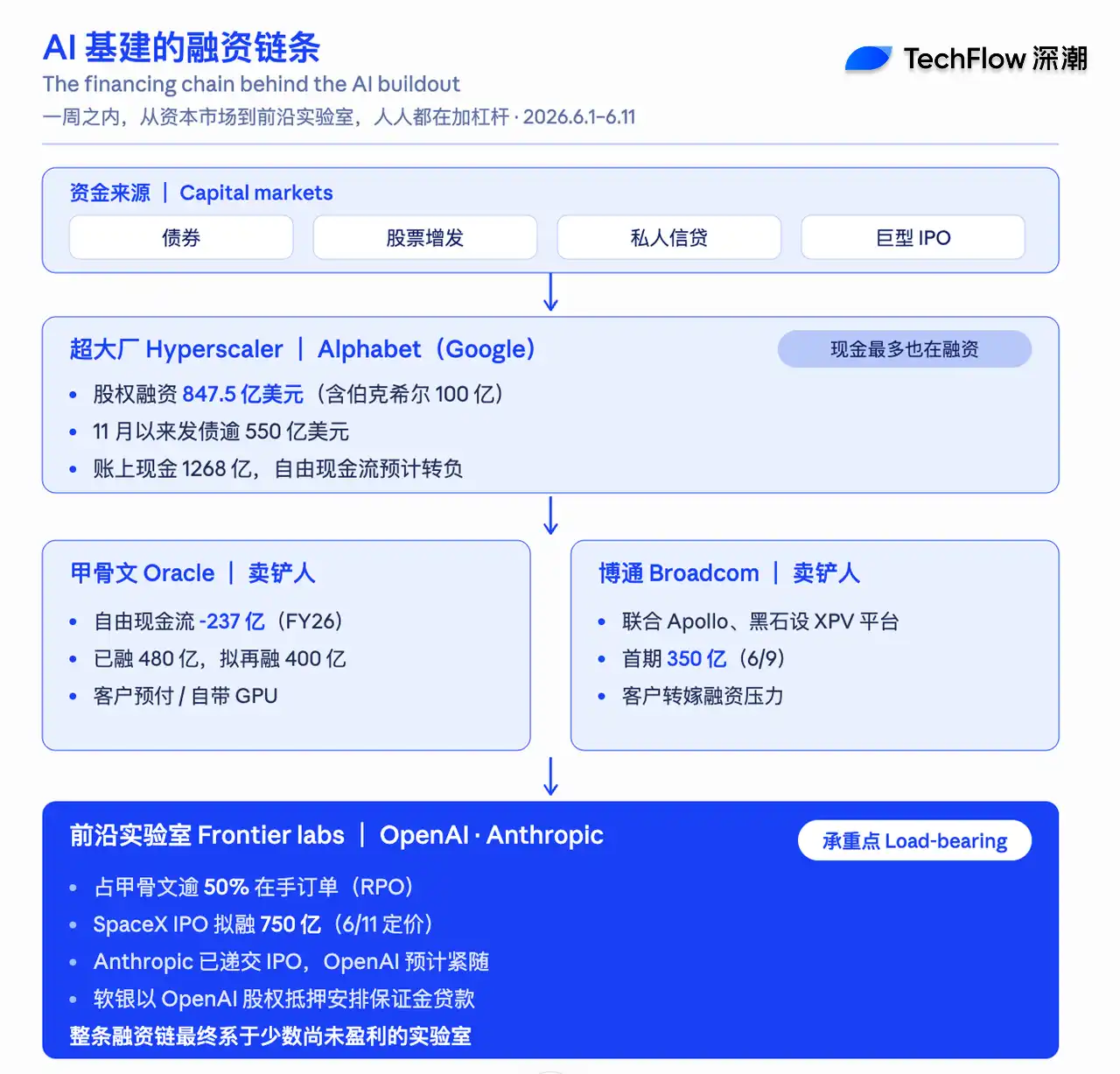
If the income statement is the surface, the financing chain is the true protagonist of this past week. From the very upstream to the very downstream, almost every link is paying for this same AI infrastructure build-out by leveraging up or diluting equity.

The most convincing case study is Alphabet. According to its SEC filing, on June 1, it announced an $80 billion equity financing; on June 2, it upsized and priced the deal at $84.75 billion, including a $10 billion private investment from Berkshire Hathaway. The anomaly is that this company is not short on cash at all. According to multiple media reports, Alphabet had $126.8 billion in cash as of March 2026, annual operating cash flow of $174 billion, and has issued over $55 billion in new debt since November. Despite this, Melius Research estimates Google's free cash flow will turn negative in the coming years. Investor Dan Niles' commentary on this is that capital is not infinite, and the fact that Google, with "the strongest technology stack in all of AI," still needs to raise massive amounts of financing precisely illustrates the intensity of this round of investment.

Looking downstream, every link on the chain is doing the same. New cloud vendor Oracle has negative free cash flow, relies on dual-track debt and equity financing, and asks customers to prepay for GPU costs or bring their own GPUs to reduce its own construction capital outlay; the chip "shovel sellers" like Broadcom, on June 9, partnered with Apollo and Blackstone to establish the AI XPV Platform, with an initial $35 billion targeting over 20 gigawatts of computing power by 2028, serving frontier labs including Anthropic and OpenAI. And at the very end of the chain, the labs are simultaneously employing even more aggressive tools: there were previous reports of SoftBank arranging margin loans secured by OpenAI equity; now SpaceX is rushing towards a Nasdaq IPO targeting $75 billion, Anthropic has confidentially filed for an IPO, and OpenAI is expected to follow closely.

The total scale of this investment is also rapidly inflating. According to CreditSights, the combined capital expenditure for mega-cap companies in 2026 is estimated at around $750 billion, up about 67% from 2025; Goldman Sachs' alternative metric puts the 2026 capex forecast for mega-caps at $518 billion, revised up from $314 billion at the start of the year. Whichever metric is used, the direction is consistent: expenditures are accelerating, the portion that can be covered by operating cash flow is shrinking, and the gap needs to be filled by capital markets.
The Chain's Pressure Point Rests on a Few Unprofitable Labs

Leverage itself isn't terrifying; what's terrifying is who the leverage ultimately rests upon. Pulling this financing chain to its end reveals that its pressure point is highly concentrated.

Oracle's $638 billion backlog seems impregnable, but according to Bank of America, over 50% comes from OpenAI alone; simultaneously, Oracle also disclosed that most of the RPO growth in the past two quarters came from large AI contracts, with customers either prepaying GPU costs or procuring GPUs themselves before handing them to Oracle. Broadcom's six major custom chip customers are similarly concentrated among a handful like Google, Meta, Anthropic, and OpenAI. In other words, from the financing of the mega-caps, to the orders of the "shovel sellers," to the injection of private credit and insurance funds, the ultimate payer for the entire chain converges onto a small group of unprofitable frontier labs like OpenAI and Anthropic, who are themselves queuing up for funding.

The record-breaking revenue is real, and the $638 billion backlog is real; but the buyers of these orders are highly concentrated, are themselves sustained by financing, and the leverage of the entire chain is being re-examined by the market. This past week, the market did not deny AI's growth; it simply started demanding to see clearly who will pay the bill for this growth, and how. SpaceX is set to price after market close on June 11 and list on the Nasdaq at $135 per share, with a valuation of approximately $1.77 trillion on June 12. Whether this largest-ever IPO can be digested smoothly will be the next stress test for this financing chain.


Criptomoedas em alta

Perguntas relacionadas

QWhat were the main reasons behind the significant sell-off in the AI sector of the U.S. stock market over the past week?

AThe sell-off was driven by a combination of macroeconomic factors and sector-specific concerns. The stronger-than-expected U.S. non-farm payrolls data raised interest rate expectations, triggering a rotation from high-valuation growth stocks (like AI) into defensive sectors. Simultaneously, the market began to reassess the massive capital expenditure required for AI infrastructure. Companies like Broadcom and Oracle reported record revenues but also signaled the need for continued heavy investment and financing, leading to a market focus on negative free cash flow and growing debt, which caused their stock prices to fall despite strong earnings.

QHow did the market's valuation focus shift for AI companies like Oracle and Broadcom, according to the article?

AThe market's valuation focus shifted from the income statement (profit and revenue growth) to the cash flow statement and balance sheet. Investors are no longer just rewarding 'record' earnings; they are now pricing in the significant capital required to generate those earnings. For example, Oracle's record $638 billion backlog and revenue were overshadowed by its negative free cash flow and plans for further large-scale debt and equity financing. For Broadcom, the market focused on the declining gross margin guidance and the increased capital intensity of its AI chip business, even as AI revenue soared.

QWhy did Alphabet, despite having a massive cash reserve, conduct a major equity financing round?

AAlphabet announced an $84.75 billion equity financing round even with $1268 billion in cash and strong annual operating cash flow because, according to analyst estimates (like from Melius Research), its free cash flow is projected to turn negative in the coming years due to the immense intensity of AI infrastructure investment. As noted by investor Dan Niles, this move by a company with the 'strongest technology stack in AI' highlights the enormous scale of capital required for this buildout, suggesting that even the most cash-rich players need to tap external funding to sustain the AI arms race.

QWhat is the common weak point or 'pressure point' in the AI infrastructure financing chain identified in the article?

AThe common weak point or 'pressure point' in the AI financing chain is its heavy reliance on a small group of unprofitable, frontier AI labs like OpenAI and Anthropic. A significant portion of the record orders for companies like Oracle (over 50% from OpenAI alone) and Broadcom's major custom chip customers are concentrated with these labs. These labs are themselves dependent on continued fundraising (e.g., private credit, impending IPOs) to pay their bills. This creates a concentrated risk where the entire chain's viability depends on the financial health and ability of a few non-profitable entities to keep raising capital.

QWhat upcoming event does the article suggest will be the next major test for the AI financing chain?

AThe article suggests that SpaceX's upcoming IPO, scheduled to price on June 11 and list on Nasdaq on June 12 with a target valuation of approximately $1.77 trillion, will be the next major test for the AI financing chain. As the largest IPO in history, its success in being absorbed by the market will serve as a crucial indicator of investor appetite and capacity to fund the massive capital requirements at the end of the AI infrastructure investment chain.

Leituras Relacionadas

Can Japan Buy Growth with AI? Will the Bond Market Believe It?

Japan's cabinet has introduced the 2026 Basic Policy on Economic and Fiscal Management and Reform, shifting its primary fiscal target. The new framework moves away from the traditional annual primary balance goal and instead prioritizes a stable reduction of the debt-to-GDP ratio. This change is tied to a strategy of increased "responsible proactive fiscal" spending, aiming to boost long-term growth through investments in strategic sectors like AI, semiconductors, energy, and robotics. The government estimates total public and private investment in 62 key technologies could exceed 370 trillion yen by 2040. The market reaction has been mixed and cautious. While equity markets may respond to policy signals, bond markets are focused on fiscal credibility. Concerns center on whether the weakening of the clear primary balance anchor could lead to looser fiscal discipline. If investors doubt that these strategic investments will generate sufficient productivity gains, tax revenue, and nominal growth to outpace rising interest costs, they may demand higher yields on Japanese Government Bonds (JGBs). Recent volatility in the yen and JGB yields, with the 10-year yield briefly reaching 2.9%, reflects this skepticism. The success of this new framework hinges on two factors: whether Japan can achieve a nominal growth rate consistently higher than its long-term interest rates, and whether future budgets demonstrate disciplined control over bond issuance. The government's narrative is that strategic investment is essential to break Japan's cycle of low growth, aging, and labor shortages. However, the bond market will continuously assess the credibility of this plan, pricing the risk that it may represent fiscal expansion rather than a viable growth strategy.

marsbitHá 23m

Can Japan Buy Growth with AI? Will the Bond Market Believe It?

marsbitHá 23m

Misjudged A-Shares: Resilience, Expectations, and Confidence

China's A-share market recently faced selling pressure, especially in tech sectors, initially triggered by a global tech sell-off that began in South Korea. However, the article argues this is a case of "mistaken injury" and highlights the market's underlying resilience. This resilience stems from three main pillars: **1) Tech Sector Fundamentals:** Unlike Korea's market dominated by a few memory chip stocks, China's tech sector is diversified across computing, communications, electronics, and semiconductors, supported by dual narratives of global AI supply chains and domestic substitution. Core areas like optical modules and fiber optics continue to show strong earnings growth. **2) "National Team" Support:** State-backed institutions and large corporations have made significant market purchases and announced buybacks, providing liquidity and signaling confidence. This is seen as a stabilizing policy signal, often associated with market bottoms. **3) Broader Market Pillars:** Other major sectors are showing endogenous recovery momentum. Consumer stocks benefit from stabilizing CPI and signs of sector recovery (e.g., liquor price hikes). Cyclical sectors like aluminum have high earnings, potential price increases due to tight supply, and low valuations. The financial sector offers stable dividends and low valuations. The conclusion is that the sell-off was driven by external contagion, not a collapse in fundamentals. With strong policy support and recovering momentum across key sectors, the A-share market possesses the toughness to regain stability.

marsbitHá 54m

Misjudged A-Shares: Resilience, Expectations, and Confidence

marsbitHá 54m

Trading

Spot

Artigos em Destaque

Como comprar BILL

Bem-vindo à HTX.com!Tornámos a compra de Billions Network (BILL) simples e conveniente.Segue o nosso guia passo a passo para iniciar a tua jornada no mundo das criptos.Passo 1: cria a tua conta HTXUtiliza o teu e-mail ou número de telefone para te inscreveres numa conta gratuita na HTX.Desfruta de um processo de inscrição sem complicações e desbloqueia todas as funcionalidades.Obter a minha contaPasso 2: vai para Comprar Cripto e escolhe o teu método de pagamentoCartão de crédito/débito: usa o teu visa ou mastercard para comprar Billions Network (BILL) instantaneamente.Saldo: usa os fundos da tua conta HTX para transacionar sem problemas.Terceiros: adicionamos métodos de pagamento populares, como Google Pay e Apple Pay, para aumentar a conveniência.P2P: transaciona diretamente com outros utilizadores na HTX.Mercado de balcão (OTC): oferecemos serviços personalizados e taxas de câmbio competitivas para os traders.Passo 3: armazena teu Billions Network (BILL)Depois de comprar o teu Billions Network (BILL), armazena-o na tua conta HTX.Alternativamente, podes enviá-lo para outro lugar através de transferência blockchain ou usá-lo para transacionar outras criptomoedas.Passo 4: transaciona Billions Network (BILL)Transaciona facilmente Billions Network (BILL) no mercado à vista da HTX.Acede simplesmente à tua conta, seleciona o teu par de trading, executa as tuas transações e monitoriza em tempo real.Oferecemos uma experiência de fácil utilização tanto para principiantes como para traders experientes.

336 Visualizações TotaisPublicado em {updateTime}Atualizado em 2026.06.02

Como comprar BILL

Discussões

Bem-vindo à Comunidade HTX. Aqui, pode manter-se informado sobre os mais recentes desenvolvimentos da plataforma e obter acesso a análises profissionais de mercado. As opiniões dos utilizadores sobre o preço de BILL (BILL) são apresentadas abaixo.

活动图片











