When Depth Becomes an Illusion: Polymarket Faces 'Order Attack' Stress Test

比推Publicado em 2026-02-26Última atualização em 2026-02-26

Resumo

A sophisticated "order attack" is exploiting a critical vulnerability in Polymarket's hybrid off-chain matching/on-chain settlement system. For less than $0.10 in gas fees on Polygon, an attacker can initiate a trade and then, in the brief window before on-chain execution, drain their wallet via a high-gas transfer. This causes the initial trade to fail on-chain due to insufficient funds. However, Polymarket's off-chain system responds by forcibly removing all the legitimate market maker orders that were matched with the failed transaction. This attack has two primary profit methods. First, attackers clear the order book of competitors, create a liquidity vacuum, and then place their own orders with artificially wide spreads to monopolize trading. Second, they "hunt" automated trading bots: after a trade is matched off-chain, a bot hedges its new position, but the attacker then forces the original trade to fail on-chain. This leaves the bot with an unhedged, risky position, which the attacker exploits for profit. One identified attacker address, created in February 2026, reportedly profited over $16,000 in a single day by targeting just 7 markets. The attack severely undermines market maker confidence, threatens the platform's liquidity, and exposes a fundamental design flaw. While the community has developed monitoring tools, Polymarket team has not yet issued an official fix.

Author: Frank, PANews

Original Title: Less Than 10 Cents Collapses Millions in Liquidity, Order Attacks May Empty Polymarket's Liquidity Foundation


A single on-chain transaction costing less than $0.10 can instantly wipe out market-making orders worth tens of thousands of dollars from Polymarket's order book. This is not a theoretical scenario but a reality that is currently unfolding.

In February 2026, a user disclosed a new type of attack targeting Polymarket's market makers on social media. Blogger BuBBliK described it as "elegant & brutal" because the attacker only needs to pay less than $0.10 in Gas fees on the Polygon network to complete an attack cycle in about 50 seconds. The victims—market makers and automated trading bots who have placed buy and sell orders with real money—face multiple blows: forced order removal, passive exposure of positions, and even direct losses.

PANews reviewed an attacker address flagged by the community and found that the account was registered in February 2026, participated in only 7 markets, but has already recorded a total profit of $16,427, with the core gains made essentially within a single day. When the liquidity foundation of a prediction market leader valued at $9 billion can be leveraged at a cost of a few cents, this exposes far more than just a technical vulnerability.

PANews will delve into the technical mechanisms, economic logic, and potential impact of this attack on the prediction market industry.

How the Attack Happens: A Precision Hunt Exploiting a "Time Gap"

To understand this attack, one must first understand Polymarket's trading process. Unlike most DEXs, Polymarket uses a hybrid architecture of "off-chain matching + on-chain settlement" to pursue a user experience close to that of centralized exchanges. User order placement and matching are completed instantly off-chain, and only the final fund settlement is submitted to the Polygon chain for execution. This design allows users to enjoy zero-Gas order placement and second-level execution, but it also creates a "time gap" of a few seconds to over ten seconds between off-chain and on-chain processes. The attacker precisely targets this window.

The attack logic is not complex. The attacker first places a buy or sell order normally via the API. At this time, the off-chain system verifies the signature and balance without issue and matches it with other market makers' orders on the order book. But almost simultaneously, the attacker initiates an on-chain USDC transfer with an extremely high Gas fee, transferring all the funds out of the wallet. Because the Gas fee is much higher than the platform relayer's default settings, this "draining" transaction is confirmed by the network first. When the relayer subsequently submits the matching result to the chain, the attacker's wallet is already empty, and the transaction fails and rolls back due to insufficient balance.
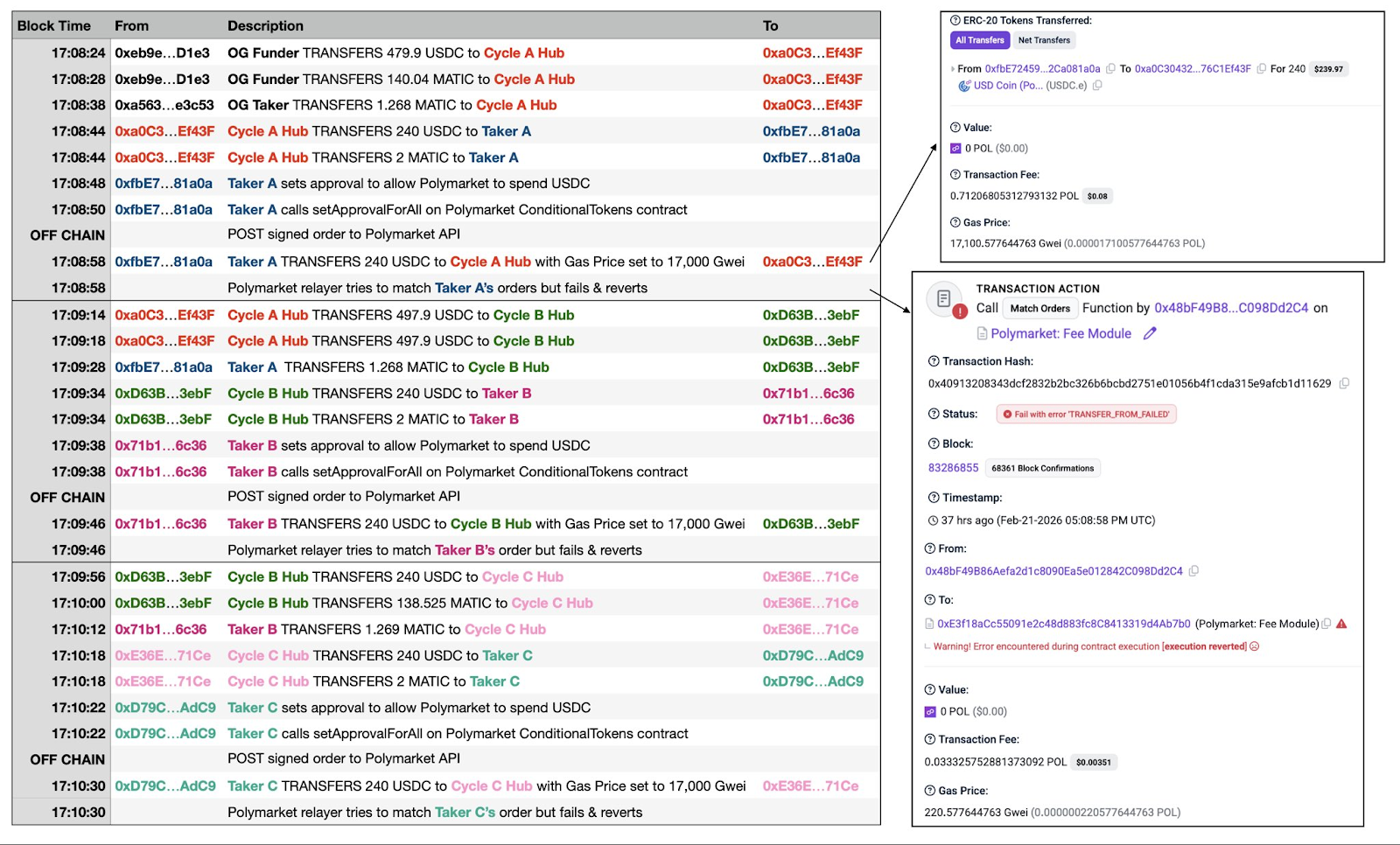
If the story ended here, it would only waste a bit of the relayer's Gas fee. But the truly fatal step is this: although the transaction fails on-chain, Polymarket's off-chain system will forcibly remove all the innocent market maker orders that participated in this failed matching from the order book. In other words, the attacker uses a transaction destined to fail to "one-click clear" the buy and sell orders placed by others with real money.

To use an analogy: It's like shouting a high bid at an auction, then turning around at the moment the hammer falls and saying "I have no money," but the auction house confiscates all the bidding paddles of the other normal bidders, causing the auction to fail.

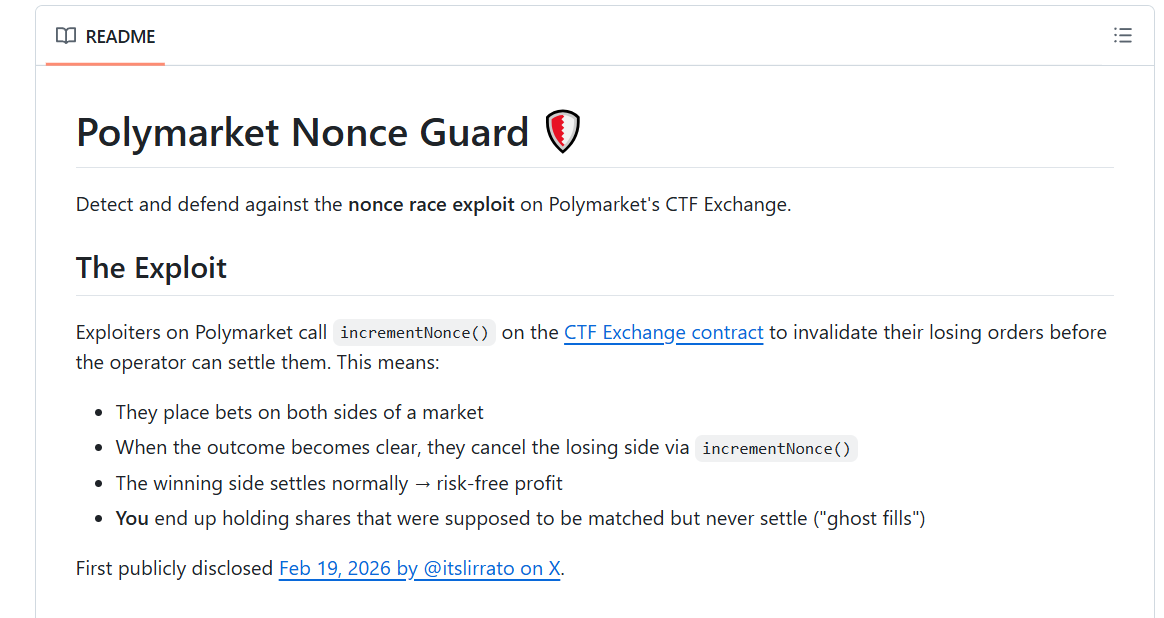
It is worth noting that the community later discovered an "upgraded version" of this attack, named "Ghost Fills." The attacker no longer needs to front-run the transfer but directly calls the "cancel all orders" function on the contract after the order is matched off-chain and before on-chain settlement, instantly invalidating their own order to achieve the same effect. More cunningly, the attacker can place orders in multiple markets simultaneously, observe the price trend, then only keep the favorable orders to execute normally and use this method to cancel the unfavorable ones, essentially creating a "win-only" free option.

Attack "Economics": A Few Cents in Cost, $16,000 in Profit

Beyond directly clearing market maker orders, this state desynchronization between off-chain and on-chain is also used to hunt automated trading bots. According to monitoring by the GoPlus security team, affected bots include Negrisk, ClawdBots, MoltBot, and others.

The attacker clearing others' orders and creating "ghost fills" do not directly generate profits themselves. So how is the money actually made?

PANews found that the attacker's profit paths mainly follow two routes.

The first is "monopolizing market making after clearing the field." Under normal circumstances, the order book of a popular prediction market has multiple market makers competing to place orders. The spread between the best bid and ask is usually narrow, for example, bids at 49 cents and asks at 51 cents, with market makers earning微利 from the 2-cent spread. The attacker repeatedly initiates "doomed-to-fail transactions" to forcibly clear all these competitors' orders. The market then becomes a vacuum. The attacker immediately places their own buy and sell orders but with a significantly widened spread, for example, bids at 40 cents and asks at 60 cents. Other users needing to trade, having no better quotes, are forced to accept this price, allowing the attacker to profit from the 20-cent "monopoly spread." This mode cycles: clear the field, monopolize, profit, clear again.

The second profit path is more direct: "hunting hedging bots." A concrete example illustrates this: Suppose the price of "Yes" in a certain market is 50 cents. The attacker places a $10,000 "Yes" buy order to a market-making bot via the API. After the off-chain system confirms the match, the API immediately tells the bot, "You have sold 20,000 shares of Yes." Upon receiving the signal, the bot, to hedge risk, immediately buys 20,000 shares of "No" in another related market to lock in profits. But then, the attacker causes that $10,000 buy order to fail and roll back on-chain, meaning the bot actually never sold any "Yes." The hedge position it thought it had now becomes a naked one-sided bet, holding only 20,000 shares of "No" without the corresponding short position to protect it. The attacker then trades in the market for real, profiting from the bot being forced to sell these unprotected positions or directly arbitraging from the market price shift.

On the cost side, each attack cycle only requires paying less than $0.10 in Gas fees on the Polygon network. Each cycle takes about 50 seconds, theoretically allowing about 72 executions per hour. One attacker set up a "dual-wallet循环系统" (Cycle A Hub and Cycle B Hub operating alternately), achieving fully automated high-frequency attacks. Hundreds of failed transactions have been recorded on-chain.

On the profit side, an attacker address flagged by the community and reviewed by PANews shows that the account was newly registered in February 2026, participated in only 7 markets, but has already realized a total profit of $16,427, with the largest single profit reaching $4,415. Core profit-making activities were concentrated within an extremely short time window. That is, the attacker used a total cost of possibly less than $10 in Gas to leverage over $16,000 in profit in a single day. And this is just one flagged address; the actual number of addresses involved in the attack and the total profit may be far greater.
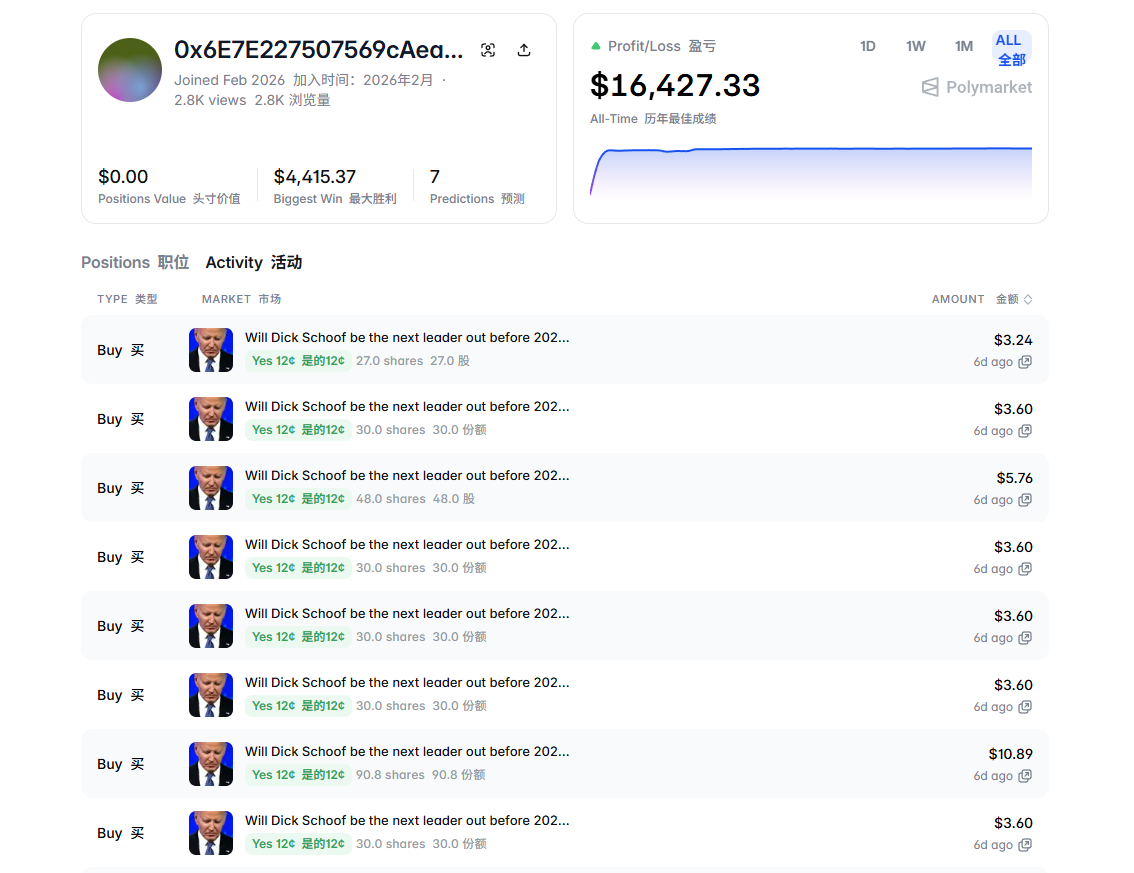
For the victimized market makers, the losses are more difficult to quantify. A trader running a BTC 5-minute market bot on Reddit stated losses reached "thousands of dollars." The deeper damage lies in the opportunity cost of frequently forced order removal and the operational overhead of被迫调整做市策略.

A more棘手的问题 is that this vulnerability is an issue with the underlying mechanism design of Polymarket and cannot be fixed in the short term. As this attack method becomes public, similar attacks will become more common, further damaging Polymarket's already fragile liquidity.

Community Self-Help, Warnings, and the Platform's Silence

As of now, Polymarket官方 has not released a detailed statement or fix for this order attack. Some users have stated on social media that this bug was reported multiple times months ago but was consistently ignored. It is worth mentioning that Polymarket previously chose to refuse refunds when facing the "governance attack" (UMA Oracle vote manipulation) incident.

With no official action, the community began to find its own solutions. A community developer voluntarily created an open-source monitoring tool called "Nonce Guard." This tool can monitor order cancellation operations on the Polygon chain in real-time, build a blacklist of attacker addresses, and provide general warning signals for trading bots. However, this solution is essentially a monitoring-enhanced patch and cannot fundamentally solve this type of problem.
Compared to other arbitrage methods, the potential impact of this attack method could be more far-reaching.

For market makers, the hard-maintained orders can be batch-cleared without warning, completely destroying the stability and predictability of market-making strategies. This may directly shake their willingness to continue providing liquidity on Polymarket.

For users running automated trading bots, the成交 signals returned by the API are no longer trustworthy. Ordinary users trading may suffer significant losses due to instantly disappearing liquidity.

For the Polymarket platform itself, when market makers dare not place orders and bots dare not hedge, the order book depth will inevitably shrink, and this vicious cycle will further intensify.


Twitter:https://twitter.com/BitpushNewsCN

Bitpush TG Discussion Group:https://t.me/BitPushCommunity

Bitpush TG Subscription: https://t.me/bitpush

Original Link:https://www.bitpush.news/articles/7614683

Criptomoedas em alta

Perguntas relacionadas

QWhat is the core mechanism behind the 'order attack' on Polymarket?

AThe attack exploits a time gap between off-chain order matching and on-chain settlement. An attacker places an order that gets matched off-chain, then immediately executes a high-Gas transaction to drain their wallet on-chain. When the settlement transaction is submitted, it fails due to insufficient funds, but the system incorrectly removes all the legitimate market maker orders that were part of that failed match from the order book.

QWhat are the two main profit paths for the attackers described in the article?

A1. Clearing competitors' orders to monopolize market making: After removing other market makers' orders, the attacker posts their own orders with a much wider bid-ask spread, forcing other traders to accept these unfavorable prices. 2. Hunting hedging bots: The attack causes automated trading bots to hedge based on a false 'filled' signal. When the original trade fails on-chain, the bot is left with an unhedged, risky position, which the attacker then exploits for profit.

QWhat is the estimated cost and profit for the attacker from a single marked address?

AThe cost per attack cycle is less than $0.10 in Gas fees on the Polygon network. A single marked attacker address, active for only about a day, recorded a total profit of $16,427, with the core profits being made within an extremely short time window.

QHow does the 'Ghost Fills' upgrade to the attack work?

AIn the 'Ghost Fills' method, instead of racing to drain their wallet, the attacker simply calls the 'cancel all orders' function on the contract after their order has been matched off-chain but before it settles on-chain. This instantly invalidates their own order, achieving the same effect of causing the match to fail and forcing the removal of the innocent market makers' orders.

QWhat has been the response from the Polymarket platform and the community to these attacks?

AAs of the article's writing, Polymarket's official platform had not released a detailed statement or a fix for the vulnerability. In response, the community has taken initiative, with a developer creating an open-source monitoring tool called 'Nonce Guard' to track order cancellations, build a blacklist of attacker addresses, and provide early warning signals for trading bots.

Leituras Relacionadas

As Consensus Accelerates, What Are Young Investors Betting On?

Title: As Consensus Forms Faster, What Are Young Investors Betting On? In the rapid evolution of tech investment, a new generation of young investors is navigating a landscape where AI, robotics, commercial aerospace, and quantum computing are advancing simultaneously. Traditional investment logic based on financial models is giving way to a need for deep technical understanding and the ability to act before industry consensus forms. An analysis of trends from the "WAIC FUTURE TECH" list of young investment leaders reveals key shifts in focus. The first major trend is the movement of AI from the digital screen into the physical world. Investment is shifting from large language models and chatbots towards embodied AI, robotics, AI hardware, and edge computing. While demonstrations generate excitement, the real challenge lies in achieving scalable, reliable, and cost-effective delivery in complex real-world environments like factories and logistics. Success depends not just on algorithms but on the integration of sensors, actuators, and control systems. Second, the competitive focus for large models is moving beyond raw capability toward building an "intelligence flywheel." The goal is to create self-reinforcing systems where user interaction generates data, improving the model, which in turn enhances the user experience and attracts more engagement. Companies that successfully embed AI into workflows to create these closed-loop systems can build lasting value that isn't easily erased by the next model upgrade. Third, facing a potential bottleneck in high-quality human-generated data, investors are looking at new underlying technologies. Reinforcement learning and self-play, as demonstrated by AlphaGo Zero, offer paths for AI to generate its own experience. Scientific foundation models, which aim to build general AI capabilities for fields like life sciences and materials discovery, represent a non-consensus direction that could unlock new frontiers of knowledge and data. Finally, in deep-tech areas like quantum computing, commercial aerospace, and space-based infrastructure, patient capital is essential. These fields have long, uncertain development and validation cycles involving complex engineering, supply chains, and regulations. Investment here requires a long-term view, focusing on foundational team capabilities and the eventual emergence of market demand, even if commercial returns are distant. Collectively, these trends illustrate how young investors are adapting to a new era. They are learning to make earlier, technically-informed judgments, balance hype with real-world viability, and provide the patient capital needed to build the deep-tech foundations of the future.

marsbitHá 12m

As Consensus Accelerates, What Are Young Investors Betting On?

marsbitHá 12m

Can Japan Buy Growth with AI? Will the Bond Market Believe It?

Japan's cabinet has introduced the 2026 Basic Policy on Economic and Fiscal Management and Reform, shifting its primary fiscal target. The new framework moves away from the traditional annual primary balance goal and instead prioritizes a stable reduction of the debt-to-GDP ratio. This change is tied to a strategy of increased "responsible proactive fiscal" spending, aiming to boost long-term growth through investments in strategic sectors like AI, semiconductors, energy, and robotics. The government estimates total public and private investment in 62 key technologies could exceed 370 trillion yen by 2040. The market reaction has been mixed and cautious. While equity markets may respond to policy signals, bond markets are focused on fiscal credibility. Concerns center on whether the weakening of the clear primary balance anchor could lead to looser fiscal discipline. If investors doubt that these strategic investments will generate sufficient productivity gains, tax revenue, and nominal growth to outpace rising interest costs, they may demand higher yields on Japanese Government Bonds (JGBs). Recent volatility in the yen and JGB yields, with the 10-year yield briefly reaching 2.9%, reflects this skepticism. The success of this new framework hinges on two factors: whether Japan can achieve a nominal growth rate consistently higher than its long-term interest rates, and whether future budgets demonstrate disciplined control over bond issuance. The government's narrative is that strategic investment is essential to break Japan's cycle of low growth, aging, and labor shortages. However, the bond market will continuously assess the credibility of this plan, pricing the risk that it may represent fiscal expansion rather than a viable growth strategy.

marsbitHá 49m

Can Japan Buy Growth with AI? Will the Bond Market Believe It?

marsbitHá 49m

Misjudged A-Shares: Resilience, Expectations, and Confidence

China's A-share market recently faced selling pressure, especially in tech sectors, initially triggered by a global tech sell-off that began in South Korea. However, the article argues this is a case of "mistaken injury" and highlights the market's underlying resilience. This resilience stems from three main pillars: **1) Tech Sector Fundamentals:** Unlike Korea's market dominated by a few memory chip stocks, China's tech sector is diversified across computing, communications, electronics, and semiconductors, supported by dual narratives of global AI supply chains and domestic substitution. Core areas like optical modules and fiber optics continue to show strong earnings growth. **2) "National Team" Support:** State-backed institutions and large corporations have made significant market purchases and announced buybacks, providing liquidity and signaling confidence. This is seen as a stabilizing policy signal, often associated with market bottoms. **3) Broader Market Pillars:** Other major sectors are showing endogenous recovery momentum. Consumer stocks benefit from stabilizing CPI and signs of sector recovery (e.g., liquor price hikes). Cyclical sectors like aluminum have high earnings, potential price increases due to tight supply, and low valuations. The financial sector offers stable dividends and low valuations. The conclusion is that the sell-off was driven by external contagion, not a collapse in fundamentals. With strong policy support and recovering momentum across key sectors, the A-share market possesses the toughness to regain stability.

marsbitHá 1h

Misjudged A-Shares: Resilience, Expectations, and Confidence

marsbitHá 1h

Trading

Spot

Artigos em Destaque

Como comprar ORDER

Bem-vindo à HTX.com!Tornámos a compra de Orderly (ORDER) simples e conveniente.Segue o nosso guia passo a passo para iniciar a tua jornada no mundo das criptos.Passo 1: cria a tua conta HTXUtiliza o teu e-mail ou número de telefone para te inscreveres numa conta gratuita na HTX.Desfruta de um processo de inscrição sem complicações e desbloqueia todas as funcionalidades.Obter a minha contaPasso 2: vai para Comprar Cripto e escolhe o teu método de pagamentoCartão de crédito/débito: usa o teu visa ou mastercard para comprar Orderly (ORDER) instantaneamente.Saldo: usa os fundos da tua conta HTX para transacionar sem problemas.Terceiros: adicionamos métodos de pagamento populares, como Google Pay e Apple Pay, para aumentar a conveniência.P2P: transaciona diretamente com outros utilizadores na HTX.Mercado de balcão (OTC): oferecemos serviços personalizados e taxas de câmbio competitivas para os traders.Passo 3: armazena teu Orderly (ORDER)Depois de comprar o teu Orderly (ORDER), armazena-o na tua conta HTX.Alternativamente, podes enviá-lo para outro lugar através de transferência blockchain ou usá-lo para transacionar outras criptomoedas.Passo 4: transaciona Orderly (ORDER)Transaciona facilmente Orderly (ORDER) no mercado à vista da HTX.Acede simplesmente à tua conta, seleciona o teu par de trading, executa as tuas transações e monitoriza em tempo real.Oferecemos uma experiência de fácil utilização tanto para principiantes como para traders experientes.

271 Visualizações TotaisPublicado em {updateTime}Atualizado em 2026.06.02

Como comprar ORDER

Discussões

Bem-vindo à Comunidade HTX. Aqui, pode manter-se informado sobre os mais recentes desenvolvimentos da plataforma e obter acesso a análises profissionais de mercado. As opiniões dos utilizadores sobre o preço de ORDER (ORDER) são apresentadas abaixo.

活动图片













