When Crypto Is No Longer Fun, When Multicoin Capital Loses Its Soul

marsbitPublicado em 2026-02-05Última atualização em 2026-02-05

Resumo

Kyle Samani, co-founder and managing partner of Multicoin Capital, has announced his departure from the firm’s daily operations and investment decisions, shifting his focus to other technology sectors such as AI and life sciences. Samani, widely regarded as one of crypto’s most influential and contrarian investors, played a key role in the firm’s early bet on Solana, which yielded massive returns. In a since-deleted social media post, Samani expressed that crypto is “not as fun as it used to be,” and no longer believes in the broader Web3 vision. He now sees blockchain primarily as a financial ledger with limited applications beyond finance, though he remains optimistic about privacy and DePIN sectors. Multicoin Capital’s investment activity has slowed significantly since late 2024, with only 10 deals since October 2024, far fewer than other top VCs. The firm’s major investments, such as Wormhole and Pyth Network, have also underperformed. Samani’s exit reflects a broader trend of key figures leaving crypto during a prolonged market downturn, citing disillusionment with the industry’s direction, unsustainable models, and weakened narratives. Despite this, firms like a16z and Pantera Capital remain active, suggesting the industry’s reassessment hasn’t yet turned into a full-scale exodus.

Author: Gu Yu, ChainCatcher

Today, Kyle Samani, co-founder and managing partner of Multicoin Capital, announced on his social media account that he will step down from the daily management and investment decisions of Multicoin Capital and will explore opportunities in other technology fields outside the crypto industry in the future. Multicoin subsequently stated that the fund will continue to operate normally, and existing investments and team structure will not be affected.

The "Best Crypto Investor" Chooses to Fade Away

This is undoubtedly big news in the crypto VC circle. For a long time, Kyle Samani frequently wrote long articles, participated in industry debates, maintained a clear stance on investment strategies, and, thanks to his early investment in Solana which brought hundreds of times returns, he was not only the soul of Multicoin Capital but also one of the most influential investors in the crypto industry with significant say.

Previously, Haseeb Qureshi, managing partner of Dragonfly, wrote an article about the three crypto investors he most admired, with Dan Robinson, Chris Dixon, and Kyle Samani ranking third, second, and first respectively.

"Kyle is one of the few truly contrarian investors in the cryptocurrency space. I disagree with almost all of his views. But his initial investments, and his firm belief in holding Solana through the trough after the FTX collapse, make him undoubtedly one of the greatest venture capitalists in cryptocurrency history," wrote Haseeb Qureshi.

And it is such a "historical best" who chose to resign at one of the bleakest moments in the crypto industry, which inevitably makes one ponder the underlying meaning: even the top VC investors can no longer persist? After all, a few years ago, even when the price of SOL fell below $10 due to the FTX incident, he still stuck to his investment views and eventually proved himself with a more than 25-fold increase.

And shortly after the news was announced, a tweet posted and quickly deleted by Kyle Samani on his X account earlier today was also dug up.

According to information, Kyle Samani, in response to a吐槽 (complaint) post by X user Taran (@Taran_ss), said: "Crypto just isn't as fun as many people (including myself) once thought. I used to believe in the Web3 vision, believed in dApps. Now I don't. Blockchains are essentially asset ledgers. They will reshape finance, but that's about it, not much more. DePIN is another area worth noting. Crypto will continue to get better, but all the really interesting questions have been answered, except for on-chain privacy/confidentiality. (I still firmly believe Zama will win this track.)"

In this reply, Kyle Samani clearly believes that crypto is no longer fun and no longer believes in the Web3 vision. Apart from reshaping finance, blockchain is unlikely to play a greater role in other areas. Privacy and DePIN are the only areas he still recognizes.

Multicoin Capital's letter to LPs further verified the matter of "Kyle losing interest in crypto." stating that "Kyle's interests have expanded from cryptocurrency to other technology fields such as artificial intelligence, life sciences, and robotics. He has decided to devote time to exploring these emerging technologies."

Data also reflects that Multicoin Capital's attitude and strategy are undergoing significant changes. According to RootData, since the second half of 2025, Multicoin Capital has only participated in 4 investment rounds, and only 10 since October 2024. This not only represents a significant slowdown in investment frequency compared to before but also lags明显 behind the investment frequency of other well-known VCs during the same period, ranking outside the top 50.
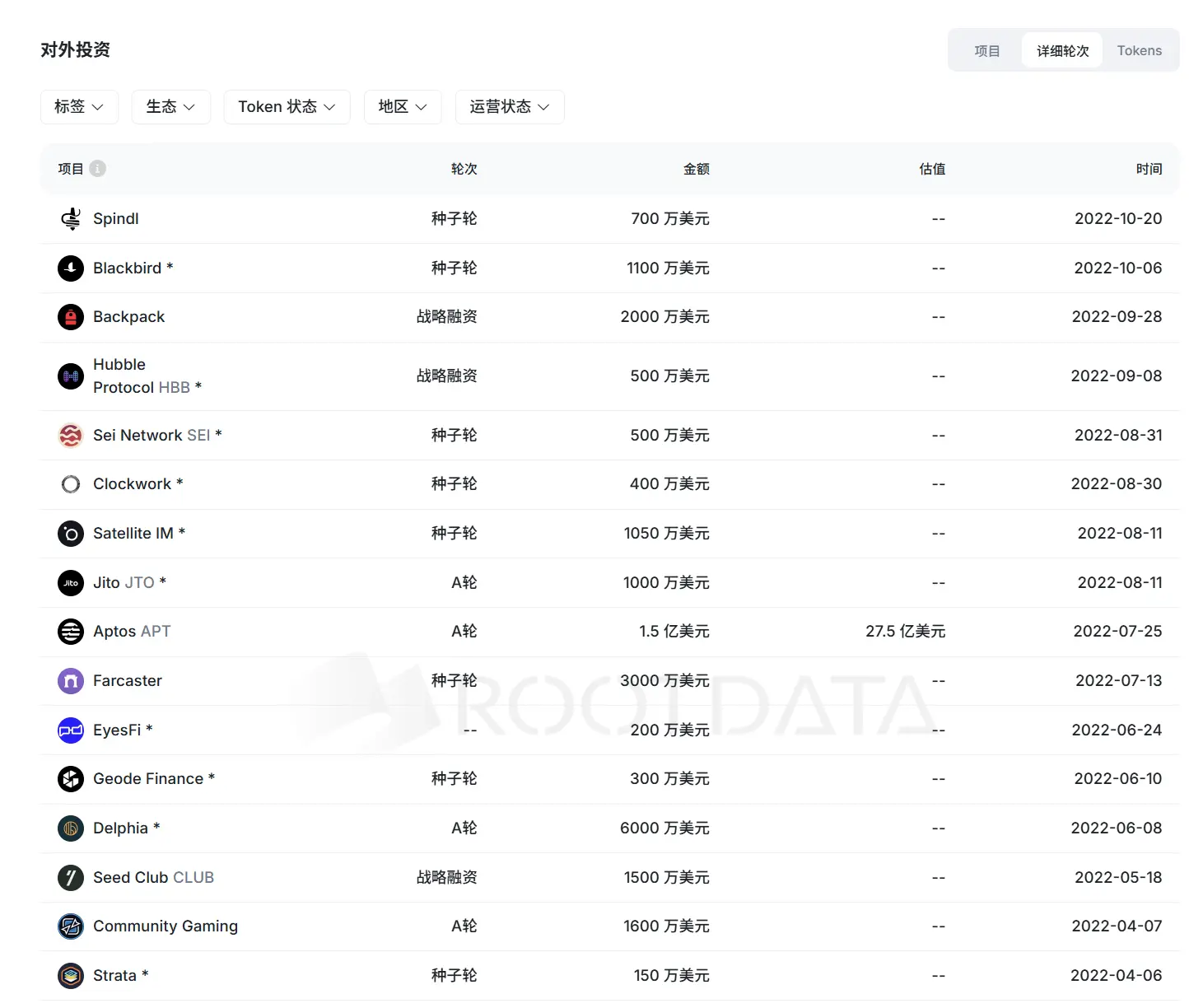
Multicoin Capital Investment Round History Source: RootData

These changes are partly due to the bleak market and performance. Among the projects Multicoin Capital heavily invested in in recent years, Wormhole, invested at a valuation of $2.5 billion (the total amount raised in this round was $225 million, second only to investment rounds in Forward Industries, FTX, and Solana), now has a token FDV of only $220 million. Pyth Network token FDV is only $480 million, and Solana's market value has fallen below $100 again.

At this point, the reason for Kyle Samani's departure is very clear: he believes the development direction of crypto has deviated from his expectations, even his values. The shattering of his ideals forced him to leave this place of disappointment and try to regain his passion in fields like AI and life sciences.

Next, Multicoin Capital will also have to face the situation after "losing its soul." Kyle Samani's exit will undoubtedly raise questions about its future direction and leadership: with the sharp slowdown in investment and organizational adjustments, will Multicoin Capital still be one of the industry's top research-oriented, conviction-driven VCs?

The Trough of Idealism

In fact, before Kyle Samani, many crypto investors and entrepreneurs have expressed similar views, resigning and choosing to temporarily leave the crypto industry. Just in January, a16z Crypto general partner Arianna Simpson announced her departure and plans to establish a new fund investing in various industries, not limited to crypto.

A more famous case is Ken Chan, former co-founder and CTO of Aevo. In an article published in November '25, he bluntly stated that he had wasted 8 years of his life on cryptocurrency and described the crypto industry as "the world's largest, most engaged super casino."

"Spending eight years in the cryptocurrency space completely destroyed my ability to discern sustainable business models. In crypto, you don't need a successful business or product to make money. The cryptocurrency industry is filled with tokens with extremely high market capitalizations but almost no users," Ken Chan believed. "This industry mentality is extremely harmful, and I believe it will lead to a long-term collapse of social mobility for the younger generation."

A series of接连出现的 cases are outlining a clearer trend: against the backdrop of a持续偏紧 macro environment, as the wealth effect of the crypto market明显减弱, the large-scale落地 of typical products is长期受阻, and the core narratives that once supported the industry's expansion are逐一证伪, the crypto industry is阶段性地 losing some of its earliest entrants and most idealistic builders and investors.

This loss does not mean a fundamental denial of crypto technology, but reflects that the patience driven by idealism is being tested by a continuously lengthening realization cycle. Before the return structure, industry order, and long-term expectations are重新建立, some core participants choose to exit阶段性地.

In past cycles, many VC investors have emphasized that high-return investments often occur when the market is "unloved," and bear markets are the best time to capture investment alpha. But now, even the "historical best investor" is choosing to turn and leave at this moment, which itself sends a signal worthy of serious consideration by the industry: the problem may no longer be just a cyclical market pullback, but the阶段性瓶颈 in the crypto industry's innovation capability, value orientation, and narrative vision is perhaps undergoing unprecedented scrutiny and re-evaluation.

Fortunately, more first-tier VCs like Coinbase Ventures, a16z, YZi Labs, and Pantera Capital remain active, with over 30 investments each in the past year. For the crypto industry in an adjustment period, the support from these VCs may not bring immediate prosperity, but it at least means that this round of re-evaluation has not yet turned into a complete exit.

Perguntas relacionadas

QWhy did Kyle Samani decide to step back from Multicoin Capital and the crypto industry?

AKyle Samani decided to step back because he no longer finds crypto interesting and has lost faith in the Web3 vision. He believes blockchain is primarily an asset ledger that will reshape finance but has limited applications beyond that, prompting him to explore other tech fields like AI and life sciences.

QWhat was Kyle Samani's reputation in the crypto investment community before his departure?

AKyle Samani was regarded as one of the most influential and top crypto investors, often described as a true contrarian. He was notably praised for his early investment in Solana and his steadfast belief in it during the FTX collapse, earning him recognition as one of the greatest venture capitalists in crypto history by figures like Haseeb Qureshi.

QHow has Multicoin Capital's investment activity changed recently according to the article?

AMulticoin Capital's investment activity has significantly slowed, with only 4 investment rounds since the second half of 2025 and 10 since October 2024. This pace is much slower than before and lags behind other prominent VCs, ranking outside the top 50 in investment frequency.

QWhat broader trend does Kyle Samani's exit reflect in the crypto industry?

AKyle Samani's exit reflects a broader trend of idealistic builders and investors leaving crypto due to diminished wealth effects, stalled product scalability, and disproven core narratives. It indicates a phase where patience is wearing thin, and some key participants are reassessing the industry's innovation capabilities and long-term vision.

QWhich areas does Kyle Samani still see potential in within the crypto space?

AKyle Samani still sees potential in on-chain privacy/confidentiality, specifically mentioning his belief in Zama winning that sector, and he acknowledges DePIN (Decentralized Physical Infrastructure Networks) as another notable area with promise.

Leituras Relacionadas

Has the 'Digital Gold' Narrative for BTC Failed?

**Title: Has the "Digital Gold" Narrative for Bitcoin Failed?** The article argues that Bitcoin's "digital gold" narrative remains valid despite a recent sharp price decline (from a peak near $126k in Oct 2025 to briefly under $61k in Feb 2026). It presents a long-term investment framework based on three core points: **1. Viewing Bitcoin as an Asset:** Bitcoin is presented as a superior potential store of value compared to gold. Key arguments are its absolute scarcity (21 million cap), superior portability, and transparent auditability via its public ledger. While acknowledging its current use in early, volatile stages (~3-4% global adoption), the author draws parallels to the early, disruptive phases of the internet and e-commerce. **2. Understanding the Recent Downturn:** The current ~50% correction is framed as a predictable, consensus-driven cycle following its post-halving peak (the 2024 halving preceded the Oct 2025 high). A crucial factor is a historic "changing of hands": the influx of new institutional buyers via ETFs allowed early, low-cost holders (miners, OG believers) to take profits. The author notes that while severe, Bitcoin's historical drawdowns (e.g., 93% in 2011, 77% in 2021-22) have been progressively smaller, suggesting maturing holder structure and decreasing volatility over time. **3. The Long-Term Perspective:** The long-term thesis hinges on Bitcoin capturing a portion of gold's market value. With Bitcoin's market cap at ~$1.4 trillion (at $70k) versus gold's ~$20 trillion, significant upside potential exists if the "digital gold" narrative is partially realized. However, the author strongly cautions that short-term risks remain, the bottom is unpredictable, and high volatility is inherent. The real risk is not Bitcoin failing but poor personal position management (over-leverage, wrong capital) and a lack of deep understanding, which can force investors out during severe downturns. The conclusion uses Amazon's 95% crash post-2000 dot-com bubble and subsequent 42x recovery as an analogy. The ultimate question is not if Bitcoin's price will rise, but if an investor's strategy and conviction can withstand the volatility to see the long-term play out. The recent divergence (gold up, Bitcoin down) is posed not as a narrative failure, but as potential evidence of this ongoing, painful transition from a speculative asset to a mainstream allocation.

marsbitHá 9h

Has the 'Digital Gold' Narrative for BTC Failed?

marsbitHá 9h

Has BTC's 'Digital Gold' Narrative Failed?

The article discusses Bitcoin's "digital gold" narrative, its recent price drop, and long-term outlook through the perspective of "Jason". It argues the narrative is not a failure but that Bitcoin represents a superior, new asset class due to its fixed supply (21 million), portability, and auditability. The piece compares its current ~3-4% global adoption rate to early internet/e-commerce, suggesting significant growth potential. Regarding the 2025-2026 price decline (from ~$126k to briefly under $61k), the author views it as a predictable, consensus-driven sell-off within Bitcoin's ~4-year cycle post-halving, exacerbated by a major "handover" from early, low-cost holders to new institutional buyers via ETFs. A key observation is that historical peak-to-trough drawdowns have lessened over time (e.g., 93% in 2011 to ~50% in 2026), indicating maturing volatility as holder structure changes. For the long term, the author uses a simple framework: Bitcoin's total market cap (~$1.4T at $70k) is only about 7% of gold's (~$20T). Even capturing 30-50% of gold's value would imply substantial upside. However, the article strongly cautions against viewing this as investment advice, emphasizing extreme volatility and the critical importance of risk management, position sizing, and deep fundamental understanding to survive severe drawdowns. It concludes by drawing a parallel to Amazon's 95% crash in 2000 and subsequent 42x recovery, stressing that the key is surviving market cycles to realize long-term potential.

链捕手Há 9h

Has BTC's 'Digital Gold' Narrative Failed?

链捕手Há 9h

From Code to Cognition: A Ten-Thousand-Word Guide to the Evolution of the Robot Brain

"From Code to Cognition: The Evolution of Robot Brains" The journey of robotic intelligence has shifted dramatically from manually coded systems to AI-driven brains. For decades, robots relied on layered software stacks—perception, state estimation, planning, control—each handcrafted. While predictable, they lacked adaptability. The 2010s saw deep learning revolutionize perception (e.g., object detection) and control (via reinforcement learning), but learned skills remained narrow. The arrival of Large Language Models (LLMs) marked a turning point. LLMs acted as high-level planners, interpreting natural language instructions and generating sequences of actions for traditional robotic systems to execute. However, true integration came with Visual-Language-Action (VLA) models, which fused vision, language, and motion prediction into a single network. Pioneered by models like RT-2 and open-source projects like OpenVLA, VLAs enable robots to reason and act directly from visual input and commands. The most advanced humanoid robots now employ a "dual-brain" architecture: a slow-thinking, large VLA (System 2) for reasoning and planning, and a fast-reacting, small network (System 1) for high-frequency motion control, sometimes with an even lower-level System 0 for balance. This split balances cognition with the physics of real-time movement. Computation is split between onboard hardware (e.g., NVIDIA Jetson) for safety-critical control loops and cloud/edge servers for non-critical tasks like learning and interfaces. A crucial driver is the open-source ecosystem—models like GR00T and OpenVLA allow startups to build upon pre-trained brains and fine-tune them with their own data, accelerating development. Despite progress, current systems struggle with recovery from errors, sample inefficiency, and long-horizon tasks. This has spurred the rise of **World Models**—neural networks that predict the consequences of actions. By simulating possible futures before acting (like NVIDIA Cosmos or Meta V-JEPA), robots can plan, recover, and generalize better. This represents the next frontier: shifting intelligence from learned reactions to an internal model of physics and cause-and-effect. The field is rapidly evolving. While not yet at its "ChatGPT moment," the convergence of cheaper hardware, scalable simulation, and world models points toward robots that are increasingly capable, adaptive, and useful. The question is shifting from "what can robots do?" to "what *should* they do?"

marsbitHá 10h

From Code to Cognition: A Ten-Thousand-Word Guide to the Evolution of the Robot Brain

marsbitHá 10h

Trading

Spot
Futuros
活动图片