What happened in crypto today – Surging ETF inflows, XRP’s morning dumps, & more

ambcryptoPublicado em 2026-03-16Última atualização em 2026-03-16

Resumo

BlockFills filed for Chapter 11 bankruptcy, revealing liabilities of up to $500 million against assets of only $50–100 million, highlighting severe liquidity stress in crypto lending. The firm absorbed $75 million in bad debt after Bitcoin's sharp decline triggered margin call failures. Meanwhile, institutional capital is shifting toward regulated crypto ETFs, with Bitcoin ETFs seeing $767.3 million in net inflows—dominated by BlackRock’s IBIT—and Ethereum ETFs adding $160.8 million. In XRP markets, a recurring "10 AM dump" pattern faded over the weekend, suggesting a potential reduction in algorithmic selling pressure. These trends point to structural vulnerabilities in crypto credit and growing institutional preference for ETF exposure.

BlockFills filed for Chapter 11 on the 15th of March, revealing liabilities between $100 million and $500 million against assets of only $50–$100 million.

This imbalance exposed severe liquidity stress. Pressure intensified earlier when Bitcoin [BTC] plunged from $97,000 to below $64,000 during February’s “Black Storm.”

As prices collapsed, institutional borrowers failed to meet margin calls. BlockFills then absorbed roughly $75 million in bad debt from these defaults.

Meanwhile, the firm had halted withdrawals on the 11th of February, signaling depleted liquidity buffers. Legal pressure soon compounded the crisis as Dominion Capital alleged misuse of customer assets.

These events reveal structural weaknesses in centralized crypto lending. When collateral values fall faster than liquidations execute, balance sheets quickly unravel.

As liquidity providers disappear, market depth thins, slippage rises, and institutional trust across crypto credit markets weakens further.

Institutional capital shifts toward crypto ETFs

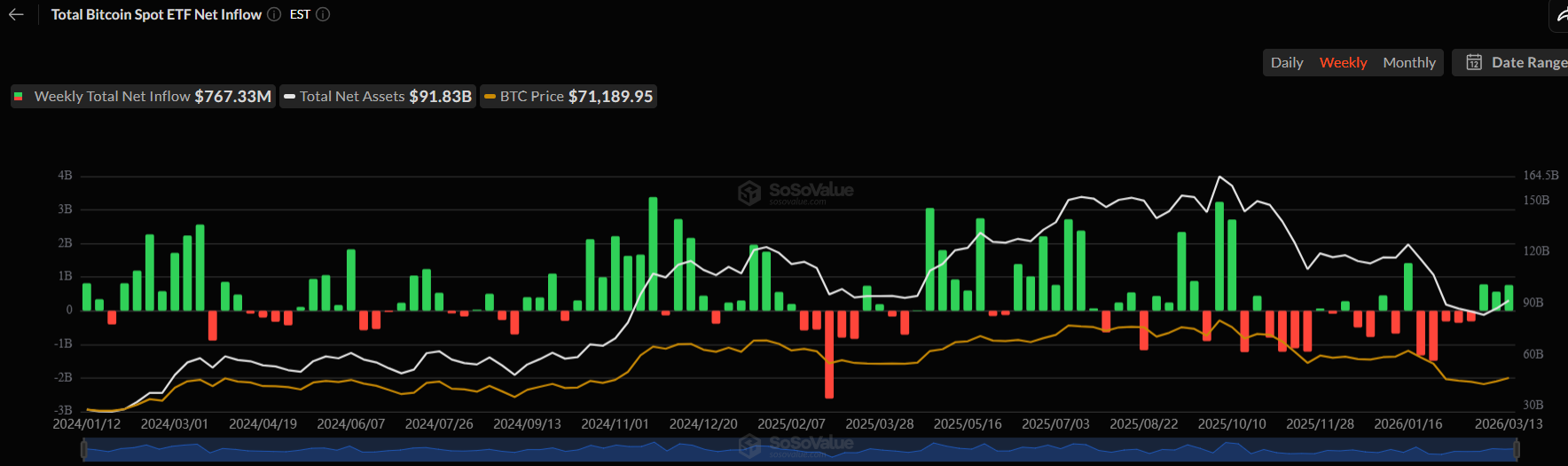
Institutional capital continues flowing through regulated crypto ETFs even as credit markets face strain. Over the past week, Bitcoin ETFs recorded $767.3 million in net inflows.

Approximately over $600 million of that capital was drawn to BlackRock’s IBIT, which dominated activity.
Source: SoSoValue

In contrast, Grayscale’s GBTC saw a $25.9 million exit, highlighting continued capital rotation. As Bitcoin [BTC] demand strengthens through ETFs, Ethereum funds also record steady accumulation.

Ethereum ETFs added $160.8 million in net inflows, reflecting steady institutional demand as investors continued reallocating exposure across different Ethereum investment products.

Beyond ETF flows, the Ethereum Foundation moved $10 million in ETH after initiating its first staking activity weeks earlier.

These developments signal that big investors prefer safer options, as ETFs are becoming more popular than riskier lending methods to access the crypto market.

Jane Street’s playbook echoes in XRP markets

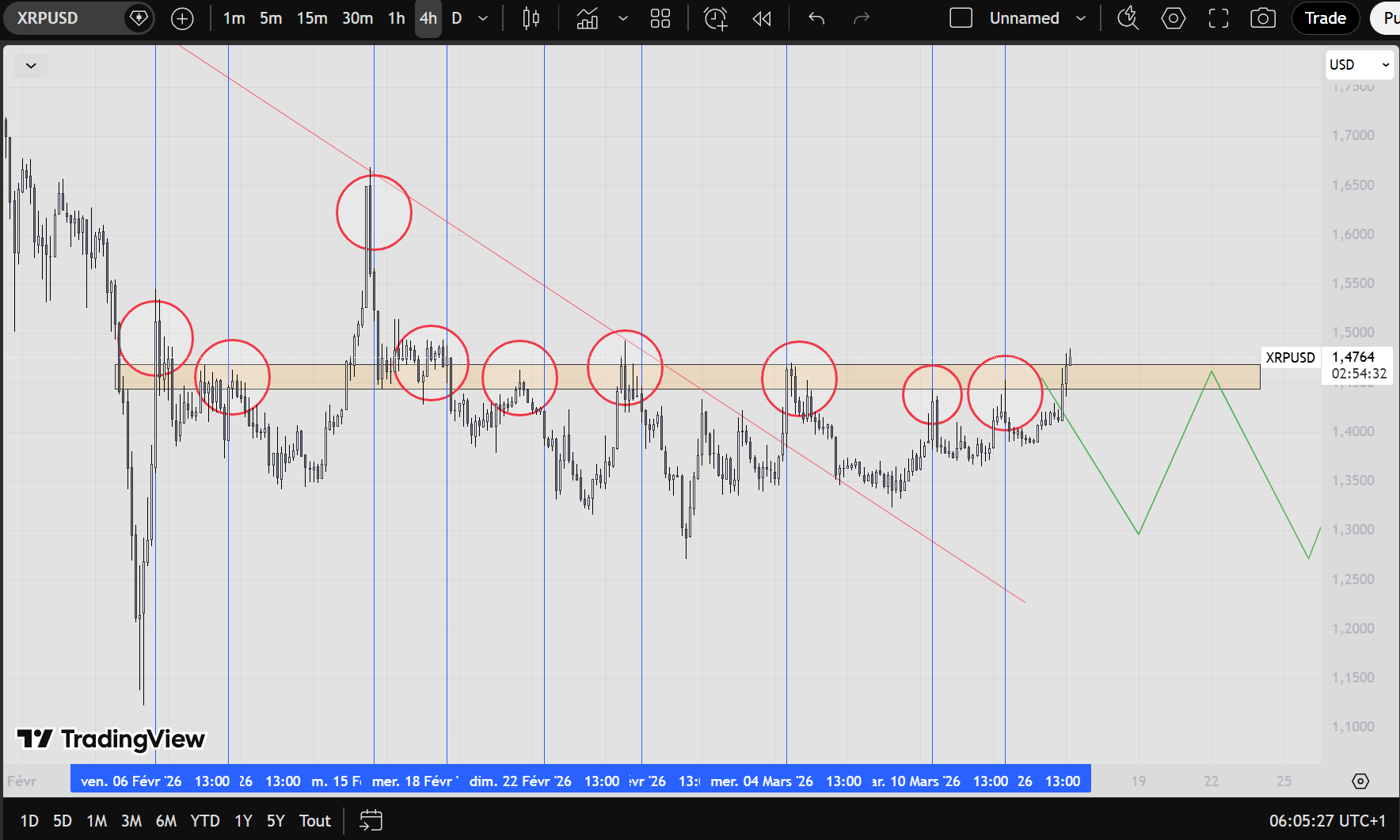
Over the weekend, Ripple [XRP] climbed from $1.41 to nearly $1.48 without a familiar rejection. This shift stood out because analyst ArthurXRP had earlier identified a recurring pattern.

In prior sessions, XRP repeatedly rallied toward the $1.48 resistance during off-hours trading.

Soon after, sharp selling pressure often appeared near the 10 AM EST U.S. market opening. Each rejection pushed the price back toward the $1.40–$1.42 range, reinforcing the ceiling.
Source: ArthurXRP/X

This behavior closely mirrors the “vanishing volatility” episode tied to the Jane Street controversy in early 2026. For months, crypto markets experienced a clockwork “10 AM dump,” widely attributed to institutional algorithmic flows.

Investigations alleged a “morning pump, afternoon dump” strategy used to profit from derivatives positioning. Yet as regulatory scrutiny intensified, the pattern abruptly faded.

Such dynamic hedge algorithms often create structured flows. When these systems pause, the selling pressure disappears. XRP’s weekend breakout therefore hints that institutional liquidity mechanisms may have temporarily stepped back.


Final Summary

  • Bitcoin’s market stress exposed structural fragility in centralized crypto lending after BlockFills’ collapse revealed liquidity mismatches and rising counterparty risk.
  • Ethereum reflects shifting institutional behavior as ETF inflows grow, while XRP’s disrupted sell pattern hints at fading algorithmic pressure.


Perguntas relacionadas

QWhat were the main reasons behind BlockFills filing for Chapter 11 bankruptcy?

ABlockFills filed for Chapter 11 due to severe liquidity stress, with liabilities between $100 million and $500 million against assets of only $50–$100 million. This imbalance was exacerbated by Bitcoin's price plunge from $97,000 to below $64,000, causing institutional borrowers to default on margin calls and resulting in approximately $75 million in bad debt. The firm had also halted withdrawals, signaling depleted liquidity, and faced legal pressure over alleged misuse of customer assets.

QHow did Bitcoin and Ethereum ETFs perform in terms of institutional inflows recently?

ABitcoin ETFs recorded $767.3 million in net inflows over the past week, with over $600 million drawn to BlackRock's IBIT. In contrast, Grayscale's GBTC saw a $25.9 million outflow. Ethereum ETFs added $160.8 million in net inflows, reflecting steady institutional demand and a shift toward safer investment products like ETFs rather than riskier lending methods.

QWhat pattern did analyst ArthurXRP identify in XRP's price movement, and how did it relate to Jane Street's controversy?

AArthurXRP identified a recurring pattern where XRP rallied toward $1.48 during off-hours trading but faced sharp selling pressure near 10 AM EST, pushing the price back to the $1.40–$1.42 range. This behavior mirrored the '10 AM dump' pattern from the Jane Street controversy in early 2026, which was attributed to institutional algorithmic flows. The weekend breakout suggested a temporary step back from these liquidity mechanisms.

QWhat structural weaknesses in centralized crypto lending were revealed by BlockFills' collapse?

AThe collapse revealed that when collateral values fall faster than liquidations can execute, balance sheets quickly unravel. This leads to liquidity providers disappearing, market depth thinning, slippage rising, and institutional trust in crypto credit markets weakening further, highlighting the fragility of centralized lending models under stress.

QHow did the Ethereum Foundation's activity reflect broader institutional trends in the crypto space?

AThe Ethereum Foundation moved $10 million in ETH after initiating its first staking activity, signaling alignment with institutional trends favoring safer, regulated options like ETFs. This, combined with steady ETF inflows, indicates a shift away from riskier lending methods toward more secure and transparent investment vehicles.

Leituras Relacionadas

From Banning Doubao to Embracing Honor: Why Did WeChat Suddenly 'Change Its Face'?

The article explores the sudden shift in WeChat's strategy towards AI assistants from mobile phone manufacturers, transitioning from strict opposition to active collaboration. For over a year, WeChat fiercely resisted attempts by phone AI assistants (like ByteDance's Doubao in late 2025) to control its features via GUI automation ("simulated clicking"), citing security and data control concerns. This stance created a significant barrier for system-level AI integration. Now, Tencent has initiated A2A (Agent-to-Agent) partnerships with major phone brands like Honor, Xiaomi, OPPO, and vivo. This model allows a phone's system AI (e.g., Honor's YOYO) to parse a user's voice command and send a structured request directly to WeChat's own internal AI agent via secure APIs. WeChat then executes the action (e.g., sending a message) and returns the result. The article attributes Tencent's "change of face" to strategic pressure. While leading in social app usage, Tencent trails rivals like ByteDance and Alibaba in standalone AI app popularity. WeChat, with its vast mini-program ecosystem, is Tencent's key asset for an AI comeback. The upcoming WeChat AI agent aims to handle tasks like booking and payments within the app. However, phone system assistants remain the primary AI entry point for most users. The A2A collaboration allows Tencent to extend WeChat's AI reach to this crucial system layer while maintaining control over its core functions and data. For phone manufacturers, embracing A2A is a pragmatic move. The GUI route proved unviable due to WeChat's blocks. A2A offers a compliant path to integrate a vital service, enhancing their AI assistants' usefulness. It allows them to focus on developing their own AI ecosystems for other services while cooperating on WeChat access. The collaboration is framed as a mutual, strategic necessity: Tencent gains a distribution channel, and manufacturers gain a key functionality. The partnership relies on a "dual authorization" mechanism for security, requiring both user and app consent for each action. While questions about long-term data privacy practices remain, experts note A2A is more secure and compliant than GUI automation. Ultimately, this cooperation is seen as a tentative, calculated truce. Tencent's long-term goal is to make WeChat an AI-powered "service OS." Phone manufacturers aim to make their system AI the central user interface. Their paths may converge or clash in the future, but for now, the A2A deal represents the opening chapter in the battle for the AI-era user入口, driven by necessity and strategic calculus on both sides.

marsbitHá 28m

From Banning Doubao to Embracing Honor: Why Did WeChat Suddenly 'Change Its Face'?

marsbitHá 28m

On-Chain Figures on the Eve of Kickoff: 1.6 Billion Traded Before the World Cup Even Begins

"On-Chain Numbers on the Eve of the World Cup: $1.6 Billion Traded Before Kick-off" Analysis of on-chain markets before the 2026 FIFA World Cup reveals significant crypto integration into football. The most striking figure is the approximately **$1.6 billion** in total trading volume on the single "World Cup Winner" contract on the Polymarket prediction market platform, accumulated before a single match was played. This represents explosive growth for a sector whose annual volume surged from ~$16B in 2024 to ~$64B in 2025. The ecosystem is maturing beyond speculation. Key developments include: 1) **Infrastructure upgrades** like Polymarket's migration to native, regulated USDC stablecoin for settlements; 2) **Reliable data oracles**, such as Chainlink, being used to resolve real-world match outcomes on-chain; and 3) **Official recognition**, with FIFA appointing its first-ever "Prediction Markets" partner. Over 100 contracts now cover everything from the outright winner to individual match results and even non-sporting risks like venue relocation. This evolution marks a fundamental shift. While crypto firms are absent from FIFA's top-tier sponsor list, the technology has deeply penetrated the tournament's financial and predictive infrastructure through regulated stablecoin settlements, decentralized oracles, and new official partnership categories. The regulatory landscape remains complex and varies by jurisdiction, but on-chain markets for the World Cup are already a multi-billion-dollar reality.

marsbitHá 1h

On-Chain Figures on the Eve of Kickoff: 1.6 Billion Traded Before the World Cup Even Begins

marsbitHá 1h

From SpaceX's IPO to the Future of Crypto: Which Crypto Sectors Will Host the Trillion-Dollar Narrative?

From the SpaceX IPO, which targets a $750 billion raise at a $1.77 trillion valuation, we can extrapolate capital flow trends relevant to crypto. The focus shifts from speculative narratives to foundational infrastructure and real-world asset (RWA) integration. Key crypto sectors poised to benefit include: 1. **AI Infrastructure**: The narrative is moving from consumer-facing AI applications to underlying, scarce resources like compute power and decentralized GPU networks (e.g., TAO, RENDER, AKT, IO). These protocols are positioning as the essential "picks and shovels" providers for the AI economy. 2. **Real-World Assets (RWA)**: Beyond tokenized treasury bonds, RWA's future lies in on-chain equity and pre-IPO assets like SpaceX. This could democratize access to high-growth assets and reshape global capital flows, benefiting infrastructure projects like ONDO, LINK, and Plume that facilitate issuance, data, and liquidity. 3. **Core Financial Infrastructure**: Stablecoins, payment networks, and DePIN (Decentralized Physical Infrastructure Networks) are critical for settling the future on-chain economy. Their role expands from internal trading tools to foundational layers for global finance, AI systems, and real-world asset networks, leading to potential value reassessment. In summary, the next cycle may prioritize long-term infrastructure value—AI compute, asset tokenization networks, and settlement layers—over short-lived application hype, mirroring the broader market's shift towards funding the foundational systems of the future.

marsbitHá 1h

From SpaceX's IPO to the Future of Crypto: Which Crypto Sectors Will Host the Trillion-Dollar Narrative?

marsbitHá 1h

Trading

Spot
Futuros

Artigos em Destaque

O que é XRP 2.0

XRP 2.0: Uma Nova Fronteira no Landscape das Criptomoedas Introdução ao XRP 2.0 No reino em constante evolução das criptomoedas, novos projetos surgem continuamente, lutando por atenção e adoção. Uma dessas iniciativas promissoras é o XRP 2.0, um novo projeto de criptomoeda concebido para aproveitar a tecnologia de blockchain avançada e as metodologias de criptografia robustas. Embora o nome tenha paralelos com o XRP da Ripple, é crucial notar que o XRP 2.0 opera de forma independente, focando em melhorar a segurança das transações, a privacidade e a escalabilidade. À medida que o panorama financeiro digital abraça cada vez mais soluções descentralizadas, o XRP 2.0 visa contribuir de forma significativa para a web3 e a expansão global dos projetos de criptomoedas. O que é o XRP 2.0? No seu núcleo, o XRP 2.0 é um projeto de criptomoeda que visa criar um ecossistema de moeda digital seguro e descentralizado. Sua tecnologia fundamental integra princípios de blockchain sofisticados com técnicas de criptografia de ponta. O objetivo abrangente do XRP 2.0 é estabelecer-se como uma plataforma confiável e eficiente que possibilita a execução rápida de transações, priorizando a proteção de privacidade aprimorada para os seus usuários. O projeto é promovido como uma solução para muitas limitações enfrentadas pelas criptomoedas existentes, propondo um sistema que pode lidar com um volume maior de transações com velocidade e privacidade melhoradas. Esta versatilidade posiciona o XRP 2.0 como um concorrente significativo em um mercado repleto de várias moedas digitais. Quem é o Criador do XRP 2.0? A identidade do criador por trás do XRP 2.0 foi identificada como 'Wilbur.' No entanto, detalhes abrangentes sobre Wilbur ou a sua entidade associada permanecem elusivos. O anonimato de muitos criadores de criptomoedas não é um fenômeno incomum na indústria, muitas vezes concebido para manter um grau de privacidade e segurança. Quem são os Investidores do XRP 2.0? Até agora, informações específicas relacionadas às fundações ou organizações de investimento que apoiam o XRP 2.0 não estão disponíveis publicamente. No setor das criptomoedas, o apoio de investidores reputados pode influenciar significativamente a credibilidade e o sucesso de um projeto, no entanto, a transparência em relação aos apoiantes financeiros do XRP 2.0 não foi estabelecida. Como Funciona o XRP 2.0? O XRP 2.0 destaca-se por empregar uma combinação de tecnologia blockchain e algoritmos de criptografia avançados que asseguram transações seguras e descentralizadas. Sua estrutura inovadora inclui características únicas projetadas para fomentar o envolvimento dos usuários e ampliar as funcionalidades além das transações convencionais de criptomoedas. Entre essas características, o XRP 2.0 incorpora capacidades potenciadas por IA, como funcionalidades de texto-para-imagem e texto-para-fala. Estas adições são projetadas para melhorar a experiência interativa dos usuários, promovendo uma maior aplicabilidade em vários setores. Ao unir avanços tecnológicos com um design centrado no utilizador, o XRP 2.0 pretende captar a atenção de uma diversa gama de indivíduos e empresas que procuram integrar soluções de criptomoedas em suas estruturas operacionais. Cronologia do XRP 2.0 Compreender o XRP 2.0 requer examinar os marcos que definiram sua jornada até agora: 23 de Julho de 2023: O XRP 2.0 é apresentado como um novo projeto de criptomoeda, visando revolucionar as capacidades de transação seguras e descentralizadas no domínio do blockchain. 8 de Setembro de 2023: O lançamento de outro projeto, XRP20, ocorre, marcando o surgimento de um token ERC-20 na blockchain Ethereum que permanece não relacionado ao XRP 2.0. 13 de Novembro de 2023: O XRP Ledger passa por uma atualização significativa com o lançamento da versão 2.0.0 do software do servidor rippled. É importante notar que este desenvolvimento está desconectado do projeto de criptomoeda XRP 2.0. Pontos-chave sobre o XRP 2.0 Para destilar a essência do XRP 2.0, vários fatores críticos emergem: Características Únicas: A inclusão de características como texto-para-imagem e texto-para-fala potenciadas por IA diversifica ainda mais as aplicações potenciais do XRP 2.0. Tecnologia Blockchain: A estrutura utiliza mecanismos de blockchain avançados e protocolos de criptografia, assegurando um ambiente seguro e descentralizado para transações. Escalabilidade e Privacidade: O XRP 2.0 prioriza proteção de privacidade aprimorada nos processos de transação e a escalabilidade necessária para acomodar uma base de utilizadores crescente. Sem Afiliação com a Ripple: Importante, apesar do seu nome, o XRP 2.0 não tem qualquer lealdade ou colaboração com o XRP da Ripple, distinguindo sua estrutura operacional e objetivos dentro do ecossistema das criptomoedas. Conclusão O XRP 2.0 representa uma empreitada ambiciosa no domínio das criptomoedas, visando oferecer uma combinação de segurança, privacidade e eficiência em transações digitais. Ao integrar tecnologias sofisticadas e características amigáveis ao utilizador, o projeto propõe-se a ampliar os horizontes do que as criptomoedas podem alcançar na economia digital atual. Embora o anonimato do seu criador e a falta de investidores divulgados possam levantar questões para alguns, o foco do XRP 2.0 em funcionalidades avançadas e descentralização aumenta seu apelo num mercado de criptomoedas cada vez mais congestionado. À medida que o panorama das criptomoedas continua a evoluir, o XRP 2.0 pode ainda emergir como um jogador crucial na expansão de soluções de blockchain seguras e escaláveis.

99 Visualizações TotaisPublicado em {updateTime}Atualizado em 2024.12.03

O que é XRP 2.0

Como comprar XRP

Bem-vindo à HTX.com!Tornámos a compra de XRP (XRP) simples e conveniente.Segue o nosso guia passo a passo para iniciar a tua jornada no mundo das criptos.Passo 1: cria a tua conta HTXUtiliza o teu e-mail ou número de telefone para te inscreveres numa conta gratuita na HTX.Desfruta de um processo de inscrição sem complicações e desbloqueia todas as funcionalidades.Obter a minha contaPasso 2: vai para Comprar Cripto e escolhe o teu método de pagamentoCartão de crédito/débito: usa o teu visa ou mastercard para comprar XRP (XRP) instantaneamente.Saldo: usa os fundos da tua conta HTX para transacionar sem problemas.Terceiros: adicionamos métodos de pagamento populares, como Google Pay e Apple Pay, para aumentar a conveniência.P2P: transaciona diretamente com outros utilizadores na HTX.Mercado de balcão (OTC): oferecemos serviços personalizados e taxas de câmbio competitivas para os traders.Passo 3: armazena teu XRP (XRP)Depois de comprar o teu XRP (XRP), armazena-o na tua conta HTX.Alternativamente, podes enviá-lo para outro lugar através de transferência blockchain ou usá-lo para transacionar outras criptomoedas.Passo 4: transaciona XRP (XRP)Transaciona facilmente XRP (XRP) no mercado à vista da HTX.Acede simplesmente à tua conta, seleciona o teu par de trading, executa as tuas transações e monitoriza em tempo real.Oferecemos uma experiência de fácil utilização tanto para principiantes como para traders experientes.

1.6k Visualizações TotaisPublicado em {updateTime}Atualizado em 2026.06.02

Como comprar XRP

Discussões

Bem-vindo à Comunidade HTX. Aqui, pode manter-se informado sobre os mais recentes desenvolvimentos da plataforma e obter acesso a análises profissionais de mercado. As opiniões dos utilizadores sobre o preço de XRP (XRP) são apresentadas abaixo.

活动图片













