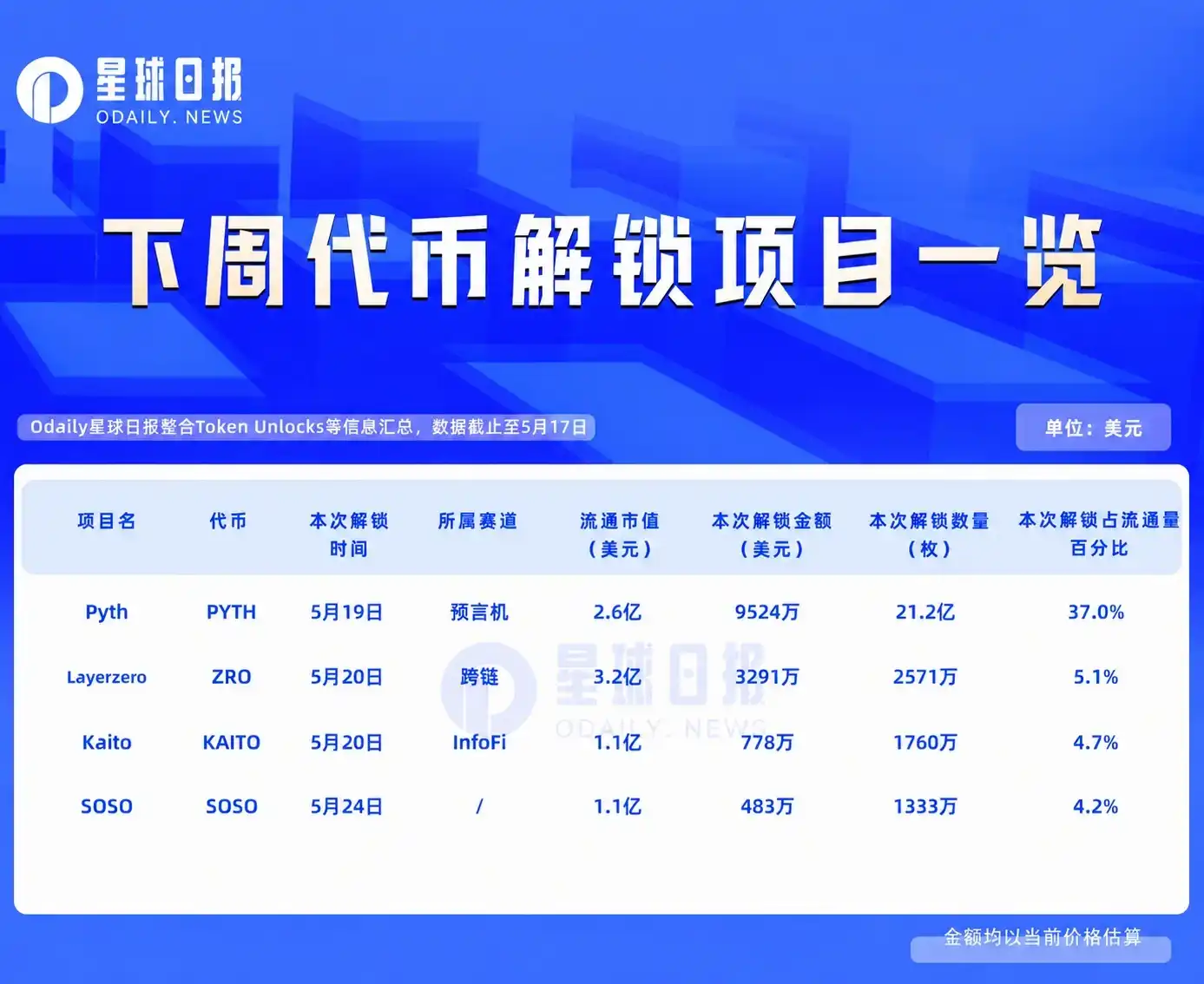
Weekly Token Unlocks: PYTH Unlocks Tokens Up to 37% of Circulating Supply

marsbitPublicado em 2026-05-17Última atualização em 2026-05-17

Resumo

This week's major token unlocks feature three notable projects, each releasing a significant number of tokens into circulation. **Pyth Network** is set for the largest unlock, releasing 2.12 billion PYTH tokens valued at approximately $95.24 million. This amount represents a substantial portion of its circulating supply. Pyth is a decentralized oracle network providing real-time financial market data for DeFi applications. **LayerZero** will unlock 25.71 million ZRO tokens, worth around $32.91 million. LayerZero is a full-chain interoperability protocol designed for secure and configurable cross-chain messaging. **Kaito** will release 17.6 million KAI tokens, with an estimated value of $7.78 million. Kaito is an AI-driven platform that aggregates and analyzes fragmented Web3 information from various sources like social media and governance forums. Each project section includes links to their official Twitter and website, along with a chart depicting their specific token release schedule.

Pyth

Project Twitter: https://twitter.com/PythNetwork

Project Website: https://pyth.network/

Tokens Unlocked This Time: 2.12 billion

Value Unlocked This Time: Approximately $95.24 million

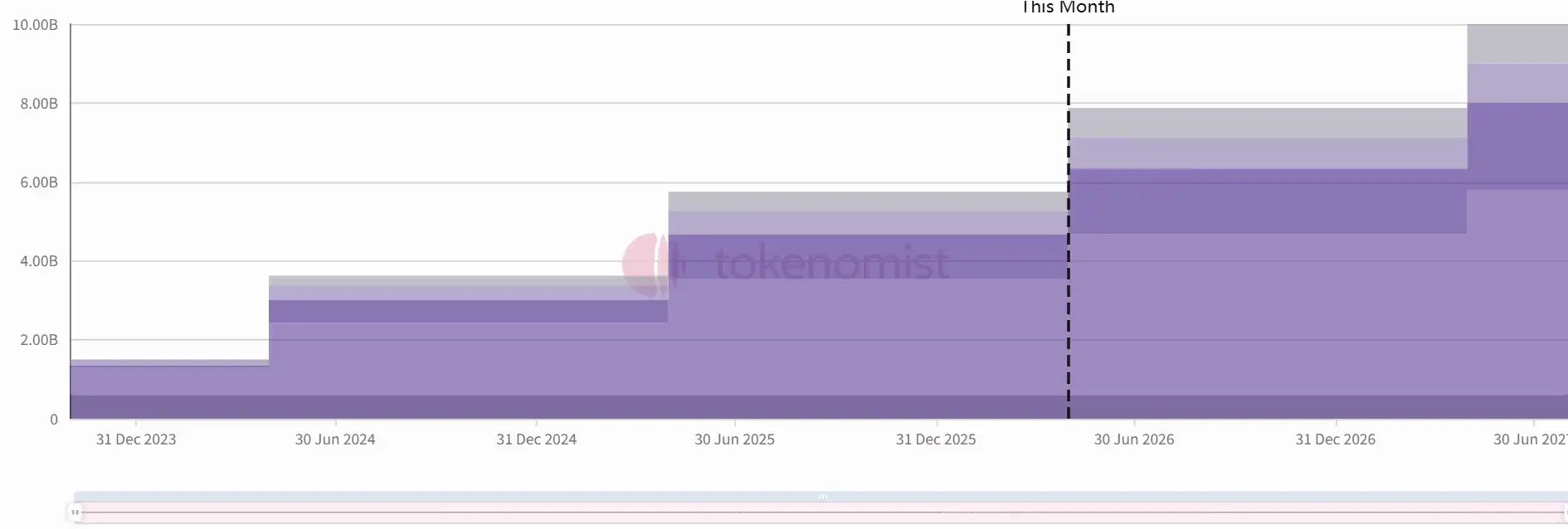
Pyth Network is a decentralized oracle project, providing real-time and accurate financial market data covering DEXs, derivatives, DeFi lending, stablecoins, synthetic assets, etc. It aims to enhance the functionality and reliability of decentralized finance (DeFi) applications.

Specific release schedule is as follows:
Layerzero

Project Twitter: https://x.com/LayerZero_Core

Project Website: https://layerzero.network/

Tokens Unlocked This Time: 25.71 million

Value Unlocked This Time: Approximately $32.91 million

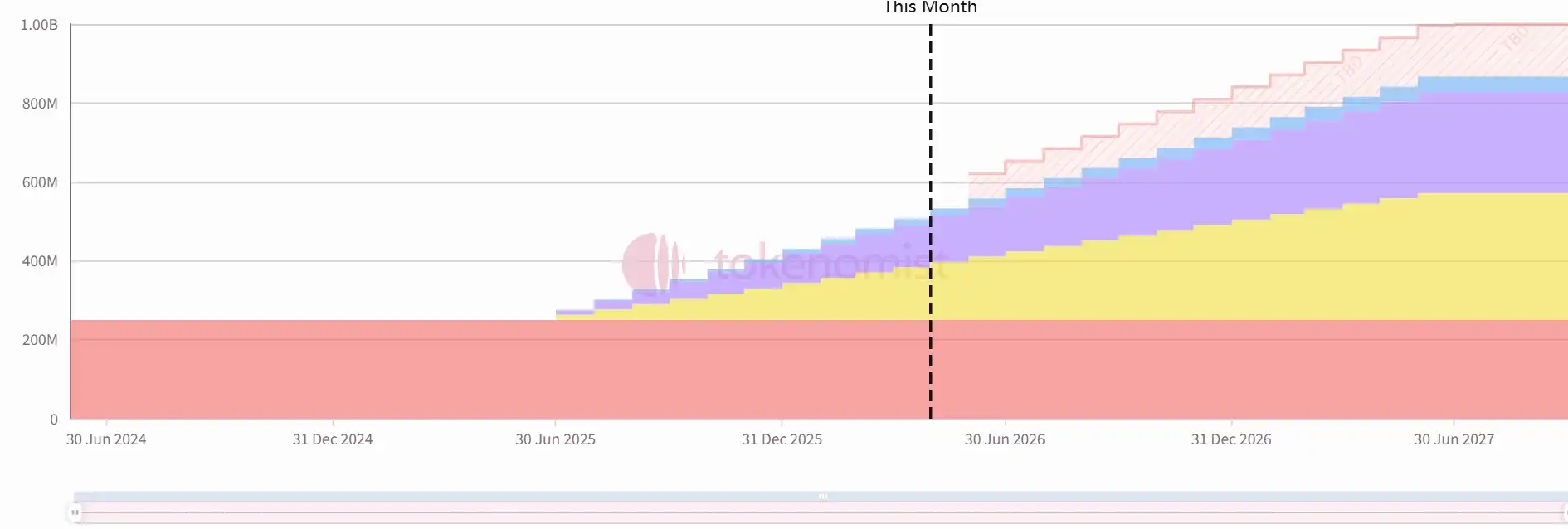
LayerZero is an omnichain interoperability protocol designed for lightweight message passing across chains. LayerZero provides trusted and guaranteed message delivery with configurable trustlessness.

Specific release schedule is as follows:
Kaito

Project Twitter: https://x.com/KaitoAI

Project Website: https://www.kaito.ai/

Tokens Unlocked This Time: 17.60 million

Value Unlocked This Time: Approximately $7.78 million

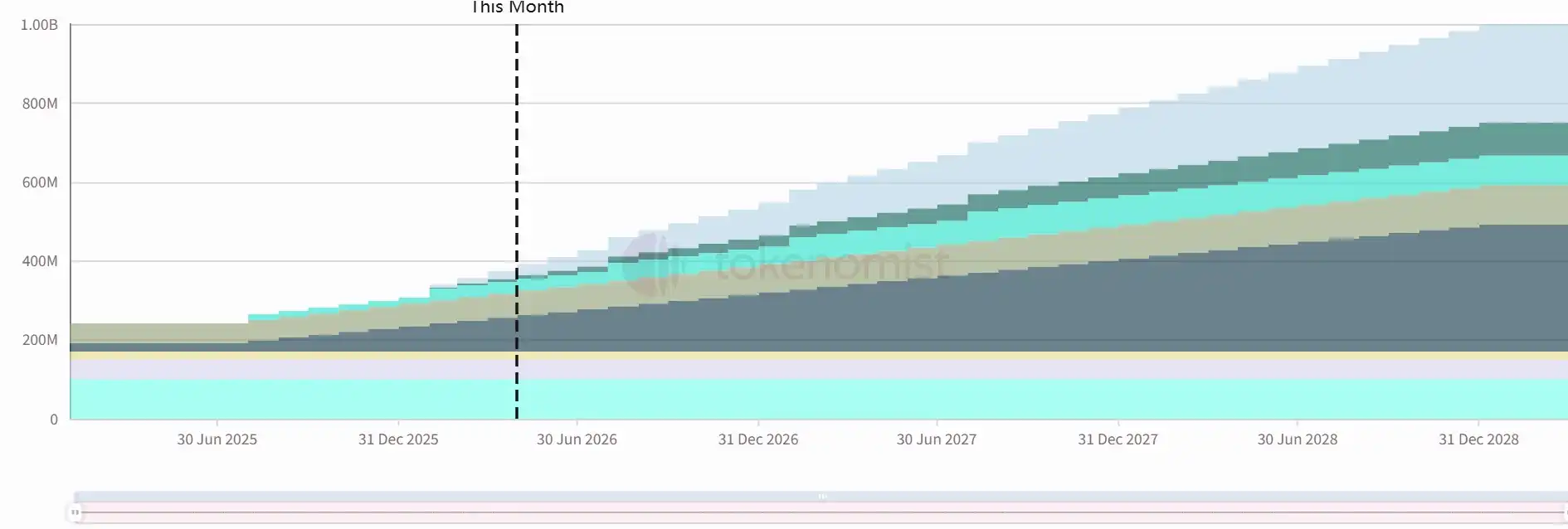
Kaito is an AI-driven Web3 information platform aimed at solving the issue of fragmented information in the crypto industry. By aggregating data from social media, governance forums, and other sources, Kaito uses AI technology to provide real-time search, sentiment analysis, and trend tracking.

Specific release schedule is as follows:
Perguntas relacionadas

QWhat percentage of the circulating supply does PYTH unlock represent according to the article?

A37% of the circulating supply.

QWhat is the primary function of the Pyth Network described in the article?

AIt is a decentralized oracle project that provides real-time, precise financial market data to enhance the functionality and reliability of DeFi applications.

QHow many tokens is LayerZero scheduled to unlock in this event?

A25.71 million tokens.

QWhat is the core purpose of the Kaito project as mentioned in the text?

AKaito is an AI-driven Web3 information platform that aims to solve information fragmentation in the crypto industry by aggregating data sources and providing real-time search, sentiment analysis, and trend tracking.

QWhat is the approximate USD value of the Pyth token unlock mentioned in the article?

AApproximately $95.24 million.

Leituras Relacionadas

The Value Distribution of Stablecoins

**Summary: The Value Distribution of Stablecoins** The article argues that stablecoins are evolving from mere trading tools into broader channels for dollar access. It divides the stablecoin ecosystem into four layers to analyze how value is distributed: 1. **Issuance Layer:** Mints stablecoins, holds reserve assets, and captures the spread between reserve yield and user costs (e.g., Tether, Circle). This layer currently earns the largest profit margin. 2. **Infrastructure Layer:** Connects stablecoins to the traditional financial system, handling fiat on/off-ramps, banking integration, compliance (KYC/AML), and asset management (e.g., Bridge, BVNK). This is the "unglamorous" but critical work, building the essential bridges between crypto and real-world finance. 3. **Acquiring/Distribution Layer:** Integrates stablecoins into merchant systems, manages payment flows, and provides enterprise financial software (e.g., Stripe, Coinbase). They act as the access point for businesses. 4. **Application Layer:** The end-users and businesses that ultimately use stablecoins for payments, settlements, or as a store of value. They benefit from convenience but have little pricing power. The core thesis is that while the issuance layer currently dominates profits, the often-overlooked **infrastructure layer holds significant long-term potential**. The real challenge and barrier to mass adoption is not the on-chain transfer of stablecoins (which is simple), but the complex "last mile" integration into existing business workflows, banking systems, and regulatory frameworks across different countries. Companies in this layer are currently in a "land grab" phase, investing heavily to build networks, secure bank partnerships, and establish compliance pathways. While their position is currently pressured by the profitable issuers above and distribution platforms below, the article suggests that if stablecoins become a default financial rail for businesses, the infrastructure providers who have done the hard work of integration will ultimately gain strong pricing power and become entrenched, essential players.

marsbitHá 5h

The Value Distribution of Stablecoins

marsbitHá 5h

The Value Distribution of Stablecoins

The Value Distribution of Stablecoins The article argues that stablecoins are evolving from a mere trading tool into a broad "dollar channel." It analyzes the industry's value chain through four layers: 1. **Issuance Layer (e.g., Tether, Circle):** The top layer that mints stablecoins, holds reserve assets, and captures the thickest interest rate spread. 2. **Infrastructure Layer (e.g., Bridge, BVNK):** Connects stablecoins to the traditional financial system, handling critical but complex "dirty work" like fiat on/off-ramps, banking integration, compliance (KYC/AML), and cross-border settlement. 3. **Acquiring/Distribution Layer (e.g., Stripe, Coinbase):** Embeds stablecoins into merchant systems, manages payment flows, and integrates with enterprise software. 4. **Application Layer:** End-users and businesses that ultimately use stablecoins for payments, settlement, or storing value. The author posits that while the issuance layer currently captures the most profit, the most overlooked and potentially critical layer is infrastructure. The core challenge for stablecoin adoption isn't the on-chain transfer (which is simple), but bridging the gap between blockchain and the real-world financial system. This involves solving practical problems for businesses: fiat conversion, reconciliation, tax handling, and user onboarding. Infrastructure companies are currently in a difficult "land-grab" phase—building networks, securing banking relationships, and achieving compliance country-by-country. They face pressure from both the profitable issuance layer above and distribution platforms below. However, the author suggests this layer is building a crucial moat. Once stablecoins become a default business rail, the infrastructure players who have done the hard work of integration may gain significant, durable value and pricing power.

链捕手Há 5h

The Value Distribution of Stablecoins

链捕手Há 5h

How to Do Research Well: Deliberately Practice the Real Skills That Matter

No one truly teaches you how to do research. You're often given a desk, a pre-selected problem, and vague instructions to "create something new." Consequently, many people reverse-engineer the job based on visible outputs—papers, posts, announcements—learning only how to *appear* like a researcher rather than how to *become* one. True research capability is built from stacking small, trainable skills, nearly all of which can be developed through deliberate practice. **Pick Your Own Problem:** Most researchers absorb problems from advisors or trends, lacking the underlying reasoning. Choosing a problem you genuinely care about, as John Schulman advises, leads to original work. Develop "taste" like a muscle: predict experiment outcomes, guess paper results from methods, and track which findings remain important over time. **Upgrade Your Inputs:** Relying on shared reading lists (arXiv hot lists, filtered group chats) leads to unoriginal conclusions. Undervalued old literature often holds crucial insights (e.g., MoE, LSTM, backpropagation). Richard Sutton's "The Bitter Lesson" or Claude Shannon's 1952 talk on creative thinking are more predictive than lengthy modern surveys. Breadth matters as much as depth: draw from neuroscience, mechanism design, hardware knowledge, and honest statistics. Read papers directly, especially appendices and limitations sections. **Write Everything Down:** As Paul Graham noted, writing exposes flaws in seemingly mature ideas. Writing is the cheapest defense against self-deception. Following Feynman's principle, Darwin programmatically wrote down facts contradicting his theory to combat memory bias. Maintain a detailed log of hypotheses, setups, predictions, results, and updated understandings. Reviewing past logs fosters essential humility.

marsbitHá 7h

How to Do Research Well: Deliberately Practice the Real Skills That Matter

marsbitHá 7h

Trading

Spot
Futuros

Artigos em Destaque

Como comprar PYTH

Bem-vindo à HTX.com!Tornámos a compra de PYTH (Pyth) (PYTH) simples e conveniente.Segue o nosso guia passo a passo para iniciar a tua jornada no mundo das criptos.Passo 1: cria a tua conta HTXUtiliza o teu e-mail ou número de telefone para te inscreveres numa conta gratuita na HTX.Desfruta de um processo de inscrição sem complicações e desbloqueia todas as funcionalidades.Obter a minha contaPasso 2: vai para Comprar Cripto e escolhe o teu método de pagamentoCartão de crédito/débito: usa o teu visa ou mastercard para comprar PYTH (Pyth) (PYTH) instantaneamente.Saldo: usa os fundos da tua conta HTX para transacionar sem problemas.Terceiros: adicionamos métodos de pagamento populares, como Google Pay e Apple Pay, para aumentar a conveniência.P2P: transaciona diretamente com outros utilizadores na HTX.Mercado de balcão (OTC): oferecemos serviços personalizados e taxas de câmbio competitivas para os traders.Passo 3: armazena teu PYTH (Pyth) (PYTH)Depois de comprar o teu PYTH (Pyth) (PYTH), armazena-o na tua conta HTX.Alternativamente, podes enviá-lo para outro lugar através de transferência blockchain ou usá-lo para transacionar outras criptomoedas.Passo 4: transaciona PYTH (Pyth) (PYTH)Transaciona facilmente PYTH (Pyth) (PYTH) no mercado à vista da HTX.Acede simplesmente à tua conta, seleciona o teu par de trading, executa as tuas transações e monitoriza em tempo real.Oferecemos uma experiência de fácil utilização tanto para principiantes como para traders experientes.

160 Visualizações TotaisPublicado em {updateTime}Atualizado em 2026.06.02

Como comprar PYTH

Discussões

Bem-vindo à Comunidade HTX. Aqui, pode manter-se informado sobre os mais recentes desenvolvimentos da plataforma e obter acesso a análises profissionais de mercado. As opiniões dos utilizadores sobre o preço de PYTH (PYTH) são apresentadas abaixo.

活动图片