Weekly Token Unlock: STRK Unlock Volume This Week Accounts for 4.4% of Circulating Supply

marsbitPublicado em 2026-03-07Última atualização em 2026-03-07

Resumo

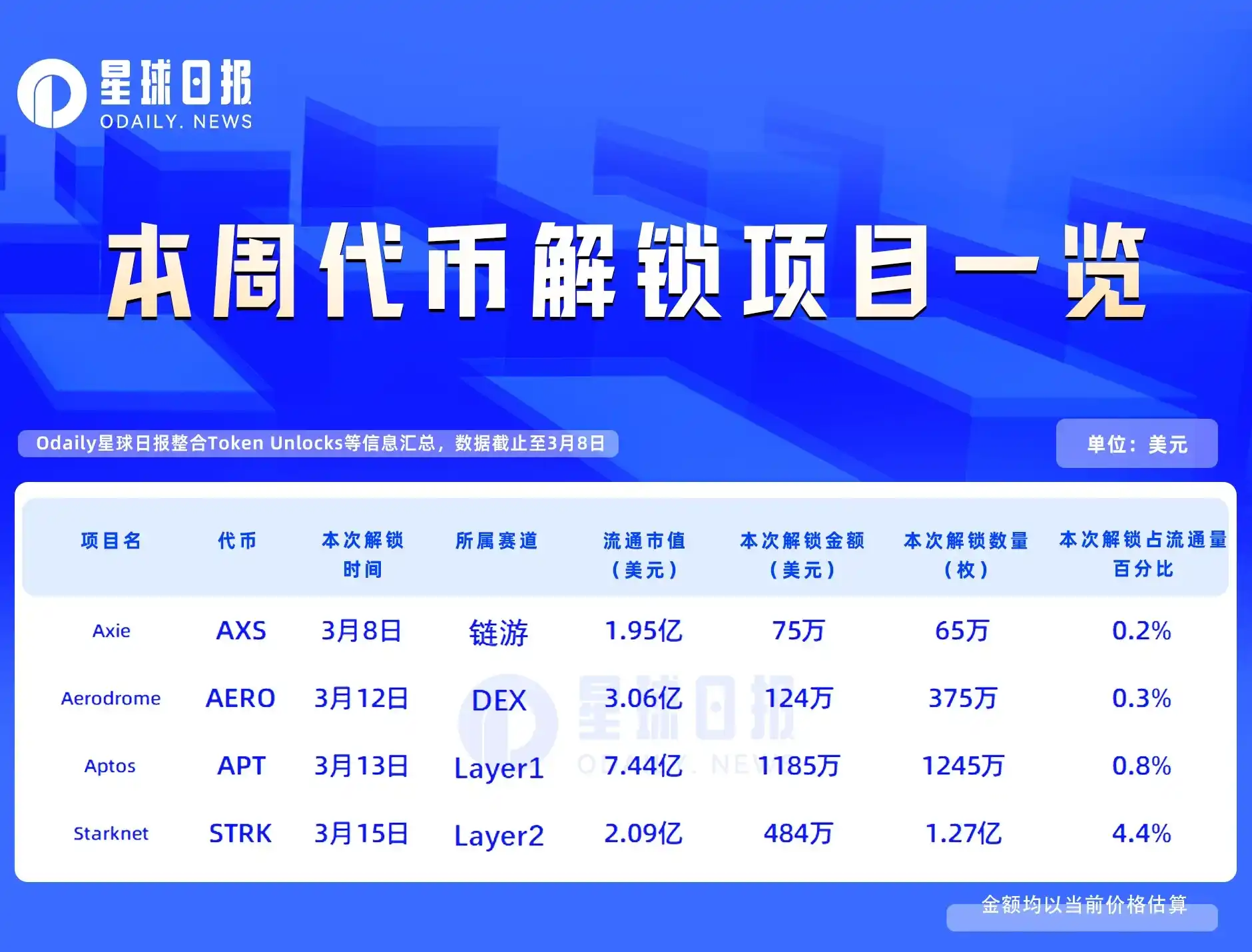
Starknet Token Unlock: STRK to Release 4.4% of Circulating Supply This Week Starknet, an Ethereum Layer 2 scaling solution using zk-STARKs technology to enable faster and cheaper transactions, is set to unlock 127 million STRK tokens this week. The unlock is valued at approximately $4.84 million and represents 4.4% of the token's circulating supply. Developed by StarkWare, which was founded in 2018 and is based in Israel, Starknet aims to improve Ethereum’s scalability by offloading transaction verification and computation from the mainnet. This approach significantly reduces the computational burden and increases network throughput. The release is part of Starknet’s predefined token emission schedule.

Starknet

Project Twitter: https://twitter.com/Starknet

Project Website: https://starknet.io/

This Unlock Amount: 127 million tokens

This Unlock Value: Approximately $4.84 million

Starknet is an Ethereum Layer 2 that utilizes zk-STARKs technology to make Ethereum transactions faster and reduce fees. StarkNet's parent company, StarkWare, was founded in 2018 and is headquartered in Israel. Its main products include Starknet and StarkEx. By using STARK, Starknet verifies transactions and computations without requiring all network nodes to validate each operation. This significantly reduces the computational burden and increases the throughput of the blockchain network.

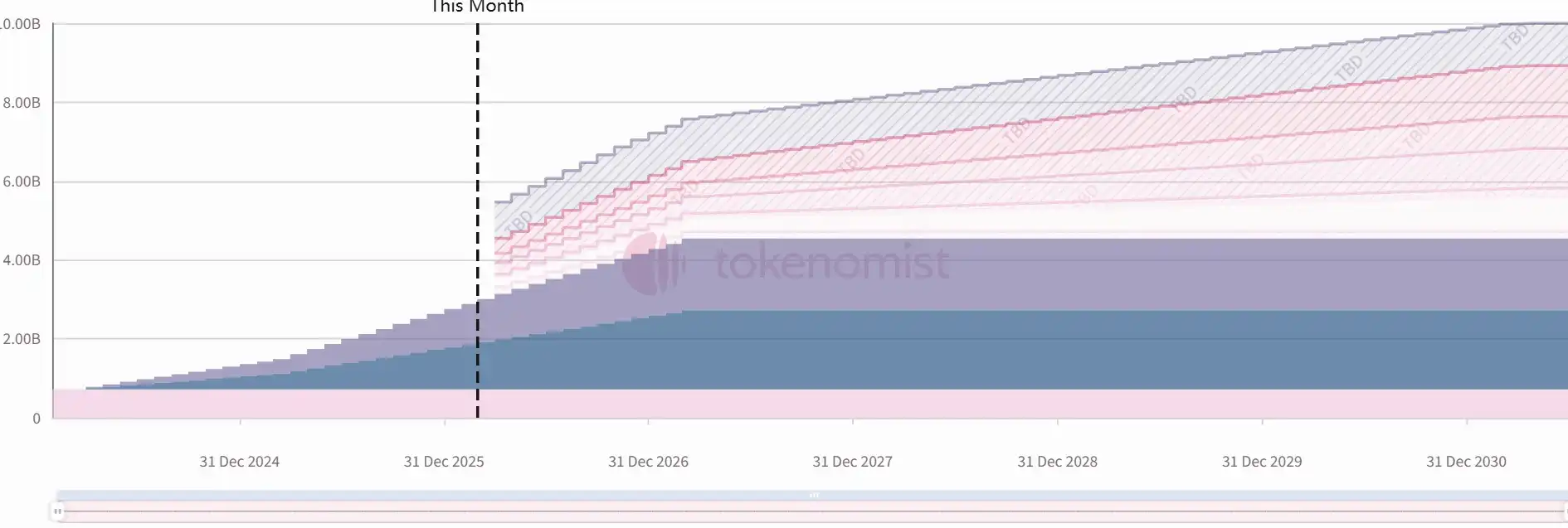
The specific release curve is as follows:

Perguntas relacionadas

QWhat is the amount of STRK tokens being unlocked this week?

A127 million tokens.

QWhat is the approximate value of the STRK tokens being unlocked this week in USD?

AApproximately $4.84 million.

QWhat is the percentage of the circulating supply that this week's STRK unlock represents?

A4.4% of the circulating supply.

QWhat is Starknet and what problem does it aim to solve?

AStarknet is an Ethereum Layer 2 that uses zk-STARKs technology to make Ethereum transactions faster and cheaper by verifying transactions without requiring all network nodes to validate each operation.

QWho is the parent company of Starknet and what are its other main products?

AThe parent company is StarkWare, which was founded in 2018 and is headquartered in Israel. Its other main product is StarkEx.

Leituras Relacionadas

In Jinjiang, Fujian, a Storage Super Unicorn Lies Quiet

In Fujian's Jinjiang, a city known for sportswear, lies a quiet semiconductor giant: Fujian Jinhua Integrated Circuit Co. (JHICC). Once a promising domestic DRAM manufacturer alongside Yangtze Memory and ChangXin Memory Technologies (CXMT), its journey was derailed in 2018 when the U.S. placed it on an Entity List and filed criminal charges for alleged trade secret theft. This halted production for years. A turning point came in February 2024 when a U.S. federal court found JHICC not guilty. However, it had lost crucial time. While CXMT soared to become a top-valued A-share company in 2024, JHICC, with an estimated valuation of 80 billion RMB, was just restarting. Its current output is primarily customized DDR4 chips, not the advanced DDR5/HBM demanded for AI, but it still benefits from the broader memory chip upcycle. JHICC's story is tied to Chen Zhengkun, a veteran engineer who left Micron to lead the venture. Founded in 2016 with state-backed funding, JHICC partnered with Taiwan's UMC to develop DRAM technology. Rapid progress was cut short by the U.S. actions, which Micron initiated, partly due to its heavy reliance on the Chinese market. Post-sanctions, Chen's team worked to rebuild the production line with reduced reliance on U.S. technology. According to its records, JHICC achieved small-scale production and revenue growth under immense pressure. It now focuses on the stable "niche" DRAM market (e.g., TVs, routers) with a monthly capacity of ~40,000 wafers, aiming for 60,000 by 2026. It holds over 1,000 patents but remains on the Entity List. For Jinjiang, investing in JHICC was a bold industrial leap. The local government provided unwavering financial and logistical support during the crisis, helping the company survive. JHICC has become the anchor for a growing local semiconductor cluster. Though its scale lags behind domestic peers, JHICC's persistence symbolizes a hard-won foothold in a global market long dominated by Samsung, SK Hynix, and Micron. Having missed one boom, it seeks a place in the new AI-driven memory supercycle.

marsbitHá 1h
In Jinjiang, Fujian, a Storage Super Unicorn Lies Quiet

marsbitHá 1h

Trading

Spot
活动图片