Web3 Social: Still Dominated by the Chinese

marsbitPublicado em 2026-01-22Última atualização em 2026-01-22

Resumo

In a span of two days, two major decentralized social protocols, Lens Protocol and Farcaster, changed ownership. Lens was taken over by Mask Network, led by Chinese founder Suji Yan, while Farcaster was acquired by Neynar, one of its clients. Combined, these protocols had raised over $200 million, with Farcaster valued at $1 billion last year. This follows the earlier acquisition of Steem by Tron’s Justin Sun in 2020, meaning two out of three prominent decentralized social protocols are now been taken over by Chinese-led teams. The author suggests that Western founders often approach decentralized social with idealism—emphasizing user-owned data and censorship resistance—while Chinese acquirers tend to view it as a business opportunity. Both Lens and Farcaster have seen declining engagement, making them attractive targets for pragmatic operators focused on usability rather than ideology. However, past acquisitions like Steem—which led to a community fork—highlight the risks of centralized control over “decentralized” protocols. Mask Network has framed its role as “stewardship” rather than outright ownership, but the very idea of a “decentralized” protocol being acquired raises questions about how much these platforms are truly user-governed. Ultimately, the piece questions whether these acquisitions will lead to a more practical and widely adopted social web or simply repeat past conflicts between idealism and commercial reality.

Written by: David, TechFlow

Within two days, two decentralized social protocols changed hands.

On January 20th, Lens Protocol announced it was being taken over by Mask Network. On January 21st, Farcaster announced it was acquired by Neynar, one of its clients.

These two protocols have raised over $200 million combined. Farcaster was valued at $1 billion last year, with investors including a16z and Paradigm. Lens is backed by DeFi giant Aave.

Now, the founders have "stepped back from day-to-day operations to work on new projects."
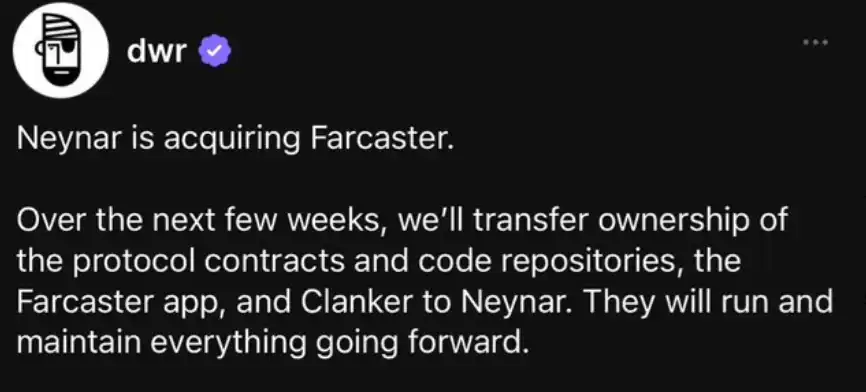
Including Steem, another high-profile project acquired by Tron in 2020, two out of these three phenomenal decentralized social protocols have been taken over by Chinese teams.

You might have forgotten about Steem. It was the pioneer of "writing to earn" launched in 2016, a benchmark project for the entire Web3 social track at its peak. After being acquired by Justin Sun, the community forked and left, but more on that later.

The Mask Network taking over Lens was founded by Suji Yan. Chinese, dropped out of UIUC at 20 to start a business, previously wrote articles for Caixin and Jiemian.

Founded Mask in 2017, focusing on overlaying Web3 features on traditional social platforms like Twitter.

Mask has been on an acquisition spree: acquired two large Japanese instances of Mastodon in 2022, bought Orb, the most active client on Lens, last year, and now has taken over Lens itself.

Suji Yan positions himself as the "Tencent of Web3".

On the Farcaster side, the acquiring Neynar was founded by two Indian-origin former Coinbase employees. But the reality that two out of three protocols were taken over by Chinese teams still holds.

Why the Chinese?

One possible explanation is capability endowment. The two most successful countries globally in making social products are the US and China. WeChat, Douyin (TikTok), Xiaohongshu (Little Red Book) – Chinese teams have proven they can build social platforms for billions of users.

But this explanation has a problem. Building products and acquiring protocols are not the same. Protocols are infrastructure, not directly facing users. You can build products on them, but the protocol itself doesn't generate the user experience.

Another reasonable explanation is price.

Looking at Brother Sun's (Justin Sun) acquisition list: bought BitTorrent for $140 million in 2018, Poloniex in 2019, Steemit in 2020, and HTX in 2022.

These targets have a common trait:

They were all once glorious but are on a downward trend. BitTorrent was the pioneer of P2P downloads, Poloniex was once a top US exchange, HTX was once one of China's top three exchanges.

Justin Sun isn't buying the best; he's buying the cheapest good stuff.

Now Farcaster is valued at $1 billion but its monthly revenue has dropped to $10,000, down over 95% year-over-year. Founder Dan Romero admitted last month in a post that "tried the social-first approach for 4.5 years, didn't succeed";

Lens has only 50,000 monthly active users, and the Aave team wants to offload it to focus on its core DeFi business.

The most valuable time for these protocols has passed, but the technical foundation and brand remain. In A-share market terms, this is called:

Fallen out of value.

There's a more subtle line of thought: decentralized social is a belief in the West, but a business in China.

Western founders in this space often carry idealism. Users should own their data, social graphs should be portable, platforms shouldn't have censorship power... Farcaster's slogan is "sufficiently decentralized", Lens's is "user-owned social".

But after five years, users don't care.

Ordinary people don't care who owns the data, or if the social graph is portable. They care if there are people to chat with, if there is interesting content, if there are associated assets that can skyrocket.

Chinese buyers taking over, to some extent, is taking this business from the idealists and handing it to the pragmatists.

Suji Yan says Mask's goal is to "bring decentralized social from the lab into daily life". Translating that:

Stop talking about ideals, first make people want to use it.

Of course, the last time a Chinese entity acquired a decentralized social protocol, the outcome wasn't pretty.

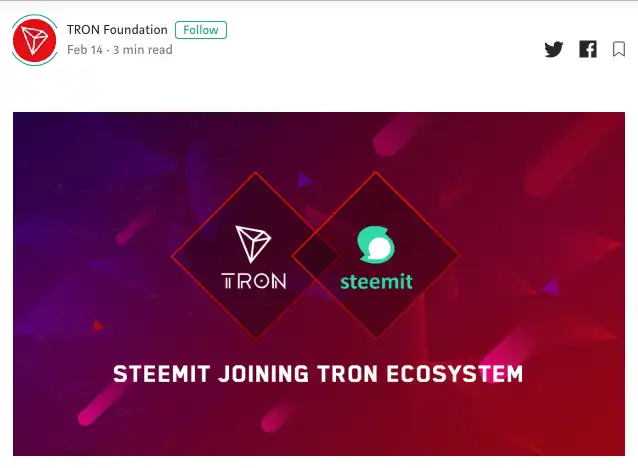
In 2020, Justin Sun acquired Steem. After the acquisition, he collaborated with exchanges to take control of Steem's network governance. The original community's reaction was a collective fork to create a new chain, Hive, using code to exclude Justin Sun's wallet.
A fork is the most extreme form of protest in the blockchain world – we're not playing with you anymore, we'll copy everything and leave.

Steemit is still running, but most active users moved to Hive long ago.

So the question is, will it be different this time?

Mask taking over Lens is officially termed "stewardship" in Chinese, meaning caretaker or custodian, not the word acquisition. The founder will continue as an advisor, and the protocol remains open.

But the fact that a "decentralized protocol" can be acquired itself says something. Contracts can be transferred, codebases can be transferred, Apps can be transferred. So where is the "decentralization"?

After the disenchantment, decentralization is just a technical architecture, not a business model. Technically decentralized doesn't prevent someone from calling the shots commercially.

After the change of leadership at Lens, Vitalik posted. He said every post he made in 2026 was through Firefly, which is precisely the multi-platform client under Mask Network.

He also said: "If we want a better society, we need better tools for mass communication."

That's true. But who builds this tool, who operates it, who decides what it looks like – decentralization doesn't answer these questions.

The answer now might be the Chinese will build it.

Then again, maybe nothing will happen. After all, there aren't many active users left.

Perguntas relacionadas

QWhat are the two decentralized social protocols that changed ownership within two days, as mentioned in the article?

ALens Protocol and Farcaster.

QWhich Chinese company took over Lens Protocol, and what is its founder's background?

AMask Network took over Lens Protocol. Its founder, Suji Yan, is Chinese, dropped out of UIUC at age 20, and previously wrote articles for Caixin and Jiemian.

QWhat is one possible reason suggested in the article for why Chinese teams are acquiring these protocols?

AOne reason is price, as these protocols have declined in value but still retain technical foundations and brand recognition, making them affordable acquisitions with potential.

QHow did the Steem community react when it was acquired by Justin Sun in 2020?

AThe Steem community forked the chain to create Hive, effectively excluding Justin Sun's wallet and moving active users away from Steemit.

QWhat does the article suggest is the key mindset difference between Western founders and Chinese acquirers regarding decentralized social protocols?

AWestern founders often approach it with idealism (e.g., user-owned data, anti-censorship), while Chinese acquirers view it as a practical business, focusing on usability and adoption rather than ideological goals.

Leituras Relacionadas

Lowering Expectations for BTC's Next Bull Market

The author, Alex Xu, explains his decision to significantly reduce his Bitcoin holdings (from full to ~30% of his portfolio) during the current bull cycle, citing a lowered long-term outlook for BTC's price appreciation in the next cycle. He outlines six key reasons for this reduced expectation: 1. **Diminished Growth Drivers:** The narrative of exponential user adoption has largely played out with institutional ETF adoption. The next major growth phase—adoption by sovereign national reserves or central banks—seems unlikely in the near future. 2. **Personal Opportunity Cost:** More attractive investment opportunities have emerged in other assets, such as undervalued companies. 3. **Industry-Wide Contraction:** The broader crypto industry is struggling, with most Web3 business models (SocialFi, GameFi, DePIN) failing. This overall萧条 (depression) reduces the fundamental demand and consensus for Bitcoin. 4. **Strain on Major Buyer:** MicroStrategy, a major corporate buyer of BTC, faces rising financing expenses for its debt, which could slow its purchasing rate and create significant marginal pressure on the market. 5. **Increased Competition from Gold:** The emergence of "tokenized gold" has closed the functional gap (portability, divisibility) between physical gold and Bitcoin, offering a strong competitor in the non-sovereign store-of-value space. 6. **Security Budget Concerns:** The block reward halving continues to exacerbate the long-standing issue of funding Bitcoin's network security, with new fee source explorations like Ordinals and L2s largely failing. The author's decision to hold a significant (though reduced) position reflects a cautious, not bearish, outlook. He remains open to increasing his exposure if the fundamental reasons for his skepticism change or if new positive catalysts emerge.

marsbitHá 26m

Lowering Expectations for BTC's Next Bull Market

marsbitHá 26m

Can Iran 'Control' the Strait of Hormuz?

Iran has announced a comprehensive plan to assert control over the strategic Strait of Hormuz, a critical global oil shipping chokepoint. The proposed measures include requiring all vessels to obtain Iranian permission for passage, imposing fees for security, environmental protection, and navigation management—preferably paid in Iranian rials—and absolutely banning Israeli ships. Vessels from countries deemed hostile by Iran’s top security bodies may also be barred. Analysts suggest Iran’s motives are multifaceted: increasing pressure on the U.S. and Israel by leveraging control over oil transit to influence global prices and inflation; creating a new revenue stream, potentially exceeding $7.7 billion annually, to counter Western sanctions and support postwar reconstruction; and using transit permissions as bargaining chips in future negotiations, notably with the U.S. However, the plan faces significant practical and diplomatic challenges. Enforcing comprehensive interception and fee collection in the busy waterway, patrolled by international military forces, would be difficult. The U.S. has already countering with a blockade of Iranian ports and threats to intercept any ship paying fees, potentially strangling Iran’s oil exports and fee revenue. Broad international opposition, led by European and Gulf states, and legal controversies further complicate implementation. The proposal may ultimately serve more as a negotiating tactic than a feasible policy, with its execution remaining highly uncertain.

marsbitHá 1h

Can Iran 'Control' the Strait of Hormuz?

marsbitHá 1h

Trading

Spot
Futuros
活动图片