Web3 gaming shifts to sustainability as confidence returns: BGA

cointelegraphPublicado em 2025-12-12Última atualização em 2025-12-12

Resumo

The blockchain gaming sector is shifting toward sustainable economics and showing improved sentiment, according to the Blockchain Game Alliance (BGA). In its annual report, the BGA noted the industry is moving beyond speculative origins toward a product-led future. A survey of over 500 professionals revealed optimism rebounded to 65.8%, with a focus shifting from token economics to sustainable revenue models. Growth is now driven by high-quality games, resilient revenue models, and scalable payment infrastructure. The sector faced significant challenges, with annual funding dropping from $4 billion in 2021 to $293 million in 2025, leading to studio closures and a failure rate of 80-93% for Web3 games. However, factors like clearer U.S. regulations and the adoption of stablecoins are aiding recovery. Stablecoins enable fast, low-cost, borderless transactions without crypto volatility. Nearly 30% of respondents cited high-quality game launches as crucial for growth, with industry leaders emphasizing that real adoption is now taking hold.

The blockchain gaming sector is shifting to more sustainable economics and has improved sentiment and market maturity as it recalibrates its outlook, reported the Blockchain Game Alliance (BGA).

The Web3 gaming advocacy group said in its annual state of the industry report released on Wednesday that the sector is “moving beyond its speculative origins toward a more operationally disciplined, product-led future.”

In a survey of over 500 global blockchain gaming professionals, the level of optimism rebounded to 65.8% from its 2024 lows, with the focus shifting from token economics to sustainable revenue models.

“The clearest indicator of the industry’s broader transition lies in its reorientation toward sustainable economics.”

Growth is now anchored in delivering high-quality games, resilient revenue models, and payment infrastructure to support real-world commerce at scale, the report noted.
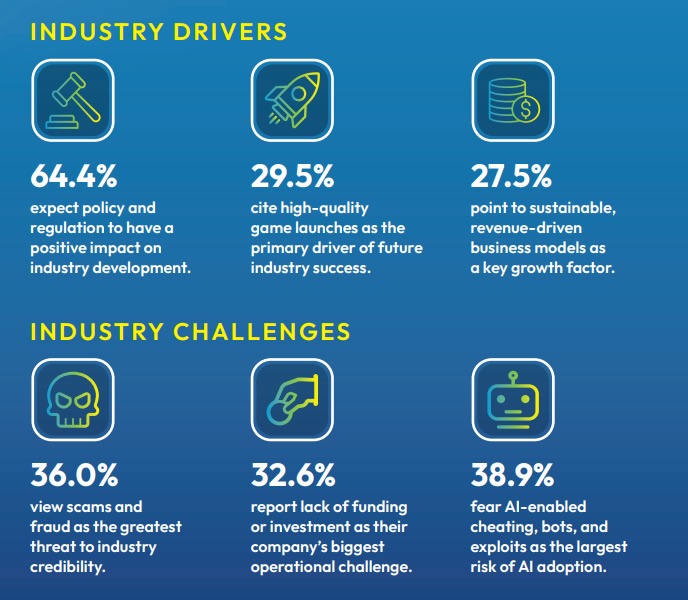
Clearer regulations are positive for the industry, said survey respondents. Source: BGA

A tough period for Web3 gaming

Blockchain and Web3 gaming have shifted from peak euphoria in 2021, driven by a play-to-earn explosion and speculative capital, to a low point in 2024, following the collapse of P2E models, a decline in confidence, and a drying up of funding, with studios closing and reputations being damaged.

Related: Investors target ‘fun-first’ crypto games as funding jumps 94% in July

Annual funding dropped dramatically to $293 million in 2025, down from $4 billion in 2021, forcing teams toward leaner, bootstrap-focused operations. Top-tier venture firms paused all new Web3 gaming investments, and project token prices collapsed more than 90% from cycle peaks.

Between 80% and 93% of Web3 games failed, with average lifespans of only months and studios that raised millions couldn’t sustain operations without continuous capital injections.

On the path to recovery

Several developments were cited as contributing factors to the recovery of the beleaguered sector, including regulatory shifts and the growing popularity of stablecoins.

Animoca Brands co-founder Yat Siu said recent crypto-friendly shifts in US regulations mean that companies no longer need to rely on setting up nonprofit foundations when planning token launches.

The BGA said that stablecoins were transformative for Web3 games, they gave gamers “fast, low-cost, borderless transactions without the volatility associated with other crypto assets.”

Additionally, nearly 30% of survey respondents cited high-quality game launches as the most important factor for industry growth.

Immutable’s vice president of global sales, Andrew Sorokovsky, said that “despite the negative headlines, blockchain gaming is now one of crypto’s most proven sectors — where quality projects are thriving and real adoption is taking hold.”

Magazine: XRP’s ‘now or never’ moment, Kalshi taps Solana: Hodler’s Digest
Leituras Relacionadas

Is Ethereum Truly a "World Computer"?

Title: Is Ethereum Really a "World Computer"? Ethereum, envisioned as a "world computer" by its founder Vitalik Buterin, aims to be a decentralized platform for global applications. However, a recent analysis by Four Pillars raises questions about whether it is more accurately a "Western computer," based on the geographical distribution of its validators. Currently, the United States dominates with 38.19% of all validators, followed by Germany at 13.04%. Combined, these two countries account for over half of the network. In contrast, Asian representation is minimal, with Singapore holding only 3.15%. The concentration is partly due to affordable cloud hosting services like Hetzner and OVH in Europe and North America, as well as the prevalence of residential validators in the U.S., where individuals run nodes via home internet connections. When examining professionally operated validators, the distribution becomes more balanced. The U.S. share drops to 25.81%, while Asian countries like Singapore (7.28%), Hong Kong (6.44%), Japan (6.38%), and South Korea (4.59%) collectively approach the U.S. level. This shift reflects strategic deployments by institutions to meet regulatory requirements and reduce latency for local users. However, regions like South America, the Middle East, and Africa remain underrepresented. Ethereum's peer-to-peer network mechanisms, such as gossipsub, disadvantage areas with low node density, creating a feedback loop where delayed message propagation reduces validator performance and rewards. This imbalance challenges Ethereum's promises of censorship resistance and global accessibility. Despite these issues, opportunities exist for growth in underrepresented regions. As demand for localized staking infrastructure rises, early entrants in areas like the Middle East could establish dominant positions by offering compliant, low-latency solutions. The evolving validator landscape highlights both the structural challenges and the potential for Ethereum to move closer to its "world computer" ideal.

Foresight NewsHá 1h

Is Ethereum Truly a "World Computer"?

Foresight NewsHá 1h

Trading

Spot
活动图片