Warsh Has Only Two Paths Ahead: Either Trigger "Financial Crisis 2.0" or Ignite "Dollar Crisis 1.0"?

marsbitPublicado em 2026-08-05Última atualização em 2026-08-05

Resumo

In a critical analysis, economist aka Shan argues that incoming Fed Chair Kevin Warsh faces two stark policy choices, either of which could lead to a severe economic crisis comparable to the Great Depression. Warsh has publicly committed to bringing inflation down to 2%, but with the US CPI averaging over 3% for the past decade, the task is monumental. Shan outlines two potential paths: First, maintaining a hawkish stance with continued rate hikes, quantitative tightening, and fiscal consolidation would pop the simultaneous and dangerously large AI, real estate, and private credit bubbles, triggering a "Global Financial Crisis 2.0" more severe than 2008. Second, caving to political pressure and reverting to zero-interest-rate policy and quantitative easing would accelerate the collapse of the dollar's purchasing power, leading to a "Global Currency Crisis 1.0." Shan emphasizes there is no middle ground. The analysis highlights the role of Cantillon Effects, explaining how money created from 2008-2020 flowed unevenly into financial assets, suppressing commodity prices. A critical shift occurred in 2022 as commodities began to catch up, locking in high inflation pressure for years. Given this backdrop and immense political pressure during a future "Lehman moment," Shan concludes the probability of Warsh sticking to a truly hawkish policy is "extremely low, close to zero." The more politically expedient path of renewed monetary easing, despite its long-term consequences for the...

Original Author: Xu Chao

Original Source: Wall Street News

In the view of economist aka Shan, the monetary policy choices of the new Fed Chairman, Kevin Warsh, are pushing the U.S. economy towards a crossroads with no way back—no matter which path he chooses, an economic crisis comparable to the Great Depression of 1929 seems almost certain. The only difference lies in whether this crisis manifests as an asset crash or the complete collapse of the U.S. dollar's purchasing power.

Over the past two months, Warsh has made high-profile statements on multiple occasions, vowing to bring inflation down below 2% and admitting he has "no magic wand." However, his words have not shaken price trends; futures markets only experienced brief volatility during his speeches before quickly returning to high levels. More critically, the U.S. CPI has fallen below 2% only twice in the past decade—1.8% in 2019 and 1.2% in 2020—with the ten-year average well above 3%, indicating that the long-term loose monetary policy has led to deeply entrenched issues.

Against this backdrop, Warsh's options are reduced to two diametrically opposed paths: the first is to persist with tightening, puncture the bubble, and trigger a "Global Financial Crisis 2.0" (GFC 2.0) similar to but more severe than 2008; the second is to return to easing under pressure, ultimately exchanging the systemic collapse of the dollar's purchasing power for short-term stability, i.e., "Global Currency Crisis 1.0" (GCC 1.0). Shan judges that, in the face of immense political pressure, the probability of Warsh choosing the latter overwhelmingly outweighs the former.
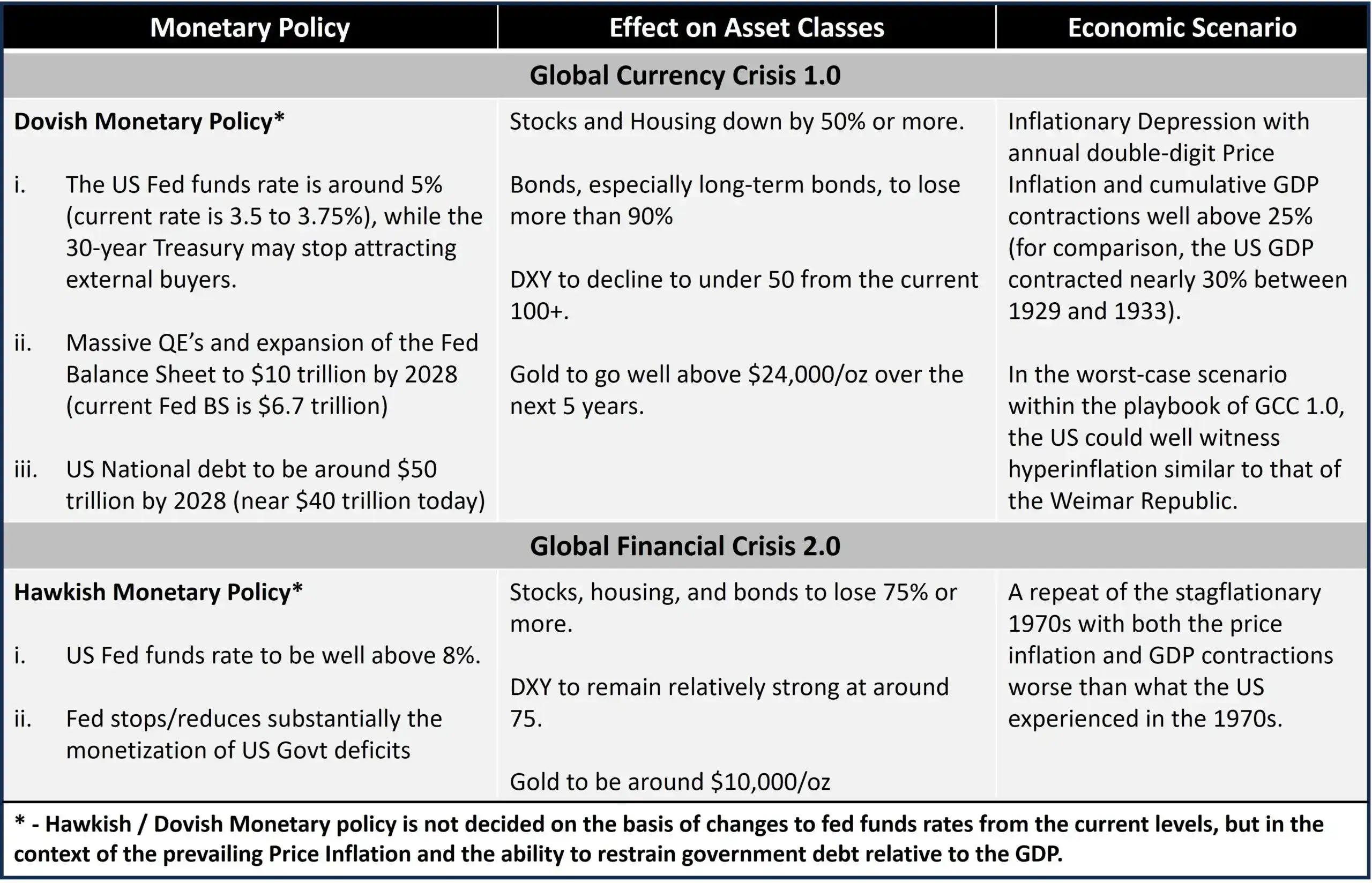
No Middle Ground: Two Paths Leading to the Same Crisis

According to the analytical framework of economist aka Shan, there is no middle ground between GFC 2.0 and GCC 1.0. Either outcome will lead to a severe economic recession.

If Warsh maintains a hawkish stance—continuing to raise interest rates, advancing quantitative tightening (QT), and pushing the government toward budget balance—the multiple asset bubbles, already inflated to dangerous levels, will burst one after another. Unlike 2008, which only saw a housing bubble burst, today there coexist an AI bubble, a housing bubble, and a private credit bubble. Each alone is larger than the subprime mortgage crisis of 2008, and their combined detonation would far exceed the impact of the Lehman moment.

If Warsh repeats Ben Bernanke's playbook under recessionary pressure—zero interest rate policy (ZIRP) plus quantitative easing (QE)—the excessive issuance of money will accelerate the collapse of the dollar's purchasing power, ultimately evolving into a currency crisis. Ironically, Bernanke won the Nobel Prize in 2022 for his crisis response at that time, yet the dilemma the U.S. faces today is precisely the direct consequence of that loose policy approach.
Cantillon Effects: Why 2026 Is Different from 2008

The key to understanding this crisis lies in an often-overlooked concept in monetary economics—the Cantillon Effects. Its core logic is that newly created money does not flow evenly into all assets but concentrates in specific asset categories during different periods, creating an asymmetric impact on prices.

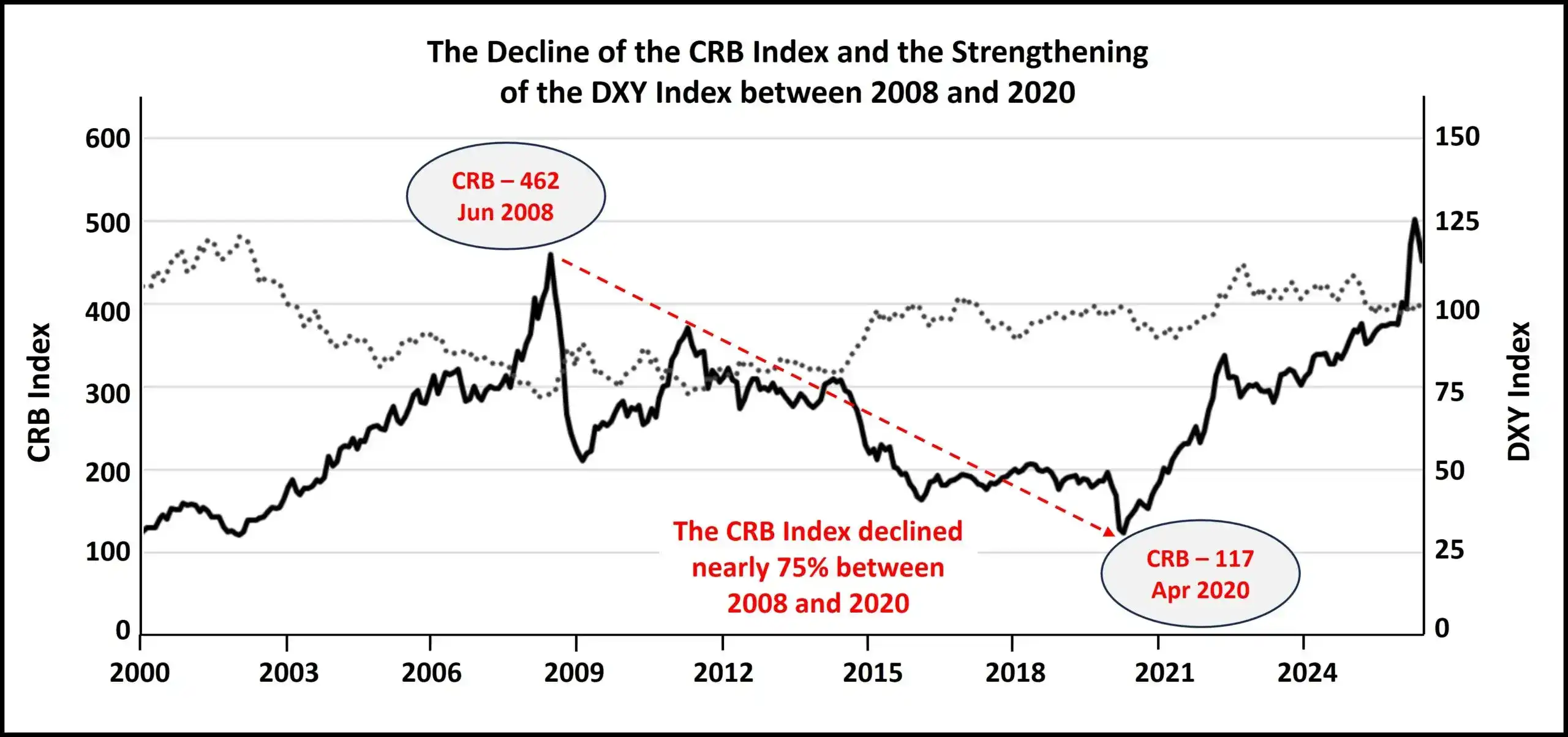
Between 2008 and 2020, the U.S. M2 money supply ballooned from $7 trillion to $20 trillion, the Federal Reserve's balance sheet expanded from less than $1 trillion to nearly $8 trillion, and the national debt climbed from under $10 trillion to nearly $30 trillion. During this period, stocks, real estate, and bonds soared, but commodity prices moved inversely—the CRB Commodity Index fell by nearly 75% cumulatively over this decade-long cycle of monetary excess.

2022 was the decisive turning point in this cycle. Historically suppressed commodity prices are beginning to catch up, reflecting the accumulated monetary inflation from previous years. This means that simply due to the historical debt accumulated over past decades of deficit expansion and artificially low interest rates, the U.S. already faces at least a decade of high inflation pressure—and if monetary policy spirals out of control on this basis, high inflation could easily turn into hyperinflation at any moment.

Can Warsh Walk the Talk?

Observable evidence so far suggests that the probability of Warsh genuinely implementing hawkish policies is extremely low.

The real test will come when the "contemporary Lehman moment" arrives—when multiple bubbles burst in sequence, the economy plunges into a sharp recession, and political pressure to restart ZIRP and QE becomes overwhelming. The question is whether Warsh has the willpower to withstand this pressure and make the economically correct but politically costly choice: raising interest rates, continuing to shrink the balance sheet, and forcing fiscal consolidation.

aka Shan is blunt about this: he personally believes this probability is "extremely low, even close to zero." Inflation is ultimately a policy choice, but in the face of political reality, the more damaging yet more convenient path is often the final choice.

Perguntas relacionadas

QAccording to the article, what are the two primary policy paths facing Fed Chair Kevin Warsh, as analyzed by economist aka Shan?

AThe two paths are: 1) Persisting with monetary tightening to burst the asset bubbles, triggering a severe 'Global Financial Crisis 2.0' (GFC 2.0). 2) Reverting to easing policies under political pressure, which would ultimately lead to a systemic collapse of the US dollar's purchasing power, resulting in a 'Global Currency Crisis 1.0' (GCC 1.0).

QWhy does the article argue that the potential crisis in 2026 would be more severe than the 2008 financial crisis?

AThe article argues it would be more severe because, unlike 2008 which involved primarily the housing bubble, the current economy is characterized by multiple massive bubbles simultaneously—AI, real estate, and private credit. Each is described as larger than the mortgage crisis of 2008, meaning their combined rupture would create a shock far exceeding the 'Lehman Moment.'

QWhat is the 'Cantillon Effect' and how does it relate to the current economic situation described in the article?

AThe 'Cantillon Effect' is a monetary economics concept stating that new money does not flow evenly into all assets but concentrates in specific asset classes at different times, causing asymmetric price impacts. The article uses it to explain why asset prices (stocks, real estate) soared from 2008-2020 while commodity prices fell, and why a catch-up in commodity prices starting in 2022 now contributes to persistent high inflation pressure.

QWhat does the article suggest is the most likely outcome of Kevin Warsh's policy dilemma, and why?

AThe article suggests the most likely outcome is that Warsh will choose the path leading to 'Global Currency Crisis 1.0' (GCC 1.0). Economist aka Shan assesses the probability of Warsh sticking to a truly hawkish stance as 'extremely low, close to zero' because the political pressure to restart zero-interest-rate policies (ZIRP) and quantitative easing (QE) during a severe recession would be overwhelming.

QAccording to the article's analysis, what is the fundamental cause of the high inflation pressure the US currently faces?

AThe fundamental cause is the massive accumulation of historical debt and monetary expansion over past decades through deficit spending and artificially low interest rates. This created latent inflationary pressure. The article states that based on this accumulated debt alone, the US faces at least a decade of high inflation pressure, which risks turning into hyperinflation if monetary policy loses control.

Leituras Relacionadas

Playing the "Decoupling" Card Again? Domestic Optical Modules Face a Stress Test

The U.S. Federal Communications Commission (FCC) is reportedly drafting a ban on importing new models of Chinese-made optical transceiver modules, with a potential implementation target of 2026. This "decoupling" move comes as Chinese firms, led by industry leaders like Zhongji Innolight and Eoptolink, dominate the global optical module market with over 60% share, and hold an even larger position in the high-speed 800G and 1.6T segments critical for AI data centers. Market reactions were mixed: U.S. optical module stocks initially rose, while Chinese A-shares opened lower but largely recovered by the close. Analysis suggests a complete U.S. decoupling from Chinese modules faces significant hurdles. North American cloud giants (Meta, Google, Microsoft, Amazon) and NVIDIA have massive demand for high-speed modules, estimated at around 40 million units in 2026. U.S. manufacturers' combined monthly production capacity for these modules is less than one-fifth that of a single major Chinese player like Zhongji Innolight, which reported production of 23.76 million units in 2025. Chinese companies are heavily reliant on the U.S. market, with over 90% of revenue for top firms coming from overseas, primarily the U.S. However, they have begun mitigating risks by establishing assembly plants in Southeast Asia and Mexico. Industry observers note the final impact depends on whether any potential U.S. restrictions target specific companies or products based on origin. Past U.S. sanctions on Chinese tech firms have often spurred increased domestic R&D and market diversification. Despite initial stock volatility, shares of major Chinese optical module companies pared losses, indicating market belief in the sector's resilience and the practical difficulties of abruptly replacing Chinese supply.

marsbitHá 24m

Playing the "Decoupling" Card Again? Domestic Optical Modules Face a Stress Test

marsbitHá 24m

When the Competition in Chip Manufacturing Equipment Stops Being Just About Who Is More Advanced

The competition in chip manufacturing equipment is no longer solely about who has the most advanced technology. While performance, yield, and cost remain key, U.S. export controls are adding a critical new dimension: long-term supply chain reliability. Major chipmakers like Samsung and SK Hynix, despite having mature supply chains with leading American and European vendors, are reportedly evaluating etching equipment from China's AMEC for their Chinese factories. This move is not primarily about immediate replacement or AMEC's current capabilities. Instead, it's a risk mitigation strategy. Companies are concerned that future U.S. policies could disrupt their access to spare parts, software updates, and maintenance for existing equipment over its decade-long lifespan. For chipmakers investing billions in fabs with long planning cycles, this policy-induced uncertainty is a significant new risk. The U.S., through its controls, is inadvertently eroding the very reliability and certainty that were foundational strengths of its equipment suppliers. This creates a pivotal shift for Chinese semiconductor equipment. Previously seen largely as a "domestic replacement" option when foreign gear was unavailable, they are now being assessed as potential "contingency suppliers" by global players—even before a supply disruption occurs. This provides a crucial entry point for validation in real production lines, which is essential for iterative improvement. Chinese equipment, particularly in areas like etching, has progressed from prototypes to participating in mass production within China, gaining valuable experience. However, this does not signify full global competitiveness. Gaps remain in advanced lithography, metrology, and other key tools. The current evaluations are largely confined to foreign firms' China-based fabs, not their global procurement networks. The core change is in the decision-making framework. Efficiency-driven globalization favored single, optimal suppliers. An era of heightened geopolitical risk is forcing companies to value "replaceability." While technical prowess remains paramount, supply chain certainty is now being factored into a device's competitive equation. Ultimately, U.S. policies have not made Chinese equipment more advanced, but they have given global customers a compelling reason to start testing it. The competition has expanded: it's no longer just about who is more advanced, but also about who can be relied upon to stay.

marsbitHá 24m

When the Competition in Chip Manufacturing Equipment Stops Being Just About Who Is More Advanced

marsbitHá 24m

Trading Volume Increased by 2.5x, Why Did Circle's Revenue Only Grow by 7%?

Circle's Q2 performance presents a seemingly contradictory picture: the transaction volume of its stablecoin USDC surged 151% year-over-year to $14.8 trillion, while its "Total Revenue & Reserve Revenue" grew by only 7% to $701 million. This discrepancy highlights the core of Circle's business model. Revenue is primarily driven not by transaction volume, but by the average amount of USDC in circulation and the yield generated from its reserves. Key points: 1. **Revenue Drivers:** Over 90% of revenue comes from "reserve income," which is a function of average USDC circulation (up 25% YoY) and the reserve yield (which fell by 66 basis points). The net effect was a mere ~5% increase in reserve income. 2. **Transaction vs. Revenue:** High transaction volume indicates robust usage of USDC for payments and settlements, but does not translate directly to revenue. It must first convert into a sustained, average circulating balance. 3. **Cost Structure:** After accounting for distribution and other costs, the metric "Revenue Less Direct Costs" (RLDC) grew faster than total revenue, with its margin improving. However, rising operating expenses (up 23% YoY) meant that Adjusted EBITDA growth was limited to 8%. 4. **New Initiatives:** Circle reported progress on new networks like the Circle Payments Network and upcoming products (Arc, Agent Stack), but these are currently measured by adoption metrics (e.g., transaction run-rate, number of services) rather than material revenue contribution this quarter. In summary, the financial results are determined by the interplay of USDC circulation, reserve yields, and cost structures, while high transaction volume signals underlying network strength that has not yet fully flowed through to the income statement.

marsbitHá 42m

Trading Volume Increased by 2.5x, Why Did Circle's Revenue Only Grow by 7%?

marsbitHá 42m

Samsung China, Another Step Back

Samsung China Takes Another Step Back Samsung Electronics is further retreating from the Chinese consumer market. Following the exit of its home appliance business in May, its mobile phone division is now reportedly scaling down. Stores with monthly sales below 300,000 RMB are being closed in several cities. Data shows Samsung's smartphone market share in China has plummeted to 0.1% in Q2 2026, a stark contrast to its 22% global leadership. The decline is attributed to intense competition from domestic brands offering better value, higher specs (like faster charging), and superior localization in software and services. Samsung's premium pricing and less adapted One UI system have struggled against rivals like Huawei, Xiaomi, and Honor. This consumer electronics retreat coincides with Samsung's record-breaking semiconductor profits, driven by the AI boom. In Q2 2026, the chip division contributed nearly all operating profit, while the mobile and home appliance unit posted its first-ever operating loss. Internal dynamics, like the chip division charging market prices to the mobile unit, have increased cost pressures. Samsung's strategy now appears to be a focused retreat towards the ultra-premium segment in China, similar to its global push in high-end foldables like the Galaxy Z Fold8. The company is likely to retain only key stores in major cities to serve a niche, high-end clientele. While its deep semiconductor reserves offer a cushion, this shift away from mass-market consumer electronics reduces business diversification. The move is pragmatic but signifies a fundamental transformation; Samsung is ceding mass-market influence and betting heavily on its semiconductor strength and a narrowed premium product focus.

marsbitHá 46m

Samsung China, Another Step Back

marsbitHá 46m

Trading

Spot
活动图片