Want to Follow SpaceX? Data Shows 30 Star U.S. IPO Stocks Mostly Halve in First Year

marsbitPublicado em 2026-06-11Última atualização em 2026-06-11

Resumo

"SpaceX is set for a historic IPO on June 12 under ticker SPCX, pricing at $135 per share to raise $75 billion at a valuation of about $1.75 trillion. However, data from Motley Fool on 30 high-profile tech IPOs since 2012 reveals a challenging pattern for new investors. Median returns were -9% after six and twelve months, with a median maximum drawdown of 54% in the first year. No company avoided a significant decline, including later successes like Meta and Palantir. Morningstar estimates SpaceX's fair value at only around $780 billion, less than half its IPO valuation. Despite SpaceX's dominant market share in U.S. rocket launches and a profitable Starlink subscriber base, its financials show a $4.9 billion net loss in 2025 and a trailing twelve-month revenue of $18.7 billion, resulting in a price-to-sales ratio exceeding 90. Analysts caution that while the IPO may see initial gains, historical trends suggest a high probability of substantial price declines and volatility in the following year."

Author: Curry, Chaoxiang Research

Synopsis: SpaceX is set to price after market close on June 11 and list on Nasdaq on the 12th under ticker SPCX, with an offering price of $135 per share, a valuation of approximately $1.75 trillion, raising $75 billion, making it the largest IPO in history.

However, historical data from 30 star tech IPOs compiled by Motley Fool shows: the median returns 6 months and 12 months post-listing were both -9%, with a median maximum drawdown of 54% in the first year, and none escaped unscathed. Morningstar's fair value estimate is only about $780 billion, less than half the offering valuation.
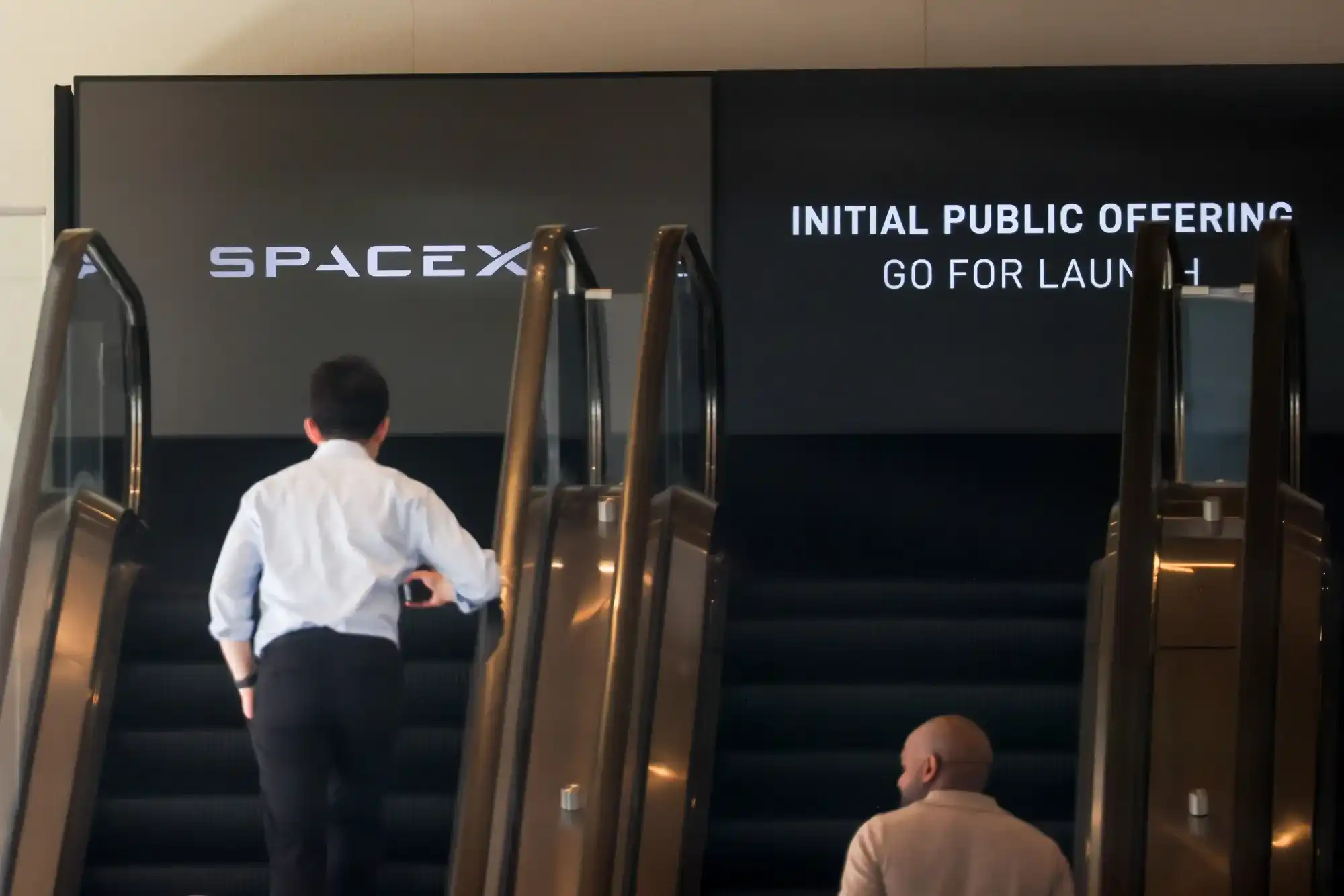
This Friday (June 12), SpaceX will list on Nasdaq under the ticker SPCX. According to a Reuters report on June 3, the offering price was set at $135 per share, issuing about 5.56 billion shares to raise $75 billion, corresponding to a valuation of about $1.75 trillion (some sources calculate it as $1.77 trillion based on post-offering shares). By either measure, this is the largest IPO in stock market history, with Goldman Sachs leading a syndicate of 21 underwriters. The final pricing will be determined after the U.S. market close on June 11.

The hype is undeniable. SpaceX stated in its S-1 filing that the company has "identified the largest executable total addressable market in human history," quantified at $28.5 trillion. The retail allocation was set at about 30% of the float, roughly three times the usual level for large IPOs.

The problem is, for ordinary investors rushing in on the first day, the answer provided by historical data is quite grim.

The Median Ledger: Small Gains in the First Three Months, Collective Losses After Six

In an article published on June 9, Motley Fool analyst Ryan Vanzo analyzed the post-listing performance of 30 star technology companies since 2012, with a sample ranging from Facebook and Twitter to Coinbase, Robinhood, Rivian, Arm, and CoreWeave.

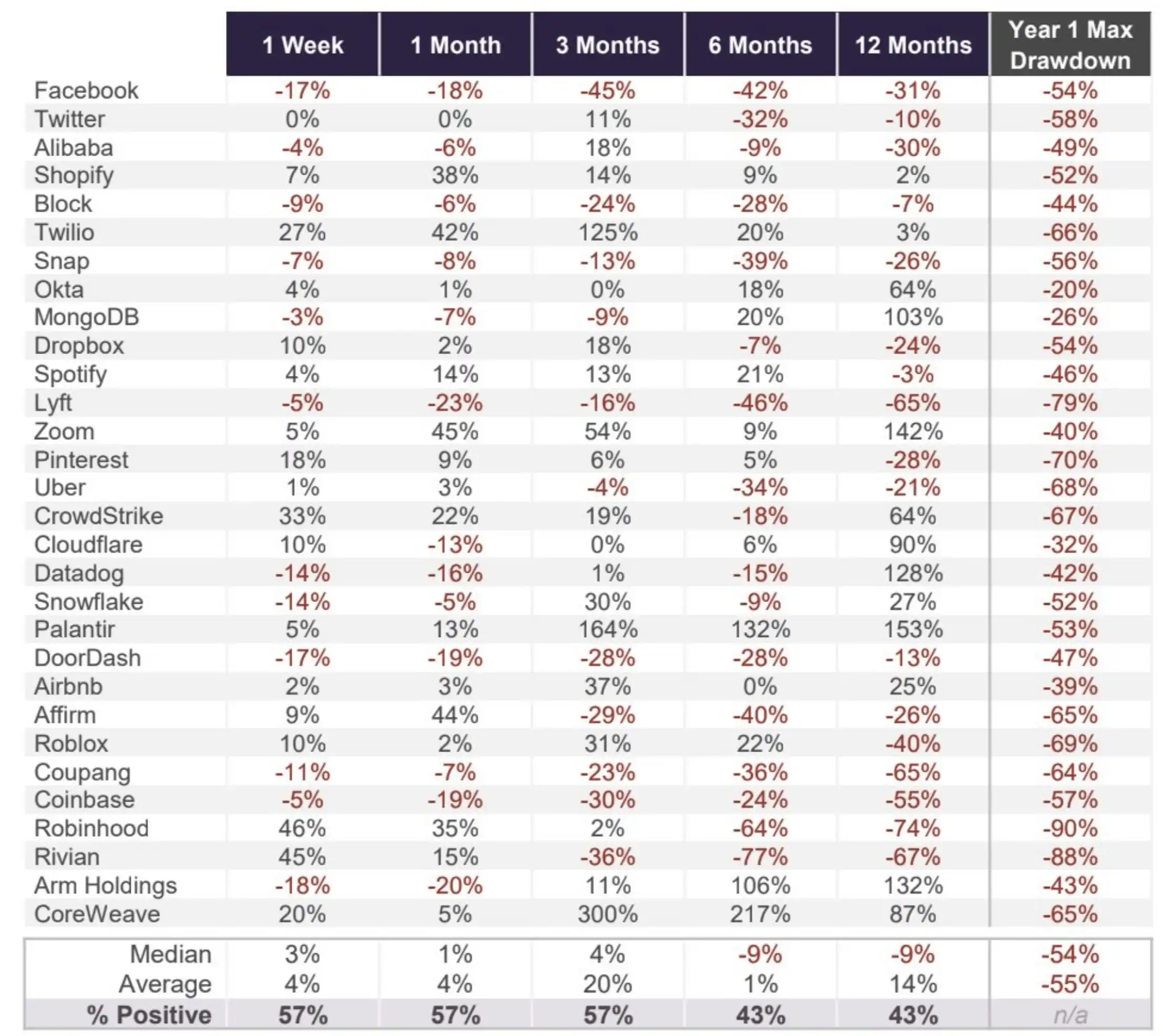
The shape of the median curve is telling: median returns were +3% after 1 week, +1% after 1 month, and +4% after 3 months—all passable up to this point. But extending to 6 months, the median becomes -9%; at 12 months, it remains -9%. The proportion of companies with positive returns also collapses in sync, dropping from 57% maintained in the first three months to 43% at both the 6-month and 12-month marks. In other words, holding for a full year results in losses for most momentum buyers.

Individual stock divergence is extreme. CoreWeave soared 300% three months after listing, Palantir gained 164% in three months, and Zoom rose 142% in twelve months. But negative cases are equally dense: Lyft fell 65% in twelve months, Robinhood dropped 74%, Rivian fell 67%, and Coupang declined 65%. There is no stable relationship between star power and post-IPO returns.
Median Maximum First-Year Drawdown 54%, Robinhood and Coinbase Both Halved

More striking than returns are the drawdown figures. The median maximum drawdown within the first year of listing for the 30 companies was 54%, with an average of 55%. Okta had the smallest drawdown at 20%, and none avoided it.
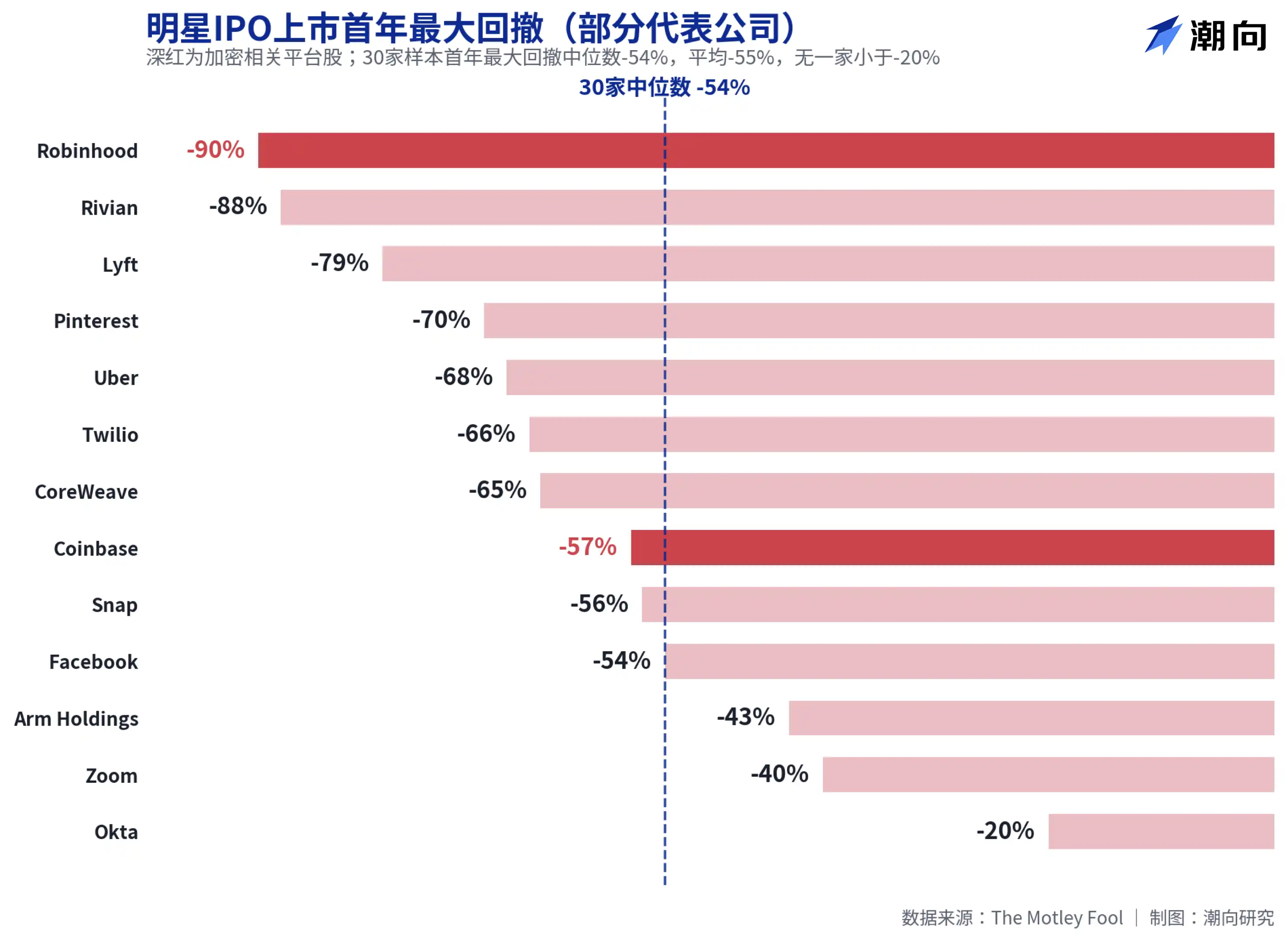
Two platforms familiar to crypto users are in the hardest-hit areas. Robinhood's maximum drawdown in its first year was 90%, the highest among the 30; Coinbase saw a 57% drawdown. Even companies later proven to be big winners were not exempt: CoreWeave had a 65% first-year drawdown, Palantir 53%, and Meta (then Facebook) 54%. This data points to a simple conclusion: even if you pick the right company, buying at the opening price will likely subject you to floating losses at the halving level first.

Academic research paints a similar picture. Jay Ritter, Director of the IPO Research Program at the University of Florida, tracked 1,479 IPOs from 2012 to 2021, finding an average first-day return as high as 23.6%, but the average total return over the subsequent three years was only 10.6%. The Wall Street Journal cited Ritter's data stating that investors who bought on the first day and held for three years underperformed a market-cap-weighted index by about 21%. The excitement of the first day largely borrowed future gains.

SpaceX's Ledger: $18.7 Billion in Revenue Supporting a $1.75 Trillion Valuation

Returning to SpaceX itself, the valuation debate is more concrete than historical patterns.

According to financial data cited by The Motley Fool, SpaceX's 2025 revenue was $18.7 billion, a 33% year-over-year increase, but it reported a net loss of $4.9 billion, reversing a profit of about $790 million in 2024. S-1 data compiled by BitMEX shows a single-quarter net loss of $4.28 billion in Q1 2026, with cumulative losses reaching $41.3 billion, of which the AI business (post-merger with xAI) burns about $2.5 billion per quarter. Calculated at a $1.75 trillion valuation, the price-to-sales ratio exceeds 90 times.

Morningstar's stance is the most direct. Analysts at the firm called SpaceX "severely overvalued," suggesting long-term investors will have opportunities to buy at better margins of safety after the IPO, and set the fair value estimate at approximately $780 billion, less than half the offering valuation. A reference point: SpaceX's over-the-counter tender offer in December 2025 corresponded to a valuation of about $800 billion. In just over half a year, the pricing more than doubled.

Bullish logic also exists. The rocket launch business holds over 80% of the U.S. market share, and Starlink has over 12 million paying subscribers and is profitable, forming the foundation of this valuation. Vanzo's own judgment is that SpaceX's stock will likely perform well on its first trading day, but given the valuation level and historical data, it wouldn't be surprising to see the stock struggle over the next 12 months.

For those preparing to place orders on Friday, this data from 30 companies is at least worth a glance: history doesn't guarantee repetition, but halving in the first year has been the norm for this game over the past fourteen years.

Perguntas relacionadas

QAccording to the article, what is the historical median performance of 30 high-profile tech IPOs after 12 months, based on Motley Fool's data?

AAccording to Motley Fool's data on 30 high-profile tech IPOs since 2012, the median return after 12 months is -9%.

QWhat is the median maximum drawdown in the first year for the 30 IPO companies studied, and which company had the worst drawdown?

AThe median maximum drawdown in the first year for the 30 companies is 54%. The company with the worst drawdown was Robinhood, with a 90% drawdown.

QWhat does the article state as Morningstar's fair value estimate for SpaceX, and how does it compare to the reported IPO valuation?

AMorningstar's fair value estimate for SpaceX is approximately $780 billion. This is less than half of the reported IPO valuation of about $1.75 trillion.

QBased on financial data cited in the article, what was SpaceX's revenue and net profit/loss for 2025?

AIn 2025, SpaceX's revenue was $18.7 billion, but it reported a net loss of $4.9 billion.

QWhat key reasons does the article mention for investors being bullish on SpaceX's valuation?

AThe article mentions that the bullish case for SpaceX's valuation is based on its rocket launch business holding over 80% of the U.S. market and its Starlink service having over 12 million profitable subscribers.

Leituras Relacionadas

Misjudged A-Shares: Resilience, Expectations, and Confidence

China's A-share market recently faced selling pressure, especially in tech sectors, initially triggered by a global tech sell-off that began in South Korea. However, the article argues this is a case of "mistaken injury" and highlights the market's underlying resilience. This resilience stems from three main pillars: **1) Tech Sector Fundamentals:** Unlike Korea's market dominated by a few memory chip stocks, China's tech sector is diversified across computing, communications, electronics, and semiconductors, supported by dual narratives of global AI supply chains and domestic substitution. Core areas like optical modules and fiber optics continue to show strong earnings growth. **2) "National Team" Support:** State-backed institutions and large corporations have made significant market purchases and announced buybacks, providing liquidity and signaling confidence. This is seen as a stabilizing policy signal, often associated with market bottoms. **3) Broader Market Pillars:** Other major sectors are showing endogenous recovery momentum. Consumer stocks benefit from stabilizing CPI and signs of sector recovery (e.g., liquor price hikes). Cyclical sectors like aluminum have high earnings, potential price increases due to tight supply, and low valuations. The financial sector offers stable dividends and low valuations. The conclusion is that the sell-off was driven by external contagion, not a collapse in fundamentals. With strong policy support and recovering momentum across key sectors, the A-share market possesses the toughness to regain stability.

marsbitHá 7m

Misjudged A-Shares: Resilience, Expectations, and Confidence

marsbitHá 7m

The Clarity Act's Journey Through Congress: The Thorny Path of Bipartisan Compromise in the U.S.

The U.S. Congress is struggling to advance the crypto market structure bill known as the Clarity Act, with bipartisan compromise proving difficult. Key hurdles include unresolved disputes over "yield" products and, more critically, the inclusion of strong ethics provisions for elected officials—a non-negotiable demand for many Democrats. While a compromise on yield was reached in May, securing only limited Democratic support in committee, the separate Senate Agriculture Committee version later passed with no Democratic votes due to the ethics impasse. As Republicans push for a full Senate vote in July, demands for ethics rules have expanded, and other contentious issues like developer protections and concerns from law enforcement and large banks further complicate negotiations. Despite consensus on the need for legislation, the path forward is unclear. Recent discussions between senators and White House officials aim to find acceptable ethics language. Some lawmakers question whether a compromise text can garner enough bipartisan support, with one Democrat stating the current proposal lacks the strong ethics provisions required for their vote. Potential short-term goals for the crypto community include symbolic Senate action before the August recess, a longer-term aim for passage by 2026, or establishing a detailed framework that addresses ethics and other compromises. The process remains arduous, relying on the traditional, vote-by-vote effort to build bipartisan support.

marsbitHá 26m

The Clarity Act's Journey Through Congress: The Thorny Path of Bipartisan Compromise in the U.S.

marsbitHá 26m

Are Kalshi and Polymarket Founders at Odds? This Business Rivalry Is More Brutal Than You Think

"The Rivalry Between Kalshi and Polymarket Founders Turns Bitter and Litigious" The intense feud between Tarek Mansour, CEO of Kalshi, and Shayne Coplan, founder of Polymarket, has escalated far beyond typical business competition into personal animosity and regulatory battles. Both lead billion-dollar prediction market platforms, but their approaches differ sharply. Kalshi positions itself as the compliant operator, securing U.S. regulatory approval before launching. In contrast, Polymarket initially operated offshore, allowing U.S. users to access its platform via VPN, which drew regulatory scrutiny. The conflict reached a peak in November 2024 when FBI agents raided Coplan's New York apartment. While Coplan publicly blamed political motives, his team privately suspected Kalshi was involved. According to sources, Kalshi's lawyers had previously reported Polymarket's operations to federal prosecutors, highlighting its accessibility to U.S. users despite a ban. This incident fueled mutual accusations and underhanded tactics, including social media smear campaigns and attempts to sabotage each other's major business deals. Their rivalry also played out in Washington, influencing regulatory debates. Kalshi actively lobbied against Polymarket's practices, framing them as illegal and unethical. Polymarket, after facing a CFTC fine and investigation, later acquired a licensed U.S. firm to launch a domestic app, regaining a foothold. Despite the hostility, both companies have seen massive growth, with combined trading volumes soaring. However, increased regulatory scrutiny, particularly around insider trading on Polymarket's platform, continues to pose challenges. The founders' deep-seated mutual disdain ensures their battle for market dominance remains as much a personal vendetta as a commercial one.

marsbitHá 35m

Are Kalshi and Polymarket Founders at Odds? This Business Rivalry Is More Brutal Than You Think

marsbitHá 35m

Trading

Spot
活动图片