Wallet in Telegram rebrands to Walt as Gram wallet debuts

cointelegraphPublished on 2026-09-01Last updated on 2026-09-01

Abstract

Telegram has restructured its cryptocurrency services around two main offerings: the new self-custodial Gram wallet and the rebranded broader crypto platform, Walt (formerly Wallet in Telegram). Gram wallet is now the default option in Telegram settings, focusing on payments, transfers, and purchases within the app. Walt, accessible via search, expands into services like trading, investing, and supporting assets across multiple blockchains. The two remain linked, with Walt enabling multichain deposits to the Gram wallet. This shift centralizes a self-custodial wallet for daily transactions while positioning Walt as a comprehensive crypto and financial products hub.

Telegram is reshaping its crypto offering around two key services: its new self-custodial Gram wallet and Wallet in Telegram, the broader crypto platform now rebranding as Walt.

Telegram has rolled out its native Gram wallet across the messaging app, making the self-custodial service its default wallet in user settings, according to an announcement shared with Cointelegraph.

Gram wallet will focus on payments, transfers and purchases across Telegram, while Walt will offer broader crypto services including trading, investing and support for assets across multiple blockchains. Walt will no longer serve as Telegram’s default crypto wallet and will instead be accessible through search.

The split marks a major shift in Telegram’s crypto ecosystem, putting a native self-custodial wallet at the center of everyday transactions while repositioning Walt around a wider range of crypto and financial products. Telegram founder Pavel Durov first teased Gram wallet in July, saying the company planned to bring a native non-custodial wallet to every Telegram app.

“We’ll be gradually rolling it out to our billion+ users over the next couple of weeks,” he said Monday in a Telegram post.
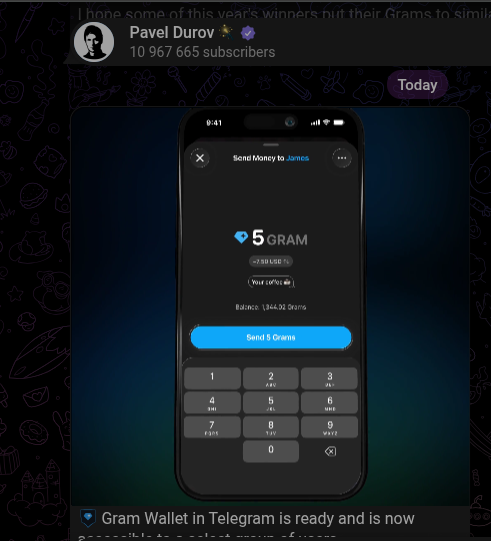
Source: Pavel Durov on Telegram

Gram and Walt will remain connected

Gram wallet will serve as Telegram’s transaction layer for transfers and payments. The self-custodial wallet will support purchases of Telegram Collectibles, including gifts, usernames and phone numbers, as well as payments for services and everyday purchases.

Gram wallet and Walt will remain connected, with Walt allowing users to make multichain crypto deposits to Gram wallet.

Wallet in Telegram becomes Walt

Wallet in Telegram’s rebrand reflects the service’s expansion beyond its origins as a wallet primarily used to buy and hold Gram (GRAM), formerly known as Toncoin (TON).

Walt supports deposits, holdings and withdrawals for more than 300 crypto assets across four blockchains, alongside trading in more than 200. The platform also offers more than 100 tokenized stocks, exchange-traded funds (ETFs) and metals.

Related: Apple briefly removes Telegram from App Store, Gram rebounds

Its other products include crypto yield services and perpetual futures, a type of derivative contract without an expiration date. Walt offers perpetual trading across more than 70 assets, including cryptocurrencies, oil, natural gas and metals.

“We started as a simple wallet for buying TON, but over the past four years we’ve grown into a full-scale crypto platform inside Telegram, launching Earn, real-world assets and perpetual trading,” said Andrew Rogozov, founder and CEO of The Open Platform (TOP) and Walt.

Magazine: Do the Coldcard attacks mean all hardware wallets are now insecure?

Related Questions

QWhat are the two key crypto services Telegram is focusing on after the recent changes?

ATelegram is focusing on two key crypto services: the new self-custodial Gram wallet, which becomes the default for transactions, and the rebranded Walt platform, which offers a wider range of crypto and financial services.

QWhat is the primary function of the new Gram wallet within Telegram?

AThe primary function of the Gram wallet is to serve as Telegram's transaction layer for payments, transfers, and purchases, including Telegram Collectibles and payments for services.

QHow did the service formerly known as 'Wallet in Telegram' change, and what does the new name 'Walt' signify?

AThe service formerly known as 'Wallet in Telegram' has been rebranded to 'Walt'. This change reflects its expansion from a simple wallet primarily for buying TON (now GRAM) into a full-scale crypto platform offering trading, investing, yield services, perpetual futures, and support for assets across multiple blockchains.

QAccording to the article, how are the Gram wallet and Walt platform connected?

AGram wallet and Walt remain connected. The Walt platform allows users to make multichain crypto deposits into their Gram wallet.

QWhat did Telegram founder Pavel Durov announce regarding the rollout of the Gram wallet?

ATelegram founder Pavel Durov announced that the company plans to gradually roll out the native Gram wallet to its more than one billion users over the next couple of weeks.

Related Reads

Xsolla ZK Introduces a Gas Token Designed to Let Digital Items Move Between Games and Players

Xsolla ZK, Inc. has introduced Xsolla Gas (XLA), the native token of Xsolla ZK, an Ethereum Layer 2 ZK rollup network for games. XLA is designed to pay network fees when players transfer or share eligible digital items on the network. Players who prefer not to set up a separate wallet can buy XLA-NT, a non-transferable gas credit usable only for network fees on Xsolla ZK, through Xsolla Gas Station using familiar payment methods. XLA is also available on crypto exchanges including Kraken, LBank, and Biconomy in supported markets. The initiative addresses a key limitation: most digital items today live on a single game's backend and cannot be transferred to friends or used in other games, and they become inaccessible if a game shuts down. Blockchain-backed items stay with players, but transferring them typically requires a separate wallet and the right token. Xsolla ZK aims to lower these barriers. Players use Xsolla Backpack, an inventory for owned digital items; items issued in transferable form are designed to remain available even if the issuing game shuts down, and players can give them to others. Players sign in with their usual account, without needing a seed phrase or separate wallet setup. Chris Hewish, President of Xsolla (USA), said players should be able to share and gift digital items they own anytime, anywhere, with anyone they know, and that developers gain a new way to monetize games while players gain items that are theirs to keep. Developers and partners can also use XLA to pay network fees for their item activity. More than 1,500 game teams use Xsolla's tools, and Xsolla Backpack and Xsolla Gas Station are available without additional development for teams using compatible Xsolla products, integrating with existing player and payment flows. XLA is an ERC-20 token on Ethereum mainnet with a total supply of 1 billion and becomes the base token of Xsolla ZK through the canonical bridge.

TheNewsCrypto27m ago

Xsolla ZK Introduces a Gas Token Designed to Let Digital Items Move Between Games and Players

TheNewsCrypto27m ago

Hyperliquid API Wallet Permissions Keep Expanding: Once an AI Agent Is Attacked, It Could Drain the Main Account

As personal AI agents take over everyday financial decisions, Hyperliquid is seen as an ideal decentralized trading foundation thanks to its deep liquidity and composability. However, the API wallets that underpin automated trading have quietly seen their security boundaries erode across network upgrades over the past year. Lacking fine-grained permission policies, a compromised API wallet can even trigger staking slashing, spot locking, and priority fee burning, exposing the main account to total loss. The article traces how API wallets—originally scoped to prevent direct withdrawals or external transfers—have accumulated expanded permissions through successive upgrades, with no cap on margin exposure. A maliciously altered API wallet controlling an account with over ~$40M could buy 500,000 HYPE, stake it, link it to a malicious HIP-3 market, invite slashing, and lock the main account's funds for 183 days. Because API wallets are now the default trading method across the Hyperliquid frontend and third-party apps, and agents must interact with untrusted internet environments, prompt injection or key leakage can let attackers drain funds without ever stealing a private key. Existing fine-grained control via HyperEVM smart contracts introduces too much latency for high-frequency trading, while custodial solutions outsource trust to centralized middleware. The proposed fix is a lightweight bitmap permission field set at API wallet creation, recording which operation types the wallet may trigger—mirroring the mechanism already used in HIP-3 deployer sub-lists. Validating the signer against the main account's bitmap adds negligible overhead, and critically, old API wallets would never auto-inherit new permissions from future L1 upgrades. This would safely unlock staking and transfer interfaces, remove reliance on centralized custody, and pave the way for large-scale personal AI agent adoption on HyperCore.

marsbit1h ago

Hyperliquid API Wallet Permissions Keep Expanding: Once an AI Agent Is Attacked, It Could Drain the Main Account

marsbit1h ago

Upbit and Bithumb Customer Deposits Plunge 31.86%, Falling $1.87 Billion in 2026

Customer deposits in South Korean won at Upbit and Bithumb, South Korea's two largest crypto exchanges, fell 31.86% in the first nine months of 2026, according to regulatory disclosures published November 17. The platforms held about ₩5.36 trillion ($4 billion) in customer cash at end-September, down from ₩7.87 trillion at end-2025—a reduction of roughly ₩2.51 trillion ($1.87 billion). Upbit operator Dunamu saw deposits drop 31.9% from ₩5.83 trillion to ₩3.97 trillion, while Bithumb fell 31.8% from ₩2.04 trillion to ₩1.39 trillion. The figures were disclosed via South Korea's Financial Supervisory Service electronic filing system. Customer crypto holdings also lost value: Upbit's book value fell 10.9% from ₩62.23 trillion to ₩55.46 trillion, and Bithumb declined 13.1% from ₩17.90 trillion to ₩15.56 trillion. However, quantities of several major cryptocurrencies held for customers increased despite lower valuations—Upbit added 13,259 Bitcoin, 337,609 Ether and 1.22 million Solana versus year-end levels, and Bithumb reported higher holdings of Bitcoin, Ether, XRP and Solana. The data indicate the deposit decline does not necessarily mean investors withdrew entirely from the crypto market; disclosures do not explain whether funds went to bank accounts, crypto purchases or elsewhere. The drop comes amid weaker trading activity in South Korea's digital asset market, adding pressure on major exchanges.

TheNewsCrypto1h ago

Upbit and Bithumb Customer Deposits Plunge 31.86%, Falling $1.87 Billion in 2026

TheNewsCrypto1h ago

Trading

Spot
活动图片