‘Walled off’ – Hyperliquid, Phantom press CFTC for 3 DeFi demands

ambcryptoPublicado em 2026-07-10Última atualização em 2026-07-10

Resumo

Hyperliquid and Solana-based wallet Phantom have urged the U.S. Commodity Futures Trading Commission (CFTC) to modernize regulations for decentralized finance (DeFi). In a letter, they made three key requests: first, that non-custodial software developers not be automatically treated as brokers or exchanges; second, that existing no-action relief for self-custodial wallets be formalized into guidance; and third, that the CFTC create a framework allowing regulated entities to use blockchain for trading and settlement. They argue these changes are necessary to prevent stifling innovation and pushing activity offshore. The request responds to a CFTC inquiry on barriers to fintech partnerships. Similar exemptions are under discussion in the proposed CLARITY Act. However, granting these requests could face legal challenges from traditional market participants like the Chicago Mercantile Exchange (CME), which has previously sued the CFTC over crypto product approvals. Traditional players argue DeFi platforms should meet the same regulatory standards as conventional exchanges. With the CLARITY Act's future uncertain, any CFTC action on DeFi exemptions may lead to further litigation.

Hyperliquid and Solana-based wallet Phantom have urged the U.S derivatives market regulator, Commodity Futures Trading Commission [CFTC], to modernize its regulations.
Source: HPC

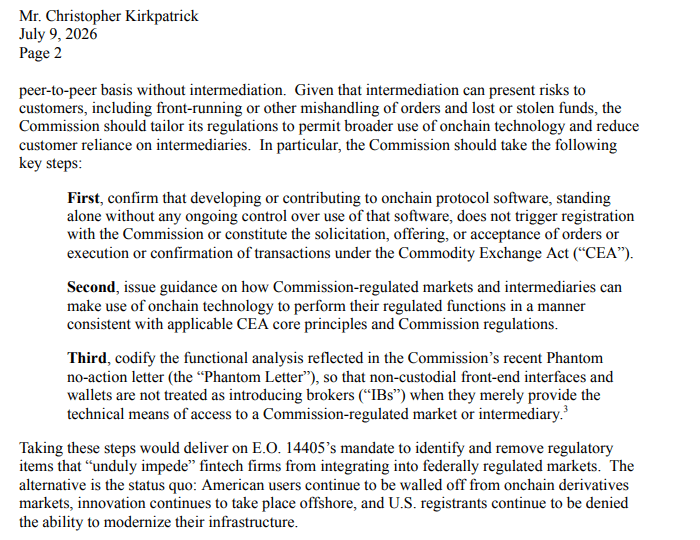
In a letter sent to the CFTC, the DeFi players requested three things. First, the agency should not treat a non-custodial software developer (users control funds, not the platform) as a broker.

In other words, creating on-chain protocols should not automatically trigger CFTC registration as an exchange or clearinghouse. Put plainly, they want developer protections.

Second, the no-action relief granted to self-custodial wallets, as issued to Phantom in March 2026, should be made formal guidance.

An industry coalition made a similar argument and pushed in April. If adopted, non-custodial DeFi front-ends like Phantom would not need broker-dealer or exchange registration to handle even U.S tokenized stocks.

Finally, they want the CFTC to create a framework that allows regulated entities to use blockchain for trading and settlement.

Why are DeFi firms seeking exemptions?

The letter was a response to the CFTC’s request for information regarding issues that are preventing fintechs from partnering with its regulated entities.

Some of the issues raised by Hyperliquid and Phantom are DeFi exemptions, some of which are being deliberated in the CLARITY Act. In fact, even the SEC is exploring a similar “innovation exemption” for tokenized assets trading.

The DeFi players cautioned that failure to explore these recommendations would reinforce the status quo, with dire consequences.

The alternative is the status quo: American users continue to be walled off from onchain derivatives markets, innovation continues to take place offshore, and U.S. registrants continue to be denied the ability to modernize their infrastructure.

Why DeFi exemptions request could be delayed

But these requests, even if granted, could trigger legal challenges from traditional market participants. The Chicago Mercantile Exchange (CME) has already sued the CFTC over its approval of Kalshi’s crypto perpetuals (perps).

CME argued that perps are swaps rather than futures, meaning the contracts should fall under its regulatory framework. That stance prompted the CFTC to reconsider how it defines swaps.

Hyperliquid Policy Center founder Jake Chervinsky called the CME lawsuit anti-competitive and a “shocking misjudgement.”

Citadel Securities and the umbrella body representing traditional exchanges have also opposed DeFi exemptions, particularly for tokenized asset trading. They argue regulators should treat every platform as a broker based on its function, not its underlying technology.

In short, DeFi platforms handling U.S. tokenized stocks should meet the same disclosure requirements and legal obligations as traditional exchanges.

Like CME, other traditional market participants could sue the agency if it grants the requested DeFi exemptions, particularly because lawmakers have not codified them and the CLARITY Act’s future remains uncertain.


Final Summary

  • Hyperliquid and Phantom have requested CFTC for formalized exemptions for DeFi front-ends
  • But with the CLARITY Act still in limbo, CME and other traditional players will continue to legally challenge the regulator over such requests.


Perguntas relacionadas

QWhat are the three main requests that Hyperliquid and Phantom made to the CFTC in their letter?

AFirst, that the CFTC should not treat non-custodial software developers as brokers, thereby providing developer protections. Second, to formalize the no-action relief granted to self-custodial wallets into official guidance. Third, to create a framework allowing regulated entities to use blockchain for trading and settlement.

QWhat potential consequence do Hyperliquid and Phantom warn about if the CFTC fails to act on their recommendations?

AThey warn that failure to explore these recommendations would reinforce the status quo, where American users are walled off from on-chain derivatives markets, innovation continues offshore, and U.S. registrants are denied the ability to modernize their infrastructure.

QWhy could the CFTC's potential approval of DeFi exemptions face legal challenges?

ATraditional market participants like the Chicago Mercantile Exchange (CME) could sue the CFTC, as they have already done over its approval of Kalshi's crypto perpetuals. These players argue that DeFi platforms should be treated based on their function, not technology, and must meet the same requirements as traditional exchanges.

QWhat is the CLARITY Act and what is its current status mentioned in the article?

AThe CLARITY Act is legislation that is deliberating some of the DeFi exemption issues raised by Hyperliquid and Phantom. The article states that the Act's future remains uncertain and it is currently 'still in limbo.'

QWhat argument did traditional entities like CME and Citadel Securities make against granting DeFi exemptions?

AThey argue that regulators should treat every platform as a broker based on its function, not its underlying technology. They believe DeFi platforms handling U.S. tokenized stocks should meet the same disclosure requirements and legal obligations as traditional exchanges.

Leituras Relacionadas

Why Bitcoin Holds Above $64,000 After Fed's Hard Pause

**Bitcoin Stabilizes Near $64,000 Following Hawkish Fed Pause** The cryptocurrency market, led by Bitcoin, remained stable around $64,000 despite a volatile reaction to the latest U.S. Federal Reserve meeting. The Fed paused interest rates but signaled a hawkish stance, with three committee members voting for an increase—the highest dissent since 2016. This limits risk appetite but hasn't triggered panic selling. Key market highlights include Bitcoin ETFs seeing a net inflow of $32.1 million, breaking a streak of outflows, while Ethereum ETFs experienced outflows of $18.65 million. Liquidations affected about 90,000 traders. Technically, Bitcoin finds support around $63,000-$63,500, with major resistance near $66,000. While its price is about 49% below its all-time high, institutional demand via ETFs and the absence of mass capitulation support a potential recovery scenario in the second half of the year. Major altcoins showed mixed movements, with Solana attracting capital while Ethereum faced selling pressure despite strong on-chain metrics like a growing staking queue. Regulatory news took a pause as the U.S. Senate delayed the CLARITY Act vote until at least autumn. For the final trading day of July, U.S. inflation and consumer spending data will be crucial. Bitcoin's key levels to watch are $63,000 support and $66,000 resistance. Sustained ETF inflows and Bitcoin holding above $63,000 are seen as positive signs for a potential market recovery later in the year.

cryptonews.ruHá 1h

Why Bitcoin Holds Above $64,000 After Fed's Hard Pause

cryptonews.ruHá 1h

Trading

Spot
活动图片




