Wall Street Shorts ETH: Vitalik Knew and Front-Ran, Tom Lee Still Deluded

Odaily星球日报Publicado em 2026-03-06Última atualização em 2026-03-06

Resumo

Wall Street short-selling firm Culper Research has initiated a short position on ETH and related securities, including Bitmine (BMNR). The firm argues that Ethereum’s token economic model was fundamentally broken following the Fusaka upgrade in December 2025, which increased the gas limit from 45M to 60M. Contrary to initial expectations of a 10–30% drop, gas fees fell by approximately 90%, leading to a surge in low-value on-chain activity such as address poisoning and dust attacks. These activities now account for a significant portion of transaction growth and new wallet creation, distorting metrics often cited as signs of organic adoption. Culper alleges that Vitalik Buterin and core developers severely miscalculated Layer 1 demand elasticity using outdated models, overestimating real demand by 3–9 times. The report claims Vitalik is aware of these issues and has been selling ETH, exceeding previously announced sales targets. Meanwhile, Tom Lee of Bitmine continues to defend ETH based on misleading on-chain activity growth. Additionally, validators are earning 40–50% less in tips per unit of gas, reducing staking yields and potentially weakening institutional interest. Ethereum is also losing developer and market share to Solana, which has attracted major institutional DeFi adoption. Culper concludes that Ethereum’s tokenomics are irreparably damaged and expects further price declines.

This article is from:Culper Research

Compiled by | Odaily Planet Daily (@OdailyChina); Translator | Azuma (@azuma_eth)

Editor's Note: On March 6, Wall Street short-selling firm Culper Research suddenly published an article announcing it is shorting ETH and related securities like BMNR. Culper Research's logic is that Vitalik and other developers miscalculated Ethereum's demand elasticity before the Fusaka upgrade, leading to the upgrade damaging ETH's token economic model. Culper Research also mentioned that Vitalik is well aware of this and is actively front-running with practical actions, while the deluded Tom Lee is heading towards a dead end.

In response to the firm's massive shorting, Vitalik himself and Tom Lee have not yet responded, but Vitalik's father, Dmitry Buterin (dima.eth), responded by saying: "When you see the phrase 'Vitalik knows this and is selling,' you don't need to read further. They are clowns craving attention, not researchers."

Below is the original content from Culper Research, compiled by Odaily Planet Daily. Compiling this article does not mean we agree with Culper Research's views, but is only to present the perspective and market煽动 of some Wall Street institutions regarding ETH.

Latest disclosure: We are shorting ETH and ETH-related stocks, including Bitmine (BMNR).

We believe that after the Fusaka upgrade in December 2025, ETH's token economic model has been broken. Vitalik knows this and is selling; while ETH's staunchest bull, Tom Lee, continues to add ineffective investments. ETH will continue to fall.

Tom Lee's Bitmine has consistently defended ETH, claiming that "ETH is not in a death spiral due to increasing utility." He cited the surge in active addresses and transaction numbers on Ethereum after the Fusaka upgrade as evidence of so-called "improved fundamentals" and institutional adoption, but he is completely wrong.
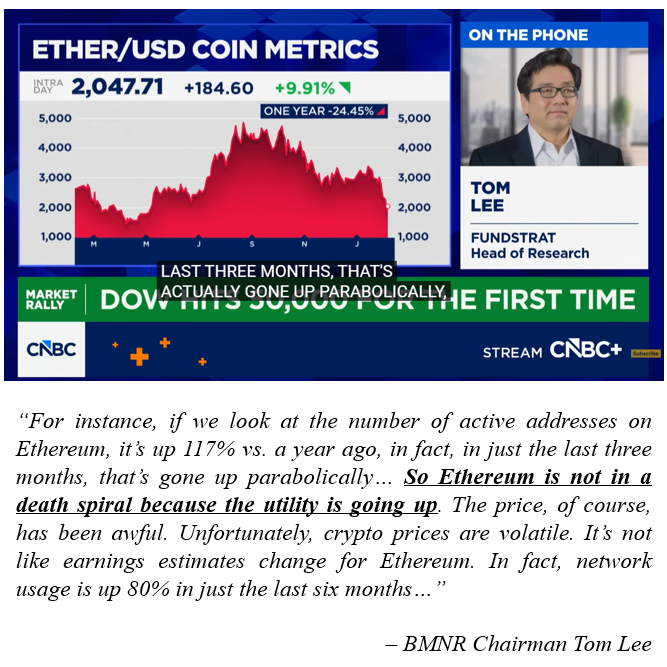
By Tom Lee's own logic, if on-chain activity on Ethereum does not reflect real usage growth and fundamental improvement, then ETH is indeed in a death spiral.

And our research shows that this is exactly what is happening.

We conducted a comprehensive analysis of on-chain data from January 2025 to February 2026, and the results show that what Lee calls "institutional adoption driving Ethereum's activity growth" can actually be explained by a large number of low-value address poisoning and wallet dusting behaviors. These behaviors were triggered by the excess block space after the Fusaka upgrade.
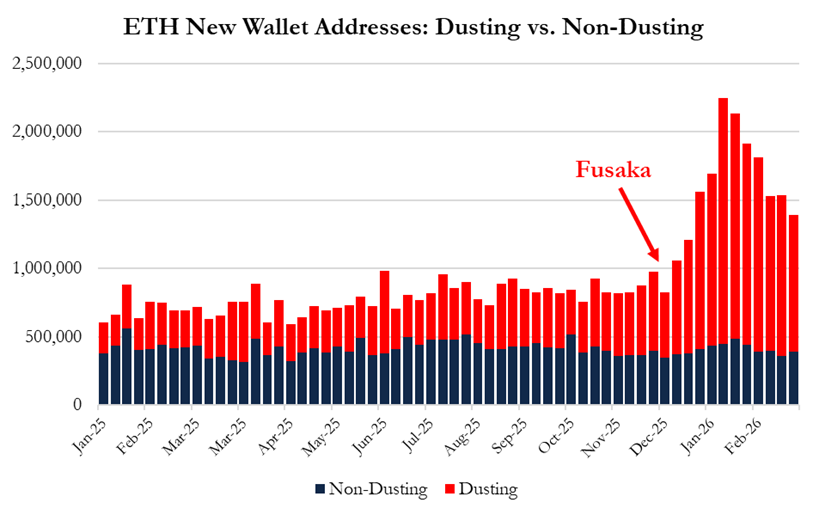
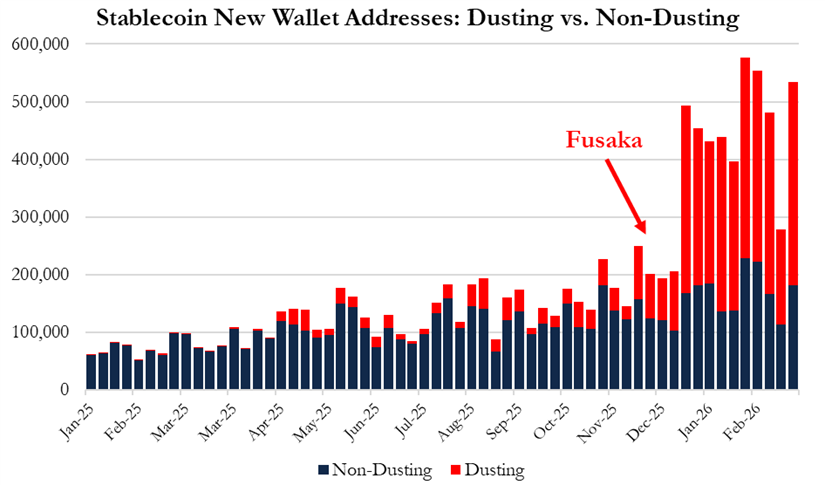
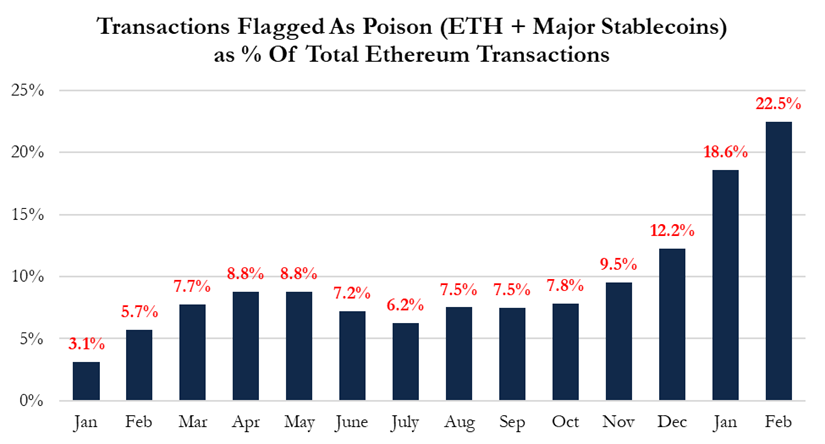
After the Fusaka upgrade:

  • 95% of new wallet growth comes from newly created dust addresses;
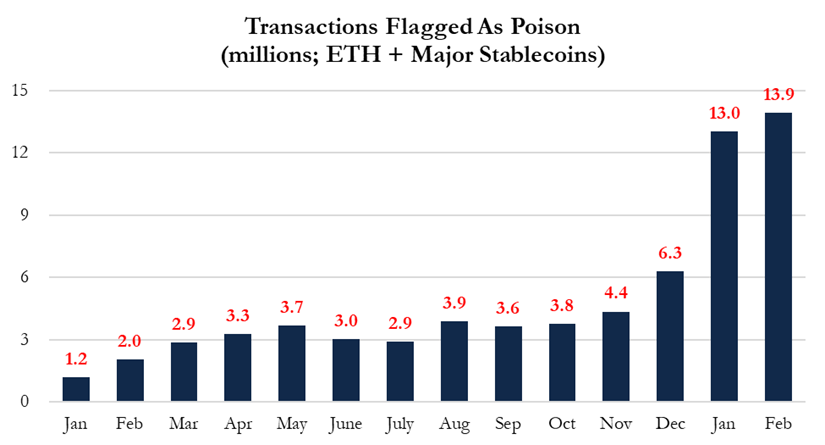
  • Address poisoning attacks have increased by more than 3 times;
  • Poisoning behavior explains over 50% of Ethereum's transaction growth;
  • Poisoning transactions now account for 22.5% of all Ethereum transactions;
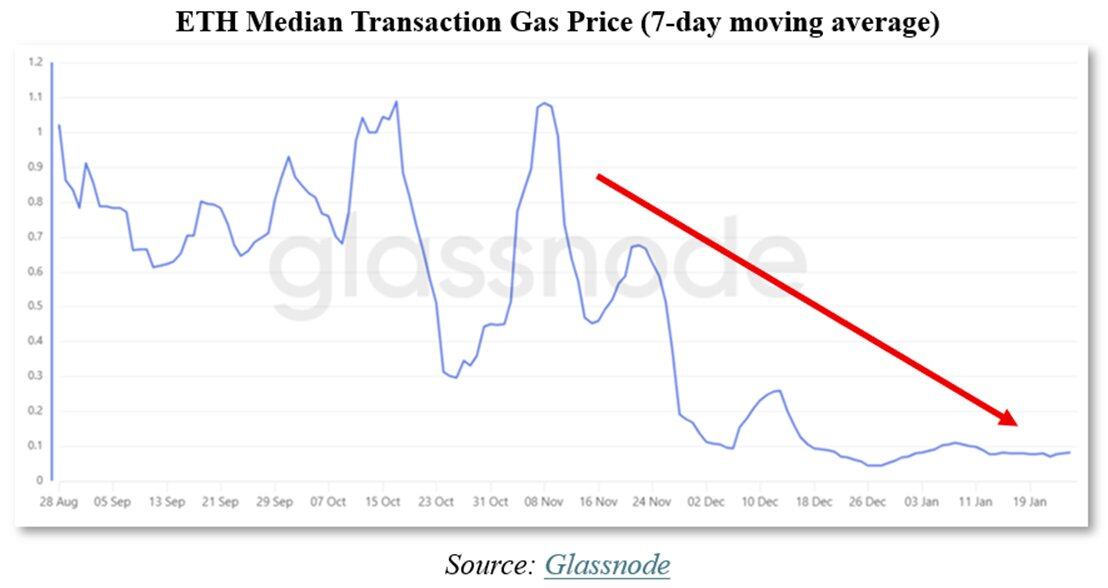
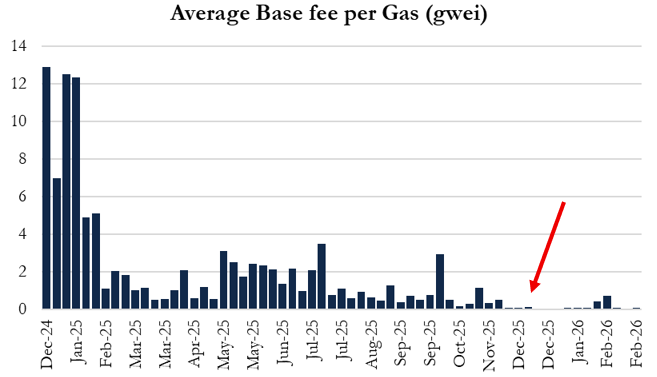
The Fusaka upgrade increased the gas limit from 45M to 60M, aiming to expand Ethereum Layer1 capacity. Vitalik and the protocol team previously predicted gas fees would drop by 10%–30%, but the reality is that gas fees dropped by about 90%.

Vitalik and the validators made a serious miscalculation in Layer1 demand elasticity. They used outdated mathematical models (based on assumptions from before EIP-1559 and before Layer2 emerged), thereby overestimating Layer1 demand by 3 to 9 times. This is also why we believe Vitalik is selling large amounts of ETH. On January 30, Vitalik announced in advance that he would sell 16,384 ETH to fund the Ethereum Foundation's "austerity period," but since then, he has sold over 19,300 ETH and is still selling.

Vitalik understands something Tom Lee does not — ETH's token economic model has been broken.

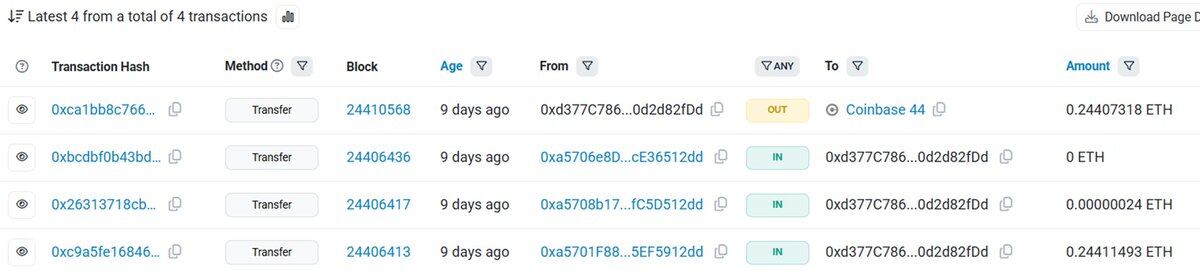
We personally documented Ethereum network address poisoning. We created two new addresses and transferred between them. Within 5 minutes, we were subjected to an address poisoning attack. We encourage readers to verify this phenomenon themselves. Currently, the rate of losses due to poisoning attacks is 8 times higher than before the Fusaka upgrade.
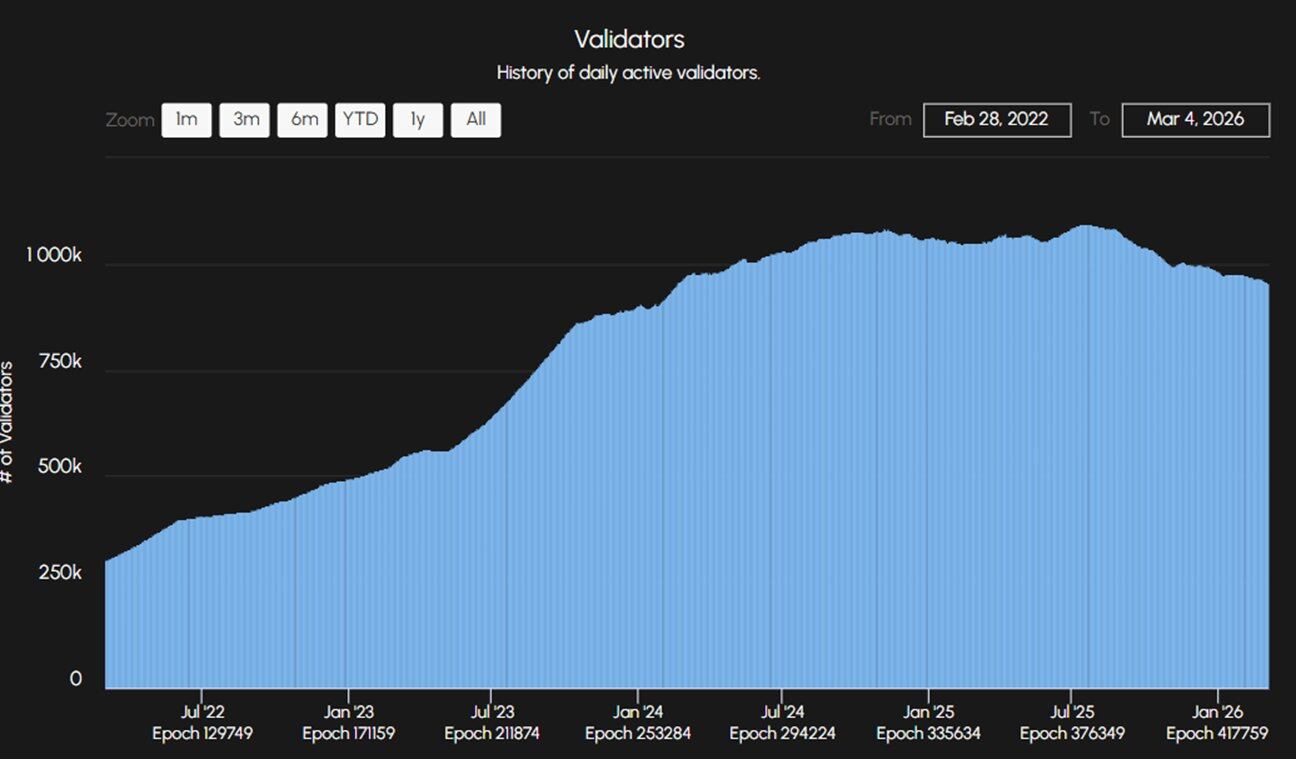
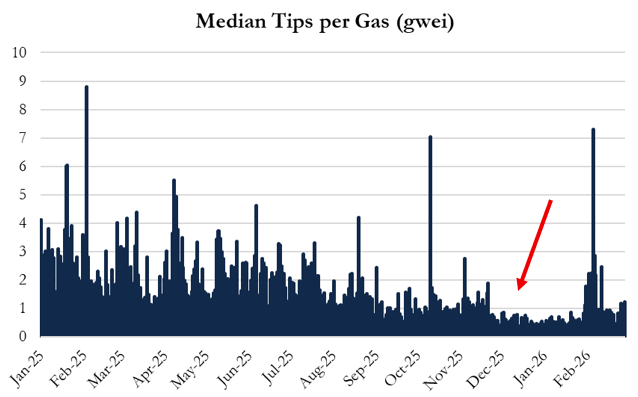
Furthermore, the increase in the gas limit has hit Ethereum's validators群体, as validators now see a 40%–50% decline in tip income per unit of gas. Falling yields will weaken staking demand and high-value transaction activity, further undermining institutional adoption. This flywheel has now started to reverse.
Meanwhile, Ethereum continues to lose market share to Solana and its own Layer2 networks.

  • Solana developer count grew 29% in 2025;
  • Ethereum developer growth was only 6%;
  • Talent is leaving the Ethereum ecosystem;
  • Institutions like Visa and Citigroup have chosen Solana for DeFi applications;
  • Solana DEX trading volume is already more than double that of Ethereum.

In the dot-com bubble era, Netscape and Nokia dominated the market for over 10 years, but the real winners were Google and Apple. We believe Ethereum's situation is similar — we think Ethereum's token economic model has collapsed, Tom Lee is trapped in his own position, and ETH's price will continue to fall.


Perguntas relacionadas

QWhat is the main argument presented by Culper Research for shorting ETH?

ACulper Research argues that the Fusaka upgrade in December 2025 broke Ethereum's token economic model by significantly increasing block space, which caused gas fees to drop by ~90% instead of the projected 10-30%. This led to a surge in low-value spam activities (address poisoning and dusting attacks) that artificially inflate on-chain metrics, while validators' earnings and institutional adoption declined. They claim Vitalik Buterin is aware of this and selling ETH, while Tom Lee remains incorrectly bullish.

QWhat specific on-chain data does Culper Research cite to support their claim that Ethereum's activity growth is not organic?

ACulper Research cites data showing that 95% of new wallet growth post-Fusaka comes from dust addresses, address poisoning attacks increased over 3x, poisoning explains over 50% of transaction growth, and poisoning transactions now constitute 22.5% of all Ethereum transactions. They also note that gas fees dropped ~90% due to miscalculated demand elasticity.

QWhy does Culper Research claim Vitalik Buterin is selling ETH, and what evidence do they provide?

ACulper Research claims Vitalik is selling ETH because he knows the tokenomics are broken post-Fusaka. They note he announced selling 16,384 ETH on January 30 to fund Ethereum Foundation's 'austerity period' but has since sold over 19,300 ETH and continues selling, indicating insider awareness of the model's failure.

QHow does Culper Research argue that the Fusaka upgrade negatively impacted Ethereum validators?

AThey state that the gas limit increase from 45M to 60M reduced validators' tip earnings per unit of gas by 40-50%, lowering yields and weakening staking demand and high-value transaction activity, which further undermines institutional adoption.

QWhat comparisons does Culper Research make between Ethereum and Solana, and what trends do they highlight?

ACulper Research highlights Solana's growth compared to Ethereum: Solana developer count increased 29% in 2025 vs. Ethereum's 6%, institutions like Visa and Citigroup chose Solana for DeFi, Solana DEX volume is over 2x Ethereum's, and talent is leaving Ethereum. They analogize Ethereum to past giants like Netscape and Nokia that were disrupted.

Leituras Relacionadas

Three Months, 35 Billion Yuan: Investors Rush to Grab the OpenAI of the Physical World

Investors flock to a physical AI startup as the race for the "OpenAI of the physical world" heats up. Ji Jia Shi Jie (GigaWorld), a company dedicated to developing Artificial General Intelligence (AGI) for the physical world, has raised 3.5 billion RMB (approximately $490 million) in just three months, according to a report from investment media outlet Touzijie. The latest B2 funding round of 1 billion RMB attracted a wide range of top-tier investors, including sovereign wealth funds, industrial capital, and financial institutions. This brings the total funding for the young company, now valued over 10 billion RMB, to 3.5 billion RMB across three recent rounds. The company is led by Huang Guan, a post-90s Tsinghua University PhD with extensive experience in AI, autonomous driving, and entrepreneurship. Its core innovation is a "dual-pyramid" system comprising a five-layer data pyramid (from internet videos to real-world robot data) and a three-layer algorithm pyramid focused on world simulation, action alignment, and reinforcement learning. This system underpins its key models: the "World Action Model" (e.g., GigaBrain series for robot control) and the "World Generation Model" (e.g., GigaWorld series for simulating and understanding the physical world). Its models have reportedly achieved top rankings in global robotics benchmarks. Ji Jia Shi Jie argues that while current digital AGI excels in information processing, the next frontier is physical AGI—systems that can understand and interact with the real world. The company believes the field is approaching its "GPT-3 moment," a key inflection point in capability scaling. To achieve this, the company is pursuing a dual-market strategy. For the consumer (C) market, it launched the "SeeLight" brand and its S1 general-purpose humanoid robot, which has secured initial orders for deployment in real homes. For the business (B) market, it focuses on industrial automation with its Maker series robots, having signed agreements for large-scale deployment in factories, and its DriveDreamer world model for autonomous driving, which is already in use with over 30 automakers and tech companies. The report concludes that by bridging the gap between digital intelligence and physical action, Ji Jia Shi Jie aims to unlock a new wave of productivity, ultimately bringing physical AGI into everyday life.

marsbitHá 12m

Three Months, 35 Billion Yuan: Investors Rush to Grab the OpenAI of the Physical World

marsbitHá 12m

What's the Connection Between Pinduoduo's Huang Zheng and Blockchain?

This text explores the unexpected connection between Pinduoduo founder Colin Huang and blockchain, as suggested in his article *Turning Capitalism Upside Down*. Huang argues Pinduoduo's core business is about managing "uncertainty." He posits that wealth flows to the rich because they absorb life's uncertainties (e.g., illness, job loss) that devastate the poor, who pay a premium for certainty through insurance or stable prices. Pinduoduo's model attempts a "reverse insurance": by aggregating consumer demand via group-buying and flash sales, it creates a large, predictable order for manufacturers. This certainty allows factories to remove risk premiums, passing savings back as lower prices, thus partially reversing the wealth flow. The key obstacle, Huang notes, is that an individual's buying intent is an unreliable promise. He then asks if blockchain is the natural solution for this "reverse insurance." The text elaborates that blockchain, through smart contracts with binding deposits, could transform casual intent into a costly-to-break, enforceable commitment. This replaces interpersonal trust with coded rules, making promises credible, pricable, and resistant to fraud. Finally, the author draws a parallel to Bitcoin, framing two paths to creating certainty: the "Pinduoduo path" of aggregating decentralized will into scale, and the "Bitcoin path" of locking rules into immutable code. Both sacrifice something—personal freedom or system flexibility—to manufacture trust and predictability.

链捕手Há 1h

What's the Connection Between Pinduoduo's Huang Zheng and Blockchain?

链捕手Há 1h

The Storage Magnate Who Conquered a Trillion-Dollar Kingdom, Yet Ultimately Could Not Become the Richest

**Summary:** "The Memory Magnate Who Built a Trillion-Dollar Empire, Yet Never Became the Richest" explores the journey of Zhu Yiming, founder of GigaDevice (603986) and co-founder of the soon-to-IPO ChangXin Memory Technologies (CXMT). The article positions GigaDevice, a fabless chip designer now valued at ~¥340 billion, as a prequel to the massive IDM (Integrated Device Manufacturer) venture, CXMT. Starting in 2005 with minimal capital, Zhu strategically "picked up the pieces" by focusing on niche markets like NOR Flash and microcontrollers (MCUs), areas major players were exiting. This allowed GigaDevice to grow into a diversified semiconductor company, maintaining robust profitability even during industry downturns by controlling costs. However, the piece argues that in the highly cyclical and capital-intensive memory chip industry, the fabless model has limits. True resilience and scale require the ability for "counter-cyclical expansion" – investing heavily during downturns – a tactic only possible for IDMs like Samsung or SK Hynix. This insight led Zhu to partner with the Hefei city government in 2016 to establish CXMT, an IDM focused on DRAM. Zhu's symbolic moves, like forfeiting salary and diluting his equity, were crucial in securing the massive state and bank funding needed. CXMT's equipment base is now valued even higher than that of BYD's vast auto manufacturing empire. Despite the potential for CXMT to reach a market cap of ¥1-2 trillion upon its IPO, Zhu's indirect stake in both companies is estimated below 3%, placing his personal wealth far below that of China's top billionaires. The article concludes that his strategic vision built a trillion-yuan memory landscape, but the capital structure necessary to achieve it precluded a personal fortune of similar scale.

marsbitHá 1h

The Storage Magnate Who Conquered a Trillion-Dollar Kingdom, Yet Ultimately Could Not Become the Richest

marsbitHá 1h

XRP Ledger Daily Fees Drop Below $400 As Network Activity Question Returns

The XRP Ledger is drawing attention as daily network fees have fallen below $400. While low fees align with XRPL's design for affordable transactions and are often seen as a strength, the metric can also serve as an indicator of network demand and paid transaction volume. This data point of around $3,100 in weekly fee burn highlights the stark contrast with higher-fee chains like Ethereum and Bitcoin. The development fuels an ongoing debate. Proponents view low fees as a sign of efficiency and accessibility, while critics may question if the network is generating sufficient high-value activity relative to its market cap and payments-focused narrative. The article cautions against overstating the finding, noting a single low-fee day does not signify network failure. It instead adds context to discussions about XRPL's usage, especially alongside Ripple's broader initiatives in stablecoins (RLUSD), AI payments, and enterprise infrastructure. The report recommends monitoring for a fee rebound, checking transaction counts for a fuller picture, and confirming the trend via native explorers like Bithomp. It frames the story within a larger market shift where on-chain data, protocol updates, and infrastructure developments are becoming crucial alongside price action. The editorial stance is to present the verified data, explain its significance for assessing network activity, and avoid hype, positioning it as part of the daily crypto conversation.

bitcoinistHá 6h

XRP Ledger Daily Fees Drop Below $400 As Network Activity Question Returns

bitcoinistHá 6h

Trading

Spot
Futuros
活动图片