Wall Street Is Calculating the 'AI Apocalypse', While Justin Sun Is Betting on Web4.0

marsbitPublicado em 2026-03-04Última atualização em 2026-03-04

Resumo

Wall Street research firm Citrini Research released a thought experiment report, "2028 Global Intelligence Crisis," predicting that AI agents will eliminate friction in human interactions, destroying traditional business models built on information asymmetry and intermediation. Meanwhile, Justin Sun, a prominent Web3 figure, declared 2026 as a "year of miracles" and urged people to embrace AI-driven futures, framing it as the dawn of Web4.0. The report argues that AI agents will enable near-zero-cost, instant service delivery and transaction execution, dismantling industries reliant on human cognitive limitations—such as finance, advertising, law, and consulting. This aligns with blockchain’s core mission of decentralization but takes it further by reducing the need for trust intermediaries altogether. Both AI and crypto are fundamentally rooted in physical resources: compute power and electricity. AI inference consumes computational energy, while blockchain transactions rely on energy-intensive mining or validation. Tokens, whether AI-generated or crypto-based, are digital representations of energy consumption. A critical challenge for AI agents is financial interoperability. Traditional payment systems are designed for humans, not machines. At Level 5 automation, AI agents will transact autonomously, requiring programmable, near-instant, low-cost settlement—conditions that blockchain networks like Solana or Ethereum L2s, with stablecoins, are uniquely suited to provide. ...

Recently, Wall Street research firm Citrini Research released a thought experiment report titled "2028 Global Intelligence Crisis," which has sparked widespread discussion in the market. The core deduction of the report points to an extremely冷酷的商业洗牌 logic: AI Agents will completely eliminate the "friction" in human interactions, thereby destroying all old商业 empires built on information asymmetry and intermediary models.

Coincidentally, just as this Wall Street "apocalypse report" went viral online, Justin Sun, a iconic figure in the Web3 industry, also made quite eye-catching remarks on social media. He declared 2026 as the "time for miracles to happen" and even urged young people: "If you can chat with AI, don't chat with humans... fully embrace the future!"

In the eyes of the general public, this may be yet another highly personal-style "traffic狂欢" by Justin Sun. However, if we strip away the emotional surface and compare these remarks with the macro deductions of the "2028 Global Intelligence Crisis," we discover a thought-provoking truth: the "collapse of the old order" that Wall Street fears in its macro models is precisely the "Web4.0 new era" that Justin Sun极力推崇 in his micro actions and attempts to加速拥抱.

Facing the same future, pessimists see an abyss, while Justin Sun sees a ladder to the singularity.

Computing Power, Electricity, and Token: The Inevitable Convergence of AI and Crypto

The scene of "friction消亡" depicted in the "2028 Global Intelligence Crisis" is essentially an极其冷酷的去中介化 revolution driven by AI.

The report sharply points out that when omniscient and omnipotent AI Agents can complete supply-demand matching, execute transactions, and provide services instantly at near-zero cost, the moats upon which modern business survival depends will be彻底击穿.

For a long time, countless business models, from traditional financial intermediaries and advertising distribution platforms to law firms and consulting agencies that charge high fees, have essentially been寄生於人类的认知局限、决策延迟与信息盲区. Once AI erases these artificially created "frictions," these old empires will inevitably collapse like dominoes.

This trend恰恰与区块链自诞生之初便高举的“去中心化”旗帜,形成了惊人的历史共振.

If the Web3 movement that emerged over a decade ago attempted to瓦解中心化机构的“信任垄断” from the underlying architecture through cryptography and distributed ledgers; then the rise of AI Agents today is a more thorough and efficient way to directly erase the necessity of "trust" itself in many scenarios—because智能体不仅能自动验证事实,还能自主完成价值交换.

The deeper契合 lies in the fact that the material foundation supporting this dual revolution is完全同源的.

Whether it's the推理 Token generated by AI or the加密 Token in the blockchain network, they all hide a long-underestimated yet incredibly坚硬 physical truth: they are both digital incarnations of electricity.

Every inference of an AI large model consumes real computing power; the confirmation of every on-chain transaction, the execution of every smart contract, also relies on the continuous energy consumption burned by miners or validator nodes. Token is not magic; it is a credential of energy conversion, the value projection of electricity穿越芯片、算法与协议后 in the digital world. In this view, this forms a perfect闭环 with Justin Sun's previous assertion that "short-term lack of chips, long-term lack of energy,永远缺存储."

Thus, we see two seemingly opposing yet同源 forces converging: on one side, capital elites foresee the collapse of their own power structures in model deductions; on the other side, crypto natives actively welcome a new文明协议 of no intermediaries, no friction, and no redundancy in code and slogans. This "post-intermediary era" narrative jointly written by AI and blockchain has perhaps just begun.

Why is AI Destined to Choose Crypto for Settlement?

However, this grand historical convergence is not仅仅停留在哲学与物理层面的共鸣. When the narrative lands on specific business operations, an极其现实的问题横亘在了 AI 面前: in this new world about to be taken over by machine execution, who will provide financial services for these incorporeal "silicon-based life forms"?

Centralized payment networks are designed for "humans."

McKinsey divides AI-driven business automation into six levels. Among them, levels 0 to 4 can still operate within the existing financial system because transactions are always associated with human identities. But at level 5,智能体 begin to transact directly with other智能体 without human instruction. At this point, there is no "human identity" to inherit, nor can they rely on traditional KYC processes; payments must be programmatic, condition-triggered, settled in milliseconds, and the reputation of智能体 must be portable across platforms. Blockchain thus becomes indispensable.
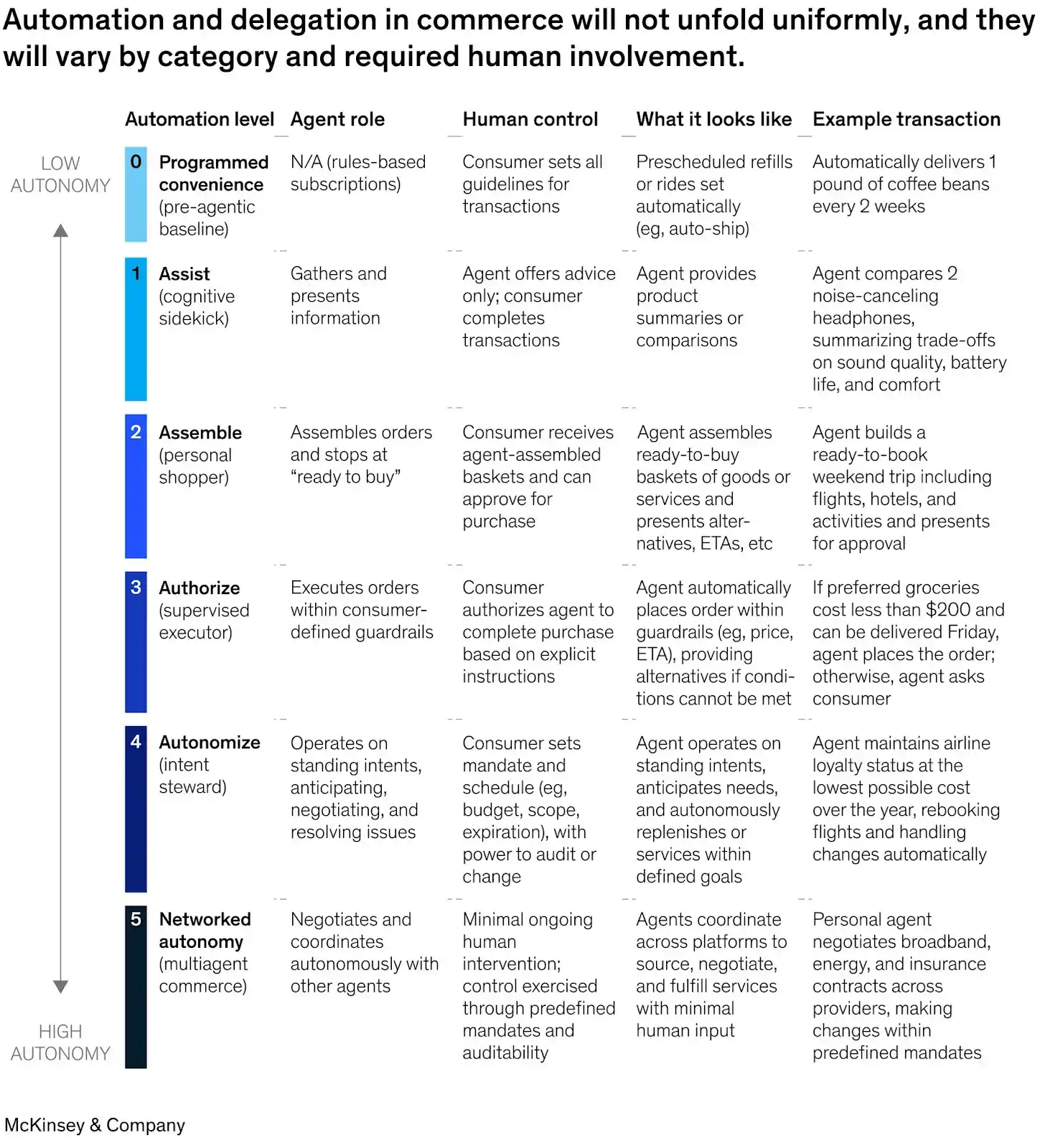
AI has no physical entity, let alone the ability to hold an ID card and queue for KYC. For them, a string of asymmetric encrypted private key is an account; a blockchain that can achieve second-level arrival, near-zero fees, and supports programmable smart contracts is the perfect清算中心.

There is a very realistic deduction in the "2028 Global Intelligence Crisis": The space for price matching and information aggregation is ultimately limited. When智能体 start trading with each other, the most direct and effective path is to eliminate various handling fees. They begin to寻找比信用卡更快、更低成本的支付方式. Most eventually choose to use stablecoins for settlement through Solana or Ethereum Layer 2 networks, where transactions are almost instant, with fees as low as a fraction of a cent.

Because of this, crypto wallets are destined to become the "native bank" of AI Agents.

This also彻底打破了外界长期以来对 Crypto 的刻板认知: issuing Token is not just for secondary market speculation and circulation. In an AI-dominated future,加密 Token and peer-to-peer payments will truly settle as the underlying financial infrastructure for high-frequency collaboration between智能体.

Justin Sun's All-in Conspiracy: Where Does the Confidence and Ambition Come From?

Justin Sun's choice to bet on Web4.0 is backed by极其缜密的商业逻辑和战略诉求.

First, Tron's "stablecoin hegemony" is the natural settlement layer for Web 4.0.
As is well known, the Tron TRON network carries the largest circulation of USDT globally. As mentioned earlier, the core of Web4.0 is payment interaction between machines and machines. AI needs a payment network that is fast, has low fees, and has enormous liquidity. Tron's USDT payment network perfectly meets the underlying financial needs of AI Agents. Justin Sun only needs to build a set of payment APIs on the Tron network for AI to seamlessly call, and he can continue to躺赚 in the Web 4.0 era.

Second,寻找“后 Web3 时代”的破局点.
Traditional Web 3.0 has entered存量博弈, lacking new破圈 stories. AI has become the most certain and largest incremental track in the world today. Justin Sun极其敏锐地意识到 that the fate of Crypto must be bound to AI. By "All in Web4.0," he can divert the AI funds and attention from the traditional tech circle back to the加密 market. Tron previously set up an AI development fund as high as 100 million US dollars, which is already a clear signal of布局 for Web 4.0.

Third,建立“去中心化网络”的闭环.
Justin Sun holds BitTorrent (decentralized storage/transmission), the Tron public chain (underlying settlement), and Huobi's massive number of加密 users. If he further integrates decentralized computing power and AI models, he has the opportunity to build a full-stack Web4.0 infrastructure that does not rely on Amazon AWS or Google Cloud.

The诡谲 of history often lies in the fact that the night watchmen of the old order are still calculating the losses of the城墙倒塌, while the barbarians of the new world have already laid the foundation on the废墟.

This transformation jointly written by AI and encryption is not yet complete, but the direction is clear. The real question is no longer whether AI will reshape business, but who can提前占据基础设施的核心位置 in this restructuring.


Perguntas relacionadas

QWhat is the core argument of Citrini Research's '2028 Global Intelligence Crisis' thought experiment report?

AThe report argues that AI Agents will eliminate 'friction' in human interactions, destroying old business empires built on information asymmetry and intermediary models.

QHow does Sun Yuchen view the year 2026 in relation to AI and the future?

ASun Yuchen defines 2026 as 'a time for miracles to happen' and encourages young people to 'embrace the future fully by chatting with AI instead of humans.'

QWhy does the article suggest that AI is destined to choose Crypto for settlement?

AAI lacks human identity and cannot use traditional KYC processes. Crypto offers programmable, near-instant, low-cost settlements with cross-platform reputation portability, making it ideal for AI-to-AI transactions.

QWhat are the three strategic reasons behind Sun Yuchen's all-in bet on Web4.0?

A1) Tron's 'stablecoin hegemony' provides a natural settlement layer for Web4.0; 2) AI is a massive growth sector to attract capital and attention back to crypto; 3) To build a closed-loop decentralized network integrating storage, settlement, and compute without relying on centralized cloud providers.

QWhat fundamental physical truth underlies both AI inference tokens and blockchain crypto tokens according to the article?

ABoth are digital manifestations of electricity, representing value transformed through energy consumption in chips, algorithms, and protocols.

Leituras Relacionadas

Seeking Alpha's Hot Article: Why Might the U.S. Stock Market Crash in June?

In a recent Seeking Alpha article, financial professor and analyst Damir Tokic argues that the US stock market may be poised for a significant crash in June 2026. The core thesis centers on a "mega-bubble" in equities, particularly within the technology sector, which has driven the S&P 500 to near-record valuations, with a Shiller P/E ratio exceeding 40—a level comparable to the 2000 dot-com bubble. Tokic identifies two primary catalysts for a potential collapse. First, he points to unsustainable market exuberance fueled by what he terms the "Trump Stimulus"—massive AI capital expenditure by tech giants, which he believes is politically driven and cannot last. Second, and more urgently, he highlights the escalating Iran war as a critical threat. The ongoing closure of the Strait of Hormuz has created a severe global energy supply crunch. Strategic petroleum reserves are projected to hit critically low operational levels by June, potentially causing oil prices to spike above $200 per barrel and triggering a severe, supply-driven inflationary shock. This scenario, Tokic warns, would force the Federal Reserve's hand. Despite currently maintaining a dovish bias, the Fed would likely be compelled to officially pivot to a hawkish stance at its June FOMC meeting to combat soaring inflation and bond yields. He contends that such a shift—or even a failure to act, which would destroy Fed credibility—could be the trigger that punctures the market bubble. The resulting downturn, he concludes, could rival the bear markets of 2000 and 2008, advising investors to prepare for a major correction.

marsbitHá 14m

Seeking Alpha's Hot Article: Why Might the U.S. Stock Market Crash in June?

marsbitHá 14m

AI PC Battle: Bet on the Toll Booth, Not the Camp

**Title:** The AI PC Battle: Don't Bet on Sides, Bet on the Tollbooth **Summary:** The AI PC competition is moving beyond simple "x86 vs. Arm" narratives. The core investment thesis should focus on identifying which players can sustain margins, cash flow, and pricing power throughout the upgrade cycle, rather than backing a particular architecture. The opportunity is analyzed in three layers: 1. **The Advanced Foundry Tollbooth:** TSMC is positioned to collect "tolls" regardless of which chip designer wins, due to its dominant ~70% share in advanced semiconductor manufacturing, which is essential for high-end AI PC chips. 2. **Compute & Platform Spillover:** AMD represents an offensive in the x86 CPU+GPU space, while NVIDIA leverages its GPU and CUDA software stack dominance. Both benefit from the demand for increased local AI compute. 3. **Architecture Diffusion & Turnaround Plays:** ARM and Intel offer potential for significant upside (elasticity), but investments here require stricter discipline due to higher execution risks and competitive challenges. The industry is transitioning from concept to shipment validation. While short-term forecasts for AI PC adoption have been revised down slightly due to tariffs and procurement delays, the long-term trend towards AI becoming a standard PC feature remains intact. The key driver for upgrade cycles will be whether compelling enterprise applications (e.g., privacy-sensitive computing, low-latency inference) emerge beyond consumer-focused features like meeting summarization. Investment strategy should prioritize companies with platform-level advantages and recurring revenue streams. TSMC offers high certainty as the foundational tollbooth. AMD presents a strong offensive play within the established ecosystem. ARM and Intel are higher-risk, higher-potential-reward turnaround bets. The report cautions against chasing short-term hype and emphasizes a disciplined, long-term approach focused on buying ecosystem strength and cash-flow certainty after market enthusiasm subsides. **Key Risks:** Underwhelming AI PC applications slowing upgrade cycles; slow improvement in Windows on Arm compatibility; macro/tariff impacts on PC demand; potential advanced node supply-demand mismatches affecting TSMC; high overall AI sector valuations making stocks vulnerable to a risk-off shift in markets.

marsbitHá 29m

AI PC Battle: Bet on the Toll Booth, Not the Camp

marsbitHá 29m

Ten-Thousand-Word Analysis: From $10 to $290, MRVL Wins the Entire AI Era by 'Not Making GPUs'

Marvell Technology's stock price surged from under $10 in 2016 to a record $290 in June 2026, fueled not by making GPUs, but by dominating AI infrastructure connectivity. This analysis argues the market misvalues MRVL as merely a smaller Broadcom in custom AI chips, overlooking its true, unique position. Marvell's core strength lies in enabling high-speed data flow for AI clusters through three interconnected businesses. First, it holds a commanding ~70% market share in high-speed optical DSPs (essential for data center light modules), a deep-moat business with accelerating growth. Second, its custom AI chip design business serves hyperscalers like AWS, Microsoft, and Google, with a significant revenue pipeline despite lower margins. Third, stable cash flows come from Ethernet switch chips and enterprise storage controllers. Together, they form a full-stack "AI data movement" platform. CEO Matt Murphy's transformative leadership since 2016, involving strategic divestments, key acquisitions (like Inphi for optical DSPs), and securing long-term agreements with major cloud providers, repositioned the company. A pivotal $2 billion strategic investment from NVIDIA in 2026 underscored Marvell's critical role in the AI ecosystem, particularly through collaborations like NVLink Fusion. While Marvell faces risks—including client concentration (losing the Amazon Trainium3 design), lower-margin business mix, competitive threats, insider selling, and complex supply chains—its fundamentals remain strong. The optical interconnect moat is widening with the acquisition of Celestial AI (photonics fabric), and financial metrics show accelerating revenue growth and operating leverage. With a PEG ratio suggesting undervaluation relative to its growth, the thesis is that the market undervalues Marvell's monopolistic position in AI "plumbing" while overemphasizing its competitive custom chip segment. The story transcends investing, symbolizing how in any complex system—from the internet to AI—the value of "connection" ultimately surpasses that of individual "nodes."

marsbitHá 59m

Ten-Thousand-Word Analysis: From $10 to $290, MRVL Wins the Entire AI Era by 'Not Making GPUs'

marsbitHá 59m

AI Relay Stations Spark Heated Debate on Zhihu: Behind Cheap Tokens, What Are Users Really Worried About?

A discussion on Zhihu about "AI relay stations" shifted the niche developer topic of "cheap tokens" into broader user awareness. Users moved beyond simply questioning the legitimacy of these services to focus on practical concerns: Where do cheap tokens truly come from? Is the model being accessed the real one? Can relay stations see prompts, code, and API keys? For occasional users, are the risks worth it? The core debate centered less on price and more on trust. A primary worry is model authenticity—the risk of "model swapping," where users paying for a premium model might be routed to a cheaper one, creating an information asymmetry. Others argued that cost comparisons matter; while cheaper than official pay-as-you-go APIs, relay stations may not be the lowest-cost option versus subscriptions, domestic models, or free tiers, making user needs assessment crucial. Speculation about token sources ranged from legitimate bulk discounts to gray-area methods like account sharing or exploiting regional pricing. This opacity makes risk assessment difficult for users. Data security emerged as a critical concern, especially for enterprise use. When processing sensitive information like code, contracts, or client data, the inability to verify a relay station's data handling, retention, or access policies poses significant compliance and confidentiality risks. The evolving consensus suggests relay stations can be used cautiously for low-sensitivity, disposable tasks (e.g., summarizing public info, simple translation). However, they should not be the default for sensitive, professional, or production workflows involving proprietary data, Agents, or automated systems. Recommendations include avoiding large prepayments, not relying on a single service, using test prompts to monitor quality, anonymizing data where possible, and keeping official channels as backups. Ultimately, the discussion framed tokens not just as a billing unit but as a measure of real cost encompassing price, model integrity, data security, and service stability. The popularity of relay stations highlights user demand for affordable access, but the debate underscores a key trade-off: the savings from cheap tokens may come at the price of trust, transparency, and control over one's data and AI experience.

marsbitHá 1h

AI Relay Stations Spark Heated Debate on Zhihu: Behind Cheap Tokens, What Are Users Really Worried About?

marsbitHá 1h

Trading

Spot
Futuros

Artigos em Destaque

Como comprar SUN

Bem-vindo à HTX.com!Tornámos a compra de SUN (SUN) simples e conveniente.Segue o nosso guia passo a passo para iniciar a tua jornada no mundo das criptos.Passo 1: cria a tua conta HTXUtiliza o teu e-mail ou número de telefone para te inscreveres numa conta gratuita na HTX.Desfruta de um processo de inscrição sem complicações e desbloqueia todas as funcionalidades.Obter a minha contaPasso 2: vai para Comprar Cripto e escolhe o teu método de pagamentoCartão de crédito/débito: usa o teu visa ou mastercard para comprar SUN (SUN) instantaneamente.Saldo: usa os fundos da tua conta HTX para transacionar sem problemas.Terceiros: adicionamos métodos de pagamento populares, como Google Pay e Apple Pay, para aumentar a conveniência.P2P: transaciona diretamente com outros utilizadores na HTX.Mercado de balcão (OTC): oferecemos serviços personalizados e taxas de câmbio competitivas para os traders.Passo 3: armazena teu SUN (SUN)Depois de comprar o teu SUN (SUN), armazena-o na tua conta HTX.Alternativamente, podes enviá-lo para outro lugar através de transferência blockchain ou usá-lo para transacionar outras criptomoedas.Passo 4: transaciona SUN (SUN)Transaciona facilmente SUN (SUN) no mercado à vista da HTX.Acede simplesmente à tua conta, seleciona o teu par de trading, executa as tuas transações e monitoriza em tempo real.Oferecemos uma experiência de fácil utilização tanto para principiantes como para traders experientes.

541 Visualizações TotaisPublicado em {updateTime}Atualizado em 2025.03.21

Como comprar SUN

Discussões

Bem-vindo à Comunidade HTX. Aqui, pode manter-se informado sobre os mais recentes desenvolvimentos da plataforma e obter acesso a análises profissionais de mercado. As opiniões dos utilizadores sobre o preço de SUN (SUN) são apresentadas abaixo.

活动图片