Wall Street Giants Vie for GPU Futures, Crypto Market Already in Early Skirmish

marsbitPublicado em 2026-05-22Última atualização em 2026-05-22

Resumo

Wall Street giants CME and ICE are racing to launch GPU futures, marking a pivotal shift as computing power transforms from a critical IT resource into a tradable financial asset. In mid-May, both exchanges announced plans for futures contracts tied to GPU compute pricing indices, aiming to establish a benchmark and provide hedging tools for the volatile, trillion-dollar AI compute market. ICE partnered with data provider Ornn for a broad index covering enterprise and consumer GPUs, while CME teamed with Silicon Data to focus on an H100 leasing index with cash settlement. This push for financialization addresses a key industry pain point: the lack of risk management tools in a market dominated by a few cloud providers, where prices are opaque and highly unstable. Proponents argue futures will help large cloud operators and AI labs lock in costs and manage investment risk. However, challenges remain, including the intangible nature of compute, high market concentration, and the potential for leveraged speculation to exacerbate price swings and resource inequality. Notably, the crypto market has moved faster. Platforms like Architect Financial have already launched perpetual contracts tied to compute indices, leveraging DeFi's agility to create a parallel, global market. As Wall Street awaits regulatory approval, the race to define and control the pricing of "21st-century oil" is accelerating both in traditional and decentralized finance.

Author: Jae, PANews

Computing power has become the "new oil of the 21st century" fueling global AI operations. The computing power arms race driven by AI is transcending the physical boundaries of information technology and deeply penetrating the veins of modern financial infrastructure.

Larry Fink, the head of global asset management giant BlackRock, once pointed out that in the context of scarce AI ecosystem resources, a futures market linked to computing power might emerge. This prophecy found concrete evidence in May.

Within just one week, two leading players in the traditional financial market, CME Group and Intercontinental Exchange (ICE), the parent company of the New York Stock Exchange, announced plans to develop GPU computing power futures markets one after another.

Computing power is transforming from an intangible technological resource into a standardized financial asset that can be speculated on, traded, and hedged. The fierce competition among Wall Street giants for the pricing power of this new macro commodity also marks the official opening of the era of computing power asset financialization.

GPU Futures Become New Wall Street Battleground: ICE Aims for Universal Coverage, CME Seeks First-Mover Advantage

In this beachhead landing war for the financialization of computing power assets, the two Wall Street titans have chosen different entry paths.

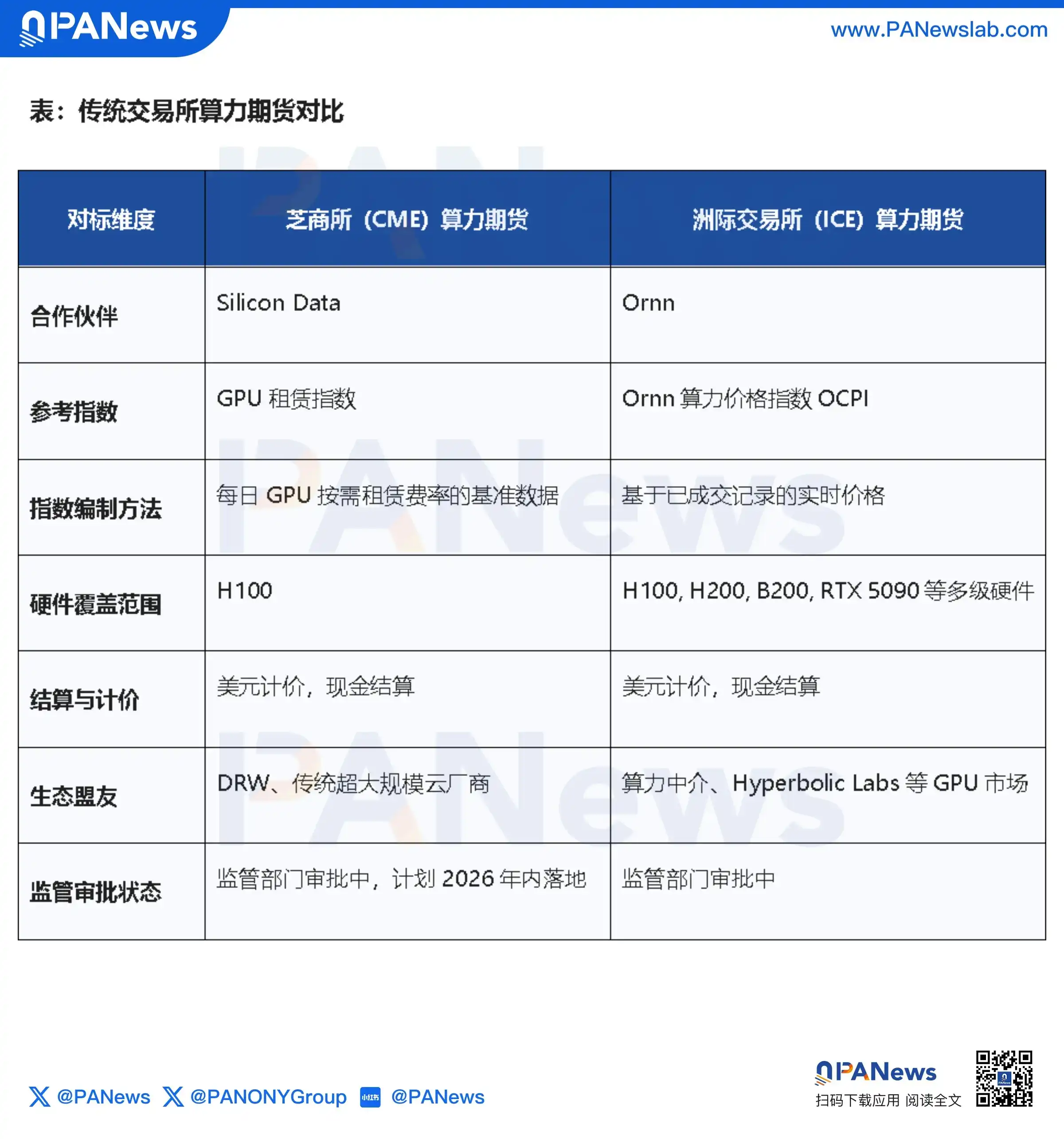
On May 19th, ICE, in collaboration with data provider Ornn, entered the fray, planning to launch a series of GPU computing power futures contracts based on the Ornn Computing Price Index (OCPI).

The OCPI introduced by ICE is the world's first computing power index constructed from real transaction records. Ornn ensures the transparency of this pricing data by distributing the index in real-time to Bloomberg Terminals through its subsidiary Ornn Data, thereby avoiding the issue of "listed price distortion."

Ornn co-founder and CEO Kush Bavaria believes computing power has grown into a trillion-dollar market, and ICE's futures listing will provide a risk transfer layer for institutional buyers and computing power operators.

ICE's computing power futures contracts cover not only mainstream enterprise-grade high-end GPUs like H100, H200, and B200 but also include high-end consumer-grade graphics cards like the RTX 5090, offering refined hedging options for computing power needs across different scenarios. This means ICE is attempting to seize pricing power for computing power across the entire spectrum, from cloud to edge, and from training to inference.

To further solidify the index's industrial foundation, Ornn has also brought in Hyperbolic Labs, one of the world's largest GPU marketplaces, as an ally. Its co-founder and CEO, Jasper Zhang, pointed out that the current GPU market is increasingly resembling the global commodity market, and ICE's move precisely addresses the risk management pain points of new computing power service providers (Neoclouds) and AI labs.

Rather than saying ICE is actively entering the computing power futures market, it's more accurate to say it is rushing to catch up. In fact, CME had already made the first move a week earlier.

On May 12th, CME announced it would partner with GPU market intelligence and benchmark data provider Silicon Data, backed by trading giant DRW, to launch the world's first computing power futures contracts. As a benchmark in the global derivatives market, CME's entry signifies that computing power has officially been included in the sequence of "macro commodities" recognized by Wall Street.

Unlike ICE's broad approach, CME's computing power futures are anchored to Silicon Data's compiled "H100 Lease Index." By providing daily standardized tracking of real-time on-demand leasing rates across major cloud service providers and new GPU cloud platforms, it establishes a unified pricing benchmark for a highly fragmented and opaque spot market.

To avoid depreciation and transportation losses associated with physical hardware delivery, CME's GPU futures contracts will adopt a cash settlement model. The underlying asset being traded is not the physical chip but expectations for future H100 leasing prices.

For large-scale cloud service providers, this provides a much-needed hedging tool. When a cloud service provider invests billions in procuring H100s, it only needs to establish a short position in the CME computing power futures market to lock in a minimum return on investment (ROI) for its servers, thereby mitigating the risk of asset devaluation caused by plummeting computing power prices.

This approach closely mirrors the logic that once turned crude oil, natural gas, and electricity into commodities.
Computing Power Futures Ignite Pricing Power Battle, Financialization Brings Both Opportunities and Tests

Since the wave of large language models swept the globe, computing power has leapt from an "IT resource" to a "strategic material" contested by the AI triumvirate (OpenAI, Anthropic, Google) and Silicon Valley giants like Meta. Simply put, whoever hoards more GPUs holds the entry ticket to the AI era.

But problems have also emerged: the computing power market is too expensive and too unpredictable.

The four cloud giants—Amazon AWS, Microsoft Azure, Oracle, and Google GCP—control about 78% of global IT power capacity and 69% of H100 supply. Spot leasing prices sometimes surge severalfold, only to plummet during chip generation updates. If an AI lab wants to lock in computing power a year in advance, it may have to pay a significant premium; if not, it faces the risk of supply disruption.

What's more troublesome is that the computing power market lacks hedging instruments.

DRW founder Don Wilson frankly stated: The explosive growth of capital-intensive investments like data centers has historically been constrained by the lack of effective risk management tools. The launch of a computing power futures market is a solution to this pain point.

One could argue that whoever masters the pricing power of computing power masters the Bretton Woods system of the AI era.

The battle for computing power pricing rights between the two Wall Street giants reveals that this emerging factor of production is at a historical intersection of "financialization" and "commoditization." This evolution is underpinned by industry cycles but also accompanied by non-negligible potential risks.

From a supply-demand cycle perspective, the global computing power market is entering a new phase of rebalancing. Although early-stage explosive growth in AI applications led to extreme supply-demand mismatch for high-end GPUs and leasing prices soared multiple times, with the large-scale completion of data center construction and chip generation iterations, spot prices will exhibit high volatility. The market urgently needs forward pricing tools to smooth out risks.

However, the "intangible nature" of computing power means it cannot replicate the delivery logic of traditional commodities. Physical chips have a short lifecycle, typically facing technological obsolescence or depreciation within 18 to 24 months, rendering physical delivery forward contracts invalid. Therefore, using a "standard computing unit," such as converting to a benchmark unit like 1 hour of H100 runtime, supplemented by cash settlement, has become the industry's recognized optimal solution. However, this also increases the complexity of pricing models.

Furthermore, the supply side of computing power is highly concentrated, and the spot market is essentially an oligopoly. Building a derivatives market on such a structure creates an inherent fragility in the price discovery mechanism, making futures prices susceptible to indirect manipulation via spot prices.

More importantly, once the computing power derivatives market fully opens, its leverage attributes might amplify price volatility in the spot market. Inflows of leveraged capital and speculative fervor could drive up procurement costs for computing power, turning small and medium-sized AI enterprises into the "harvested," potentially evolving into a "financial hunt" that further exacerbates the uneven distribution of computing resources.

Wall Street Awaits Approval, Crypto Players Already Charging Ahead

While Wall Street's two major exchanges still await regulatory approval, players in the crypto market have already taken the lead.

As early as January this year, Architect Financial Technologies, founded by the former president of FTX US, partnered with Ornn to launch perpetual contracts linked to the OCPI-H100 index through its AX platform.

As more platforms follow suit, it's not impossible that centralized exchanges (CEX) will successively list related computing power futures markets. Additionally, they might launch structured wealth management products for ordinary users or fixed investment products tied to GPU leasing rates, further achieving seamless integration between the crypto market and traditional financial macro assets.

Compared to the heavily regulated CME and ICE facing lengthy approval processes, perpetual decentralized exchanges (Perp DEX) operating on smart contracts possess higher agility and the institutional advantage of permissionless innovation.

Perp DEXs also don't need to go through the lengthy listing procedures of CEXs. For instance, developers only need to stake 500,000 HYPE tokens (or potentially lower thresholds in the future) to list computing power perpetual contracts linked to GPU indices on Hyperliquid's HIP-3 market. This product development capability will allow DeFi to establish a global computing power speculation market unrestricted by geography or barriers, operating even outside Wall Street's regular trading hours.

However, computing power futures is, after all, a nascent asset class with relatively high risk coefficients in its early stages. The computing power market is predominantly over-the-counter (OTC), making data sources susceptible to manipulation. In more extreme cases, such as facing black swan events like technological breakthroughs or chip embargoes, computing power indices might experience non-continuous, sharp price fluctuations. Both scenarios can lead to price distortion, triggering large-scale liquidations of highly leveraged contracts.

Regardless, the Wall Street giants' scramble for computing power futures marks an inflection point in the convergence of AI infrastructure and modern finance.

GPU computing power, once viewed more as an IT resource, is being experimented with as a quantifiable, tradable, hedgeable standardized asset, embedding the logic of technological resource allocation into the global financial system.

With the commoditization of computing power assets, its resource allocation logic may also shift from relying solely on spot procurement to being increasingly influenced by financial market price signals. In the future, computing power might gradually form more mature price discovery mechanisms and capital allocation systems, much like foundational factors of production such as energy and electricity.


Perguntas relacionadas

QWhich two major Wall Street exchanges are competing to launch GPU computing power futures, and what are the key features of their respective proposed contracts?

AChicago Mercantile Exchange Group (CME Group) and Intercontinental Exchange (ICE) are competing. CME, partnering with Silicon Data, plans to offer cash-settled futures contracts based on the 'H100 rental index' to hedge against price fluctuations for large cloud providers. ICE, partnering with data provider Ornn, aims to offer a broader range of futures based on the Ornn Computing Power Index (OCPI), covering both enterprise-grade (e.g., H100, H200) and high-end consumer-grade GPUs (e.g., RTX 5090) to establish pricing power across the entire computing spectrum.

QAccording to the article, what is the primary problem or pain point in the current AI computing power market that these futures contracts aim to solve?

AThe primary problem is the extreme volatility and unpredictability of computing power prices in a fragmented and opaque market. Prices can surge or plummet dramatically due to supply-demand imbalances and rapid hardware iteration. Major AI companies and cloud providers lack effective risk management tools to hedge against these price swings, making long-term planning and investment difficult.

QWhat potential risks does the article associate with the financialization of computing power through futures markets?

AKey risks include: 1) Price manipulation due to the highly concentrated, oligopolistic nature of the underlying spot market (controlled by major cloud providers). 2) Amplified price volatility as leverage and speculative capital enter the derivatives market. 3) Increased procurement costs for smaller AI firms, potentially exacerbating resource inequality. 4) The inherent complexity of creating a pricing model for an 'intangible' asset like computing power that faces rapid technological obsolescence.

QHow have cryptocurrency market players reacted to the trend of computing power financialization, compared to traditional Wall Street institutions?

ACryptocurrency market players have moved faster and with more agility. For example, Architect Financial Technologies launched a perpetual contract tied to the OCPI-H100 index as early as January. The article suggests that decentralized perpetual contract exchanges (Perp DEXs) could create permissionless, global markets for computing power speculation, operating outside traditional trading hours and with lower listing barriers than heavily regulated Wall Street exchanges or even centralized crypto exchanges (CEX).

QWhat is the core 'commodity' being traded in proposed computing power futures contracts like CME's, and how is it settled to avoid physical hardware issues?

AThe core commodity is the future price expectation for standardized computing power units, specifically the rental/lease rate for GPU runtime (e.g., one hour of H100 computing time). To avoid issues related to the physical depreciation, transportation, and rapid obsolescence of hardware chips, these contracts are designed to be cash-settled. The contracts are settled financially based on the difference between the contracted price and the benchmark index price at expiration, rather than requiring the physical delivery of GPUs.

Leituras Relacionadas

Fei-Fei Li's Team Clarifies the Concept of 'World Models', Sora Merely a Renderer

"World Models" has become a widely used yet confusing term in AI. To address this, a team led by Fei-Fei Li and World Labs proposed a functional taxonomy based on the Partially Observable Markov Decision Process framework. This taxonomy categorizes systems called "world models" into three distinct projections: Renderers, Simulators, and Planners. Renderers, like OpenAI's Sora and other video generation models, focus on producing photorealistic visual outputs for human perception. They prioritize visual fidelity over physical accuracy. Simulators, such as NVIDIA Omniverse, aim to compute precise future environmental states for computational tasks like engineering analysis or digital twins. Planners, like Vision-Language-Action models, take in observations and goals to output executable actions for robots or agents. The article clarifies that most current "world models," including Sora, are primarily Renderers. They generate convincing visuals but lack the core ability to simulate state transitions based on actions, a key requirement for a true world model in classic reinforcement learning definitions. This conceptual confusion has practical implications, leading to potential misalignment in technology selection, investment, and public understanding of AI capabilities. Clear categorization is crucial. It helps enterprises avoid costly mistakes (e.g., using a renderer for robot training), allows investors to accurately assess markets, and enables researchers to build comparable benchmarks. While future systems may integrate these functions, recognizing current boundaries is essential for honest assessment and progress.

marsbitHá 6m

Fei-Fei Li's Team Clarifies the Concept of 'World Models', Sora Merely a Renderer

marsbitHá 6m

Bloomberg Uncovered: How Do China's Wealthy Circumvent the Annual $50,000 Limit to Transfer Assets?

**Summary: How Wealthy Chinese Circumvent $50,000 Annual Foreign Exchange Limits** Despite China's strict capital controls, including an annual $50,000 per person foreign exchange quota, an estimated $150 billion in funds still leaves the country annually via various gray and underground channels. This report outlines the evolution of China's "capital wall" and the methods used to bypass it. **The Evolving Capital Controls:** * **Foundation (1994):** The system of "current account convertibility with strict capital account controls" was established. * **Quota Set (2007):** The $50,000 individual annual forex purchase limit was formalized. * **Crackdown Begins (2015-2017):** Following market volatility, enforcement tightened. Banks were required to scrutinize transactions, and channels like using UnionPay cards for Hong Kong insurance premiums or buying overseas property were blocked. * **Digital & Legal Upgrades (2024-2026):** Enhanced algorithms now flag suspicious patterns (e.g., "smurfing"). The Common Reporting Standard (CRS) provides Chinese tax authorities with data on citizens' offshore accounts. Unlicensed cross-border brokers have been targeted. **Five Primary Methods for Moving Capital:** 1. **Underground Banking / "Hawala" (Duiqiao):** The largest-scale method. No money crosses borders. Clients pay RMB to a domestic account; an overseas associate deposits equivalent foreign currency into the client's offshore account. Risks include high fees, account freezes, and legal penalties. 2. **"Smurfing" or "Ant Moving":** Using multiple individuals' $50,000 quotas to pool funds for one offshore recipient. Increasingly detected by anti-money laundering algorithms. 3. **Trade Invoice Manipulation:** Businesses over-invoice imports or under-invoice exports via offshore shell companies, creating a pretext to transfer excess funds abroad under the guise of trade. 4. **Channel Migration:** After a crackdown on internet brokers, funds flow toward more compliant but costly channels like major banks' cross-border wealth management services or Qualified Domestic Institutional Investor (QDII) quotas. 5. **Structural Arrangements:** High-net-worth individuals use complex, high-cost legal structures involving offshore trusts, insurance, and investment migration programs to transfer asset ownership. **Regulatory Response: Focusing on People, Not Just Money** The current strategy extends oversight from enterprises to **individual residents**. Tools like CRS allow retroactive visibility into offshore assets. Cryptocurrencies, once seen as a potential loophole, are now actively monitored and prosecuted as an illegal channel. The underlying driver remains: with significant wealth concentrated among millions of affluent households seeking diversification amid domestic economic shifts, the incentive to move assets offshore persists despite regulatory barriers.

marsbitHá 26m

Bloomberg Uncovered: How Do China's Wealthy Circumvent the Annual $50,000 Limit to Transfer Assets?

marsbitHá 26m

Ethereum's Ballmer Moment: As Everyone Is Bearish, the Circulating Supply Is Disappearing

"Ethereum's Ballmer Moment: Circulation Shrinks Amid Bearish Sentiment" Amid widespread bearish sentiment, with prominent figures like Bankless founder David Hoffman selling ETH and young developers flocking to Solana, some argue Ethereum is entering its "Ballmer era"—akin to Microsoft's perceived stagnation under Steve Ballmer. While surface-level criticisms about slow protocol development, cautious leadership, and competitive pressure are valid, underlying fundamentals tell a different story. Approximately 30% of ETH is staked, major holders like BitMine are accumulating, and spot ETFs continue to absorb supply. Regulatory clarity, including the SEC/CFTC's March ruling on staking rewards and the potential passage of the CLARITY Act, is transforming crypto from a regulatory threat into a legitimized framework. This institutionalization, alongside a shrinking circulating supply (with net issuance around 0.23% annually), creates significant buy-side pressure independent of fee-based value capture. The broader crypto total addressable market is expanding through regulated stablecoins, tokenized assets, and institutional adoption. While public chains face competition from permissioned alternatives, the winning model appears to be permissioned assets settling on public chains like Ethereum and Solana. The author advocates a non-maximalist, barbell strategy: holding ETH for its institutional role and supply squeeze, SOL for consumer/throughput trends, BTC as a macro hedge, and a basket of next-gen L1s. Key bullish drivers for ETH include rapid circulation shrinkage, potential Q2 staked ETF approvals, regulatory tailwinds solidifying its role as a default settlement layer, and the optionality of an eventual "Satya moment" leadership shift. Despite bearish consensus, the current setup—where crypto is "not hot" and regulatory groundwork is being laid—presents a compelling investment opportunity. The crypto cycle's focus may have shifted to AI, but blockchain infrastructure is gaining a legal and institutional foothold precisely while attention is elsewhere.

marsbitHá 26m

Ethereum's Ballmer Moment: As Everyone Is Bearish, the Circulating Supply Is Disappearing

marsbitHá 26m

Trading

Spot
Futuros
活动图片




