Wall Street Capital Enters ARC, Circle Sparks a System-Level Competition for Stablecoins

marsbitPublicado em 2026-05-13Última atualização em 2026-05-13

Resumo

Wall Street Capital Enters the ARC Arena as Circle Launches a System-Level Battle for Stablecoin Dominance On May 11, Circle successfully raised $222 million in a pre-sale funding round for its new blockchain and native token, ARC, giving the network a fully diluted valuation of $3 billion. The investor lineup, featuring Wall Street giants like BlackRock and Intercontinental Exchange alongside top-tier venture capital firms such as a16z and ARK Invest, signaled a collective strategic bet on future financial infrastructure. This move marks Circle's significant evolution from a stablecoin issuer (notably USDC) to a designer of financial systems. While USDC operates on external blockchains like Ethereum, making Circle dependent on their performance, ARC aims to create a dedicated infrastructure for the circulation, payment, and clearing of stablecoins. This would integrate currency issuance and circulation into one system, potentially shifting Circle's business model from asset management to infrastructure provision. The convergence of traditional finance and crypto-native capital in this funding round underscores a broader industry shift: stablecoins are transitioning from being mere trading tools to becoming core components of financial infrastructure. By controlling both the issuance (via USDC) and the流通 pathway (via ARC), Circle could establish a closed-loop system from issuance to settlement. If successful, this infrastructure could optimize costs, lower barriers for in...

Author: Winnie, CryptoPulse Labs

On May 11, Circle successfully raised $222 million in a pre-sale funding round for its new blockchain and native token ARC. Following the completion of the funding, the fully diluted valuation of the ARC network reached $3 billion.

While this figure itself is not staggering, what truly captured market attention was the investor lineup behind it. From the world's top venture capital firm a16z to Wall Street giants like BlackRock and Intercontinental Exchange, and further to crypto and tech capital like ARK Invest and General Catalyst, the consortium nearly covers key institutions across the global financial system.

This makes ARC more than just a blockchain project funding event; it resembles a collective bet on the future financial infrastructure. It also marks a new stage where the stablecoin industry is shifting from product competition to system competition.

I. Circle's Transformation: From Stablecoin Issuer to Financial System Architect

Looking back at Circle's development path, its core identity has long been very clear: it is a stablecoin issuing company, with USDC as its flagship product.
The logic of USDC is not complicated. Its core is to establish a credible digital dollar, providing a relatively stable medium of exchange in the crypto market through transparent reserves, a compliant structure, and a USD peg mechanism.

At this stage, Circle functioned more like an on-chain bank, responsible for issuing, custody, and maintaining user trust in the digital dollar.

However, the problem lies in the fact that this model is inherently dependent. Although USDC is important, it operates on external public chains like Ethereum and Solana. The performance, cost, and congestion of these chains directly impact the user experience of USDC. In other words, Circle controls the issuance of money but not the system through which it circulates.

The emergence of ARC is precisely a response to this structural problem.

From its design logic, ARC is not intended to become another general-purpose public chain, but rather a highly verticalized on-chain infrastructure. Its core objective is to specifically serve the circulation, payment, and settlement system for stablecoins.

In other words, if USDC is the digital dollar, then ARC aims to build the financial highway on which that digital dollar runs. In this system, a stablecoin is no longer just an asset flowing on a chain. It is integrated into a unified settlement network, forming a complete closed loop from issuance to transfer to settlement.

The key significance of this design is that, for the first time, Circle is attempting to integrate currency issuance and currency circulation within the same system, thereby breaking free from dependence on external public chains. At a deeper level, this transformation is essentially a restructuring of the business model.

In the past, Circle relied primarily on interest income from reserve assets, essentially operating as an asset management-style stablecoin company. If ARC successfully operates, it will have the opportunity to shift towards an infrastructure fee model, similar to a payment network or settlement system provider.

This suggests that Circle's role may evolve from issuing dollars to defining how dollars flow in the digital world. The significance of this change is not merely a product upgrade but a leap from the application layer to the protocol layer.

II. Top Investors Gather: A Mutual Embrace of Traditional Finance and Crypto Capital

The primary reason this funding round for ARC garnered widespread attention is not the amount raised, but the signal conveyed by the investor structure itself.

Leading this round is the renowned venture capital firm Andreessen Horowitz (a16z). Its $75 million investment not only provides financial support but, more importantly, confirms ARC's positioning as Web3 infrastructure.

In a16z's investment logic, ARC is clearly not an ordinary application project but appears more like a component of the future internet financial system.

However, what truly shocked the market was the collective entry of traditional financial institutions. Traditional financial giants, including BlackRock, Intercontinental Exchange (parent company of the NYSE), Apollo Funds, Standard Chartered Ventures, SBI Group, and Janus Henderson Investors, participated in various forms.

The commonality among these institutions is very clear: they essentially control or are deeply involved in the global flow of funds and settlement systems.

Simultaneously, crypto-native capital also participated, including institutions like ARK Invest, General Catalyst, Haun Ventures, and Bullish. This structure is quite rare because it signifies that two financial systems, long separate in the past, are reaching a consensus around a single infrastructure project.

If the logic of crypto investment over the past decade has been to find high-growth assets, then this round of funding for ARC is more like searching for the gateway to the future financial system.

Venture capital is betting on technological evolution, Wall Street is betting on settlement efficiency, crypto capital is betting on ecosystem dominance, and Circle happens to stand at the intersection of these three forces.

This kind of simultaneous betting by multiple parties is uncommon in financial history. It resembles more of a system-level alignment in advance: the future of finance may no longer be a fragmented system but may gradually converge towards a unified on-chain settlement layer.

III. From Trading Tool to Financial Infrastructure Reconstruction: Stablecoins Enter a New Era of Infrastructure

ARC's current fully diluted valuation of $3 billion, viewed in isolation, is just a funding figure. But placed within the industry structure, it actually represents a deeper shift: stablecoins are evolving from trading tools into the core layer of financial infrastructure.

In the past, discussions about blockchain focused more on public chain performance, DeFi ecosystems, or exchange liquidity. However, as stablecoins gradually become the unit of account for the on-chain economy, the entire competitive logic is changing.
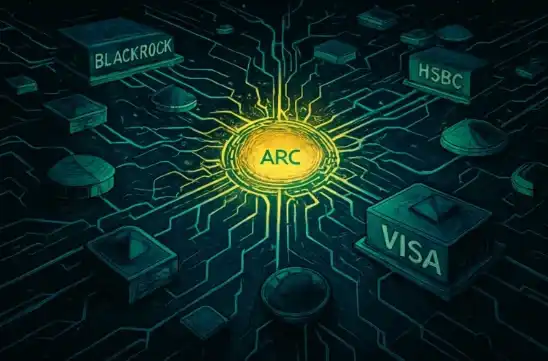
Whoever controls the circulation path of stablecoins holds the key gateway to on-chain finance.

Against this backdrop, Circle's strategy becomes very clear. First, solve the trust problem with USDC; then, solve the circulation problem with ARC; finally, form a complete closed-loop system from issuance to settlement.

If this structure is established, then Circle will no longer be just a stablecoin company but may evolve into an infrastructure operator for the on-chain financial system.

In terms of industry impact, this model could bring about changes at three levels. First, cost structure optimization: cross-chain transfers and settlement of stablecoins will be processed within a unified system, significantly reducing transaction costs and friction. Second, lower barriers for institutional access: banks, funds, and payment companies can directly connect to a unified on-chain system without needing to adapt to multi-chain ecosystems. Third, a strengthening trend of financial standardization: on-chain finance may gradually form foundational standards similar to internet protocol layers, and ARC has the opportunity to become one of the core participants.

More importantly, once such infrastructure is proven successful, its impact will no longer be confined to the crypto industry but may gradually touch the core links of traditional finance, especially cross-border payment and settlement systems.

The existing SWIFT system has operated for decades. If the on-chain stablecoin system establishes advantages in efficiency and cost, then the reconstruction of financial infrastructure is no longer a theoretical question but a matter of time.

Conclusion

The $222 million funding event for ARC is, in essence, not just a simple project funding story but a staged signal of financial system evolution.

When capital from different systems like BlackRock, Intercontinental Exchange, and ARK Invest simultaneously bets on the same chain, it indicates that the market has already begun to acknowledge a trend: stablecoins are no longer just trading tools but are becoming one of the candidate standards for global financial infrastructure.

What's truly worth watching is not how high ARC's valuation can go, but whether it will become one of the default paths for future global capital flow. And if this trend holds true, then today's $222 million may be just a small step in the prologue of the entire financial system's reconstruction.


Perguntas relacionadas

QWhat is the key strategic shift that Circle's launch of the ARC network represents, according to the article?

AThe launch of ARC represents Circle's strategic shift from being solely a stablecoin issuer (of USDC) to becoming a financial system designer. It marks a transition from an application layer company dependent on external public chains to a protocol layer infrastructure provider, aiming to integrate currency issuance and circulation into one unified, closed-loop system.

QWhy does the article consider the ARC funding round significant beyond the $222 million amount raised?

AThe significance lies in the composition of the investor consortium. It includes a rare convergence of top traditional financial giants (like BlackRock, Intercontinental Exchange), elite venture capital (a16z), and major crypto-native funds (ARK Invest, General Catalyst). This signals a collective bet by key players from different financial spheres on a shared future financial infrastructure, indicating a system-level alignment.

QHow does the ARC network aim to change the fundamental business model of Circle, as described in the article?

AARC aims to shift Circle's business model from reliance on interest income from reserve assets (an asset management model) to an infrastructure fee model. By controlling the dedicated network for stablecoin flow and settlement, Circle could become a payment network or clearing system provider, generating revenue from infrastructure usage.

QWhat are the three potential industry-wide impacts the article suggests ARC's model could bring about?

A1. Cost structure optimization: Lowering transaction costs and friction by unifying cross-chain transfers and settlements within one system. 2. Lowering institutional access barriers: Banks and payment companies could directly connect to a single on-chain system instead of adapting to multiple chains. 3. Strengthening financial standardization: Potentially establishing core foundational standards for on-chain finance, similar to internet protocols, with ARC as a key participant.

QWhat broader historical financial system does the article suggest ARC and stablecoins could potentially challenge or impact in the long term?

AThe article suggests that if successful and efficient, the on-chain stablecoin system, with infrastructures like ARC, could potentially challenge or impact the core of traditional cross-border payment and settlement systems, specifically referencing the decades-old SWIFT (Society for Worldwide Interbank Financial Telecommunication) system.

Leituras Relacionadas

Earning Six Figures and Still Struggling to Rent in San Francisco

A couple in San Francisco with a combined tech income over $360,000 struggled for months to find a one-bedroom apartment under $5,000 per month. Their story highlights how the AI wealth boom, driven by upcoming IPOs from companies like OpenAI and Anthropic, is dramatically escalating the city's cost of living. Even six-figure salaries are becoming insufficient for a comfortable lifestyle. The article details the financial reality for tech workers earning around $180,000 annually. After taxes, retirement contributions, and healthcare, take-home pay is roughly $7,000 per month. With average rents exceeding $3,800 and one-bedrooms often costing $4,500-$5,200, discretionary income shrinks to $1,500-$2,500. This contrasts sharply with reported median total compensations of $640,000 at OpenAI and $420,000 at Anthropic. The AI gold rush is identified as the primary driver. The scale of potential wealth from these IPOs, far surpassing previous tech booms, is flooding the housing market. Data shows San Francisco's average rent is now the highest in the U.S., with vacancy rates in desirable neighborhoods plummeting to around 3%. The overall cost of living is 65.6% above the national average. The piece features multiple professionals, including a 25-year-old with a $250,000 salary, facing housing instability, fierce competition for rentals, and a persistent, low-grade financial anxiety despite high earnings. It concludes that the rapid concentration of AI wealth is redefining what constitutes a "high salary" in San Francisco, pushing out mid-tier tech talent and creating a stark divide between those in the AI sector and everyone else.

marsbitHá 1h

Earning Six Figures and Still Struggling to Rent in San Francisco

marsbitHá 1h

Rate Hikes to Save STRC, Selling Bitcoin to Preserve Credit: Strategy Picks Its Two Most Expensive Paths

Over the past six weeks, Strategy has faced a significant crisis of confidence, with its core securities MSTR and STRC experiencing sharp price declines. The situation escalated as the company utilized dollar reserves intended for dividends and interest payments to repurchase debt, and then sold a small amount of Bitcoin for the first time since 2022—an action that contradicted its "never sell" narrative and signaled potential liquidity strain. In response, Strategy introduced a Digital Credit capital framework. This formalized a series of measures to manage the pressure down its capital structure: ordinary shareholders have already borne costs through equity dilution from an $11.5 billion ATM offering; new rules enforce a hard dollar reserve covering at least 12 months of expected dividend and interest payments; the STRC dividend rate was increased from 11.5% to 12%; and, most notably, Bitcoin was officially integrated into the capital toolkit, with board authorization to sell up to $1.25 billion worth if needed to support obligations and repurchase programs. The market reacted with a mix of relief and skepticism. While the announcement triggered a sharp single-day rally in both MSTR and STRC, the preferred shares still trade at a significant discount. Supporters view the framework as pragmatic crisis management that provides a price floor and clearer rules. Critics argue that institutionalizing Bitcoin sales undermines the core investment thesis and, with Bitcoin's price below the company's average cost basis, amounts to selling assets at a loss to maintain its financial structure. The broader context shows institutional Bitcoin buying drying up, highlighting that Strategy's challenges and new framework are now a key indicator for overall market risk sentiment. Ultimately, the framework buys time, but STRC's return to par value depends on market belief in the company's ability to cover dividends without further dilution or substantial Bitcoin sales—a task that would be easier if Bitcoin's price recovers.

链捕手Há 1h

Rate Hikes to Save STRC, Selling Bitcoin to Preserve Credit: Strategy Picks Its Two Most Expensive Paths

链捕手Há 1h

Has Bitcoin Bottomed? Unpacking 12 Key Data Indicators

Author: BitalkNews **Title: Has Bitcoin Bottomed? Analyzing 12 Key Data Indicators** The current Bitcoin price is around $59,600, representing a maximum drawdown of approximately 53% from the 2025 high. The market is in a deep correction phase. Multiple indicators suggest valuations are nearing historical lows, but a confirmed bottom requires more time. **Summary of Key Indicators:** 1. **Fear & Greed Index:** At 16, indicating "Extreme Fear," similar to levels seen during the 2022 FTX collapse. 2. **Rainbow Chart:** BTC has fallen into the "Bitcoin is dead" zone, only the second such occurrence historically. 3. **MVRV Ratio:** Currently around 1.13, near the lower historical band, pointing to a bottoming valuation area (approx. $53,200-$53,400). 4. **Realized Price:** The aggregate cost basis is ~$53,400; the current price is only about 12% above it but hasn't broken below yet. 5. **UTXO Profit/Loss Ratio:** Has dropped to its lowest level this cycle, signaling a potential "capitulation" event often seen near cycle bottoms. 6. **Long-Term Holder SOPR:** For holders >155 days, it's at 0.662, now negative, indicating seasoned investors are selling at a loss. 7. & 8. **Miner Health:** ~20% of miners are unprofitable, and actual miner revenue is below theoretical levels, indicating ongoing miner stress. 9. **ETF Flows:** U.S. spot BTC ETFs have seen sustained net outflows, including a 13-day streak with over $1.7B in weekly outflows. 10. **Strategy Risk:** Strategy's stock premium has significantly contracted, pressuring the traditional "borrow-to-buy" model. 11. **Bear Duration & Drawdown:** The correction has lasted >265 days with a ~52.5% drawdown, shorter in depth but lengthy in duration. 12. **Market Expectations (Polymarket):** Betting markets suggest an ~80% probability of BTC falling below $55,000 and a notable chance below $50,000. **Conclusion:** Bitcoin is in a deep correction with potential bottom formation. Valuation metrics are in historically low ranges, and on-chain capitulation signals are accumulating. However, a complete shakeout isn't finished—the realized price hasn't been breached, and ETF demand hasn't reversed. The area below $60,000 holds long-term appeal, but patience is advised. Key signals to watch for include a return to ETF inflows, a recovery in the Long-Term Holder SOPR, and easing miner pressure.

marsbitHá 1h

Has Bitcoin Bottomed? Unpacking 12 Key Data Indicators

marsbitHá 1h

Trading

Spot
活动图片