Vitalik Wrote a Proposal Teaching You How to Stealthily Use AI Large Models

比推Publicado em 2026-03-13Última atualização em 2026-03-13

Resumo

Vitalik Buterin and Ethereum Foundation's AI lead Davide Crapis co-authored a proposal titled "ZK API Usage Credits," which introduces a method for anonymously accessing AI models like ChatGPT using zero-knowledge proofs. Instead of requiring users to register and link personal information, the proposal suggests depositing funds (e.g., 100 USDC) into a smart contract. Users can then generate a zero-knowledge proof to verify they are on an encrypted whitelist and have sufficient balance—without revealing their identity. This approach aims to protect user privacy while preventing abuse. Although still in the research phase and facing skepticism, the proposal reflects Vitalik's broader focus on privacy and Ethereum's potential role in providing a tamper-proof data layer in the AI era, where verification and anonymity may become increasingly critical.

Author: Deep Tide TechFlow

Original Title: Vitalik Wrote a Proposal Teaching You How to Stealthily Use AI Large Models


Everyone is talking about AI, and the crypto space seems much quieter on the timeline.

Meanwhile, ETH has been hovering around 2000 for almost two months. What Vitalik says or does doesn't seem to attract much attention anymore.

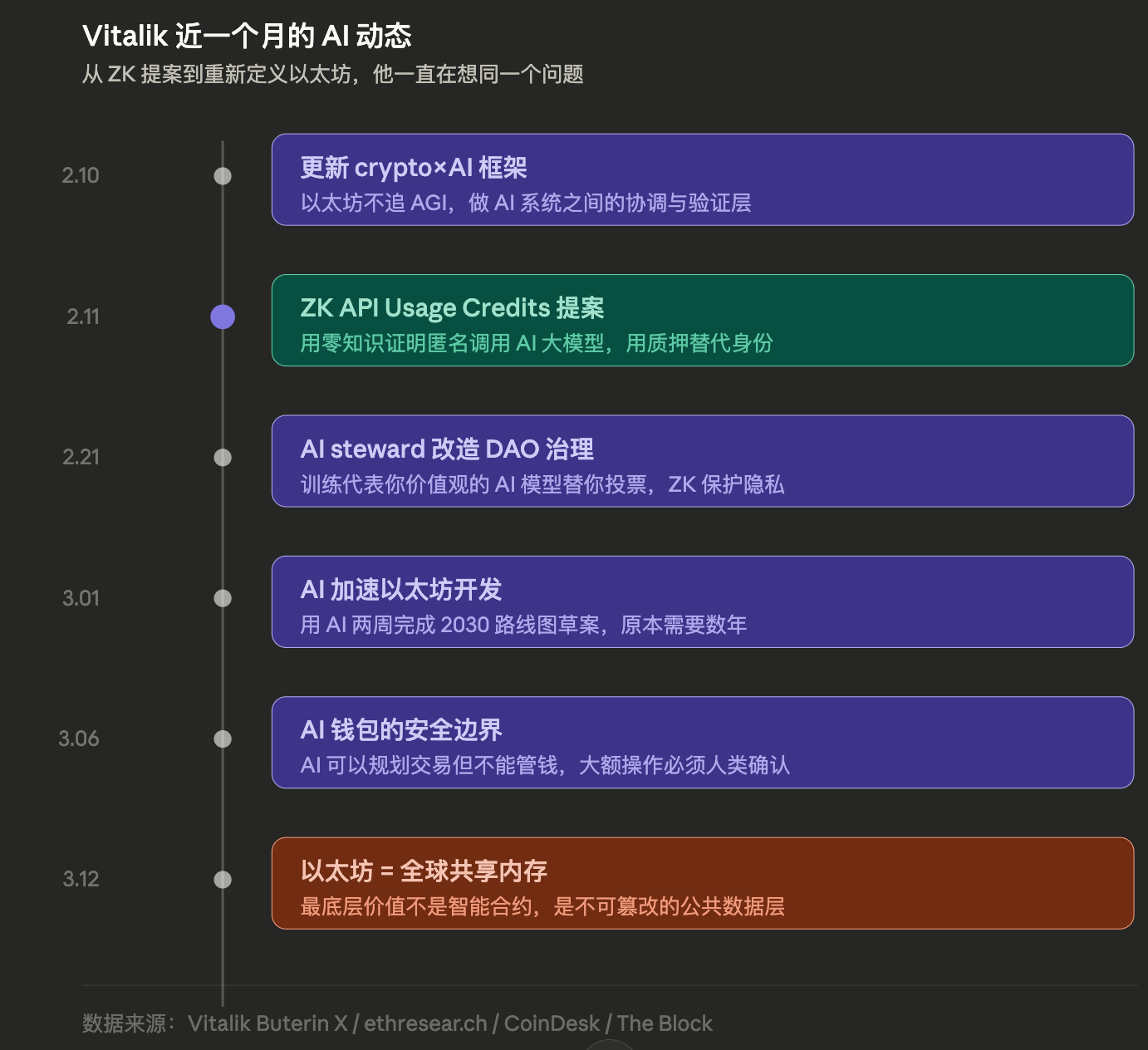
However, I recently checked his X (Twitter) and found that AI has influenced more than just us. Over the past month, a significant portion of his posts have been about AI, and they've even reached the level of technical proposals.

Among them, the most noteworthy is a proposal co-authored with Davide Crapis, the AI lead at the Ethereum Foundation, published on ethresear.ch on February 11th, titled "ZK API Usage Credits."
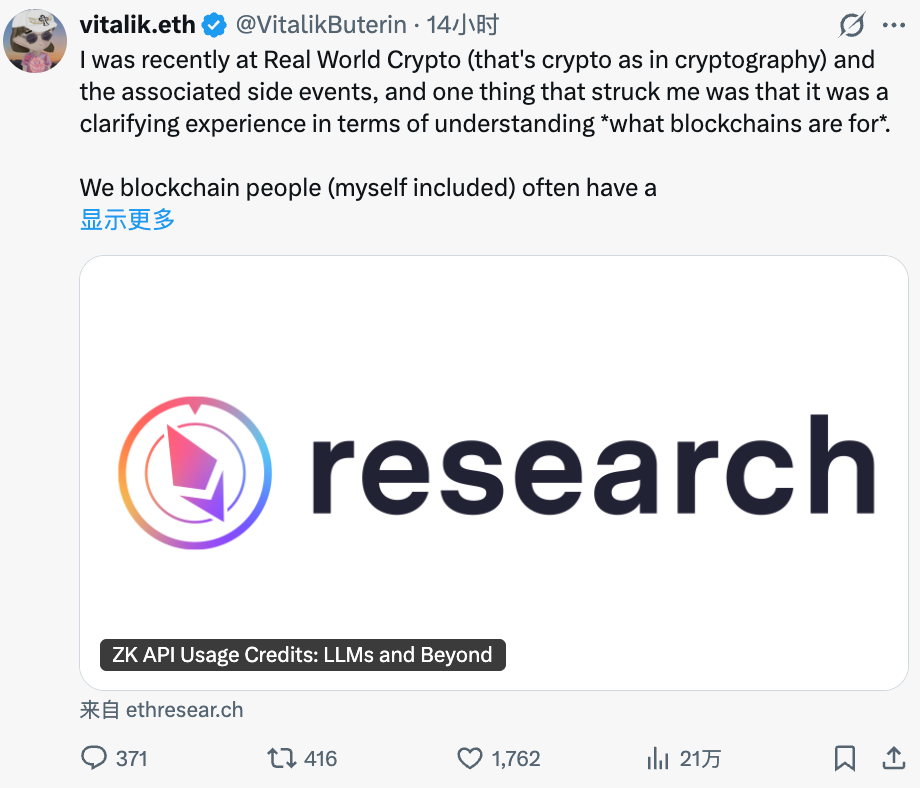
In a nutshell, it's about using zero-knowledge proofs to let you anonymously call AI large models.

Right now, whether you use ChatGPT or call Claude's API, there's only one way to pay:

Register an account, bind an email, bind a credit card.

Every conversation you have, every prompt you send, the platform knows it's from you. What you asked, when you asked it, how many times you asked—all tied to your real identity.

Vitalik and Crapis's proposal offers another path.

  1. The user deposits a sum of money into a smart contract, say 100 USDC.

  2. The contract registers this deposit into an encrypted on-chain list. After that, every time you call the API, you don't need to reveal your identity; you just generate a zero-knowledge proof.

  3. This proof does two things for the service provider: it proves you're on the list, and it proves your balance is sufficient. But the proof itself doesn't reveal which specific entry on the list you are.
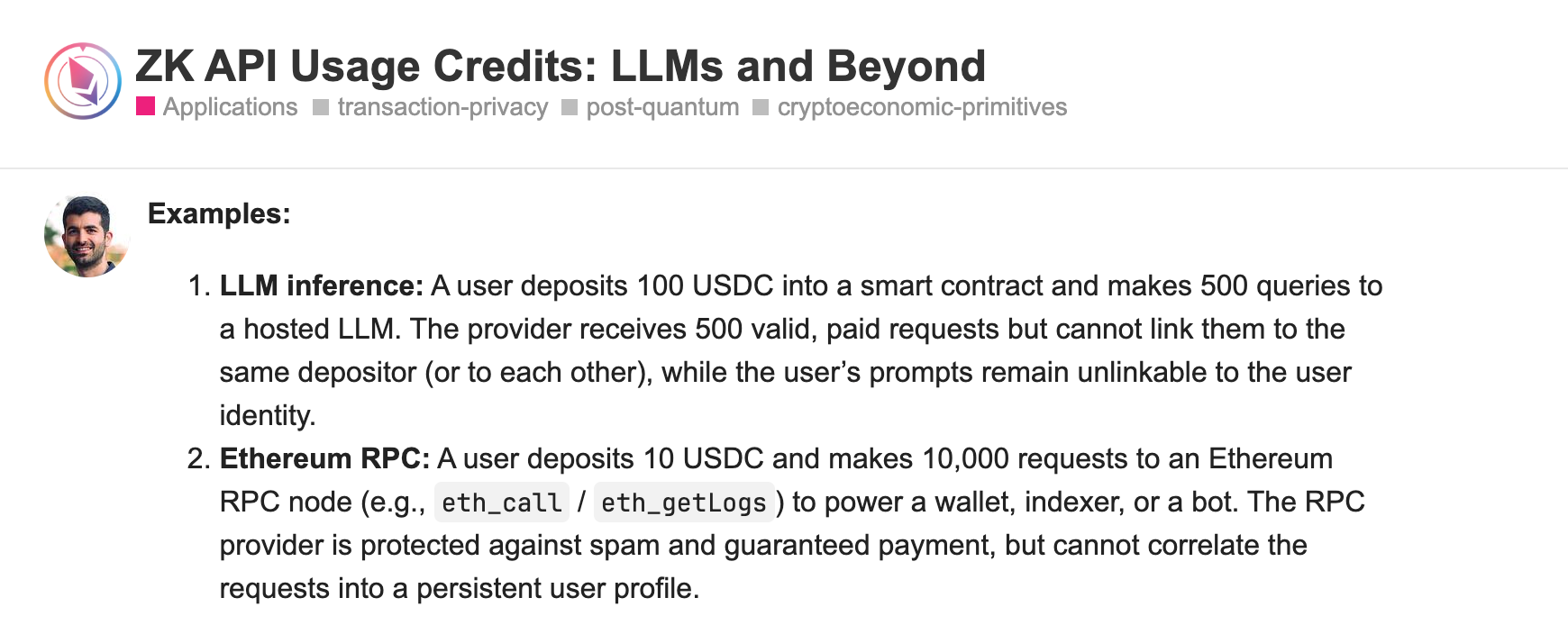
The service provider gets paid and can prevent abuse, but never knows who you are.

You can interpret this proposal as Vitalik believing that in the AI era, users shouldn't have to surrender their identity just to use an AI tool.

This proposal is still in the research phase, far from implementation, and large model manufacturers might not agree to such a method. The comments section of the proposal is also full of rebuttals and skepticism, arguing that AI model companies will always find a way to know your real identity.

But the author believes the significance of this proposal isn't entirely about whether it can be implemented.

Privacy is something Vitalik has worked on for a decade. From early support for Tornado Cash to promoting zero-knowledge proofs as a core technical roadmap for Ethereum, this thread has never been broken. It's just that in the past few years, privacy in the crypto industry's narrative lacked a big enough story to carry it.

AI has filled that story. When you talk to a large model more than anyone else every day, privacy becomes a real demand.

Vitalik Embraces AI

From February until now, a significant portion of what Vitalik has posted on X has been related to AI, with a density that suggests it's more than just casual chat.

Yesterday he posted a long thread saying he recently attended a cryptography conference where people cared about privacy, cared about open source, cared about censorship resistance... but had no affection for blockchain.
Among that crowd, he conducted a thought experiment:

Forget "we are the Ethereum community," start from scratch and think about where Ethereum is actually most useful.

His conclusion is that Ethereum's most fundamental value is as a bulletin board. A place where anyone can write, anyone can read, and no one can change or delete anything.

In the context of AI, this might be the most important thing Vitalik has said in the last couple of years.

We are entering an era of infinitely cheap generation. Text, images, videos, identities—AI can mass-produce them all. When everything can be forged, what becomes scarce?

These questions ultimately point to the same place: a public, persistent, irreversible data layer. And an unchangeable record is exactly what Ethereum can provide.

Over the past two years, the skepticism Ethereum has faced can be summed up in one sentence: What do you still have that others can't replace?

Looking at it now, Vitalik hasn't answered that question directly.

However, the Ethereum Foundation has done a few low-key things over the past year: formed a 50-person privacy team, established a nearly 50-person privacy research cluster, released the Kohaku privacy framework, specifically appointed an AI lead; the 2026 roadmap lists institutional-grade privacy and faster transaction confirmation as top priorities.

Looking back at his intensive output this month, it's mostly been discussions about Ethereum's privacy and efficiency issues in the context of AI.

I think Vitalik is betting on one thing: the more powerful AI becomes, the more rigid the demand for privacy and verification infrastructure will be. Whether Ethereum can meet this demand is another matter, but he has clearly chosen his table.

ETH is still hovering around 2000. Most people still aren't paying much attention to what he's been saying lately.

But perhaps in a few years, looking back, this might be the time we should have been paying attention.


Twitter:https://twitter.com/BitpushNewsCN

BitPush TG Discussion Group:https://t.me/BitPushCommunity

BitPush TG Subscription: https://t.me/bitpush

Original link:https://www.bitpush.news/articles/7619566

Perguntas relacionadas

QWhat is the main idea of Vitalik Buterin's proposal 'ZK API Usage Credits'?

AThe main idea is to use zero-knowledge proofs to allow users to anonymously call AI large language model APIs. Users deposit funds into a smart contract, which registers them on an encrypted on-chain list. They can then generate a zero-knowledge proof to show they are on the list and have sufficient balance without revealing their identity.

QHow does the proposed system protect user privacy when using AI models?

AThe system protects privacy by allowing users to generate a zero-knowledge proof that verifies they are on the approved list and have enough funds, without disclosing which specific user they are. The service provider receives payment and can prevent abuse but never learns the user's identity.

QWhy does Vitalik Buterin believe privacy is crucial in the AI era?

AVitalik believes that as AI becomes more integrated into daily life and people interact more with models than with humans, privacy becomes a genuine and critical need. Users should not have to surrender their identity just to use an AI tool.

QWhat role does Ethereum play in Vitalik's vision for the future?

AVitalik sees Ethereum's core value as providing a public, persistent, and immutable data layer—a bulletin board that anyone can write to and read from, but no one can alter or delete. This becomes essential in an AI era where content and identities can be easily forged, creating demand for verifiable and tamper-proof records.

QWhat actions has the Ethereum Foundation taken recently regarding AI and privacy?

AThe Ethereum Foundation has formed a 50-person privacy team, established a nearly 50-person privacy research cluster, released the Kohaku privacy framework, and appointed an AI lead. Their 2026 roadmap prioritizes institutional-grade privacy and faster transaction confirmations.

Leituras Relacionadas

Annual Salary of Millions Competing for Electricians, Meta Rushes to Open Its Own Technical School

The AI boom is facing an unexpected bottleneck: a severe shortage of skilled construction workers and electricians. As tech giants like Meta, OpenAI, and Alphabet race to build massive data centers—such as OpenAI's $16 billion "Stargate" project—they are hitting a critical labor wall. The U.S. needs an estimated 130,000 more electricians, 240,000 construction workers, and 150,000 supervisors by 2030 for AI infrastructure alone, but tens of thousands of electrician jobs go unfilled each year. While AI companies offer high premiums, with electricians earning up to $280,000 annually, worker scarcity still causes massive losses—delays on a single project can cost $14.2 million per month. The complexity of building AI data centers, which require immense power (equivalent to powering hundreds of thousands of homes), sophisticated electrical systems, and advanced liquid cooling solutions, demands highly skilled technicians who are in short supply. To combat this, companies are investing heavily in training. Meta has committed $115 million to a free training school offering tuition, housing, and stipends, targeting 5,000 new workers. OpenAI is partnering with unions to secure skilled labor. These efforts are paying off, with a significant rise in Gen Z interest in trade schools over college. However, the power demands are staggering. AI data centers are driving a rapid surge in electricity consumption, projected to account for up to 12% of U.S. power use by 2028 and raising costs for consumers. Furthermore, the construction boom is project-based, leading to a potential future glut of trained workers once building peaks, which could depress wages industry-wide. The race for AI supremacy now depends as much on skilled hands as on advanced chips.

marsbitHá 1h

Annual Salary of Millions Competing for Electricians, Meta Rushes to Open Its Own Technical School

marsbitHá 1h

OpenAI No Longer Sells Its Most Expensive Model for Profit

OpenAI is shifting its business strategy away from promoting its most expensive, flagship models for every task. Recent price cuts—80% for GPT-5.6 Luna and 20% for Terra—signal a deeper change: the company now actively advises users that many tasks don't require the most powerful model. Instead, OpenAI recommends a tiered approach: use the high-end GPT-5.6 Sol for complex planning and analysis, then delegate execution to cheaper models like Luna. This mirrors moves by Anthropic, which recently launched Claude Opus 5 at half the price of its top model, Fable 5. Both companies are de-emphasizing flagship models as primary revenue drivers, using them instead for brand prestige and technological showcases. The industry is entering a "mass-market" phase, similar to automotive, where high-volume, cost-effective models handle daily operations and drive scale. OpenAI's price reductions are partly enabled by AI models themselves optimizing underlying code and infrastructure, creating a self-reinforcing cycle of efficiency gains and cost reduction. Competition is shifting from "who is smartest" to "who offers the best value." The goal is no longer selling individual models but fostering widespread API adoption and ecosystem lock-in. By making AI calls cheap and ubiquitous, companies like OpenAI aim to become the indispensable, utility-like infrastructure powering automated workflows—the "water and electricity" of software, quietly embedded everywhere.

marsbitHá 1h

OpenAI No Longer Sells Its Most Expensive Model for Profit

marsbitHá 1h

Trading

Spot
活动图片





